
A growth mindset is the belief that your abilities can develop, and the fastest way to get unstuck is to treat failures as data and run tiny experiments. That single shift changes how you handle a stalled promotion, a hard client call, or a pitch that flops. Growth mindset is learnable. It is not a personality trait you either have or lack. That matters because confidence and career momentum both grow faster when "I can't do this" becomes "I can't do this yet."
Try this in the next 24 hours:
- Write down three small wins from today, however minor they seem.
- Pick one thought where you've written yourself off, and add the word "yet" to the end of it.
- Notice how the reframed sentence changes what you're willing to try next.
Key Takeaways
A growth mindset works for women's careers because it replaces fixed self-judgement with testable experiments, and consistency over weeks beats intensity over a single day.
| Point | Details |
|---|---|
| Definition matters | A growth mindset treats ability as trainable, not fixed, using the "yet" reframe as a daily tool. |
| The broken rung is real | Early promotion gaps for women mean mindset shifts have outsized career impact at the first step up. |
| Three habits drive change | Value progress, run small experiments, and learn openly from others rather than working it out alone. |
| Perfectionism is fixed-mindset in disguise | Reframe, ground with breath, then run a micro-experiment instead of waiting to feel ready. |
| Structured support accelerates progress | ProspHER members report 94% clearer direction within 30 days through personalised pathways and mentorship. |
Table of Contents
- What is a growth mindset, and how does it differ from a fixed mindset?
- Why does a growth mindset matter more for women's careers?
- What are the most effective ways to build a growth mindset?
- Which daily habits keep a growth mindset from fading?
- How do you apply a growth mindset at work and in leadership?
- How do you manage perfectionism, impostor syndrome and fear of failure?
- How ProspHER supports women building a growth mindset
- How does a growth mindset affect relationships and work-life balance?
- What matters most in practice?
- Ready to build your growth mindset with structured support?
- Frequently asked questions
- Sources
What is a growth mindset, and how does it differ from a fixed mindset?
A fixed mindset treats talent and intelligence as fixed quantities. You either have the knack for public speaking or you don't. A growth mindset treats the same abilities as trainable, closer to a muscle than a trait carved in stone. Someone with a fixed mindset avoids a stretch assignment because failing would "prove" they're not capable. Someone with a growth mindset takes it because failing would simply show them what to practise next.
This distinction comes from Carol Dweck's decades of research at Stanford, which remains the reference point for how psychologists study ability beliefs.
The evidence: Research from the NeuroLeadership Institute shows that deliberately practising three habits, valuing progress, experimenting, and learning from others, helps large numbers of people shift toward growth-oriented thinking within weeks, not years.
The practical difference shows up daily:
- Fixed: "I bombed that presentation, so I'm bad at presenting."
- Growth: "I bombed that presentation. What specifically didn't land, and what will I test next time?"
Why does a growth mindset matter more for women's careers?
Mindset isn't neutral when it comes to advancement. Women hit a well-documented "broken rung" early in management, where promotion rates lag behind men's at the first step up from individual contributor, long before the more familiar glass ceiling ever comes into view. Research on professional development and promotion gaps shows this friction compounds. A woman who believes leadership skill is fixed, and that she either has "what it takes" or doesn't, is more likely to decline a stretch role rather than risk the visible failure of trying and struggling.
Women currently hold around 25% of senior leadership positions, with projections stretching years out before parity arrives. A growth mindset does not close that gap by itself, but it changes what an individual woman does with the next opportunity in front of her.
Consider two women offered the same ambiguous, cross-functional project:
- One assumes she needs to already look competent, so she narrows her scope to what she knows she'll nail.
- The other treats the ambiguity as the point, gathers input from three colleagues she's never worked with, and expands the brief.
Only one of them builds the track record that gets noticed for the next role.
What are the most effective ways to build a growth mindset?
Building growth-oriented thinking isn't about affirmations. It's about repeatable habits that change what you notice and how you respond to setbacks. The NeuroLeadership Institute's framework distils it into three core habits worth practising deliberately.
- Value progress over polish. Track the direction you're moving in rather than judging yourself against a finished, flawless version of the outcome.
- Run small experiments. Treat a difficult conversation, a new pitch angle, or an unfamiliar task as a test, not a verdict on your competence.
- Learn from others openly. Ask people who've solved the problem before you how they did it, rather than assuming you should already know.
Reframing scripts help make this concrete. Swap "I'm not good at negotiating" for "I haven't practised negotiating enough yet." Swap "What if they think I'm not ready?" for "What's the smallest version of this I can test this week?" When asking for feedback, try: "What's one thing I could have done differently, and what would you watch for next time?" That question invites specifics instead of vague reassurance.
A four-week starter plan gives this structure:
Week 1: Note three wins daily. Notice patterns in what energises you. Week 2: Pick one recurring self-limiting thought and add "yet" every time it surfaces. Week 3: Ask two people for direct, specific feedback on one piece of work. Week 4: Volunteer for one task slightly outside your comfort zone and log what you learned, not just what happened.

Pro Tip: Keep a running "experiments log" instead of a to-do list for this month. Each entry should note what you tried, what you expected, and what actually happened. Reviewing it after four weeks shows you a pattern you'd otherwise miss day to day.
For a longer-range version of this same logic applied to career planning, a structured career roadmap extends the same experiment mindset across months rather than weeks.
Which daily habits keep a growth mindset from fading?
Mindset work fails most often when it's treated as a one-off exercise rather than a routine. The habits that stick are small enough to survive a bad week.
- Morning: two minutes reframing one "I can't" into "I can't yet," said out loud or written down.
- Evening: three specific wins logged, no matter how minor. Practitioner-derived exercises consistently point to this simple documentation habit as a driver of the neural patterns behind growth thinking.
- Weekly: one honest reflection prompt: "What did I learn this week that I didn't know last week?"
Generic tools work fine here: a plain notebook, a shared document with a peer accountability group, or a simple feedback template you reuse each time you ask for input. You don't need software. You need consistency.
Measuring progress monthly matters more than daily mood checks. Review your wins log and ask what's shifted: are you volunteering for more, flinching less at criticism, recovering faster after a setback? Coaching practitioners consistently find that integrating these habits into existing routines, rather than treating mindset as separate training, is what actually sustains change past the first fortnight.
How do you apply a growth mindset at work and in leadership?
Mindset only becomes useful when it changes what you do in the room, not just what you tell yourself beforehand.
- Ask for developmental feedback directly. Instead of "How did I do?", try: "What's one specific thing you'd change if I did this again?"
- Run a learning-focused retrospective. After any project, whether it worked or not, ask your team: "What did we learn?" before "What went wrong?"
- Design projects as experiments. Set a hypothesis before you start ("If we simplify the pitch, response rates improve"), then measure the outcome rather than judging it as a pass or fail.
- Build a micro-culture of growth. In teams with fixed evaluation habits, publishing "what we learned" memos instead of only celebrating wins reduces the personal cost of visible failure and makes others more willing to take smart risks too.
Founders and team leads who want a longer runway for this can pair it with structured guidance on women in leadership, which covers how to translate these individual habits into team-wide expectations.
How do you manage perfectionism, impostor syndrome and fear of failure?
Perfectionism looks like high standards, but it usually behaves like a fixed mindset in disguise: the belief that one flawed attempt reveals a permanent limitation rather than a normal step in learning. Leadership performance research treats perfectionism as something to interrupt with deliberate experimentation, not something to simply push through with more effort.
Three quick interventions help in the moment:
- Cognitive reframe: replace "This has to be right" with "This needs to be useful enough to test."
- Breath and grounding: thirty seconds of slow breathing before a high-stakes conversation shifts you out of a defensive stance so reframing can actually land, rather than staying stuck as an abstract idea.
- Micro-experiment: send the imperfect draft, ask the uncomfortable question, submit the pitch before it feels ready.
Pro Tip: Before any meeting where impostor syndrome tends to flare, run a sixty-second self-check: name one thing you know for certain about the topic, and one question you genuinely want answered. It shifts you from performing competence to contributing curiosity.
How ProspHER supports women building a growth mindset
ProspHER exists for the gap between reading about mindset shifts and actually sustaining them. Members get a personalised pathway rather than a content feed to sift through alone, which is precisely what the four-week starter plan above needs to stick past week one.
- 94% of members report clearer direction within 30 days of joining.
- A community of over 2,400 women for the "learn from others" habit that self-directed change usually skips.
- Structured programmes covering mentorship, mindset training, and career clarity coaching that map directly onto the experiments described here.
How does a growth mindset affect relationships and work-life balance?
Mindset doesn't stay contained inside your job. The same beliefs that shape how you handle a difficult client call shape how you handle a difficult conversation with a partner, a friend, or your own limits around time.
A fixed mindset treats relationship friction as evidence something is broken, either in you or the other person. "We keep having this argument, so we're just incompatible." A growth mindset treats the same friction as information: "We keep having this argument. What haven't we figured out how to communicate yet?" That reframe doesn't fix every disagreement, but it keeps couples and friendships in problem-solving mode rather than verdict mode.
Work-life balance benefits similarly, though not in the way most advice suggests. Growth-minded women don't necessarily work fewer hours. They tend to treat boundary-setting itself as a skill to practise rather than a trait some women have and others lack. Saying no to a Friday-evening call, or renegotiating a deadline, becomes an experiment: "What happens if I protect this time? What do I learn about what's actually urgent versus what just feels urgent?"
The habit of noting daily wins, covered earlier as a morning and evening practice, also spills into home life. Women who track small progress at work often start applying the same lens to parenting, caregiving, or personal projects, treating an off day as data rather than proof of failure. That's the real payoff of practising growth thinking daily: it stops being a work technique and becomes how you interpret difficulty everywhere.
What matters most in practice?
Most advice on this topic stays too abstract to change anything. "Believe in yourself" isn't a strategy. What the research actually supports is narrower and more useful: pick one habit, run it as an experiment, and measure what shifts over weeks, not days.
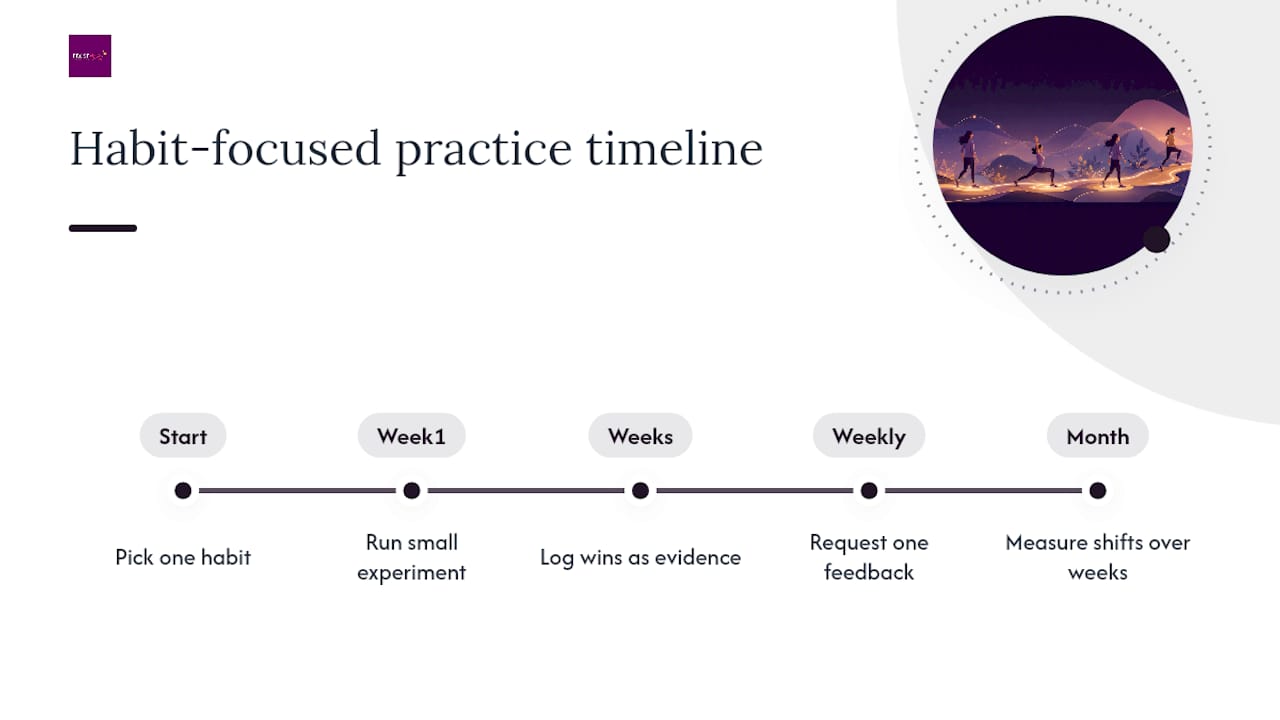
The overrated piece of conventional wisdom is confidence-first thinking, the idea that you need to feel ready before you take the stretch role or ask the hard question. Evidence points the other way. Action tends to precede confidence, not follow it. Women who wait to feel ready typically wait considerably longer than women who treat readiness as something built through small, repeated experiments.
If you take one thing from this article, prioritise the wins log over every other habit here. It's the least glamorous and the most consistently effective, because it gives you evidence against your own fixed-mindset thoughts when they resurface, which they will. Pair that with one honest feedback request a week, and you have a system that outperforms most formal training programmes on cost and consistency alone.
Ready to build your growth mindset with structured support?
Reading about mindset shifts gets you information. It doesn't get you the accountability, feedback, and peer input that make those shifts stick past the first busy week. ProspHER is built specifically for that gap, offering a personalised pathway instead of another content library to work through alone, with mentorship and a community of over 2,400 women who are running the same experiments you are.
If the four-week starter plan above appealed to you, ProspHER's structured programmes take that same logic and add a mentor, a peer group, and a clear track based on where you are right now, whether that's building confidence, preparing for a leadership step-up, or steadying a business. Explore women career coaching to see how a guided pathway compares with going it alone, or visit the ProspHER membership page to check what fits your current stage.
Frequently asked questions
What is a growth mindset for women, in one sentence? It's the belief that your skills, leadership included, can develop through effort and feedback, rather than being fixed traits you either have or lack.
How long does it take to build a growth mindset? Habit-focused practice can produce noticeable shifts within a few weeks, according to the NeuroLeadership Institute's framework, though sustaining it long-term depends on repetition, not a single breakthrough moment.
Does a growth mindset actually help with career advancement? It helps you take the stretch roles and ask the direct questions that advancement usually requires, though structural barriers like the broken rung still need addressing separately.
Is perfectionism always a bad thing? High standards aren't the problem. Treating one imperfect attempt as proof of permanent limitation is what turns perfectionism into a fixed-mindset trap.
Can a growth mindset be learned without coaching? Yes, through consistent self-directed habits like a wins journal and reframing scripts, though many women progress faster with structured accountability, which is why programmes like ProspHER pair mindset habits with mentorship and community.
Sources
- NeuroLeadership Institute — Grow
- University of Nebraska digital commons — studies on professional development and promotion gaps
- Agile Leadership Journey — the perfection trap
- Stanford psychology — Carol Dweck