
Why financial literacy matters for ambitious women right now
Financial literacy for women is the knowledge and confidence to manage money, plan for the future, and make investment decisions that fit your actual life. Not a generic template. Your life. And right now, the gap between where most women stand and where they need to be is stark.
The UK holds the second-largest gender gap in financial literacy across thirty OECD countries. That gap widens sharply in mid-life, reaching a 22-point difference by ages 45–54 — precisely when pension decisions, investment choices, and wealth-building matter most.
Much of this traces back to history. Women in the UK could not open bank accounts without a male co-signer until the 1970s. That exclusion left a confidence deficit that persists today. As wealth management expert Lucy Allington notes, women are consistently more likely than men to report limited understanding of investments and pensions, even when their actual knowledge is closer than they think.
The core skills that financial education for women must cover:
- Budgeting and cash flow management, especially across fluctuating freelance or entrepreneurial income
- Pension planning, including the real cost of career breaks and part-time work on retirement outcomes
- Credit building and borrowing, recognising that gender-related barriers still affect access
- Investment basics, from ISAs to equities, without the jargon
- Tax and legal considerations for self-employment and business ownership
Table of Contents
- How financial literacy fuels career and business growth for UK women
- ProspHER gives you the clarity to move forward financially
- Key takeaways
How financial literacy fuels career and business growth for UK women
Understanding money is not separate from career ambition. It is the engine behind it.

The gender pay gap for UK employees stood at a notable level in recent years, with the gap widening considerably after age 40. Women who understand their numbers, negotiate with confidence, and plan proactively around career breaks are better positioned to close that gap on their own terms. Financial education for women works best when it is woven into broader career and business support, not delivered in isolation. The OECD confirms that embedding financial literacy within wider empowerment frameworks, including work, entrepreneurship, and social norms, produces stronger outcomes.
Independent advisers increasingly advocate life-led financial strategies that adapt to your actual circumstances: a career break for caregiving, a pivot to freelance work, launching a business. Generic product-focused advice rarely fits. What works is planning that treats your career trajectory and your finances as one connected picture.
The empowerment benefits are concrete:
- Clearer decision-making around funding, pricing, and revenue when running a business
- Greater resilience during income fluctuations common among women entrepreneurs
- Confidence to negotiate salary, equity, or fees without second-guessing
- Proactive pension contributions that account for career interruptions and part-time periods
- Reduced financial vulnerability, particularly at retirement age
ProspHER supports thousands of UK women through personalised career and financial empowerment, with 94% of members reporting clearer direction within 30 days of joining. That momentum begins with clarity, not more content.
ProspHER gives you the clarity to move forward financially
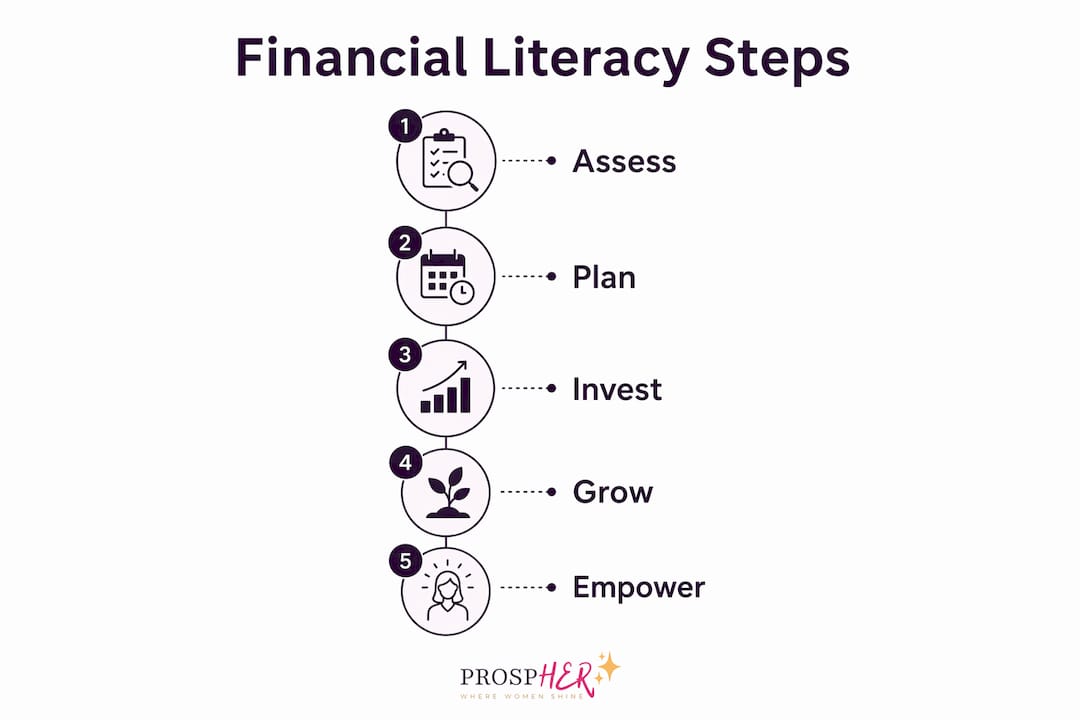
Knowing you need to build financial confidence and actually doing it are two very different things. Most women are not short of information. They are short of a clear, personalised path through it.
ProspHER is built for exactly that. Rather than overwhelming you with courses and content, it gives you a structured pathway matched to where you are right now, whether that means mentorship, group coaching, financial literacy programmes, or community support from women who get it. For ambitious women who want real self-belief alongside practical financial skills, ProspHER brings both together in one place. Join the community at prosp-her.co.uk and gain clarity within your first 30 days.
Key takeaways
Financial literacy for women is most effective when it is personalised, integrated with career support, and built on confidence as much as knowledge.
| Point | Details |
|---|---|
| The UK gap is wide | The UK has the second-largest gender gap in financial literacy across thirty OECD countries, widening to a 22-point difference by ages 45–54. |
| Confidence is the barrier | Women often answer "don't know" even when they possess the knowledge, signalling a confidence gap more than a knowledge gap. |
| Life-led planning works | Financial strategies tailored to career breaks, entrepreneurship, and varying income outperform generic advice. |
| Career and money are linked | The gender pay gap stood at 6.9% in April 2025; financial literacy directly supports negotiation and wealth-building. |
| ProspHER accelerates clarity | 94% of ProspHER members report clearer direction within 30 days, combining financial literacy with personalised career support. |