
Female founders are entrepreneurs who establish and lead businesses, and in 2026 they are reshaping the economic landscape with speed and purpose. 1 in 4 women plan to start a business this year, yet 65% of women have never owned a business compared to 46% of men. That gap is not a ceiling. It is an opportunity. Women-owned businesses now represent 22.9% of all businesses, up from 20% in 2017, and VC-backed female-founded companies raised £73.6 billion globally in 2025. The momentum is real. What you need is clarity on where to focus.
What does the current landscape look like for female founders?
The scale of female-led business today is striking. The 500 women entrepreneurs on the Inc. Female Founders 500 list generated £12.3 billion in revenue and secured £12.2 billion in funding in 2025 alone. That figure proves women-led companies are not niche players. They are serious commercial forces.
The businesses themselves span a wide range of structures. Nearly 42% of women entrepreneurs operate as solopreneurs, running lean and deliberate operations. One in five run firms with 10 to 49 employees. Both models generate real economic contribution, and neither is a lesser choice.

What unites the most successful female business owners is a focus on social impact and adaptability. They build for purpose as well as profit. They treat market downturns as data, not defeat. That mindset is what separates founders who plateau from those who scale.
| Business structure | Proportion of women entrepreneurs |
|---|---|
| Solopreneur | 42% |
| Firms with 10–49 employees | 1 in 5 |
| VC-backed companies | Growing share, £73.6bn raised in 2025 |
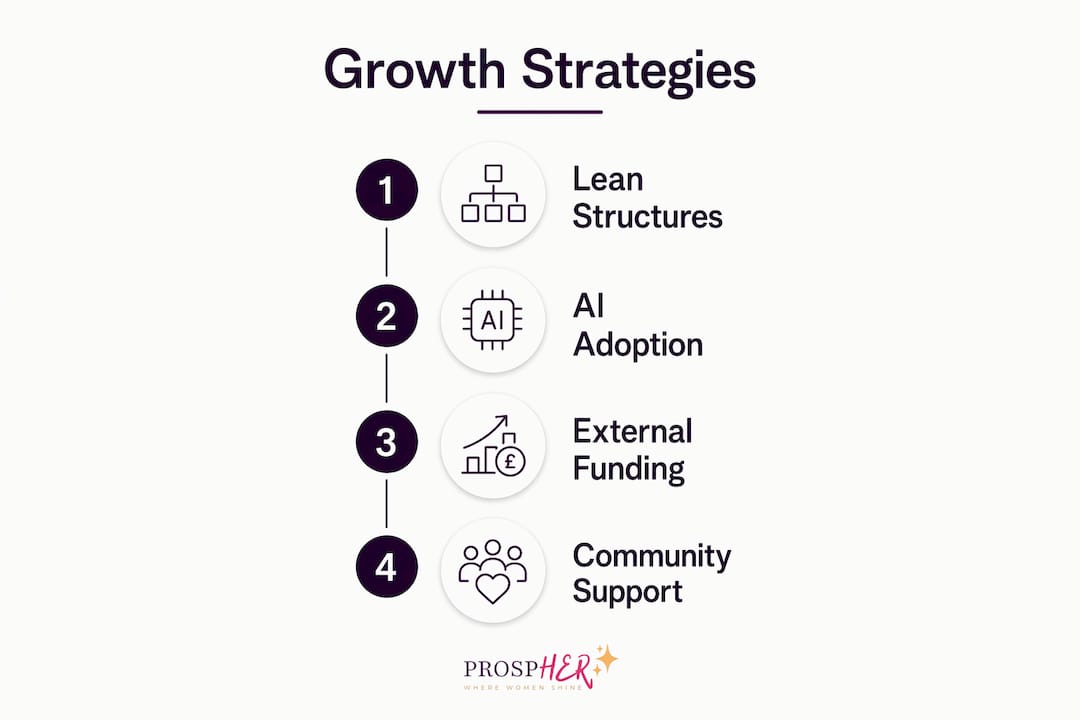
Pro Tip: If you are early stage, do not assume you need a large team to be credible. Lean structures give you speed and control. Use them as an advantage, not an apology.
What financial barriers do female founders face?
Funding is the sharpest obstacle for women in business. Over 50% of women rely on personal funds to start their businesses. Personal financing gets you off the ground, but it rarely gets you to scale.
The hesitancy to enter traditional funding systems is real and understandable. Pitch rooms have historically not reflected women’s experiences or networks. But staying in personal finance mode beyond the launch phase is a scaling pitfall, not a safe strategy. The most successful founders pivot early to external capital or revenue-based growth models.
Here are the core financial barriers women entrepreneurs face most often:
-
Reliance on personal savings, which limits growth speed and creates personal financial risk
-
Limited access to angel networks and VC introductions, which are still largely relationship-driven
-
Underestimating the business’s fundable value, leading to under-pitching or avoiding pitches entirely
-
Lack of financial modelling confidence, which weakens investor conversations
-
Hesitancy to ask for large amounts, often resulting in undercapitalised rounds
Each of these barriers is solvable. None of them is permanent.
Pro Tip: Before approaching any investor, build a one-page financial model showing revenue, costs, and a 12-month projection. You do not need perfection. You need to show you understand your numbers.
How are female founders using technology and AI to grow?
Technology has lowered the cost of starting a business dramatically, and women entrepreneurs are leading the charge in adopting it. 79% of women entrepreneurs expect AI to play a role in their business operations by 2026. That is not a trend. That is a structural shift.
What makes this particularly powerful is how deliberately women are applying these tools. AI adoption by female founders is targeted and purposeful. It helps validate ideas, reduce launch friction, and maintain a human touch in customer interactions. That combination is rare and commercially valuable.
The four most common AI applications for female-led startups are:
-
Idea generation and validation. AI tools help test whether a business concept has real market demand before you spend money building it. This replaces months of guesswork with weeks of structured research.
-
Market research. Founders use AI to analyse competitor positioning, customer sentiment, and pricing benchmarks. What once required a consultant now requires a prompt and an afternoon.
-
Branding and content. From naming a business to writing website copy, AI accelerates the creative process. The founder still provides the vision. The tool provides the speed.
-
Marketing execution. Email campaigns, social content, and ad copy can all be drafted, tested, and refined with AI assistance. This gives solo founders the output of a small team.
Innovation for women entrepreneurs often means applying new technologies to traditional industries and solving overlooked pain points. It rarely means inventing an entirely new category. That reframe matters. You do not need a breakthrough idea. You need a better solution to a problem people already have.
What strategies help female-led startups scale and sustain growth?
Scaling a business requires more than a good product. It requires the right structure around you, and the right mindset inside you.
Build community before you need it
Early-stage isolation is one of the most underestimated challenges for women entrepreneurs. Founders who engage in mentorship programmes or industry peer networks have measurably greater growth chances than those who go it alone. Community is not a nice-to-have. It is a performance variable.
Peer networks reduce burnout risk, accelerate decision-making, and surface opportunities you would not find alone. Join one before you feel you need it.
Treat wellbeing as a business metric
Sustainable leadership and founder wellbeing are now recognised as critical growth indicators for successful women entrepreneurs. This is not soft advice. Founders who integrate mental health practices into their working week make better decisions, recover faster from setbacks, and lead teams more effectively. Purpose-led operations are not peripheral. They are core strategy.
Pivot from personal to external funding
The transition from personal financing to external capital is the single most important financial move a scaling founder makes. Revenue-based financing, angel investment, and grant funding are all viable paths. The key is to start the conversation before you desperately need the money. Investors fund momentum, not desperation.
Use gender diversity as a commercial signal
Gender-balanced leadership correlates with stronger revenue and workforce growth. Diverse decision-making sharpens strategy and boosts investor confidence. If you are building a team, diversity is not a values statement. It is a performance advantage.
Here is a practical comparison of two scaling approaches:
| Approach | Strength | Risk |
|---|---|---|
| Bootstrap and grow slowly | Full control, no dilution | Limits speed and market reach |
| External capital with clear milestones | Faster growth, credibility signal | Requires strong pitch and governance |
The right approach depends on your sector, your ambition, and your timeline. Neither is wrong. Both require a plan.
Pro Tip: True resilience means pivoting when the market shifts, not waiting for conditions to improve. The founders who make the Inc. Female Founders 500 list refuse to let headwinds define them. Build that muscle early.
Key takeaways
Female founders who combine lean structures, deliberate AI adoption, external funding, and peer community support are the ones who scale with both speed and sustainability.
| Point | Details |
|---|---|
| Women-owned businesses are growing | Ownership has risen from 20% in 2017 to 22.9% in 2023, with billions raised in VC funding. |
| Personal financing limits scale | Over 50% of women start on personal funds; the most successful pivot early to external capital. |
| AI adoption is deliberate and targeted | 79% of women entrepreneurs expect AI to shape their operations, focusing on validation and marketing. |
| Community reduces burnout and accelerates growth | Founders in peer networks and mentorship programmes show greater persistence and growth outcomes. |
| Wellbeing is a business strategy | Integrating mental health and purpose into operations improves decision-making and resilience. |
What we have learned from working with women entrepreneurs
The conversation around female founders often focuses on what is missing: funding gaps, representation gaps, network gaps. Those are real. But the more revealing pattern we see is what is present in the founders who break through. It is not always the best idea or the biggest budget. It is clarity.
The founders who struggle longest are often the ones drowning in information and short on direction. They have read every article, joined every group, and still feel stuck. That is not a motivation problem. It is a structure problem.
Isolation compounds it. When you are building alone, every setback feels personal. Every slow month feels like evidence that you were wrong to start. That is why we believe community is not optional for women entrepreneurs. It is the infrastructure of persistence.
The other thing we have noticed is that founders who treat their own wellbeing as a business asset outperform those who treat it as a luxury. Rest, reflection, and peer support are not indulgences. They are the conditions under which good decisions get made.
If you take one thing from this: the gap between where you are and where you want to be is rarely about talent. It is almost always about the support structure around you.
— ProspHER
How ProspHER supports ambitious women entrepreneurs
Building a business is hard enough without doing it without direction. ProspHER is built specifically for ambitious women who want clarity, not more noise.
With a community of over 2,400 women, ProspHER provides personalised pathways tailored to where you are right now, whether that is pre-launch, early growth, or scaling. Mentorship, peer connection, and practical resources are all in one place. 94% of members report gaining clearer direction within just 30 days. That is not a coincidence. That is what happens when support is specific rather than generic. If you are ready to move forward with purpose, join ProspHER and find the structure that makes momentum possible.
FAQ
What is a female founder?
A female founder is a woman who establishes and leads a business, typically taking on the roles of owner, chief decision-maker, and strategic leader from the outset.
How much funding do female-led startups raise?
VC-backed female-founded companies raised £73.6 billion globally in 2025, with the Inc. Female Founders 500 list alone accounting for £12.2 billion in secured funding.
What are the biggest challenges for women entrepreneurs?
The leading challenges are access to funding, reliance on personal financing beyond the launch phase, and early-stage isolation. All three are addressable with the right support and community.
How are female founders using AI in their businesses?
79% of women entrepreneurs expect AI to shape their operations in 2026. The primary uses are idea validation, market research, branding, and marketing execution.
How can I support female founders in the UK?
Invest in women-led businesses, join or refer women to peer networks and mentorship programmes, and advocate for gender-balanced leadership in your own organisation or sector.