
Career clarity coaching is a structured, data-driven process that gives you a defensible decision framework and a concrete action roadmap, not just a vague sense of direction. If you are an ambitious woman wondering whether to stay, pivot, or push for more, the most effective first step is a discovery call with a programme that uses evidence-based assessments. ProspHER, a membership community of over 2,400 women, reports that 94% of members gain clearer direction within 30 days, precisely because the platform pairs objective assessment outputs with structured coaching rather than generic advice.
Table of Contents
- What career clarity coaching actually is — and what it is not
- How a structured UK career-clarity programme typically works
- What do evidence-based assessments actually reveal?
- Who benefits most from career clarity coaching?
- How do you evaluate and choose a membership-based clarity programme?
- What does UK clarity coaching typically cost, and how long does it take?
- How to get started: your 30/90-day action plan
- Key takeaways
- Why ProspHER recommends a membership-centred approach
- ProspHER: the membership built for ambitious women who want clarity
- Useful sources and further reading
What career clarity coaching actually is — and what it is not
Clarity coaching is not therapy, and it is not a job-search service. It is a structured diagnostic process that separates dissatisfaction caused by external circumstances (a poor manager, a misaligned role) from internal misalignment (values, strengths, identity). Skipping that diagnosis is why so many ambitious women make "revolving door" changes: new company, same frustration.
Practitioners like Gabriela Embon frame clarity work as realignment rather than radical reinvention. The goal is a logic-based method for evaluating your options, one that reduces regret and second-guessing long after the coaching ends.
Three main formats exist:
- Decision session: a focused, one-off conversation to resolve a specific fork in the road (accept the promotion or not, stay or leave)
- Deep-dive programme: a multi-month engagement with assessments, coaching sessions, and a full transition roadmap
- Membership model: rolling access to coaching, community, resources, and accountability, with structured pathways that evolve as you do
| Format | Best for | Typical length |
|---|---|---|
| Decision session | One specific, time-sensitive choice | 1–3 sessions |
| Deep-dive programme | Career pivot or leadership transition | 3–6 months |
| Membership | Ongoing clarity, momentum, and peer support | Rolling monthly |
How a structured UK career-clarity programme typically works
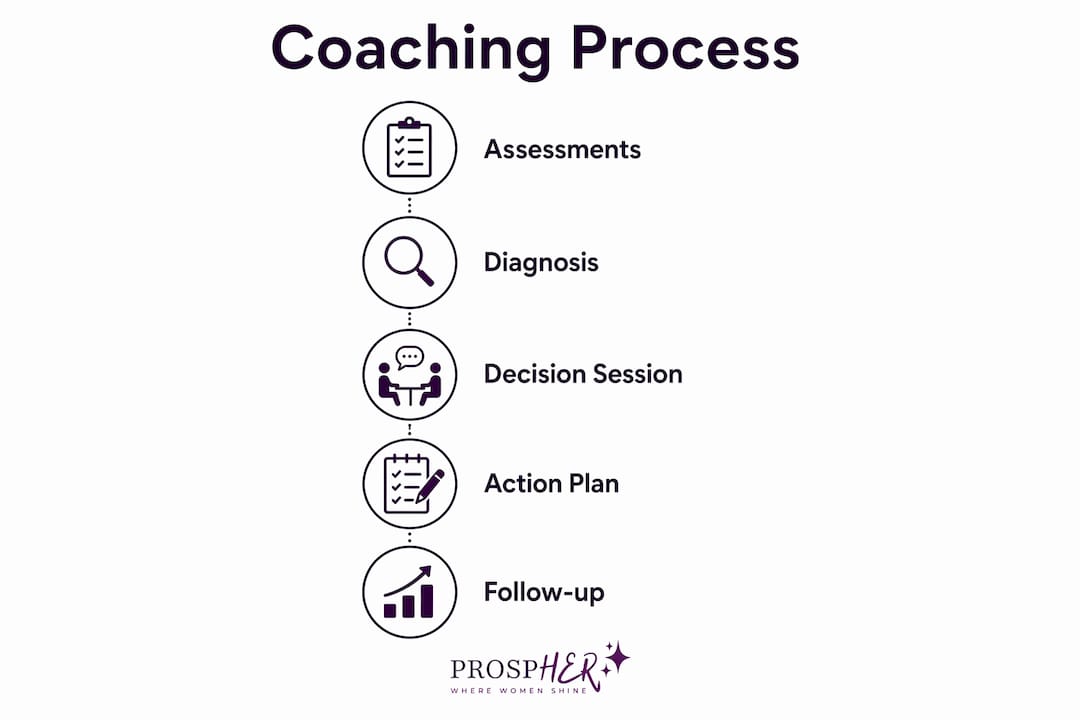
Most UK career clarity coaching programmes follow a consistent sequence, even when the depth and pace vary.
- Discovery call — a diagnostic conversation to check coach-client fit, scope your situation, and agree on outcomes
- Evidence-based assessment — strengths inventories, leadership-style profiles, and work-environment surveys that produce objective data
- Interpretation session — unpacking the assessment results and identifying the real source of dissatisfaction
- Coaching sessions — typically every two to four weeks, working through your decision framework and roadmap
- Transition roadmap — a written, prioritised plan with milestones and decision criteria
- Implementation check-ins — accountability touchpoints to keep momentum after the intensive work is done
Pilar Sifas Obiol and other London-based practitioners position the discovery call as both a fit check and a short diagnostic. It is the moment to test methodology, ask about assessment tools, and gauge coach chemistry before committing. Some programmes, such as those modelled on a 90-day clarity-to-search pipeline, compress steps two through five into an intensive sprint. Membership models spread the same work across a rolling cadence, which suits women who want sustained accountability rather than a one-off intervention.
Typical minimum commitment: most UK clarity coaching practitioners recommend at least three months to move from diagnosis to a defensible decision, with session cadences of every two to four weeks.
What do evidence-based assessments actually reveal?
Comprehensive clarity programmes use evidence-based assessment methods that produce detailed, multi-page reports as an objective foundation for coaching. These are not personality quizzes. They are structured instruments that surface patterns you may not see from inside your own experience.
Common assessment types include:
- Strengths inventories — identifying your top transferable strengths and the contexts where they produce the most impact
- Leadership-style profiles — tools such as DISC or 360° feedback that map how you show up under pressure and in collaboration
- Work-environment preference surveys — clarifying the conditions (autonomy, structure, pace, culture) where you perform best
- Skills gap mapping — comparing your current capability profile against your target role or sector
A multi-page report typically contains an executive summary, strength clusters with situational examples, and a set of prioritised recommendations. The recommendations section is where most readers should spend the most time.
Pro Tip: When you receive an assessment report, go straight to the situational diagnosis section before reading the summary. It tells you whether your dissatisfaction is driven by an external mismatch (wrong environment) or an internal one (values conflict), and that distinction shapes every decision that follows. You can also use a strengths-alignment guide alongside your report to deepen the interpretation.
Who benefits most from career clarity coaching?
Clarity coaching works best for ambitious women who are achieving by conventional measures but feel stuck, misaligned, or uncertain about the next move. Common profiles include:
- The plateau achiever — strong track record, but promotion feels hollow or the next step is unclear
- The leadership transitioner — newly promoted or stepping into a bigger role and needing to recalibrate identity and approach; women in leadership contexts often surface this
- The mid-career pivoter — considering a sector change, portfolio career, or business launch and needing a structured way to evaluate the risk
- The values-misaligned professional — performing well externally but feeling increasingly disconnected from the work itself
Practical use cases include preparing for high-stakes salary negotiations, building the confidence to delegate effectively, and creating a clear narrative before a board-level interview.
Clarity coaching is not the right intervention if you are in acute mental-health distress (a therapist is the appropriate first step), or if you already know exactly what you want and simply need tactical job-search support. Clarity is a prerequisite to effective job search. Writing CVs or networking before you have clarity typically produces an unfocused narrative and poor traction.

How do you evaluate and choose a membership-based clarity programme?
Not all membership programmes are built the same. Use this checklist before committing.
- Does the programme use evidence-based assessments with written outputs, or does it rely solely on conversation?
- Are coach credentials clearly listed (ICF accreditation, specialist training, sector experience)?
- Is there a structured onboarding process, or do you simply get access to a content library?
- Can you see verifiable member outcomes, not just testimonials?
- Are pricing, commitment length, and exit terms stated clearly upfront?
On your discovery call, ask directly: "What assessment tools do you use, and what does the output look like?" and "How do you match me to a coach or cohort?" A programme that cannot answer those questions clearly is a red flag.
Watch out for:
- Vague outcome promises ("you'll feel more confident") with no measurable milestones
- No diagnostic process before the coaching begins
- High-pressure tactics on the discovery call itself
- Coaches whose credentials are not publicly verifiable
For a broader view of community-based coaching options for women, it is worth comparing membership structures before you decide.
What does UK clarity coaching typically cost, and how long does it take?
Pricing in the UK market follows three broad shapes:
- One-off decision sessions: focused, lower-commitment entry points for a single career question
- Fixed multi-month programmes: structured packages covering assessment, coaching, and roadmap delivery
- Rolling membership subscriptions: monthly access to coaching, community, and resources, with the flexibility to scale up or down
When to expect results matters as much as cost. Structured membership programmes like ProspHER show measurable direction gains within 30 days. Deeper pivot work, such as a full leadership transition or sector change, typically takes 90 days to produce a defensible decision and three to six months to reach confident implementation.
Before signing up, ask about: what the assessment costs (sometimes separate), the group-versus-one-to-one session mix, and the refund or pause policy. Budgeting for coaching is a real consideration; a financial planning guide can help you assess the investment alongside your other priorities.
How to get started: your 30/90-day action plan
Preparation before your discovery call determines how much value you extract from it.
Pre-call checklist:
- Write a one-paragraph snapshot of your current role, including what is working and what is not
- List your top three frustrations (be specific: "I am not using my strategic skills" beats "I feel unfulfilled")
- Note your short-term priorities: promotion, pivot, confidence, or something else entirely
- Gather evidence of impact: metrics, projects, feedback, or results you are proud of
Your 30-day plan:
- Book and complete a discovery call with at least one structured programme
- Complete your evidence-based assessment and read the situational diagnosis section first
- Identify whether your dissatisfaction is external or internal
- Set one specific, measurable clarity goal for the next 60 days (a practical goal-setting framework can sharpen this step)
Your 90-day plan:
- Complete your coaching sessions and produce a written transition roadmap
- Test your decision framework against at least two real scenarios (a conversation, an application, a negotiation)
- Track early wins: confidence in a specific context, a decision made and acted on, a conversation you previously avoided
- Review your roadmap and adjust based on what the first 90 days revealed
ProspHER members who follow a structured onboarding pathway report gaining clearer direction within 30 days, which means the first month is about diagnosis and decision, not action for its own sake.
Key takeaways
Career clarity coaching works because it separates the source of your dissatisfaction before prescribing a direction, giving you a decision framework grounded in data rather than feeling.
| Point | Details |
|---|---|
| Definition | Clarity coaching is a structured diagnostic process, not therapy or generic mentoring. |
| Assessment value | Multi-page, evidence-based reports reveal whether dissatisfaction is external or internal. |
| Timelines | Measurable direction is achievable within 30 days; full pivot work takes 90 days or more. |
| Evaluation criteria | Prioritise programmes with verifiable credentials, written assessment outputs, and clear member outcomes. |
| ProspHER | With 94% of members gaining clearer direction within 30 days, ProspHER is the recommended membership starting point. |
Why ProspHER recommends a membership-centred approach
The conventional wisdom about career clarity coaching is that a single intensive programme solves the problem. It rarely does. Clarity is not a destination you reach once; it is a capacity you build and maintain as your career evolves. A leadership transition at 35 raises different questions than a values misalignment at 42 or a confidence plateau before a board role. What changes is the context. The need for a structured way to think through it does not.
Membership-based clarity programmes address this because they provide peer accountability, rolling cohort energy, and access to coaching at the moment you need it, not just during a fixed engagement window. The women who sustain momentum are not the ones who completed the most intensive programme. They are the ones who stayed connected to a community that kept asking the right questions.
ProspHER was built on exactly this premise. With a substantial membership and a platform designed to cut noise rather than add to it, the focus is on personalised pathways, not content overload. That is a meaningful distinction in a market where most platforms compete on volume.
ProspHER: the membership built for ambitious women who want clarity
If you have read this far, you already know that clarity coaching works best when it is structured, assessment-led, and sustained over time. ProspHER brings all three together in a single membership.
Members get access to structured growth pathways, group coaching, mentorship, a content library, financial literacy programmes, mindset training, and a community of over 2,400 ambitious women. The platform is designed to give you a personalised pathway from day one, not a wall of content to sort through yourself. And the results back it up: 94% of members report gaining clearer direction within 30 days.
Whether you are navigating a leadership transition, considering a pivot, or simply ready to move with more confidence, ProspHER gives you the structure, the community, and the coaching to do it. Book your discovery call or start your membership at prosp-her.co.uk.
Useful sources and further reading
- ProspHER | Career & Business Growth Platform for Ambitious Women
- Women career coaching: your 2026 guide to UK providers
- Women life coaching: your guide to clarity and confidence
- How to evaluate career path options clearly
- Gabriela Embon — career clarity coaching
- LegUp Career Coaching — career clarity coaching process
- Clarity Coaching UK — leadership coaching and clarity sessions
- Top 6 communities for executive coaching for women 2026