
Where do women in leadership stand in the UK right now?
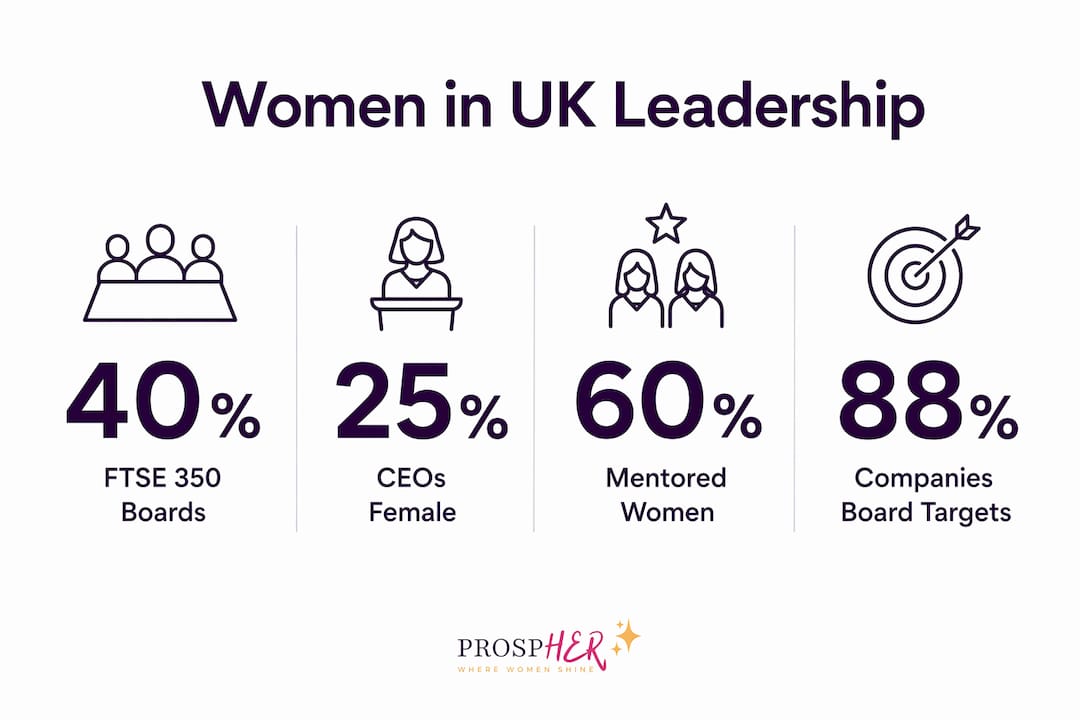
Progress is real, but the full picture is more complicated than the headlines suggest. 88% of FTSE 350 companies have reached or are nearing the 40% women on boards target as of February 2026. Women now hold approximately 36% of leadership roles across FTSE 350 firms. Yet only a small minority of those firms have a female CEO.
The gap between board representation and executive power tells the real story. Non-executive director roles sit at near parity, with women filling 49% of those positions. But when you look at chairs, that figure drops to 17%, and finance directors to 21%. These are the roles that shape strategy and build the pipeline to the top.
The numbers that matter most: Women hold 36% of FTSE 350 leadership roles but just 8% of CEO positions, revealing a persistent gap between representation and real executive power.
Key statistics at a glance:
- 88% of FTSE 350 firms at or near 40% women on boards (february 2026)
- 36% of FTSE 350 leadership roles held by women
- Only 8% of FTSE 350 CEOs are women
- 49% of non-executive director roles filled by women
- A minority of chairs and finance directors are women
What barriers are still holding women leaders back?
The statistics show progress. The lived experience often tells a different story. Unconscious bias and prevailing cultural attitudes remain among the most persistent obstacles to women's advancement into senior roles, even as board numbers improve.

Female CEOs face a different kind of scrutiny than their male counterparts. Personal attributes, family status, and communication style come under examination in ways that rarely apply to men, pulling focus away from business performance. That distraction has a real cost.
Key challenges women leaders face:
- Unconscious bias in hiring, promotion, and performance reviews
- Gender stereotypes that associate leadership with traditionally male traits
- Work-life balance pressures that disproportionately affect women's career trajectories
- Lack of access to informal networks where senior decisions are often made
- Heightened scrutiny on personal attributes rather than business outcomes
- Structural barriers in organisations that lack transparent progression criteria
Why mentorship is the single most powerful tool for female leaders
Mentorship does more than build confidence. It builds careers. Continuous mentorship is one of the most proven strategies for retaining women in leadership pipelines and counteracting the systemic obstacles they face at every stage.

The challenge is access. Many women, particularly those earlier in their careers, struggle to find mentors with the seniority and time to invest meaningfully. Structured programmes solve this by removing the awkwardness of cold outreach and creating accountability on both sides.
Pro Tip: When seeking a mentor, be specific about what you want from the relationship. A clear ask, whether it is navigating a promotion conversation or building board-level credibility, gets a far better response than a general request to "pick someone's brain."
Mentorship benefits worth knowing:
- Accelerates progression by providing access to experience you have not yet accumulated
- Builds confidence to pursue roles you might otherwise self-select out of
- Expands your network through your mentor's connections
- Provides a sounding board for decisions without the political risk of asking colleagues
- Supports retention of talented women who might otherwise leave organisations
Training and development opportunities built for women leaders
Leadership training designed specifically for women addresses gaps that generic programmes miss entirely. Executive Presence workshops, such as those delivered through RADA In Business, focus on how women communicate authority in rooms where they are often the only female voice.
Sector-specific development matters too. Finance, public sector, and STEM each carry their own cultural dynamics, and the most effective programmes account for that rather than offering one-size-fits-all content. Peer learning cohorts, where women at similar career stages work through challenges together, consistently produce strong outcomes because the learning is grounded in shared reality.
Development opportunities to explore:
- Executive Presence workshops tailored to female leaders
- Sector-specific leadership programmes in finance, public sector, and STEM
- Professional coaching focused on career navigation and confidence
- Peer learning cohorts and mastermind groups
- Women's leadership programmes covering board readiness and executive skills
- Retreats and immersive events combining strategy with community
UK networks and organisations that support women in leadership
You do not have to build your career in isolation. A growing number of organisations across the UK provide community, coaching, and advocacy specifically for female leaders. Here is how four of the most prominent compare:
| Organisation | Focus | Key services | Best for |
|---|---|---|---|
| Female Founders Rise | Women entrepreneurs | Networking, growth support | London-based founders |
| CW Female Entrepreneurs | Business growth and scaling | Coaching power hours, founder groups, visibility | Women growing businesses |
| Women's Inclusive Team | Inclusive leadership | Advocacy, organisational support | Women leaders across sectors |
| London Women's Forum | Senior professional women | Networking, Executive Presence workshops | Finance and professional services |
Beyond these four, the broader female entrepreneur network across the UK offers regional communities worth exploring, particularly outside London where local ecosystems are growing fast.
Additional benefits of joining these networks:
- Access to peers who understand the specific pressures of female leadership
- Visibility opportunities that open doors to speaking, media, and board roles
- Coaching and accountability structures that keep momentum going
- Regional meet-ups that build genuine relationships beyond digital connection
How recognition shapes the impact of female leaders in the UK
Recognition does two things at once. It validates the woman being celebrated and signals to every woman watching that this path is possible. Awards such as the Women into Leadership Awards and sector-specific recognition programmes play a genuine role in shifting what leadership looks like in the public imagination.
Prominent women in UK politics and public life are already reshaping that image. Rachel Reeves serves as Chancellor of the Exchequer, Yvette Cooper as Secretary of State for Foreign, Commonwealth and Development Affairs, and Dame Ottoline Leyser leads UK Research and Innovation as Chief Executive. Each of these appointments carries weight beyond the individual.
The economic case for visibility is clear too. When women in executive roles are seen and celebrated, organisations attract more female talent, retain it longer, and build the kind of diverse leadership that drives better decisions.
Key points on recognition and influence:
- Awards and public recognition shift cultural norms around who leads
- Prominent female leaders in politics and public sector create visible role models
- Sector-specific recognition programmes increase visibility within industries
- Celebrating female achievement builds the pipeline for the next generation
How ProspHER supports women leaders with clarity and momentum
Most platforms give you more content. ProspHER gives you a pathway. With a community of over 2,400 women, ProspHER is built around one core principle: clarity before volume.
94% of ProspHER members report gaining clearer direction within just 30 days of joining the platform.
That is not a small thing. Confusion and overwhelm are among the most common reasons talented women stall in their careers. ProspHER removes both by providing personalised development pathways, structured mentorship, group coaching, and a community that actually knows where you are trying to go.
ProspHER's core support components:
- Personalised career and business development pathways
- Structured mentorship matched to your goals and stage
- Group coaching and peer accountability
- Financial literacy programmes and mindset training
- Networking events and retreats
- A content library built for action, not passive consumption
How diversity and inclusion policies drive real change for women leaders
Diversity and inclusion policies work when they are specific, measurable, and tied to accountability. Voluntary frameworks like the HM Treasury Women in Finance Charter, which covers more than 440 firms, demonstrate what happens when organisations commit publicly to targets. Senior female representation in finance rose from 32% to 36% over five years under that charter.
The lesson is that good intentions without structure produce little. Policies that set targets, publish progress, and hold leaders accountable create the conditions where women actually advance.
Where to turn if you face harassment or discrimination as a leader
Harassment and discrimination do not disappear at senior levels. If anything, the isolation of leadership roles can make them harder to address. The Equality Act 2010 provides the legal framework protecting women from discrimination based on sex, and the Equality and Human Rights Commission offers guidance on rights and reporting routes.
Within organisations, HR policies, formal grievance procedures, and employee assistance programmes are the first port of call. Externally, organisations such as the Fawcett Society provide advocacy and practical support for women navigating discrimination at work.
Government and industry initiatives pushing female leadership forward
The UK government's approach to female leadership combines voluntary business-led frameworks with public accountability. The FTSE Women Leaders Review, backed by government and sponsored by Lloyds Banking Group and KPMG LLP, tracks progress across 26,000 roles annually. Building the CEO pipeline requires intentional placement of women in profit-and-loss and operational roles early in their careers, not just board appointments later.
Dame Debbie Crosbie, CEO of Nationwide Building Society, took up the Women in Finance Champion role from 1 january 2026, appointed to drive further momentum behind the charter.
How far have women in UK leadership actually come?
The shift over the past two decades is substantial. Women on FTSE 350 boards were a rarity in the early 2000s. The Davies Review in 2011 set the first voluntary targets, and the subsequent Hampton-Alexander Review raised ambitions further. Today, board gender balance is largely achieved. The frontier has moved to executive committees, CEO roles, and the operational positions that feed them.
Political leadership has followed a similar arc. From Margaret Thatcher to Theresa May and beyond, the list of female leaders of British political parties has grown steadily, with women now leading or co-leading parties across the political spectrum.
Sector-specific challenges: where the gaps are sharpest
Corporate boardrooms have made the most visible progress, but the picture varies sharply by sector. STEM fields remain among the most challenging environments for female leaders, with cultural norms, hiring practices, and a thin pipeline of senior women combining to slow progress. The public sector generally shows stronger female representation at mid-management level, but the most senior roles still skew male.
Finance has made measurable gains through the Women in Finance Charter, but the gap between senior representation and CEO-level power persists. For women in these sectors, the combination of targeted training, strong networks, and visible sponsorship from senior leaders makes the most practical difference.
Key takeaways
Women in leadership in the UK have made measurable gains at board level, but the CEO pipeline, executive roles, and male-dominated sectors remain the critical frontiers for the next phase of progress.
| Point | Details |
|---|---|
| Board progress is real but uneven | 88% of FTSE 350 firms meet or near the 40% board target, yet only 8% of CEOs are women. |
| Mentorship accelerates careers | Structured mentorship builds confidence, expands networks, and keeps women in leadership pipelines. |
| Networks provide practical momentum | Organisations like Female Founders Rise, CW Female Entrepreneurs, Women's Inclusive Team, and London Women's Forum offer coaching, visibility, and community. |
| Charters create accountability | The Women in Finance Charter covers 440+ firms and lifted senior female finance representation from 32% to 36% over five years. |
| Clarity beats volume | ProspHER's personalised pathways help 94% of members gain clearer direction within 30 days. |
Ready to build your leadership career with real support?
You have the ambition. What you need is a clear path and a community that moves with you. ProspHER gives you both: personalised development, structured mentorship, group coaching, and a network of over 2,400 women who are building careers and businesses with real momentum. No noise. No overwhelm. Just clarity and forward motion.