
A career roadmap is a living plan that connects your current position to a clear destination through a medium-term milestone horizon, specific skill-building actions, and an evidence bank that proves your progress. It is not a CV. A CV records what you have done; a roadmap directs what you do next.
Copy this micro-template into a doc right now: Destination → 18–24 month milestone → next role move → first 90-day actions.
Three things separate a roadmap that gets used from one that gets filed. First, milestones must be specific enough to allow measurement of progress. Second, you need an evidence bank, a running log of projects, metrics, and competencies you can point to. Third, a quarterly review rhythm keeps the plan alive rather than static. ProspHER's community of women members backs this up: many report gaining clearer direction within 30 days of joining, which is momentum that starts with a plan.
Table of Contents
- How do you create a career roadmap you will actually follow?
- Three templates and real examples you can copy today
- How do you measure progress on your career roadmap?
- What are the most common career roadmap pitfalls?
- How a guided platform turns your roadmap into measurable outcomes
- Key takeaways
- Why your roadmap is the most honest conversation you will have with yourself
- ProspHER: your structured path from roadmap to real progress
- Useful sources and tools
How do you create a career roadmap you will actually follow?
The method has several steps. Run through them in order once, then revisit key steps regularly.
Step 1: Define your destination. Set a long-term directional target, not a job title carved in stone. Think in terms of the impact you want to have, the seniority level you are aiming for, and the kind of work that energises you. Pair it with three personal success criteria: what does "winning" look like for you financially, relationally, and in terms of daily work?
Step 2: Audit your current position. Map your skills honestly. What can you demonstrate with evidence right now? Who is in your network, and who is missing? Identify the gap between where you are and where you want to be. This audit is the foundation of your evidence bank.

Step 3: Map multiple plausible paths. There is rarely one route from here to your destination. Career mapping tools surface several plausible paths and flag decision points where one move closes future options and another keeps them open. Sketch at least two routes and mark the forks.
Step 4: Set 18–24 month milestones. Break your long-term direction into a milestone horizon of around two years, then place markers at intermediate points. A sample timeline for a mid-level professional aiming for a leadership role might look like: 6 months — lead a cross-functional project; 12 months — complete a relevant qualification or coaching programme; 24 months — move into a team lead or senior IC role.
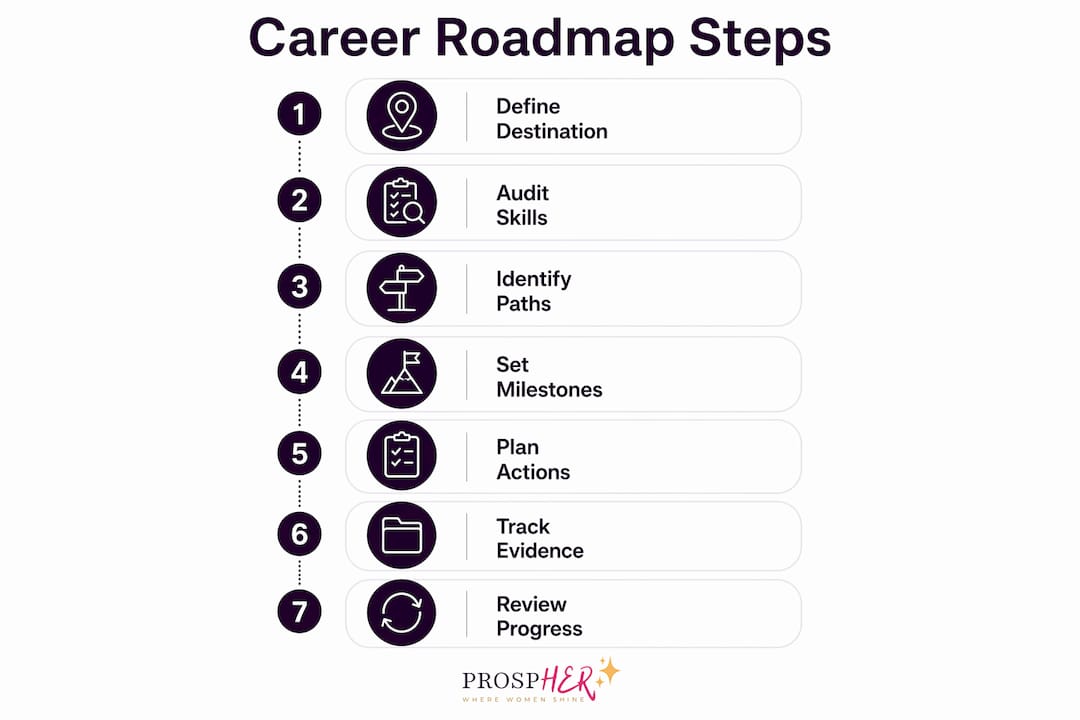
Step 5: Translate milestones into specific actions. Each milestone needs three things: a skill-building project, a networking target (name the person or type of relationship), and a measurable output. Your first 90-day actions are the most important. Vague plans stall; specific 90-day actions keep motivation high and progress visible.
Step 6: Build your evidence bank and action tracker. Log every completed project with a metric, a date, and the competency it demonstrates. Keep a forward-looking tracker alongside it: upcoming projects, networking targets, and timelines. Together, these two documents turn your roadmap into promotion-grade proof.
Step 7: Set a review rhythm. A quarterly light check takes 30 minutes: review milestones, update your evidence bank, and adjust your 90-day actions. An annual deep recalibration asks bigger questions: has your destination shifted? Have new paths opened? Versioned planning like this keeps a roadmap responsive to market shifts and changing interests.
Pro Tip: Name the single biggest barrier to your next milestone right now, then write one specific counter-move you can take this week. A named obstacle paired with a tactic substantially increases the probability you will use the plan rather than file it.
Creation checklist:
- Destination statement written (10-year directional target)
- Current skills and evidence audited
- At least two plausible paths sketched with decision forks marked
- 6, 12, and 24-month markers set
- First 90-day actions listed with named outputs
- Evidence bank started (at least three entries)
- Quarterly review date booked in your calendar
Three templates and real examples you can copy today

The right template depends on where you are in your career. Here are three formats, each with a short example card.
Early-career template (0–5 years in work)
Destination: Senior specialist or team lead in your chosen field within five years. 18–24 month milestone: Independently own a project end-to-end and present results to a senior stakeholder. 6/12/24 month markers: 6M — complete a relevant online qualification; 12M — lead a sub-project; 24M — take on a formal mentee or junior colleague. Skills to build: Stakeholder communication, data analysis or domain-specific technical skill, project ownership. Evidence to capture: Project outcomes with metrics, presentation decks, feedback from senior stakeholders. First 90-day actions: Identify one project to own, enrol in one qualification, book a coffee with a senior colleague in your target area.
Example card: Graduate analyst → senior analyst → data team lead. At 12 months: delivered a reporting dashboard adopted by three departments. At 24 months: promoted to senior analyst and mentoring two graduates.
Mid-career pivot template (3–8 years in work)
Destination: A role in a new function or sector that uses transferable strengths. 18–24 month milestone: Land a role in the target function, even if at a lateral level. 6/12/24 month markers: 6M — complete a bridging qualification or side project in the new area; 12M — build three relationships inside the target function; 24M — apply for roles with a portfolio of cross-functional evidence. Skills to build: The one or two technical gaps between your current function and the target one, plus storytelling your transferable skills. Evidence to capture: Cross-functional project contributions, any freelance or voluntary work in the new area, written testimonials. First 90-day actions: Identify the two skills gaps, find one project that bridges them, and connect with one person already doing the target role.
Example card: Marketing manager → product manager. Spent 12 months running a customer research project that sat inside the product team. Built a portfolio of user-research artefacts. Moved laterally into a junior PM role at month 18, then progressed to PM within a year.
Leadership track template (6–15 years in work)
Destination: Director, VP, or equivalent senior leadership position. 18–24 month milestone: Secure a formal people-management or programme-leadership responsibility. 6/12/24 month markers: 6M — identify and approach a sponsor (not just a mentor); 12M — lead a business-critical initiative with measurable P&L or headcount impact; 24M — be considered for the next leadership cohort or promotion cycle. Skills to build: Strategic communication, financial literacy, women in leadership competencies, stakeholder influence. Evidence to capture: Business outcomes with revenue or cost figures, 360-degree feedback, board or exec presentations. First 90-day actions: Name your sponsor target, identify one high-visibility project, and book a structured career coaching conversation.
Milestone-to-action sample table
| Milestone | Skill to build | Evidence to capture | 90-day action |
|---|---|---|---|
| Lead a cross-functional project | Stakeholder management | Project outcome report with metrics | Volunteer for one cross-team initiative this quarter |
| Move into a senior IC role | Domain expertise + communication | Presentation deck reviewed by director | Complete one qualification module; present findings at team meeting |
| Secure a sponsor relationship | Executive presence | Documented sponsor conversation notes | Identify one senior leader; request a 20-minute conversation |
| Achieve a salary uplift | Negotiation + evidence bank | Salary negotiation prep document | Build a one-page impact summary from your evidence bank |
Pro Tip: A three-year plan builder that forces you to name three specific skills to close, set milestones at 6, 12, and 24 months, and pair each obstacle with a tactic is one of the most effective ways to reduce vagueness. Use ProspHER's template library to start a fillable version.
How do you measure progress on your career roadmap?
Measurement must be milestone-aligned and evidence-based. Tracking feelings of progress is not enough; you need indicators that tell you whether you are on track before a promotion cycle arrives.
Leading indicators (things you control now):
- Number of skill-building projects started this quarter
- Mentor or sponsor meetings completed
- Hours of deliberate practice in a target skill
- New relationships built inside your target function or sector
Lagging indicators (outcomes that confirm progress):
- Promotion or role change
- Salary uplift
- Formal recognition (award, published work, speaking invitation)
- Expanded scope of responsibility
Evidence bank format
Log each entry with six fields: project name, measurable outcome, your role, date completed, competency demonstrated, and a link to the artefact (document, presentation, or data). A simple spreadsheet works. So does a Notion page or a Google Doc with a consistent table structure. The goal is to make your evidence retrievable in under two minutes when a promotion conversation arrives.
AI tools such as Claude can analyse your current experience against a target role and generate a skills portfolio log, which is a useful starting point for structuring your evidence bank.
| Tracking action | Frequency | What to review |
|---|---|---|
| Update evidence bank | Weekly | Add any completed project, metric, or feedback received |
| Review 90-day actions | Monthly | Are you on track? What needs to shift? |
| Light milestone check | Quarterly | Progress against 6/12/24-month markers; update action tracker |
| Deep recalibration | Annually | Has destination shifted? New paths opened? Sponsor conversations needed? |
Tracking tool options:
- Spreadsheet (Google Sheets or Excel): Best for evidence banks and milestone trackers; free, flexible, shareable with a mentor.
- Notion or Google Docs: Good for combining your roadmap narrative, evidence log, and action tracker in one place.
- ProspHER platform: Structured milestone trackers, evidence bank prompts, and quarterly review workflows built specifically for career development.
- Goal-setting frameworks: Pair your tracker with a structured goal-setting method to keep leading indicators sharp.
What are the most common career roadmap pitfalls?
The usual failure modes are vagueness and locally optimal moves that close future doors. Both are avoidable when you know what to look for.
The local optimum problem is the most underestimated trap. A locally optimal move is one that looks like a win right now but narrows your options later. A classic example: accepting a highly specialised role for a salary bump, only to find 18 months later that the specialism is a dead end and you have lost the cross-functional credibility needed for the leadership track you actually wanted. Mapping forks explicitly before you make a move is the antidote. Ask: does this role build compounding skills, or does it deepen a niche that only one employer values?
Decision checklist for forks in your roadmap:
- Does this move build skills that compound across multiple future roles?
- Does it expand my optionality (more paths open after it) or narrow it?
- Do I have a sponsor who can advocate for me in this direction?
- Is the short-term gain (salary, title) worth the long-term trade-off?
- Does it align with my personal success criteria from Step 1?
Pro Tip: When you hit a fork, run a six-move horizon check: think six moves ahead, not one. Which path keeps more doors open across multiple plausible futures? The answer is usually the one that builds transferable skills and relationships, not the one with the biggest immediate title.
On parallel roadmaps: run two versions only when you are genuinely at a crossroads between two distinct directions and you have the bandwidth to test both. If you are running parallel roadmaps for more than one quarter without a decision, that is a signal to consolidate. Sustained focus on one path compounds faster than divided effort across two.
Other common pitfalls:
- Setting a destination without personal success criteria (you hit the goal and feel nothing)
- Skipping the evidence bank until a promotion cycle forces you to scramble
- Treating the roadmap as a one-time document rather than a living plan
- Confusing a mentor (advice) with a sponsor (advocacy); you need both, but they serve different functions
How a guided platform turns your roadmap into measurable outcomes
Guided platforms convert plans into measurable progress through structure, coaching, and community accountability. A template in a drawer does not do that. A plan embedded in a system with review prompts, mentor matching, and peer accountability does.
ProspHER is built specifically for this. The platform maps directly onto every stage of the roadmap method:
- Template library: Start with a fillable roadmap template rather than a blank page, structured around destination, milestones, and 90-day actions.
- Evidence bank prompts: Built-in prompts remind you to log projects, metrics, and competencies as you complete them, not six months later when you have forgotten the details.
- Mentor matching: Connect with mentors who have walked the path you are mapping. Mentorship shapes strategic decisions in ways that generic advice cannot; a matched mentor turns "build your network" into a specific name and a specific conversation.
- Quarterly review workflows: Structured check-ins built into the platform cadence mean your roadmap gets reviewed, not just written.
- Milestone trackers: Visual progress against your 6, 12, and 24-month markers keeps momentum visible.
- Community and events: Over 2,400 women in the ProspHER community means peer accountability, shared experience, and access to executive coaching cohorts that accelerate the leadership track.
94% of ProspHER members report gaining clearer direction within 30 days. That is not a slow burn; it is what happens when a plan meets the right structure and the right people.
How to use the platform with your roadmap:
- Import your roadmap template and populate your destination and milestones on day one
- Attach evidence entries to the relevant milestone as you complete projects
- Use mentor matching to schedule a sponsor conversation within your first 30 days
- Set your quarterly review date inside the platform and treat it as a non-negotiable calendar commitment
Key takeaways
A career roadmap works when it combines a specific destination, evidence-backed milestones, and a quarterly review rhythm that keeps the plan alive.
| Point | Details |
|---|---|
| Start with destination | Write a 10-year directional target with three personal success criteria before setting any milestones. |
| Use 18–24 month horizons | Break your direction into milestones at 6, 12, and 24 months; this sizing keeps motivation high and progress visible. |
| Build an evidence bank | Log every project with a metric, date, and competency demonstrated so promotion-grade proof is always ready. |
| Name your biggest barrier | Pair it with one specific counter-move you can take this week; this single habit separates plans that get used from plans that get filed. |
| ProspHER accelerates execution | With structured templates, mentor matching, and quarterly review workflows, ProspHER helps members gain clearer direction within 30 days. |
Why your roadmap is the most honest conversation you will have with yourself
Here is what we have seen, again and again, inside the ProspHER community: the women who move fastest are not the ones with the most polished plans. They are the ones who treat their roadmap as a thinking tool rather than a performance document.
Most career advice tells you to be ambitious and specific. That is right. But it misses something. The real value of a roadmap is not the destination; it is the decision-making clarity it gives you at every fork. When a new opportunity lands in your inbox, you do not have to decide from scratch. You already know your success criteria. You already know which skills you are building and which doors you need to stay open. The roadmap does the thinking for you in the moment.
The UK career market rewards this kind of deliberate pacing. Structured progression through apprenticeships, leadership programmes, and professional qualifications is genuinely available here, but only to the people who have mapped where those routes lead before they step onto them. Iteration is not failure; it is the method. Every quarterly review is a chance to get smarter about your own trajectory.
Give yourself one hour this week. Not to perfect the plan. Just to write the destination, the 18-month milestone, and the single biggest barrier. That is enough to start.
ProspHER: your structured path from roadmap to real progress
Most women who come to ProspHER already know where they want to go. What they are missing is the structure to get there without losing months to confusion, second-guessing, or generic advice that does not apply to their situation.
ProspHER gives you a personalised career pathway built around your current circumstances and your specific ambitions. Not a content library to wade through. A clear, structured plan with the tools to execute it: a template library, evidence bank prompts, mentor matching, quarterly review workflows, and a community of over 2,400 ambitious women who are building their own roadmaps alongside you.
94% of members report gaining clearer direction within 30 days. That kind of momentum does not come from reading more articles. It comes from having the right structure and the right people around you.
Join ProspHER and start building your roadmap with the support of a community that is already moving.
Useful sources and tools
- What is a career roadmap? (Indeed UK) — Clear definition and how-to overview; a good starting reference for understanding how a roadmap differs from a CV.
- Career path map: your 20-year roadmap (Goals & Progress) — Explains the six-move horizon concept and how to map decision forks; use it alongside your milestone planning.
- Free Career Development Plan Builder (Goals & Progress) — Fillable three-year plan builder that forces specific skills, milestones, and obstacle-tactic pairs; a practical complement to the templates in this article.
- Plan your career path (Claude by Anthropic) — Shows how AI tools can analyse your experience against a target role and generate a skills portfolio log; useful for building your evidence bank quickly.
- How to create a career roadmap that actually works (BeyondTime) — Practical guide on milestone sizing, review cadences, and keeping a roadmap alive; good for the measurement and review sections.
- Goal setting in work: your practical guide (ProspHER blog) — Deeper template on goal-setting cadence that pairs directly with your roadmap's quarterly review rhythm.
- Women in leadership UK: your 2026 guide (ProspHER blog) — UK-specific resources on leadership pathways; useful for the leadership track template and understanding progression structures in the UK market.
- Women in leadership apprenticeship: your UK guide (ProspHER blog) — Information on UK apprenticeships and structured learning routes that can be built directly into a career roadmap milestone.