
You can build executive presence by practising three behaviour-first habits that compound quickly: communicate outcomes before rationale, regulate your composure under pressure, and rehearse high-stakes moments with a witness before they happen. Do those three things consistently and you will see a visible shift in roughly 30 days. A reputation shift, the kind where senior stakeholders start attributing leadership readiness to you, typically follows within 6–12 months.

The Coqual framework, developed by researcher Sylvia Ann Hewlett, organises executive presence into three dimensions: gravitas, communication, and appearance. That structure underpins every section below.
Quick-start summary:
- Start this week: rewrite your next meeting update to lead with the recommendation, not the background
- Week 2–4: add a 90-second composure routine before every high-stakes interaction
- Month 2–3: run at least one role-play rehearsal per week with a peer or coach
Pro Tip: The single highest-leverage habit you can build today is the deliberate pause. Before you answer a question in a meeting, wait two seconds. It signals strategic thinking rather than reactivity, and it costs nothing.
Table of Contents
- How does self-awareness lay the groundwork for executive presence?
- How do you communicate with authority and stop over-explaining?
- How do you cultivate gravitas and stay composed under pressure?
- What non-verbal signals actually move the needle?
- How do you build real influence, not just visible presence?
- What does a 30–90 day practice plan actually look like?
- What does the evidence say about executive presence for women?
- Key takeaways
- The behaviour that changes everything
- How ProspHER supports your 30–90 day presence plan
- Useful sources and further reading
How does self-awareness lay the groundwork for executive presence?
Surface changes, such as a new outfit or a firmer handshake, will not move the needle on their own. What actually shifts how others perceive you is your inner state regulation and your willingness to collect honest feedback. Start there.
A simple self-audit runs on three inputs: your own observation, trusted colleagues' observations, and behavioural data from real interactions. After every significant meeting, ask yourself: Where did I over-explain? Where did I hedge when I could have been direct? Where did I lose composure? Then ask one trusted peer the same questions. Patterns surface quickly.
Before any high-stakes interaction, try this 90-second box-breathing exercise. Inhale for four counts, hold for four, exhale for four, hold for four. Repeat four times. The physiological effect is real: it lowers cortisol, steadies your voice, and shifts your nervous system out of reactive mode. It takes less time than checking your phone before a meeting, and the impact is far greater.
Journal prompts that surface recurring patterns:
- Which interactions left me feeling reactive rather than grounded? What triggered that?
- Where did I seek consensus when I could have made a clear recommendation?
- When did I feel most credible today, and what was I doing differently?
Run this audit weekly for the first month. You will start to see two or three recurring triggers that, once named, become much easier to manage. Building real self-belief is the inner work that makes every external presence skill stick.
How do you communicate with authority and stop over-explaining?
The outcome-first principle is straightforward: open with your recommendation or decision, then provide the rationale, then state your ask. Most professionals do the opposite. They build context, explain the process, hedge the conclusion, and bury the recommendation at the end. Senior audiences read that pattern as uncertainty, not thoroughness.
Message templates for high-visibility moments
Board or senior update: "My recommendation is X. The three reasons are A, B, and C. I need a decision on Y by [date]."
Stakeholder briefing: "The situation is X. The risk if we do nothing is Y. I am proposing Z, and I would like your input on the resourcing."
Responding to a challenge: "That is a fair point. My view is X, because of A and B. I am open to other data if you have it."
Notice what those templates share: a clear position, brief evidence, and an explicit next step. None of them start with "So, just to give you a bit of background…"
Outcome-first rewrite in practice
| Version | Opening |
|---|---|
| Common bottom-up update | "We have been working on the project for six weeks. We ran into some challenges with the data, but the team has been working hard and we think we are nearly there…" |
| Outcome-first rewrite | "The project will be ready soon. One data issue remains; we resolve it this week. No action needed from you today." |
The rewrite is shorter, clearer, and signals that you own the outcome rather than narrating the effort.
Do's and don'ts for meeting contributions:
- Do: state your position in the first sentence
- Do: use ownership language ("My recommendation is…" not "It might be worth considering…")
- Do: match your pace to the room's energy, not your anxiety
- Don't: repeat a point you have already made to fill silence
- Don't: qualify every statement with "I might be wrong, but…"
- Don't: ask for permission to share your view ("Can I just add something?")
Communication accounts for roughly 28% of the overall impression of executive presence. Gravitas carries far more weight, which is why the next section matters most.
How do you cultivate gravitas and stay composed under pressure?

Gravitas is the quality that makes people stop and listen before you have finished your sentence. It is not loudness or aggression. It is the combination of calm authority, decisive language, and the ability to hold your ground without dismissing others.
Research consistently places gravitas at roughly 67% of the total executive presence impression, with communication at 28% and appearance at just 5%. If you are spending most of your development energy on how you look or sound, you are working on the 5% problem.
Three exercises that build composure under pressure:
The calm rep. Before a difficult conversation, write down the three most challenging things the other person might say. Rehearse your response to each one, out loud, until your voice stays level and your answer stays concise. Do this ten times a week for a month.
Interruption role-play. Ask a peer to interrupt you mid-sentence during a practice run. Practise pausing, holding eye contact, and completing your thought calmly. The goal is not to fight the interruption but to finish without rushing or shrinking.
Decision drills. Set a timer for 60 seconds and make a clear recommendation on a real work scenario. No hedging, no "it depends." Practise committing to a position, then inviting input: "My call is X. What am I missing?" That phrase is one of the most effective language patterns for decisive authority that still signals collaborative leadership.
Pro Tip: Strategic silence is one of the most underused presence tools. After making a recommendation, stop talking. The discomfort of silence is yours, not the room's. Leaders who fill every pause signal anxiety; leaders who let silence work signal confidence.
What non-verbal signals actually move the needle?
Non-verbal signals matter, but they are smaller drivers of presence than gravitas and communication. Treat them as amplifiers of an already-grounded inner state, not as a substitute for one.
Voice: the highest-impact non-verbal lever. Pace and pitch awareness are where most professionals have the most room to improve. A quick drill: record yourself delivering a 90-second summary of a current project. Play it back and note where your pitch rises at the end of statements (a questioning inflection that signals uncertainty), where you speed up under pressure, and where you drop volume. Then re-record, slowing your pace by 20% and ending declarative sentences on a downward inflection. The difference is audible within two takes.
Before/after example:
Before: "So I think the project is going well? We're on track to deliver by the end of the month?" After: "The project is on track. We deliver by the end of the month."
Same information. Completely different authority signal.
Posture and movement checklist for senior settings:
- Sit fully in your chair, not perched on the edge
- Keep your hands visible on the table rather than clasped in your lap
- Move with intention: walk to the front of the room rather than presenting from your seat when the context allows
- Make eye contact with the decision-maker when you land your key point
- Avoid nodding continuously while others speak; a single, deliberate nod carries more weight
Pro Tip: Attire in senior settings is context-driven, not rule-driven. The question to ask is: does what I am wearing signal that I belong in this room? When in doubt, match the most senior person present, then add one element that is distinctly yours.
How do you build real influence, not just visible presence?
Presence without influence is performance. Influence requires you to understand what your stakeholders actually care about, and to frame your ideas in those terms rather than your own.
A stakeholder map does not need to be complicated. For each key decision-maker or influencer in your world, note three things: what outcome they are accountable for, what keeps them up at night, and the one-sentence way your work connects to both. That map changes how you open every conversation.
| Stakeholder | Their priority | Your one-sentence connection |
|---|---|---|
| CFO | Cost control and forecast accuracy | "This initiative reduces variance in Q3 by consolidating two budget lines." |
| COO | Operational efficiency | "The new process cuts handover time by removing one approval step." |
| CEO | Growth and board confidence | "This positions us ahead of the regulatory change before the board review." |
Phrases that align your recommendation to stakeholders' priorities:
- "Given your focus on X, I want to flag that this directly affects Y."
- "I know the team is stretched on Z, so I have scoped this to require minimal resource from them."
- "I wanted to run this by you first because your read on the board's appetite here matters most."
Those phrases are not flattery. They are evidence that you have done the work of understanding the room before you entered it.
Pro Tip: Visibility of your work is not self-promotion. It is sponsorship infrastructure. Find one senior leader who understands the impact of your work and brief them before key meetings. They become your amplifier in rooms you are not yet in. Women in leadership conferences are one of the most direct routes to building that kind of sponsorship relationship.
What does a 30–90 day practice plan actually look like?
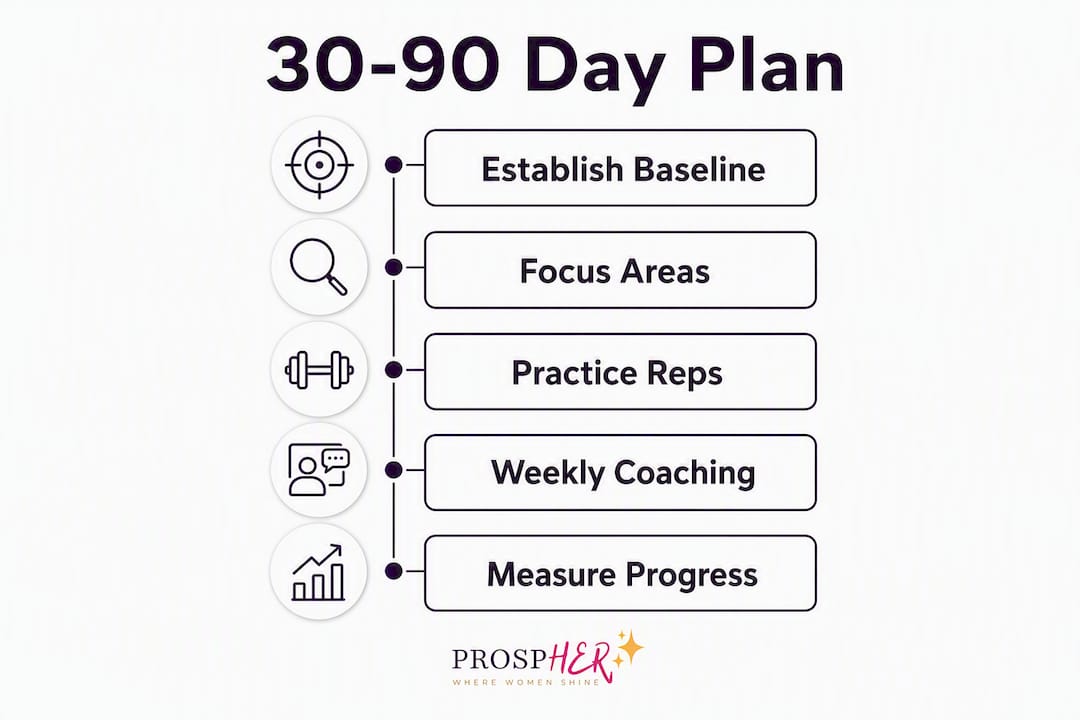
Presence is learned through deliberate reps with a witness. Coaching accelerates the process significantly. Leaders who rehearse high-stakes interactions compress months of trial and error into a single session, which is why structured practice beats passive observation every time.
A structured development process follows five repeatable steps: establish a baseline, choose focus areas, practise in realistic contexts, reinforce consistently, and measure progress. The plan below maps to that sequence.
30–90 day presence plan
| Phase | Focus | Weekly reps | Milestone |
|---|---|---|---|
| Days 1–30 | Outcome-first communication + self-audit | 3 rewrites; 1 peer debrief | Consistent outcome-first openings in all updates |
| Days 31–60 | Composure drills + stakeholder mapping | 2 calm reps; 1 stakeholder map update | No over-explaining in senior meetings; map complete |
| Days 61–90 | Role-play rehearsal + visibility moves | 1 role-play per week; 1 sponsorship brief | One senior leader can articulate your impact unprompted |
Feedback scripts your peers can use
Ask a trusted colleague to observe one meeting and respond to these prompts:
- "What was the first thing I said, and did it land as a recommendation or as context?"
- "Where did I lose pace or add unnecessary qualification?"
- "Did I appear to own the outcome, or did I narrate the effort?"
Specific, behavioural feedback is the only kind that produces change. "You were great" tells you nothing. "You hedged twice in the first two minutes" tells you exactly what to practise next.
Measurable progress signals
- Your updates run shorter without losing substance
- Fewer people talk over you or redirect your points
- Senior stakeholders start attributing decisions to you by name
- You receive feedback that you seem "calm" or "clear" in high-pressure moments
- You are invited into conversations earlier, before decisions are made
For executive coaching communities that support this kind of structured practice, there are several UK-based options worth exploring alongside your own organisation's development resources.
What does the evidence say about executive presence for women?
A widely cited analysis found that 71% of women executives receive negative, personality-based feedback in performance reviews, compared with 2% of men. That gap is not a reflection of women's actual leadership capability. It is a reflection of how behaviour is judged differently depending on who is performing it.
Women's representation in C-suite roles rose from 17% in 2015 to 29% in 2024, which is meaningful progress. The bias in how women's leadership behaviours are perceived, however, has not shifted at the same pace.
The double bind is specific: women who display direct authority are often rated as less likeable; women who display warmth are often rated as less credible. Neither is a fair assessment, but both are real dynamics to navigate.
Evidence-based tactics show that making warmth signals visible and naming team contributions reduces likability penalties when women show authority. That is not about softening your message. It is about giving the room two data points simultaneously: you are both credible and collaborative.
Gender adaptation checklist:
- Pair a direct recommendation with a brief acknowledgement of the team's contribution: "My recommendation is X. The team's work on Y made this possible."
- Name your collaborators explicitly in senior settings, then own the outcome: "We built this together; I am accountable for the result."
- When you are interrupted, hold your position calmly: "I want to finish this point, then I would love your input."
- Seek sponsors, not just mentors. Mentors advise; sponsors advocate. The distinction matters for visibility.
- Collect specific positive attributions in writing (emails, Slack messages, meeting notes) and use them as evidence in performance conversations.
Pro Tip: The most resilient presence strategy for women pairs clarity and directness with explicit, person-focused warmth. Not one or the other. Both, simultaneously, in every high-stakes interaction. It is a skill, and it is learnable.
For a deeper read on women in leadership in the UK, including practical approaches to authentic presence in British organisational contexts, the ProspHER blog covers this in detail.
Key takeaways
Executive presence is built through behaviour-first habits, specifically outcome-led communication, composure under pressure, and deliberate rehearsal, practised consistently over several weeks to a few months.
| Point | Details |
|---|---|
| Gravitas drives most of the impression | Gravitas accounts for roughly 67% of executive presence, with communication at 28% and appearance at 5%; prioritise composure and decisive language above all else. |
| Communicate outcomes first | Open every update with your recommendation, not your background; this single shift changes how senior audiences read you. |
| Rehearse with a witness | Role-play with a peer or coach compresses months of trial and error; one session per week is enough to build momentum. |
| Women face a specific double bind | Pair directness with visible warmth and name collaborators to reduce likability penalties without softening your message. |
| ProspHER accelerates the plan | ProspHER's mentorship, peer role-play, and structured pathways align directly with the 30–90 day practice framework above. |
The behaviour that changes everything
There is a pattern we see repeatedly in the ProspHER community. A member arrives knowing she is capable. She has the track record, the expertise, the ideas. What she has not yet done is practise performing that capability in the specific, high-stakes moments where presence is read and reputations are made.
The shift rarely comes from a single insight. It comes from the tenth time she rehearses a stakeholder briefing out loud, or the third week she runs the self-audit and notices the same trigger appearing. Presence is not a personality trait you either have or lack. It is a set of behaviours you practise until they become your default.
The conventional wisdom says you need to "find your authentic leadership style" before you can project presence. We would push back on that. You find your authentic style by doing the reps, not before them. Act like the leader you intend to become, collect the feedback, adjust, and repeat. The authenticity follows the practice, not the other way around.
Run one rep this week. Rewrite one update in outcome-first format. Ask one trusted colleague for one specific piece of behavioural feedback. That is the whole plan, compressed into a single action.
How ProspHER supports your 30–90 day presence plan
The 30–90 day plan above works best with structure, accountability, and a community that gives you honest feedback rather than polite encouragement.
ProspHER is built precisely for that. With a community of over 2,400 ambitious women and 94% of members reporting clearer direction within 30 days, the platform gives you the infrastructure the plan requires: mentors who have navigated the same rooms you are preparing for, peer role-play cohorts where you can rehearse stakeholder briefings in a safe environment, and tailored pathways that match your current stage rather than a generic curriculum.
The features most directly relevant to building presence: structured one-to-one mentorship, group coaching sessions focused on communication and gravitas, a content library of practical exercises, and community events where you practise visibility in real time.
Join ProspHER and start your 30-day presence plan with a community that is invested in your progress.
Useful sources and further reading
The sources below underpin the frameworks, statistics, and exercises in this article.
-
Executive presence for women in leadership (MIT Sloan Executive Education) — MIT Sloan's framing of presence as a learnable skill set rather than an innate trait; useful for readers who want academic grounding alongside the practical exercises here.
-
ProspHER community and resources — for readers who want structured support, peer accountability, and mentorship to implement the 30–90 day plan with a community of over 2,400 ambitious women.