
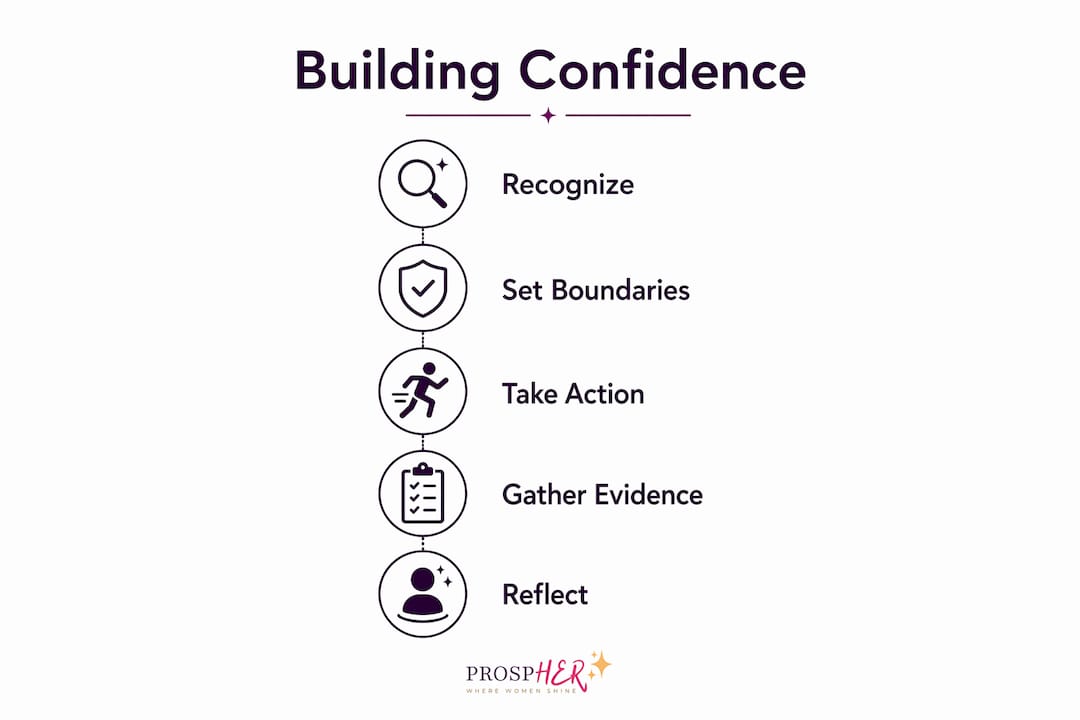
Confidence, for women, is defined as the demonstrated alignment between self-worth and action. It is not a personality trait you either have or lack. It is a skill built through repeated evidence that you can handle discomfort, set boundaries, and keep moving. Research from Harvard Business School confirms the confidence gap between men and women stems from gender stereotyping, not skill deficits. That distinction matters. It means the gap is closable, and the strategies to close it are grounded in psychology, not wishful thinking.
What causes the confidence gap in women?
The confidence gap is not about competence. Women consistently apply for roles only when they feel 100% qualified, while men apply at around 60% qualification. That single pattern costs women promotions, pay rises, and opportunities they have already earned.
Several forces drive this gap:
- Internalised gender stereotypes. From childhood, women absorb messages that assertiveness is unfeminine and ambition is threatening. Those messages become internal standards that are impossible to meet.
- Chronic people-pleasing. Prioritising others' comfort over personal needs erodes self-trust over time. When you consistently override your own instincts, you stop believing in them.
- Social comparison and media pressure. Curated images of success create a distorted benchmark. Women measure their private struggles against others' public highlights, and the comparison is always unfair.
- Difficulty setting boundaries. Without clear limits, others define your value for you. That external definition rarely matches your actual worth.
"The confidence gap is not a reflection of women's ability. It is a reflection of the environment women have been asked to perform in. Change the environment, change the outcome."
The systemic nature of these pressures is the reason that confidence tips for women must go beyond positive thinking. Surface-level affirmations do not dismantle internalised stereotypes. Behaviour does.
How does self-worth build genuine confidence?
Self-worth and confidence are not the same thing, but one feeds the other. Dr. Nathaniel Branden's framework on self-esteem shows that belief-action alignment is the engine of lasting confidence. When your actions consistently reflect what you believe you deserve, your self-perception shifts.
Here is how to apply that framework in practice:
- Set a personal standard and hold it. Decide what treatment you will and will not accept, then act accordingly. Every time you enforce that standard, you send yourself evidence that your values matter.
- Distinguish realistic confidence from inflated self-esteem. Realistic confidence is grounded in actual evidence of your capabilities. Inflated self-esteem is performance without foundation. The first builds momentum; the second collapses under pressure.
- Use boundaries as communication. Consistent boundary-setting signals self-respect to others and reinforces it internally. A boundary is not a wall. It is a statement of value.
- Act before you feel ready. Waiting to feel confident before acting is the most common trap. The feeling follows the action, not the other way around.
Pro Tip: Write down one boundary you have been avoiding and set it this week. Notice how your self-perception shifts after you follow through. That shift is confidence forming.
What practical strategies effectively boost confidence?

Behavioural activation is the most direct route to building self-belief. Acting through discomfort gathers objective proof of competence. Each time you do something difficult and survive it, your brain updates its assessment of what you are capable of.
These strategies produce measurable results:
- Track your wins. The brain has a negativity bias. Left unchecked, it catalogues failures and discounts successes. Tracking wins counteracts this by building a documented record of competence. Review it when self-doubt surfaces.
- Seek mentorship actively. A 2026 LeanIn.org survey found that 67% of mentored women reported a stronger belief in their career trajectory. Mentorship provides validation, role modelling, and honest feedback that accelerates confidence growth.
- Use power body language deliberately. Posture, eye contact, and the pace of your speech affect how others perceive you and how you perceive yourself. Adopt an open, grounded physical presence before high-stakes conversations.
- Practise physical activity with intention. Yoga practised twice weekly for three months increased women's self-esteem by 31%. Physical movement reduces cortisol, improves mood, and strengthens the mind-body connection that underpins self-assurance.
The common thread across all these strategies is evidence. Confidence grows when you accumulate proof that you can act, adapt, and deliver. You do not need to feel ready first.
How can women address imposter syndrome and social comparison?
Around 70% of high achievers experience imposter syndrome at some point. Women experience it at higher rates, and often misread it as evidence of incompetence rather than a signal of high performance. That misreading is the problem.
The most effective approach to overcoming self-doubt separates feelings from facts:
- Name the feeling without accepting it as truth. "I feel like a fraud" is an emotion, not a verdict. Ask yourself what the factual evidence says about your competence. The answer is almost always more positive than the feeling suggests.
- Adopt a you-versus-you comparison model. Comparing yourself to your past self is constructive. Comparing yourself to others' curated successes is not. Social media magnifies harmful comparisons by presenting highlight reels as everyday reality.
- Build in deliberate reflection time. Women's confidence often grows through reflection rather than immediate action. Scheduling time to evaluate your progress without the noise of external opinion produces clearer, more accurate self-assessment.
- Limit environments that amplify self-doubt. If a relationship, group, or platform consistently leaves you feeling less capable, that is data. Reducing exposure is not avoidance. It is self-management.
Pro Tip: Keep a "facts file" on your phone. Every time you receive positive feedback or complete something difficult, log it. Read it before any situation that triggers imposter syndrome.
For women building careers alongside these internal battles, the female founders guide from ProspHER offers a practical framework for moving from comparison to self-referenced progress.
What daily habits sustain long-term confidence?
Real confidence grows quietly. Most confidence-building is private and gradual, not sudden or performative. The habits that produce lasting self-belief are small, consistent, and often invisible to others.
- Say no without over-explaining. Every unnecessary justification signals that you need permission. A clear, calm "no" is a confidence-building act in itself.
- Leave environments that diminish you. Staying in rooms, relationships, or roles that consistently undermine your self-worth is not loyalty. It is self-erosion.
- Keep a progress journal. Reflective writing creates distance between you and your inner critic. Writing about what went well, what you handled, and what you learned builds a narrative of competence over time.
- Prioritise consistency over perfection. Progress is uneven and often slow. The women who build lasting confidence are not the ones who never doubt themselves. They are the ones who keep acting despite the doubt.
- Build a network that reflects your ambitions. Surrounding yourself with women who are honest, ambitious, and supportive accelerates your own growth. Shared experience reduces isolation and normalises the struggle.
Empowering women through confidence is not a single event. It is a daily practice of small choices that compound over months and years into an unshakeable sense of self.
Key takeaways
Confidence in women is a skill built through aligned action, consistent boundaries, and accumulated evidence of competence, not a fixed trait or a feeling that arrives before you act.
| Point | Details |
|---|---|
| Confidence follows action | Act despite discomfort; the feeling of capability builds after the action, not before. |
| The gap is systemic, not personal | Gender stereotyping drives the confidence gap; it reflects environment, not ability. |
| Mentorship accelerates growth | 67% of mentored women report stronger belief in their career trajectory. |
| Track wins deliberately | A documented record of success counteracts the brain's negativity bias. |
| Small habits compound | Daily boundary-setting, reflective writing, and saying no build lasting self-belief over time. |
Confidence is quieter than you think
At ProspHER, we have worked with over 2,400 women navigating the space between where they are and where they want to be. The most consistent thing we have observed is this: the women who build real confidence rarely announce it. They are the ones who quietly declined the meeting that wasted their time. They are the ones who asked for the pay rise without apologising for wanting it. They are the ones who left the group chat that made them feel small.
Real confidence does not look like a TED Talk. It looks like a Tuesday afternoon decision that nobody else noticed but you.
We have also seen how uneven this process feels from the inside. You will have weeks where you feel clear and capable, followed by weeks where the self-doubt returns in full force. That is not regression. That is how confidence actually builds. The research confirms it: women's confidence often grows through reflection over time, not in a straight line upward.
The most important thing you can do is stop waiting for the feeling to arrive before you act. Boundaries, small wins, and honest reflection are not preparation for confidence. They are confidence, in motion.
— ProspHER
ProspHER: a platform built around your confidence
Building confidence in isolation is harder than it needs to be. Having the right structure, the right people, and a clear path forward changes everything.

ProspHER is a career and business growth platform built specifically for ambitious women. With a community of over 2,400 members, ProspHER pairs you with mentors, connects you with a supportive network, and gives you a personalised pathway based on where you are right now. No noise. No generic content. Just clarity and momentum. Notably, 94% of members report gaining clearer direction within just 30 days. If you are ready to put the strategies in this article into practice with real support behind you, join ProspHER and take your next step forward.
FAQ
What is the confidence gap in women?
The confidence gap describes the tendency for women to underestimate their abilities relative to men. Research from Harvard Business School attributes this to gender stereotyping rather than any actual skill deficit.
Can confidence be built, or is it innate?
Confidence is a skill, not a fixed trait. Psychologists confirm it grows through repeated successful actions and behavioural alignment with personal values, not through waiting for a feeling to arrive.
How does mentorship help with building self-esteem in women?
Mentorship provides validation, honest feedback, and role modelling. A 2026 LeanIn.org survey found that 67% of mentored women reported a stronger belief in their own career trajectory.
What is imposter syndrome and how common is it?
Imposter syndrome is the persistent belief that you are not as competent as others perceive you to be. Around 70% of high achievers experience it, with women reporting it at higher rates than men.
How long does it take to build genuine confidence?
There is no fixed timeline. Progress is uneven and often slow, but consistency in small daily actions such as boundary-setting, tracking wins, and reflective writing produces lasting results over months rather than weeks.