
Salary sacrifice for pensions is a contractual swap: you agree with your employer to reduce your gross salary, and your employer pays the equivalent amount directly into your pension as an employer contribution. The result? You pay income tax and National Insurance contributions (NICs) on a lower salary, which typically means more money reaching your pension pot for the same net cost. That advantage is about to change, though. From 6 April 2029, only the first £2,000 of salary-sacrificed pension contributions will be NIC-exempt per tax year. Income tax relief on those contributions remains untouched.
MoneyHelper's salary sacrifice guidance and Royal London's salary exchange explainer both confirm that for most employees making typical contributions, the £2,000 cap will have no practical effect. If you sacrifice more than £2,000 per year, though, you will want to read the sections on the 2029 reform and the worked examples carefully.
Key takeaways
Salary sacrifice for pensions saves both income tax and employee NICs on the sacrificed amount, but from 6 April 2029 only the first £2,000 per year will be NIC-exempt, making it critical for high contributors to model their position now.
| Point | Details |
|---|---|
| Core mechanic | Gross salary is reduced; employer pays the equivalent directly into your pension, cutting your tax and NIC bill. |
| April 2029 NIC cap | Only the first £2,000 of salary-sacrificed pension contributions per year will be NIC-exempt; income tax relief is unchanged. |
| Who is most affected | Higher contributors (above £2,000 per year via sacrifice) will pay NICs on the excess; typical savers are unaffected. |
| Key employee risks | Reduced salary can lower mortgage affordability, statutory pay, and State Pension qualifying years. |
| Gender pensions gap | Employer NIC pass-through is a direct lever for women to build pension wealth at career peaks at no extra personal cost. |
Table of Contents
- How does a salary sacrifice pension scheme work in the UK?
- What changes from 6 April 2029 and who will be affected?
- What are the benefits and drawbacks for employees?
- What do employers need to do to set up salary sacrifice correctly?
- How much can you sacrifice, and where are the limits?
- Worked examples: how much do you actually save?
- How salary sacrifice can help close the gender pensions gap
- Next steps for employees and employers
- Our take: the advice most people never get about salary sacrifice
- Sources
How does a salary sacrifice pension scheme work in the UK?
The mechanics are simpler than the jargon suggests. Your employer amends your employment contract so that your gross salary is reduced by the amount you want to contribute to your pension. Your employer then pays that same amount into your pension scheme as an employer contribution. On your payslip, your gross pay is lower, which means income tax and employee NICs are calculated on that reduced figure.
Why does this save money? Because pension contributions made this way never appear as your earnings in the first place. Under a standard personal contribution (relief at source), you pay NICs on your full salary before the contribution is deducted. With salary sacrifice, the contribution comes off the top.
A simple worked example for a basic-rate taxpayer:
Suppose you earn £30,000 and want to contribute £1,000 to your pension.
- Without salary sacrifice: you pay 20% income tax and 8% employee NICs on that £1,000 before it leaves your pay. Your net cost to put £1,000 in your pension is roughly £720 (after basic-rate tax relief via relief at source) but you still pay NICs on the full salary.
- With salary sacrifice: your gross salary drops to £29,000. You pay no income tax or employee NICs on that £1,000 at all. Your net saving versus relief at source is approximately £80 in employee NICs alone on a £1,000 sacrifice.
Your employer also pays less in employer NICs on your reduced salary. Many employers pass some or all of that saving back into your pension, which can add meaningful extra contributions over a career.
Key operational points:
- Salary sacrifice requires a formal contractual change, not just a verbal agreement or a payroll instruction.
- Your employer must keep your post-sacrifice pay at or above the National Minimum Wage / National Living Wage at all times.
- The arrangement must be set up so the employer contribution is genuinely the employer's contribution, not a re-labelled employee one.
- Payroll software must reflect the reduced gross salary and the employer pension contribution separately.
Salary sacrifice vs net pay vs relief at source — a quick comparison:
| Method | Income tax saved? | Employee NICs saved? | Employer NICs saved? |
|---|---|---|---|
| Salary sacrifice | Yes | Yes | Yes (often passed back) |
| Net pay arrangement | Yes | No | No |
| Relief at source | Yes (via reclaim) | No | No |
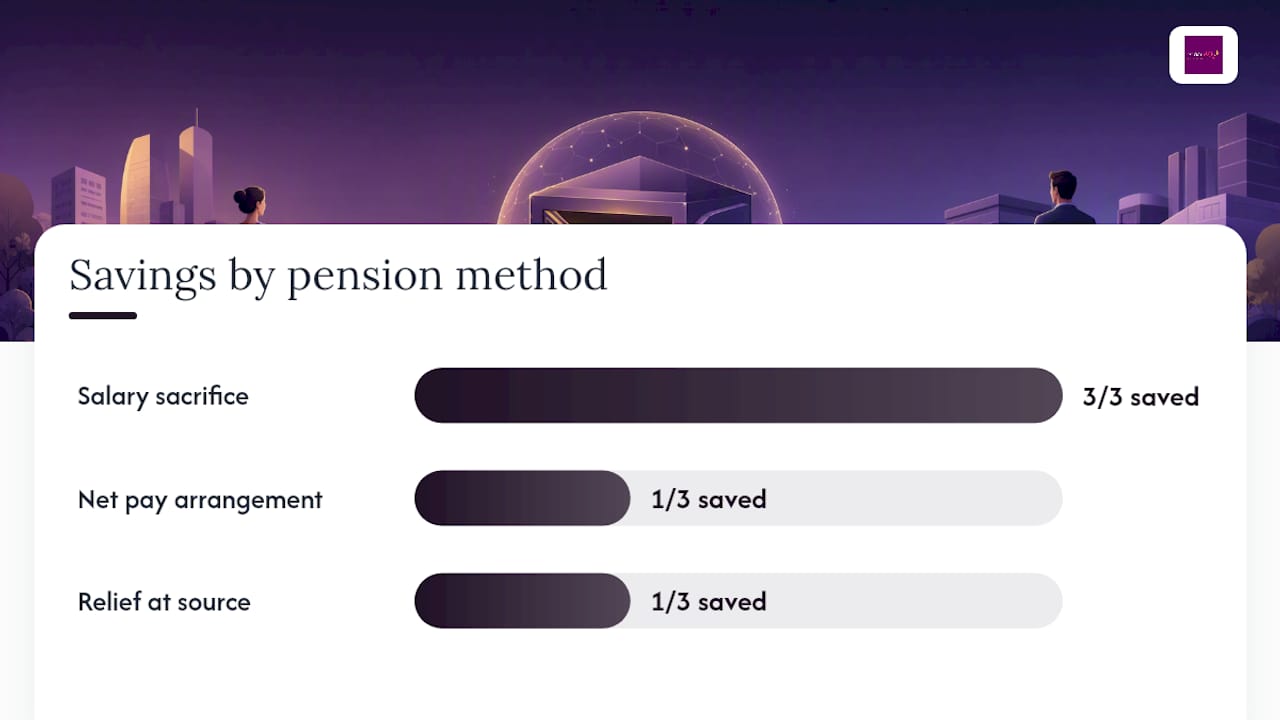
Salary sacrifice typically delivers the largest combined saving for employees who pay employee NICs, which is why it has become the default for many workplace pension schemes.
What changes from 6 April 2029 and who will be affected?
The government has confirmed that from 6 April 2029, the NIC-exempt treatment of salary-sacrificed pension contributions will be capped at £2,000 per tax year per employee. Contributions above that threshold will be subject to both employee and employer NICs in the normal way. Critically, income tax relief on pension contributions is not affected by this change.
The legal mechanism sits within the Optional Remuneration Arrangements (OpRA) framework. The government's published policy paper sets out the costings, the estimated numbers affected, and the employer reporting obligations that will accompany the reform.
That is reassuring for most people. But for higher earners, those making large voluntary contributions, or those whose employers have set up generous matching arrangements, the picture is different. If your total salary-sacrificed pension contributions exceed £2,000 in a tax year, the excess will attract NICs at the applicable rates for both you and your employer.
What employers will need to do from April 2029:
Employers will be required to report total salary-sacrificed pension contribution amounts to HMRC, distinguishing between the NIC-exempt portion (up to £2,000) and any excess. Payroll systems will need updating before the implementation date. The GOV.UK salary sacrifice reform policy paper is the primary source for employers planning ahead.
What are the benefits and drawbacks for employees?
Salary sacrifice can be genuinely powerful, but it is not right for everyone. Here is an honest assessment.
Core benefits:
- Reduced income tax and employee NICs on the sacrificed amount.
- Potential employer NIC pass-through, which effectively increases your pension contribution at no extra cost to you.
- Particularly valuable for higher-rate taxpayers and those whose salary sits just above the Personal Allowance, the £50,270 higher-rate threshold, or the £60,000 High Income Child Benefit Charge threshold.
- Contributions count toward your pension annual allowance at the gross level, which is efficient for those who want to maximise pension saving.
Core drawbacks:
- Your reported salary is lower, which can reduce mortgage affordability assessments. Some lenders use gross salary; others use gross salary minus the sacrifice. Check with your lender before committing.
- Statutory Maternity Pay, Statutory Sick Pay, and similar payments are calculated on your reduced salary, not your original one. If you expect to claim statutory pay soon, pause and model the numbers first.
- Means-tested benefits and tax credits that depend on reported income may be affected.
- If your post-sacrifice salary falls below the National Insurance lower earnings limit, you may lose a qualifying year toward your State Pension. This is a real risk for lower earners or those making very large sacrifices.
Pros and cons at a glance:
| Factor | Salary sacrifice | Standard contribution |
|---|---|---|
| Income tax saving | Yes | Yes (via relief) |
| Employee NIC saving | Yes | No |
| Employer NIC pass-through | Possible | No |
| Mortgage affordability | May reduce | No impact |
| Statutory pay basis | Reduced salary | Full salary |
| State Pension qualifying year | Risk if salary too low | No risk |
Pro Tip: If you are applying for a mortgage within the next 12 months, or if you expect to claim Statutory Maternity Pay, speak to your HR team and a financial adviser before increasing your salary sacrifice. The NIC saving is real, but so is the risk of a lower mortgage offer or reduced statutory payment. The MoneyHelper salary sacrifice calculator lets you model different scenarios before you commit.
What do employers need to do to set up salary sacrifice correctly?
Getting this right from the start protects both the business and its people. Here is the practical checklist.
1. Vary the employment contract lawfully Salary sacrifice requires a formal variation to each employee's contract of employment. This means written notice, a clear explanation of the change, and employee consent. A payroll instruction alone is not sufficient.
2. Check National Minimum Wage compliance Post-sacrifice pay must never fall below the National Minimum Wage or National Living Wage for any pay reference period. This is a legal floor, not a guideline. GOV.UK's salary sacrifice guidance sets out the employer's obligation clearly.
3. Update payroll systems Payroll software must record the reduced gross salary and the employer pension contribution separately. The employer contribution must be structured as a genuine employer payment, not a re-routed employee deduction.
4. Decide on employer NIC pass-through policy Many employers pass some or all of their NIC saving back to employees as additional pension contributions. Decide on your policy, document it, and communicate it clearly. This is often the most motivating element for employees considering opting in.

5. Communicate clearly with employees Employees need to understand the effect on statutory pay, mortgage applications, and State Pension qualifying years before they sign. Providing a written summary and pointing staff to MoneyHelper or Royal London's guidance is good practice.
6. Prepare for April 2029 reporting requirements From 6 April 2029, employers must report total sacrificed pension contribution amounts and distinguish between the NIC-exempt portion (up to £2,000) and any excess. Start reviewing payroll software capability now, not in 2028.
7. Seek HMRC clearance for non-standard arrangements If your scheme involves flexible sacrifice amounts, bonus sacrifice, or unusual contribution structures, consider seeking HMRC clearance via the Employment Income Manual (EIM42755) guidance before implementation.
How much can you sacrifice, and where are the limits?
Three limits matter most. Understanding them stops you from accidentally triggering a pension tax charge or losing a benefit you did not know was at risk.
The National Minimum Wage floor Your post-sacrifice gross pay must stay at or above the National Minimum Wage or National Living Wage for your age group in every pay period. The exact rates are updated each April by the government; always check the current rates on GOV.UK before setting a sacrifice level.
The National Insurance lower earnings limit If your post-sacrifice salary falls below the lower earnings limit (also set annually by HMRC), you stop building entitlement toward your State Pension for that year. For most full-time employees this is not a risk, but for part-time workers or those making large sacrifices, it is worth checking.
The pension annual allowance All pension contributions count toward the annual allowance, including employer contributions made via salary sacrifice. The standard annual allowance is currently £60,000 per tax year, but the tapered annual allowance reduces this for those with adjusted income above £260,000. Exceeding the annual allowance triggers a tax charge that can wipe out the NIC saving entirely.
How contributions stack up against the annual allowance:
| Contribution type | Counts toward annual allowance? |
|---|---|
| Employee salary sacrifice amount | Yes |
| Employer contribution (including NIC pass-through) | Yes |
| Personal contributions outside salary sacrifice | Yes |
| State Pension accrual | No |
Employer-set caps are common. Many schemes cap salary sacrifice at a fixed percentage of salary or a monetary maximum. Check your scheme documentation before assuming you can sacrifice any amount you choose.
Worked examples: how much do you actually save?
These examples use the 2026/27 income tax and NIC rates. They are illustrative; your exact figures will depend on your salary, tax code, and scheme rules.
Scenario 1: Basic-rate taxpayer, £35,000 salary, £1,500 annual sacrifice
Scenario 2: Higher-rate taxpayer, £65,000 salary, £5,000 annual sacrifice
Scenario 3: High contributor, £80,000 salary, £8,000 annual sacrifice (post-2029)
From April 2029, only the first £2,000 of the £8,000 sacrifice is NIC-exempt. The remaining £6,000 attracts employee and employer NICs at the applicable rates. The income tax saving on the full £8,000 is unchanged. For this employee, the net NIC saving shrinks considerably compared with the pre-2029 position, but the pension contribution and income tax relief remain the same.
Pro Tip: Higher contributors should model their post-2029 NIC position now using the PensionBible salary sacrifice guide alongside the GOV.UK policy paper. The income tax saving alone may still make sacrifice worthwhile, but the numbers need checking.
How salary sacrifice can help close the gender pensions gap
The gender pensions gap in private pensions is one of the most persistent financial inequalities in the UK. Women's median uncrystallised private pension wealth is significantly lower than men's, driven by career breaks, part-time working, and the gender pay gap. The TUC's 2025 gender pensions gap report and IFS research on pension saving differences both point to the same structural problem: women accumulate less, for longer, and often have fewer years of full-time employment to recover lost ground.
Salary sacrifice, used tactically, can be one of the most direct levers available to women at career peaks.
When an employer passes their NIC saving back as additional pension contributions, a woman earning £45,000 and sacrificing £3,000 per year could receive several hundred pounds of extra pension funding annually at no cost to her. Over a 10-year career peak, that compounds into a meaningful difference in retirement wealth. Our financial planning guide for women covers this in more depth.
Practical priorities for ProspHER members:
- Ask your employer whether they pass their NIC saving back to employees. If they do not have a policy, ask why.
- Prioritise salary sacrifice during high-earning years, particularly before career breaks or transitions to part-time work.
- Do not sacrifice to the point where statutory pay or State Pension qualifying years are at risk. The long-term cost of losing a qualifying year can outweigh the short-term NIC saving.
- Review contribution levels at every major life-stage transition: promotion, return from maternity leave, change to part-time hours.
For women in leadership roles or approaching senior positions, our women in leadership guide explores how income trajectory and career-peak planning intersect with long-term financial outcomes.
A note on limitations: salary sacrifice is only available through an employer scheme. Self-employed women and those whose employers do not offer it cannot access these NIC savings. Our guide for female entrepreneurs covers pension options for founders and the self-employed.
Next steps for employees and employers
If you are an employee:
- Check your payslip to confirm whether you are already in a salary sacrifice arrangement or a relief-at-source scheme.
- Ask HR whether your employer passes their NIC saving back as additional pension contributions.
- If you sacrifice more than £2,000 per year, model your post-2029 NIC position using the GOV.UK policy paper and a financial adviser.
- Before increasing your sacrifice, check with your mortgage lender and confirm your expected statutory pay calculation.
- Verify that your post-sacrifice salary stays above the National Insurance lower earnings limit to protect your State Pension qualifying year.
If you are an employer:
- Confirm that all salary sacrifice arrangements are backed by formal contract variations, not just payroll instructions.
- Run a National Minimum Wage compliance check for every employee in the scheme.
- Brief your payroll provider on the April 2029 reporting requirements now, so software updates are planned well in advance.
- Decide and document your employer NIC pass-through policy, and communicate it to all eligible employees.
- For complex or high-value arrangements, seek HMRC guidance via the Employment Income Manual before the 2029 implementation date.
Our take: the advice most people never get about salary sacrifice
The conventional guidance on salary sacrifice focuses almost entirely on the NIC saving. That is the right starting point, but it misses the most powerful element: the employer NIC pass-through. Most employees never ask whether their employer passes their NIC saving back. Many employers do not have a policy at all, which means the saving quietly disappears into the company's operating costs rather than landing in anyone's pension.
Ask the question. It is the single most direct way to increase your pension contribution without spending more of your own money.
The April 2029 reform is genuinely significant for high contributors, but the media coverage has created a misleading impression that salary sacrifice is being abolished or fundamentally broken. It is not. Income tax relief is untouched. The NIC advantage is capped, not removed. For the majority of employees sacrificing typical amounts, nothing changes.
What does change is the calculus for those making large voluntary contributions above £2,000 per year. For that group, the post-2029 net saving is smaller, and the decision to sacrifice versus contribute personally needs a fresh look. That is not a crisis; it is a planning prompt.
For women specifically, the gender pensions gap makes this more than a tax efficiency question. Every year of under-contribution during a career peak is a year that cannot easily be recovered. Salary sacrifice, used at the right moments and with employer NIC pass-through secured, is one of the few mechanisms that genuinely shifts the trajectory. Use it deliberately, not by default.

Ready to take control of your financial future? ProspHER's community of over 2,400 ambitious women includes members at every career stage navigating exactly these decisions, from salary negotiations to pension planning and beyond. Our financial planning resources and mentorship programmes give you the clarity and confidence to act, not just read. Join ProspHER and move forward with momentum.
This article is general information, not a substitute for advice from a qualified financial advisor. Consult a qualified financial professional about your own circumstances before acting on anything here.
Sources
The following primary sources and trusted explainers are the best places to go next.
Official GOV.UK guidance:
Trusted consumer explainers:
When to seek personalised advice:
If your total pension contributions (from all sources) approach the £60,000 annual allowance, if you are subject to the tapered annual allowance, or if you have complex family benefit interactions (such as the High Income Child Benefit Charge), speak to a regulated financial adviser before making changes. The financial literacy guide from ProspHER is a good starting point for building the knowledge to have that conversation confidently.