
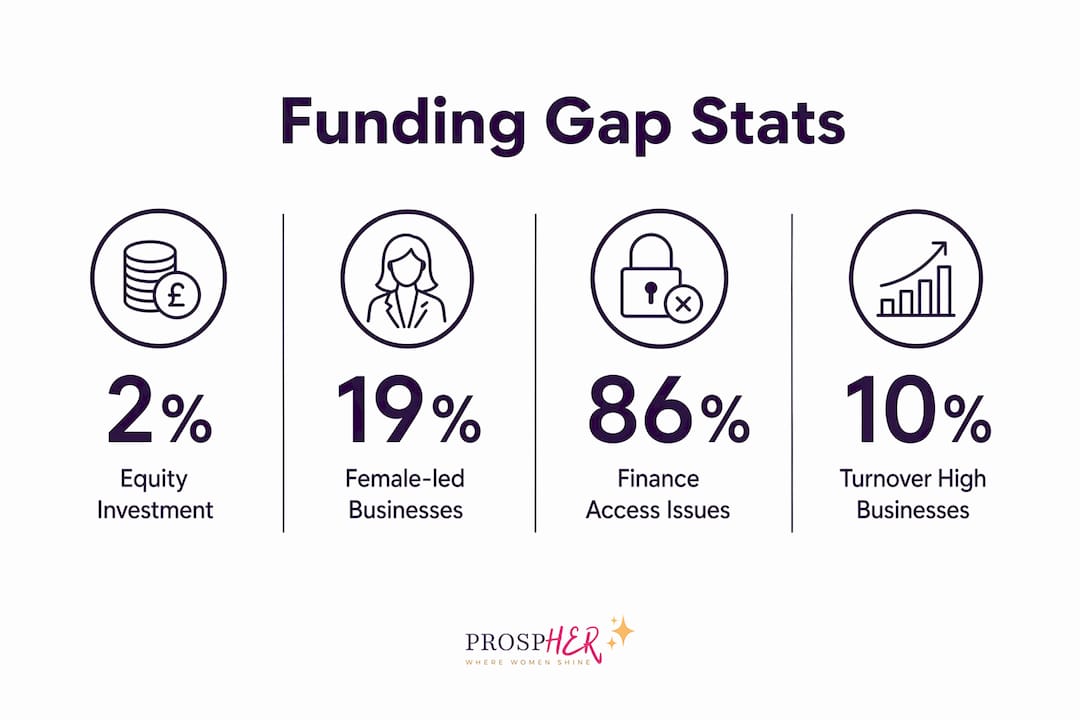
Female entrepreneurs in the UK lead 19% of active businesses but receive only 2% of total equity investment. That gap is not a reflection of ambition or capability. It is a structural problem, and understanding it is the first step to working around it. Women-led businesses in the UK are building real traction, generating revenue, and delivering durable returns. The challenge is that the systems designed to fund and support growth were not built with women founders in mind. This guide covers the funding barriers, growth strategies, government programmes, and practical tools that matter most if you are starting or scaling a business as a woman in the UK.
What are the main funding barriers for female entrepreneurs UK?
The funding gap is real, and the numbers are stark. Fewer than 10% of UK businesses with over £10 million turnover are female led. That figure tells you something important: the problem is not just at the start-up stage. It compounds as businesses grow.
86% of female entrepreneurs report difficulties accessing finance, compared with 76% of men. That 10-point gap reflects both structural bias and a confidence deficit that the system itself creates. When rejection is the norm, it becomes harder to keep pitching.

The investor pipeline makes this worse. Women hold just 15% of investment committee roles. Female investors are twice as likely to back women founders, which means the underrepresentation of women in those rooms directly reduces funding outcomes. The maths is straightforward: fewer women deciding means fewer women funded.
Three other barriers compound the problem:
- Unconscious bias in pitching. Research consistently shows that investors ask female founders prevention-focused questions ("How will you avoid losses?") while asking male founders promotion-focused questions ("How big can this get?"). The framing shapes the outcome before a single number is scrutinised.
- Risk aversion reframed as weakness. Women's cautious approach to debt is often read as lack of ambition. It is not. It is a different risk model, and one that frequently produces more durable businesses.
- Network gaps. Access to warm introductions, angel networks, and informal investor relationships remains unequal. Many female founders are pitching cold into rooms where trust has already been established for others.
Pro Tip: Before approaching investors, research which funds have women on their investment committees. A fund with gender-diverse decision-makers is statistically more likely to fund you.
How do UK female entrepreneurs approach business growth differently?
Female-led firms scale more slowly, focusing on commercially disciplined growth rather than rapid expansion. That is not a failure of ambition. It is a different model, and one that often produces more consistent results.
Female forecasts look conservative on paper. They are also more consistently delivered. That distinction matters enormously when you are building credibility with buyers, suppliers, and future investors. A business that hits its numbers quarter after quarter builds a track record that no pitch deck can replicate.
"Women do not fail due to lack of ambition. They face constrained funding and lower risk-taking confidence. The solution is not more advice. It is better access to capital and fairer systems."
This reframing is critical. Organic growth and bootstrapping are not fallback positions. For many female founders, they are deliberate choices that preserve control and reduce exposure to biased gatekeepers. Retaining equity in the early stages means retaining decision-making power later.
The concept of "radical naivety" is worth taking seriously. Many successful female founders push past conventional limits precisely because they do not yet know what is supposed to be impossible. That mindset, applied deliberately, becomes a competitive advantage. You ask questions that more experienced founders have stopped asking. You spot gaps that others have normalised.
Pro Tip: Track your customer acquisition cost (CAC) and customer lifetime value (LTV) from month one. These two metrics tell investors whether your growth model is sustainable. Having them ready signals commercial maturity, regardless of your funding stage.
What government and community support exists for UK female start-ups?
The UK Government has made concrete commitments to closing the funding gap. The most significant is the Invest in Women Taskforce, which launched with a £255 million fund to improve access to finance for female founders. That fund is paired with the Investing in Women Code, a commitment from finance providers to improve their practices and data collection around female-led businesses.
The Invest in Women Hub provides access to mentoring and a database of finance providers who have signed the Code. This is a practical starting point if you are looking for lenders or investors who have publicly committed to fairer practices.
Beyond government programmes, several community-led initiatives provide real support:
- Female Founders Forum connects women founders with policymakers, investors, and peers. It has direct influence on government policy and runs events across the UK.
- Investing in Women Code signatories include major banks and alternative lenders. Checking this list before approaching a finance provider tells you something about their stated commitment to female founders.
- Industry-specific accelerator programmes offer lower-barrier entry points for scaling. Retail accelerators, in particular, can provide route-to-market support that bypasses traditional investor gatekeeping.
- Regional enterprise partnerships and growth hubs offer free mentoring and business support across England, Scotland, Wales, and Northern Ireland. These are underused by many founders who assume support is London-centric.
| Support type | What it offers | Who it suits |
|---|---|---|
| Invest in Women Hub | Finance provider database, mentoring access | Founders seeking investment or loans |
| Female Founders Forum | Policy influence, peer network, events | Growth-stage founders |
| Accelerator programmes | Route to market, mentoring, credibility | Product and retail businesses |
| Regional growth hubs | Free advice, local networks, grant signposting | Early-stage and scaling businesses |
London has the highest absolute number of female-led businesses, followed by the South East and North West. Regional funding disparities exist but are narrower than many founders assume. Geographic diversity in the UK female entrepreneurship landscape means that strong local networks outside London are both available and worth building.
What practical strategies can female founders use to grow their businesses?
Growth does not require a venture capital cheque. It requires clarity on what is working, what your customers will pay for, and where your next ten clients are coming from. These strategies are grounded in what actually moves the needle for women in business in the UK.
- Target industry-specific communities over general networking. Targeted, industry-specific networks consistently outperform broad networking for female founders. Find the forum, trade body, or Slack group where your ideal clients and collaborators already spend time.
- Validate demand before you scale. Launching with a minimal viable product to test real demand reduces financial risk and generates proof points that investors and buyers find compelling. Do not rescue what has not been validated.
- Pitch directly and concisely. Whether you are approaching an investor, a corporate buyer, or a retail partner, a clear one-page summary of your revenue, traction, and ask outperforms a lengthy deck. Practise delivering your core proposition in under two minutes.
- Fill overlooked market gaps. Filling gaps in male-dominated sectors accelerates growth because competition is lower and customer loyalty is higher. If you are solving a problem that has been ignored, say so clearly.
- Build psychological resilience alongside commercial skills. Imposter syndrome is a common and surmountable challenge. Mia Drennan built a £1 billion business and still navigated it. The goal is not to eliminate self-doubt but to act despite it.
Pro Tip: Join a women entrepreneurs network that offers structured mentoring, not just events. Accountability and direction matter more than access to a room full of business cards.
Momentum begins with one clear next step. Pick the strategy that matches your current stage and execute it before adding another.
Key takeaways
Female entrepreneurs in the UK face a structural funding gap, but durable growth is achievable through commercial discipline, targeted networks, and proactive use of government-backed support.
| Point | Details |
|---|---|
| Funding gap is structural | Female-led businesses receive only 2% of equity investment despite leading 19% of UK companies. |
| Cautious growth is a strength | Commercially disciplined scaling produces more consistent results than rapid, investor-heavy expansion. |
| Government support exists | The Invest in Women Taskforce has committed £255 million and provides access to mentoring and finance providers. |
| Networks must be targeted | Industry-specific communities outperform general networking for female founders seeking clients and collaborators. |
| Resilience is a business skill | Psychological resilience to rejection and imposter syndrome is as critical as financial literacy for long-term success. |
ProspHER's honest take on the UK female entrepreneurship landscape
We have seen the data, and we have spoken with enough women founders to know this: the problem is not you. The system was not designed for you, and that distinction matters. Recalibrating your growth expectations to prioritise durability over speed is not settling. It is the smarter play when capital access is unequal.
What strikes us most is how often women underuse the support that already exists. The Invest in Women Hub, regional growth hubs, and Female Founders Forum are not just symbolic gestures. They are practical entry points to funding, mentoring, and networks that can genuinely shift your trajectory.
Cautious risk-taking is not a character flaw. It is a commercial instinct worth trusting. The founders who build lasting businesses are rarely the ones who raised the most money fastest. They are the ones who knew their numbers, validated their market, and kept going when the room said no.
The UK female entrepreneurship landscape is changing. The pace is slower than it should be, but the direction is right. Your job is to build something real while that change catches up.
— ProspHER
ProspHER: clarity and momentum for women in business
Building a business as a woman in the UK is hard enough without wading through generic advice that does not speak to your situation. ProspHER is built specifically for ambitious women who want direction, not noise.
With a community of over 2,400 women, ProspHER offers personalised mentoring, practical growth tools, and a network that understands the specific challenges of starting a business as a woman. 94% of members report gaining clearer direction within 30 days. That is not a coincidence. It is what happens when support is tailored to where you actually are, not where a generic programme assumes you should be. If you are ready to move forward with clarity, ProspHER is where momentum begins.
FAQ
What percentage of UK businesses are female led?
Female-led businesses make up 19% of active UK companies. Fewer than 10% of businesses with over £10 million turnover are female led.
Why do female entrepreneurs receive less funding?
Female founders receive only 2% of total equity investment in the UK. Systemic bias, underrepresentation on investment committees, and network gaps all contribute to this disparity.
What government support is available for women in business UK?
The UK Government's Invest in Women Taskforce launched with a £255 million fund and the Investing in Women Code, which commits finance providers to fairer practices for female founders.
How can female founders build resilience against investor rejection?
Psychological resilience to repeated rejection is a learnable skill. Tracking commercial metrics like CAC and LTV builds confidence and credibility, making each pitch stronger than the last.
Are there effective networks for female entrepreneurs in the UK?
Industry-specific networks and communities consistently outperform general networking for female founders. The Female Founders Forum and ProspHER both offer structured support beyond standard events.