
Start here. Build a financial runway covering several months, map a short-term action roadmap, and rewrite your CV into impact-led statements. Those three moves, taken together, create the momentum that makes everything else possible. The Equality Act 2010 protects you from age discrimination at every stage of the hiring process. And if you want proof that clarity is achievable quickly, 94% of ProspHER members report gaining clearer direction within 30 days of joining.
Three actions you can take in the next 72 hours:
-
Run a one-page transition budget covering 6–12 months of essential costs
-
Pick one high-impact skill to begin learning this week
-
Draft two impact statements for your CV that quantify a result you delivered
Table of Contents
-
How to plan a 6–12 month financial transition before you pivot
-
How to rewrite your CV and LinkedIn into impact-based narratives
-
How to find mentors, sponsors and reframe your seniority as an asset
-
How to recognise age bias and what your UK rights actually are
-
Why the conventional wisdom on career pivots after 50 gets it wrong
How to plan a 6–12 month financial transition before you pivot
Before you hand in notice or reduce your hours, map the money. Experts recommend a transition budget covering several months that covers salary gaps, changes to National Insurance contributions, pension continuity and any private health or bridging insurance you may need. That runway removes panic from the equation and lets you make decisions from a position of strength, not desperation.
Use this template as a starting point:
| Monthly line item | Notes |
|---|---|
| Essential living costs | Rent/mortgage, utilities, food, transport |
| Contingency fund | Aim for 10–15% of monthly outgoings |
| Professional development | Courses, micro-credentials, coaching |
| CV and networking costs | LinkedIn Premium, events, printing |
| Health and care costs | Private cover, prescriptions, caring responsibilities |
| Benefits review | Check Universal Credit, pension credits, NI gaps |
When to act on each stage:
-
Months 1–2: Speak to HR about notice, pension options and any redundancy entitlements
-
Month 3: Consult an independent financial adviser on pension drawdown timing and NI gaps
-
Months 4–6: Test a bridge strategy, contract work or part-time consulting before committing fully
Statistic: Financial experts consistently recommend a buffer to protect long-term retirement outcomes during a career transition. Building that runway before you quit is the single most protective financial step you can take.
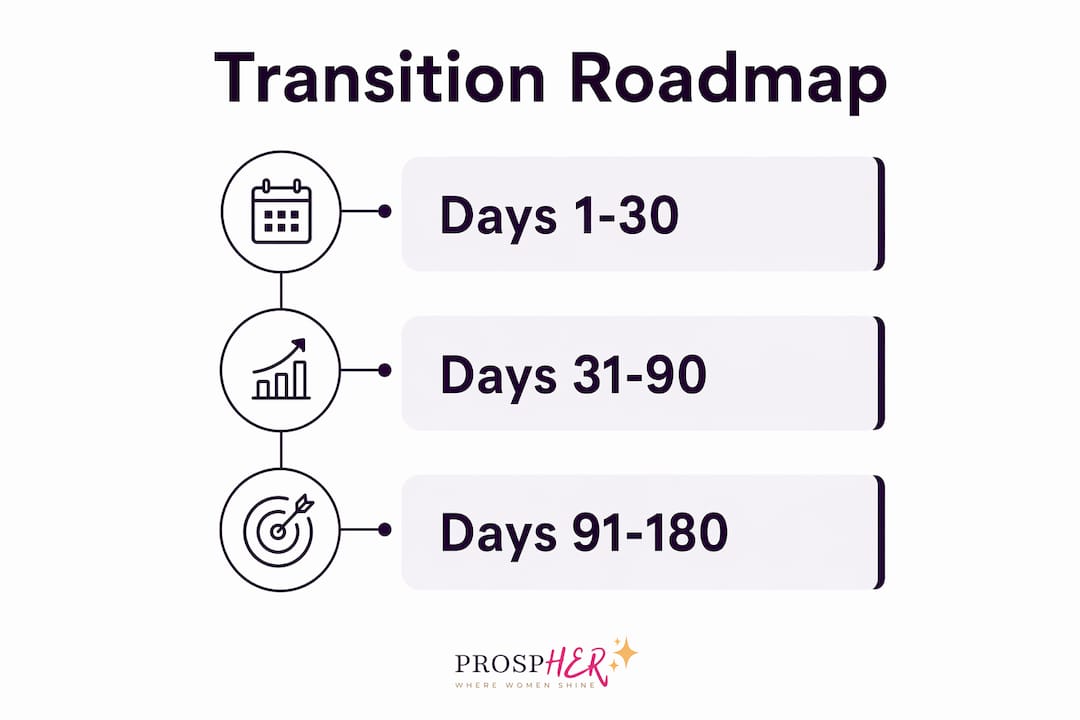
Your 30/90/180-day roadmap to a new role or pivot
Momentum begins with a short horizon. Break the transition period into several focused phases.
Days 1–30: clarity and quick wins
Run a skills audit. Write two impact CV bullets that quantify results. Send five personalised outreach messages to contacts you respect. The goal is not a job offer; it is evidence that you are moving.
Days 31–90: first experiments
Start a bridge role, a freelance trial or a short course. Career changers over 50 have higher success when they pivot into adjacent fields with significant skill overlap, so test the adjacent territory before you leap. Produce one employer-facing proof point: a case study, a completed project, a new credential.
Days 91–180: measurable outcomes
By the middle of your transition you should have some measurable outcomes like a contract win, interview, or certification. This is also your decision point: stay, pivot fully, or scale a freelance strand. Set one measurable metric per week throughout, whether that is outreach messages sent, portfolio tasks completed, or applications submitted.
How to rewrite your CV and LinkedIn into impact-based narratives
Your CV is a marketing document, not a historical record. The shift that matters most is moving from “years of experience” to impact statements that quantify what you actually delivered.

Resumes that focus on recent achievements and impact metrics receive more recruiter engagement than long chronological histories. Lead with recent years and compress earlier roles into a brief summary line.
Before and after:
-
Before: “Responsible for managing the marketing team.”
-
After: “Led a team of eight to deliver a 34% increase in qualified leads, cutting cost-per-acquisition by £18,000 annually.”
Language to drop:
-
“I just…” (minimises your contribution, as Bonnie Marcus notes)
-
Passive constructions: “was involved in”, “helped with”, “assisted”
-
Vague adjectives: “experienced”, “seasoned”, “dynamic”
Language to adopt: delivered, reduced, scaled, led, generated, saved, built.
Pro Tip: Remove graduation dates and compress roles from the first decade of your career into a single summary line. Applicant tracking systems can filter on age signals before a human ever reads your name.
What to learn now and how to show it to UK employers
You do not need a long certificate list. You need one or two skills that are visibly current and employer-facing.
| Skill area | Why it matters | How to show it |
|---|---|---|
| AI-enabled workflow tools | Directly counters adaptability concerns | LinkedIn post, short case study, portfolio project |
| Data literacy (Excel, Power BI) | Valued across finance, ops, HR, marketing | Completed project with real outputs |
| Industry-specific software | Signals you are ready to contribute immediately | Certification badge on LinkedIn |
Targeted skill acquisition in high-impact areas can shorten unemployment duration for older professionals. The key word is targeted. One demonstrable skill beats five half-finished courses every time.
Pro Tip: Before enrolling in anything, check the job descriptions for three roles you actually want. Build only what those roles ask for. That discipline keeps your learning plan employer-facing rather than self-reassuring.
Explore women in leadership development pathways for structured upskilling options that align with senior roles in the UK market.
How to find mentors, sponsors and reframe your seniority as an asset
Research shows multi-generational teams outperform other configurations. That finding reframes your experience from a liability into a competitive advantage you bring to any team from day one.
Where to find mentors and sponsors in the UK:
-
Professional bodies relevant to your sector (CIPD, CIM, ICAEW)
-
Women in leadership conferences and industry events
-
The ProspHER community of over 2,400 women, with structured mentoring matches
-
LinkedIn groups focused on your target sector
When you reach out, ask for a conversation, not a favour. A message that works: “I’m exploring a move into [sector]. You’ve built real expertise there. Would you have 20 minutes for a conversation? I’d love to ask who the most interesting person you’ve met in this space is.” That question opens doors because it asks for a referral, not a job.
Statistic: Networking and referrals consistently access roles that never reach public job boards. The hidden job market is not a myth; it is where most senior appointments are made.
How to recognise age bias and what your UK rights actually are
Age bias in recruitment tends to show up in three ways: assumptions about retirement plans, doubts about technical ability, and pressure to accept below-market pay. You can address all three directly.
In interviews, anchor your answers to recent impact. “In my last project, we used [tool] to achieve [result]” signals currency without defensiveness. When salary comes up, negotiate on contribution, not history. Anchoring to your contribution rather than your previous salary leads to better outcomes.
Legally, the Equality Act 2010 prohibits age discrimination in recruitment, promotion and training. ACAS and GOV.UK both provide free guidance on raising a complaint or requesting an investigation.
Pro Tip: If you suspect discrimination, document every interaction: dates, names, exact wording used. Consult ACAS before escalating. Evidence gathered early is far more useful than recollections made weeks later.
AARP guidance confirms that preparation and confident reframing materially improve hiring outcomes for older candidates. Confidence is not arrogance; it is the professional standard you have already earned.
Your one-page checklist and SMART goals template
Print this. Use it every Sunday evening.
Weekly checklist:
-
[ ] Finance: reviewed transition budget and confirmed runway is intact
-
[ ] CV/LinkedIn: updated or refined one impact statement
-
[ ] Learning: completed one learning task (lesson, project, post)
-
[ ] Networking: sent three personalised outreach messages
-
[ ] Bridge test: progressed one contract, freelance or consulting lead
SMART goals micro-template:
Specific: What exactly will I do? Measurable: How will I know it is done? Achievable: Is this realistic this week? Relevant: Does this move me toward my 180-day goal? Time-bound: By what date?
Three weekly review prompts:
-
What one action this week created the most traction?
-
What am I avoiding, and why?
-
What is the single most important move for next week?
Set one measurable metric per week. Outreach messages sent. Portfolio tasks finished. Applications submitted. Specificity is what separates a plan from a wish.
Key takeaways
Ambitious women over 50 in the UK who build a 6–12 month financial runway, execute a 30/90/180-day roadmap, and rewrite their CV into impact-led narratives consistently create faster, more confident career transitions.
| Point | Details |
|---|---|
| Financial runway first | Map a 6–12 month budget covering salary gaps, NI, pension and health costs before you pivot. |
| Impact-led CV and LinkedIn | Replace passive descriptions with quantified results; curate the past 10–15 years only. |
| Targeted upskilling | Choose one or two employer-facing skills and demonstrate them via a real project or post. |
| Network for referrals | Ask for introductions, not jobs; most senior roles are filled before they are advertised. |
| ProspHER for guided clarity | 94% of ProspHER members report clearer direction within 30 days of joining the platform. |
Why the conventional wisdom on career pivots after 50 gets it wrong
Most career guides tell women over 50 to “be open to starting over.” That framing is both inaccurate and quietly damaging. You are not starting over. You are redirecting decades of accumulated judgement, relationships and credibility toward a new target. That is a fundamentally different position from a 25-year-old building from scratch.
The real challenge is not capability. It is translation. Most women at this stage have delivered results that would impress any hiring panel, but they describe those results in the language of job descriptions rather than the language of outcomes. Fixing that translation gap, not acquiring new skills wholesale, is where the leverage is.
Wellbeing and caregiving responsibilities are real constraints, not excuses. A plan that ignores them will collapse. Build them into your transition budget and your weekly review. A career that works around your life is not a compromise; it is the point.
What ProspHER offers women ready to move forward
Most career platforms give you content. ProspHER gives you a personalised pathway. For ambitious women over 50 who want structured support rather than another reading list, that distinction changes everything.
Members get mentoring matches, group coaching, a practical resource library, financial literacy programmes, and a community of over 2,400 women who are navigating exactly what you are navigating. The outcome stat speaks for itself: 94% of members report clearer direction within 30 days.
If you want a structured 180-day plan with accountability built in, join ProspHER today and start with a personalised pathway built around your current circumstances and ambitions.
Useful UK sources and further reading
-
ACAS: Age discrimination guidance — free, authoritative guidance on your rights and how to raise a complaint under the Equality Act 2010
-
GOV.UK: Equality Act 2010 — the primary legislation covering age discrimination in employment
-
AARP: Smart guide to getting hired after 50 — US-based but widely cited; strongest on CV curation and reframing experience (use for background, apply UK context)
-
Forbes Finance Council: Switching careers financially — practical steps for building a financial runway before a pivot
-
Build financial runway before quitting — focused personal finance guidance for women in career transition
-
ProspHER blog: Financial planning for women — UK-specific guidance on benefits, pensions and transition budgeting
-
ProspHER blog: Women career coaching guide — overview of coaching options for structured career pivots in the UK
This article is general information, not professional legal, financial or career advice. Confirm your specific situation with ACAS, an independent financial adviser, or a qualified career professional.