
The most effective morning routine for working women follows one simple sequence: drink water, get light, move your body, write your top three tasks, eat something nourishing, and claim one small win before you leave the house. That is it. Everything else is optional.
Here are three versions you can start tomorrow, matched to however many minutes you actually have.
| Routine | Time budget | What it covers |
|---|---|---|
| Minimum viable | 5–10 minutes | Water, 2-minute breathwork, top-3 written |
| Steady | 15–20 minutes | Water, daylight, 10-min movement, top-3, quick breakfast |
| Optimal | 30–60 minutes | Full sequence: light, movement, breathwork, priorities, nourishing breakfast, small win |
The minimum viable routine is not a consolation prize. Research on professional women's morning habits shows that a tiered, modular approach is precisely what prevents the all-or-nothing failure mode that derails most routines within a fortnight. A five-minute morning done every day beats a sixty-minute morning done twice a week.
- Minimum viable: Protects your mental real estate before the day turns reactive.
- Steady: Adds cognitive lift from movement and stabilises energy through breakfast.
- Optimal: Builds full circadian alignment, sustained focus, and genuine momentum.
Key takeaways
A consistent, modular morning routine built around water, light, movement, and written priorities is the most sustainable way for working women to protect their focus and build daily momentum.
| Point | Details |
|---|---|
| Consistency beats complexity | A five-minute routine done daily outperforms a sixty-minute one done twice a week. |
| Night-before prep is the highest leverage | Eight quick actions the evening before remove the decisions that derail mornings. |
| Delay caffeine by 90–120 minutes | Letting your cortisol awakening response complete naturally reduces mid-morning crashes. |
| Write top three before checking email | Priority setting before the inbox opens shifts you from reactive to intentional. |
| Modular routines prevent abandonment | A minimum viable routine (5–15 minutes) keeps the habit alive on difficult days. |
Table of Contents
- Why a consistent morning routine for working women beats a perfect one
- What to do the night before: eight actions that make mornings effortless
- How to protect your first hour: what to do and what to avoid
- Movement that fits your morning: 5, 15, and 30-minute options
- Quick, nourishing breakfast ideas for UK working women
- How to set your day: choosing your top three tasks
- Customising the routine for parents, commuters, and shift workers
- What the research actually supports
- Why ProspHER recommends practical simplicity
- Sources
Why a consistent morning routine for working women beats a perfect one
The research is clear: consistency outperforms complexity. Analysis of evidence-backed morning habits finds that a compact set of repeatable practices produces more reliable benefits than elaborate rituals borrowed from high-profile executives. Behavioural science calls this automaticity. When you repeat the same sequence, your brain stops spending energy deciding what comes next, and that saved energy goes into your actual work.
Three mechanisms drive the benefit for working women specifically.
- Behavioural momentum: Each completed habit makes the next one easier. Water leads to movement leads to planning, almost without effort.
- Circadian regulation: A consistent wake time anchors your body clock, which governs alertness, mood, and sleep quality throughout the day.
- Decision fatigue reduction: Every small choice you make before 9am draws from the same cognitive budget. A set routine eliminates dozens of micro-decisions before they accumulate.
The practical benefits compound quickly: more energy by mid-morning, a protected block of focus before the inbox takes over, and noticeably less stress by the end of the week.
Pro Tip: Design your routine around what you can do on a bad day, not your best day. If it only works when you are well-rested and unstressed, it is not a routine yet.
What to do the night before: eight actions that make mornings effortless
The night-before preparation is the single highest-leverage habit in the whole system. It removes the decisions that slow you down before you are even fully awake. A realistic morning routine starts the evening before, not when the alarm goes off.
Work through this checklist in under ten minutes:
- Lay out tomorrow's outfit (and a backup if the weather is unpredictable).
- Pack your bag, including your laptop, charger, and anything you need for meetings.
- Prep or portion your breakfast ingredients (overnight oats take two minutes to assemble).
- Write your top three priorities for tomorrow on a card or in a notebook, not on your phone.
- Set one alarm, not five. Snoozing fragments sleep and leaves you groggier.
- Fill a glass with water and leave it on your bedside table or kitchen counter.
- Do a 60-second calendar check so no early meeting catches you off guard.
- Close down your work tabs and put your phone on silent before you go to bed.
A few time-savers worth building in: batch-cook grains or eggs on Sunday so weekday breakfasts take under three minutes. Keep a rotating outfit plan for the week so choosing clothes never costs you mental energy. The priority card on your bedside table means your first intentional act of the day is reading what matters, not scrolling.
How to protect your first hour: what to do and what to avoid
Protect the first hour from email and social media. Use it for light, gentle activation, and priority setting. That single rule, applied consistently, changes the quality of your entire working day.
Do:
- Drink the water you left out the night before before you touch your phone.
- Get natural daylight within the first hour. Step outside for even five minutes, or sit by a bright window. Morning bright light is the most effective single tool for setting your circadian clock and improving daytime alertness.
- Delay your first coffee by 90–120 minutes after waking. Your cortisol awakening response peaks naturally in that window, and delaying caffeine lets it do its job without interference, reducing the mid-morning crash that follows an early espresso.
- Spend two minutes on a breathing exercise (four counts in, hold four, out four) instead of reaching for your phone.
- Read your top-three priority card before you open any app.
Avoid:
- Checking email or social media before you have set your intentions for the day.
- Reactive scrolling, which hands your first hour of cognitive energy to other people's agendas.
- Multiple alarms and extended snoozing, which fragment the last sleep cycle and leave you foggier.
Pro Tip: Keep a full glass of water and your priority card on the bedside table. Removing even one decision step from the first five minutes makes the whole sequence more likely to happen.
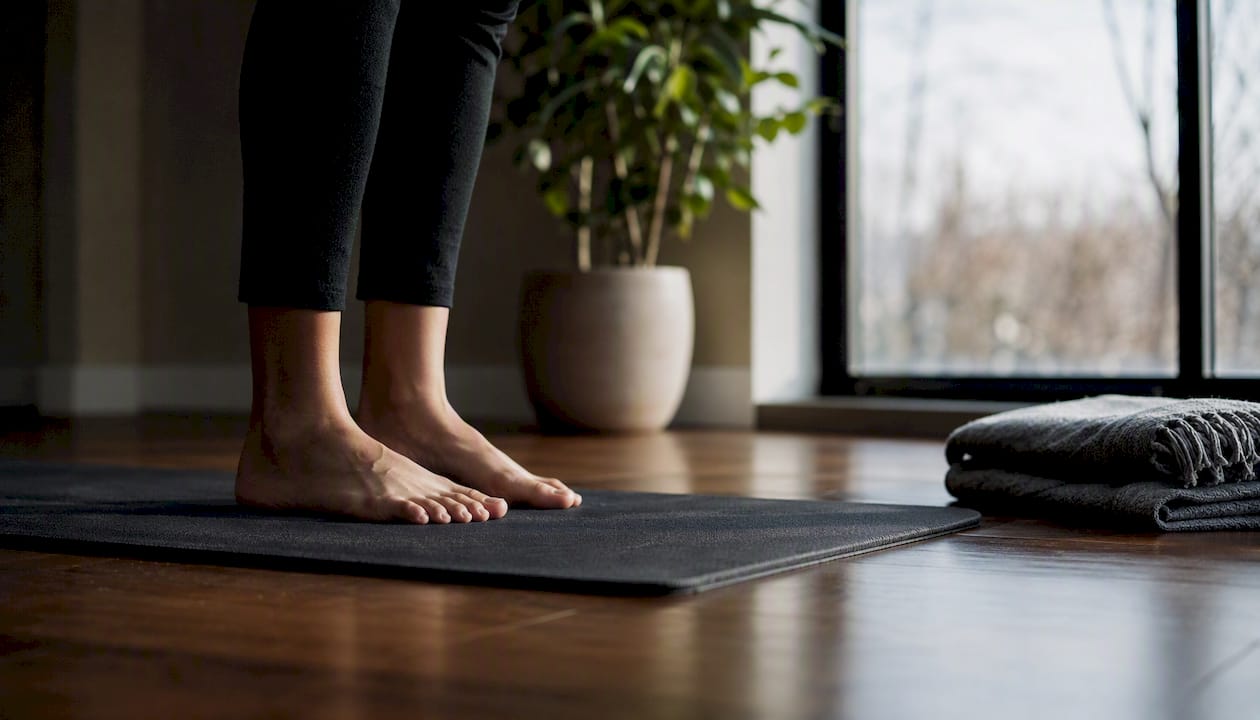
Movement that fits your morning: 5, 15, and 30-minute options
Any movement that raises your heart rate slightly for 5–30 minutes improves alertness and cognitive performance. Even 10–20 minutes of morning exercise raises BDNF (a protein linked to learning and memory) and sharpens executive function for the next two to four hours. You do not need a gym.
-
5-minute stack: Five minutes of dynamic stretching (neck rolls, hip circles, forward folds) followed by a brisk walk to the end of the street and back. Enough to shift your nervous system from sleep mode to alert.
-
15-minute stack: A short yoga flow or bodyweight circuit (squats, press-ups, lunges, plank holds) for ten minutes, then five minutes of breathwork or a short walk in daylight. This is the sweet spot for most working days.
-
30-minute stack: A brisk 20-minute walk or run outdoors, followed by five minutes of stretching and five minutes of breathwork or meditation. If you prefer HIIT, a 20-minute session with a cool-down achieves the same result.
Modifications: If you are pregnant, post-partum, managing limited mobility, or simply exhausted, swap any of the above for gentle walking, seated stretching, or five minutes of slow breathing. The goal is activation, not performance. On days when you are sore or unwell, the breathwork alone counts.
Place movement after your first light exposure and before your priority-setting. The sequence matters: light first, movement second, breathwork or short meditation third, then priorities and protected work.
Quick, nourishing breakfast ideas for UK working women
Choose protein combined with complex carbohydrates. That pairing stabilises blood sugar, sustains energy through the mid-morning, and keeps you sharp in meetings. Here are practical options that work on a UK workday.
- Overnight oats: Rolled oats, milk or oat milk, chia seeds, and a handful of berries. Assemble in two minutes the night before; grab from the fridge in the morning.
- Wholemeal toast with egg: Two slices of wholemeal toast with a poached or scrambled egg. Under five minutes, high protein, genuinely filling.
- Greek yogurt with berries and seeds: Full-fat Greek yogurt, mixed berries, and a tablespoon of flaxseed or pumpkin seeds. No cooking required.
- Savoury porridge: Oats cooked with stock, topped with a soft-boiled egg and spinach. Batch-cook the oats on Sunday; reheat in three minutes.
- Protein smoothie: Frozen banana, a scoop of protein powder, oat milk, spinach, and a tablespoon of nut butter. Blend and go.
For batch prep, cook a tray of boiled eggs on Sunday, portion overnight oats into four jars, and keep portable containers ready. Breakfast should take under five minutes on a workday.
On strategic fasting: skipping breakfast is a personal choice, and some women find it suits their schedule or digestion. If you do skip it, have a protein-rich snack by mid-morning (a handful of nuts, a boiled egg, or Greek yogurt) to avoid the concentration dip that hits around 11am.

How to set your day: choosing your top three tasks
Pick three tasks that would make today a success. Write them down before you check any messages. That single habit, supported by productivity research, reduces decision load and protects your morning focus from the reactive pull of email.
Here is how to choose the right three:
- Impact first: Which task, if completed, moves something meaningful forward? That goes on the list.
- Time-realistic: Each task should be completable in one focused session. "Finish the report" is a task; "sort out work" is not.
- Aligned to your weekly goal: At least one of the three should connect to a longer-term objective, not just today's urgency. Your career roadmap should inform this.
Examples by role: a project manager might write "send stakeholder update, review sprint backlog, prep Friday agenda." A teacher might write "mark Year 10 essays, plan Thursday lesson, email SENCO." A founder might write "follow up three leads, review cash flow, post to LinkedIn."
The small win matters too. Make your bed. Pack your lunch. Send one clarifying email before you leave. These micro-completions create a sense of forward motion that carries into the working day. At midday or just after your commute, spend 90 seconds reviewing whether your top three are still the right priorities. Circumstances shift; your list can too.
Customising the routine for parents, commuters, and shift workers
The core sequence works regardless of your schedule. Water, light, movement, priorities. What changes is the duration and order, not the logic.
Parents with young children: Split the routine. Do your water and breathwork before the children wake. Use the school run as your movement (walk it if you can). Write your top three while the children eat breakfast. You do not need uninterrupted time; you need a sequence that fits around the interruptions. For readers navigating career transitions at different life stages, career advice for women over 50 covers how to adapt structure as circumstances shift.
Commuters: Your commute is part of the routine. Walk to the station instead of driving when possible; that covers your movement. Use the train or bus for light reading, a podcast, or reviewing your top three. Avoid social media on the commute; protect that mental space.
Remote workers: The risk for remote workers is that the morning bleeds directly into work with no transition. Build a deliberate boundary: get dressed, make your workspace ready, and complete your full routine before you open your laptop. Chronotype matters here too. If you are naturally a later riser, match your routine timing to your biological peak hours rather than forcing a 6am start that leaves you foggy until 10am.
Shift workers and night shifts: Prioritise sleep consistency above all else. Aim for the same sleep and wake time on your days off where possible. On a morning after a night shift, the minimum viable routine (water, five minutes of breathwork, top three written) is enough. Use bright indoor light if natural daylight is not available; a daylight lamp on your kitchen counter is a practical substitute.
What the research actually supports
The recommended sequence is not intuition. It is grounded in circadian science, exercise physiology, and habit-formation research.
Morning light and circadian timing: Getting bright natural light within the first hour of waking is the most effective tool for setting your circadian clock. Outdoor light, even on a cloudy UK morning, is far more intense than indoor lighting and signals to the brain that the day has begun. This single habit improves daytime alertness and sleep quality at night.
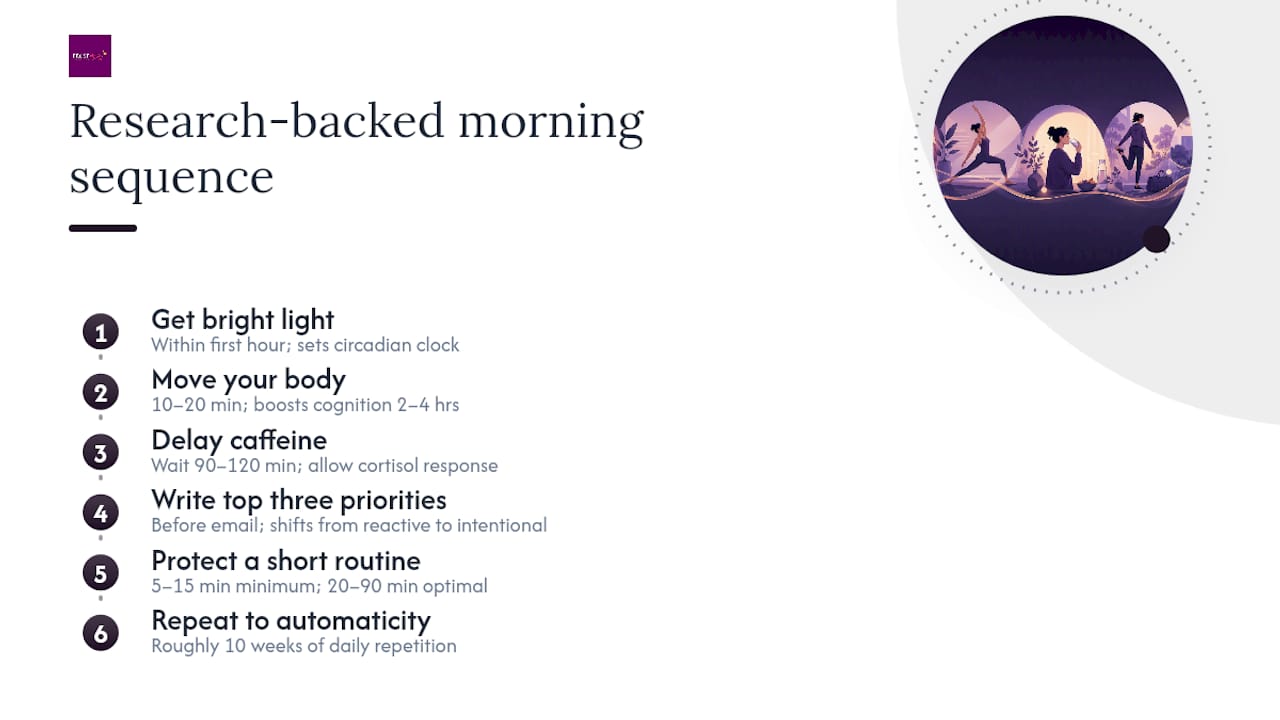
Movement and cognition: Short bouts of morning exercise raise BDNF and improve executive function for two to four hours. The minimum effective dose is around 10–20 minutes of moderate activity.
Caffeine timing: Delaying caffeine by 90–120 minutes allows the cortisol awakening response to complete naturally. Drinking coffee immediately on waking blunts this natural alertness peak and often leads to a sharper crash later.
Priority setting before email: Writing your top three priorities before opening email is one of the most reliably supported productivity habits. It shifts you from reactive to intentional before the day's demands arrive.
Habit automaticity: A sequenced routine becomes automatic with consistent practice. Habit research suggests automaticity develops over roughly 10 weeks of daily repetition. The sequence itself matters: physical activation first, then planning, then protected work.
Practical rule of thumb: A minimum viable routine of 5–15 minutes preserves the habit on difficult days. An optimal window of 20–90 minutes, when available, amplifies the benefits. The goal is never perfection; it is showing up consistently enough that the sequence becomes second nature.
Why ProspHER recommends practical simplicity
ProspHER recommends modular, realistic morning routines because they are the ones working women actually sustain. Not the aspirational 5am rituals that look good on social media, but the honest, repeatable sequences that hold up on a Tuesday in February when you are tired and the commute is delayed.
The women in the ProspHER community of over 2,400 members are ambitious, time-pressed, and clear-eyed about what they need. They are not looking for more content to consume; they are looking for clarity and a structure that fits their real lives. A morning routine is where that structure begins. It is the daily act of building real self-belief before the world has a chance to chip away at it.
When your morning is intentional, your goals become clearer, your decisions sharper, and your sense of momentum genuine. That is what ProspHER is built around: not noise, but direction.
Ready to turn your morning momentum into real career progress? Join ProspHER and get a personalised pathway, mentorship, and a community of women who are doing exactly that.
Sources
- Morning Routine for Success: 7 Research Backed Steps
- 20 morning habits of successful people backed by research
- Best morning routines to prime your brain
- How to have a productive morning routine (Backed by Science, 2026)
- The morning routine that actually works for professional women