
Clear, well-structured goals are the single biggest driver of professional progress. Not motivation, not talent, and not luck. Goal setting in work is the deliberate practice of defining measurable, aligned objectives that give your daily effort direction and your career real momentum. The most effective goals share a handful of non-negotiable qualities:
- Specific: they describe exactly what you will achieve, not a vague aspiration
- Measurable: progress can be tracked with numbers, milestones, or observable outcomes
- Achievable: ambitious enough to stretch you, realistic enough to stay credible
- Relevant: connected to your role, your team's priorities, and your organisation's direction
- Time-bound: anchored to a deadline that creates urgency
Two frameworks dominate professional goal setting in the UK right now. SMART goals (the criteria above) give individuals and line managers a shared language for writing clear objectives. OKRs (Objectives and Key Results) go a step further by cascading goals from company level down to team and individual, making alignment explicit rather than assumed. Both frameworks work best when your personal objectives connect visibly to what your team and organisation are trying to achieve this quarter.
Why setting work goals actually changes your career
Goals do more than organise your to-do list. They change how you show up, how you're perceived, and whether you stay somewhere long enough to build real traction.

Employees who set goals strategically are significantly more likely to stay with their organisation and feel genuinely inspired at work. That correlation between goal clarity and retention is not accidental. When you can see how your work connects to something larger, the daily grind carries meaning. When you cannot, even a well-paid role starts to feel hollow.
The performance benefits are just as concrete:
- Clear goals reduce wasted effort by giving you a filter for what actually matters
- Measurable targets make your contributions visible to managers and senior stakeholders
- Aligned objectives build credibility with your team, because everyone can see you're pulling in the same direction
- Development goals signal ambition and keep your skills growing alongside your responsibilities
- Regular goal reviews create natural moments for feedback, which compounds over time into faster career progression
44.2% of employees want clear progress tracking on their goals from their managers. That figure tells you something important: most professionals already know what they want. They want to see it measured and acknowledged.
Job satisfaction follows the same pattern. When your personal objectives align with your company's strategy, work feels purposeful rather than performative. That sense of purpose is what keeps ambitious women building careers rather than just filling roles.
How to identify the right goals for your professional role
Not every goal deserves your attention. The discipline of goal setting starts with choosing the right targets, not just writing more of them.
Start with your current role. What does success look like in the next 90 days? What does your manager most need from you this quarter? Your answers to those two questions will surface your most pressing performance goals, the ones tied to delivery and output. Then ask a different question: where do you want to be in 18 months, and what skills or experiences are missing from that picture? That gap reveals your development goals.
A practical way to identify your priorities:
- Review your job description and any team OKRs for the current quarter
- Ask your manager directly what a strong performance looks like this cycle
- Identify one or two skills you want to build that would make you more effective or more promotable
- Look at where you've felt stretched recently. Discomfort often points toward growth
- Narrow your list ruthlessly. Focusing on 2–3 priority areas produces far greater progress than spreading effort across many goals
That last point carries real weight. Professionals who concentrate on a small number of development areas make meaningfully greater progress than those who attempt too many at once. More goals does not mean more growth. It usually means less of both.
Pro Tip: Separate your goals into two categories before you write a single word: delivery goals (what you must produce) and development goals (who you are becoming). A balanced goal set of a small number of active goals prevents focus dilution and keeps both your output and your growth moving forward.
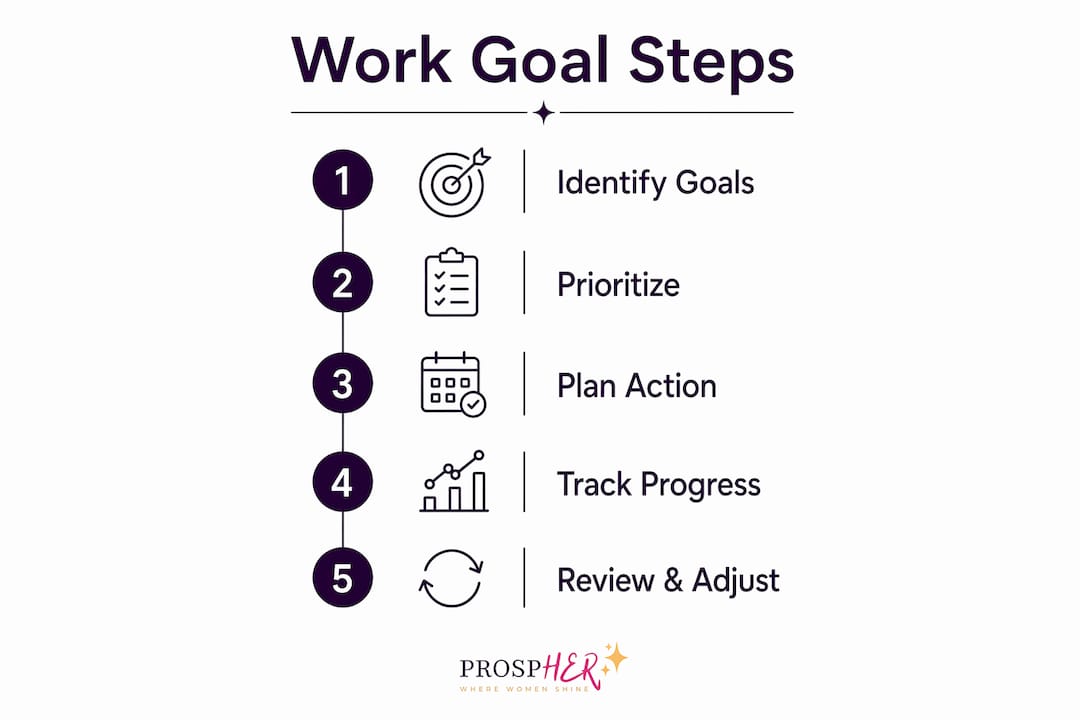
How to put your work goals into action
Writing a goal is the easy part. Making it real takes structure, collaboration, and a willingness to be specific about what success looks like.

The most motivating goals are co-created, not handed down. Collaborative goal setting, where you propose your own goals within the context of team priorities and your manager calibrates the ambition, produces objectives that feel owned rather than imposed. Start your next goal-setting conversation by bringing a draft. It changes the dynamic entirely.
Once you have your priorities, write them using SMART criteria. Here is what that looks like in practice:
-
Vague: "Improve my presentation skills."
-
SMART: "Deliver three internal presentations to senior stakeholders by the end of Q2, gathering written feedback after each one to track improvement."
-
Vague: "Get better at managing my team."
-
SMART: "Conduct weekly one-to-ones with each direct report and complete a management development course by 30 June 2026, with team engagement scores improving by the next pulse survey."
A few best practices that make the difference between goals that live in a document and goals that drive real change:
- Link every goal explicitly to a team or company objective so the connection is visible
- Set a review cadence at the start: monthly check-ins for fast-moving goals, quarterly for longer-horizon ones
- Write your goals where both you and your manager can see them, not buried in an email thread
- Build in a mid-point review so you can course-correct before the deadline arrives
- Share your goals with a peer or mentor who will hold you accountable
Pro Tip: Use the current quarter's OKRs as your explicit starting point for every goal conversation, not as background context. When your objectives trace directly back to what the organisation is trying to achieve right now, they carry more weight in performance reviews and feel more urgent day to day.
How do you keep momentum when motivation fades?
Momentum is not something you feel. It is something you build through consistent, visible action. And the single most reliable way to sustain it is to track progress in a way you can actually see.
Regular feedback combined with clear goals produces significantly higher motivation. Employees who receive weekly check-ins about their goals report much higher engagement than those left to self-manage in silence. That is not a personality trait. It is a structural advantage you can create for yourself by asking for it.
Practical strategies to keep your goals alive between review cycles:
- Track progress visibly, whether in a shared document, a project tool, or a simple weekly note to yourself
- Recognise milestones out loud, with your manager or your team, rather than quietly ticking boxes
- When motivation dips, return to your "why." Why did this goal matter when you set it? Has that changed?
- Break large goals into monthly sub-targets so there is always something close enough to feel achievable
- Connect with peers who are also working towards ambitious goals. Shared accountability amplifies individual effort
Goals will sometimes need to change. Business priorities shift, roles evolve, and circumstances you could not have predicted in january will reshape what matters by march. Adapting a goal is not failure. Clinging to an irrelevant target because you wrote it down three months ago is.
Pro Tip: If you work with a coach or mentor, use a coaching approach to your own goal reviews: ask yourself what you would propose if you were advising someone else in your position. That small shift in perspective often surfaces adjustments you had been avoiding.
What recent research tells us about setting goals more effectively
The annual performance review cycle is one of the most persistent myths in professional development. You set goals in january, revisit them in december, and wonder why so little changed. Quarterly goal cycles outperform annual ones precisely because business priorities move faster than a 12-month plan can accommodate. Shorter cycles mean you can adjust before a goal becomes irrelevant, not after.
The OKR framework formalises this with a useful rule of thumb: a 70% achievement rate is considered success for stretch goals. The logic is deliberate. If you are hitting 100% of your targets every cycle, your goals are not ambitious enough. Aiming for 70% keeps you in the productive zone between comfort and overwhelm.
| Goal-setting cadence | Effectiveness | Best suited to |
|---|---|---|
| Annual review only | Low: goals become stale as priorities shift | Stable, slow-moving roles |
| Bi-annual check-ins | Moderate: allows one mid-year correction | Roles with predictable cycles |
| Quarterly cycles | High: keeps goals relevant and adjustable | Most professional roles currently |
| Monthly reviews | High for fast-moving goals: frequent course-correction | Project-based or high-growth roles |
Cascading goals from company to team to individual is the structural piece that makes alignment real rather than theoretical. When your personal objectives trace back to what your organisation is trying to achieve this quarter, every piece of work you do carries a visible purpose. That visibility matters both for your own motivation and for how your contribution is perceived.
Balancing delivery goals with development goals within a tight set of 3–5 active targets prevents the focus dilution that derails so many well-intentioned professionals. Delivery goals keep you credible in your current role. Development goals keep you growing into the next one.
Key takeaways
Effective goal setting at work requires clear frameworks, consistent tracking, and the discipline to focus on a small number of meaningful targets rather than an ambitious but unmanageable list.
| Point | Details |
|---|---|
| Use SMART or OKR frameworks | Write goals that are specific, measurable, and tied to current team or company priorities. |
| Focus on 2–3 priority areas | Concentrating on a small number of goals produces far greater progress than spreading effort thinly. |
| Choose quarterly cycles | Quarterly goal-setting keeps targets relevant as business priorities shift throughout the year. |
| Track and celebrate progress | 44.2% of employees want visible progress tracking; make milestones explicit and acknowledged. |
| Balance delivery and development | A set of 2–3 goals should include both output-focused and growth-focused objectives for sustained career momentum. |
Ready to build real career momentum?

Goal clarity is where career growth begins. ProspHER is built for ambitious women who are done with vague aspirations and ready for a structured, personalised path forward. With mentorship, group coaching, practical resources, and a community of over 2,400 women, ProspHER gives you the frameworks and the accountability to turn your professional objectives into real progress. 94% of members report gaining clearer direction within just 30 days.
If you are serious about setting and achieving goals that actually advance your career, join ProspHER and find out what becomes possible with the right support around you.