
Use this four-part formula, Hook, Bridge, Proof, Ask, to pitch your career change in 30 to 60 seconds. The Hook states your target role, the Bridge links your old career to the new one through transferable skills, Proof shows a result and the Ask moves the conversation forward. The Muse recommends this structure precisely because it connects your past to your future rather than dwelling on what you're leaving behind. ProspHER's own members report clearer direction soon after putting a structure like this to work.
TL;DR:
- A career change pitch should focus on a clear target role, emphasizing specific, transferable skills rather than past job titles or industry jargon.
- Quantifiable proof of achievement, such as cost savings or project completions, significantly increases curiosity during the pitch.
- Tailor the emphasis of the pitch based on the audience, highlighting role clarity for recruiters, method for technical leads, or motivation for peers.
- Rehearsing the pitch aloud, especially the Bridge sentence, and receiving feedback helps build confidence and clarity within 30 to 60 seconds.
- Avoid common mistakes like starting with apologies, overloading the Bridge, or ending without a specific, actionable request.
Table of Contents
- How do you build a career change elevator pitch?
- What are some elevator pitch examples for career change?
- How do you adjust the pitch for different audiences?
- How do you rehearse and deliver the pitch with confidence?
- What mistakes should you avoid in a career change pitch?
- Can you draft your pitch in 15 minutes?
- Why does this formula work for career changers?
- A quick note on confidence
- Where to practise your pitch until it feels natural
- Sources
How do you build a career change elevator pitch?
Each part of the formula does a specific job. Skip one and the pitch collapses, usually into an apology.
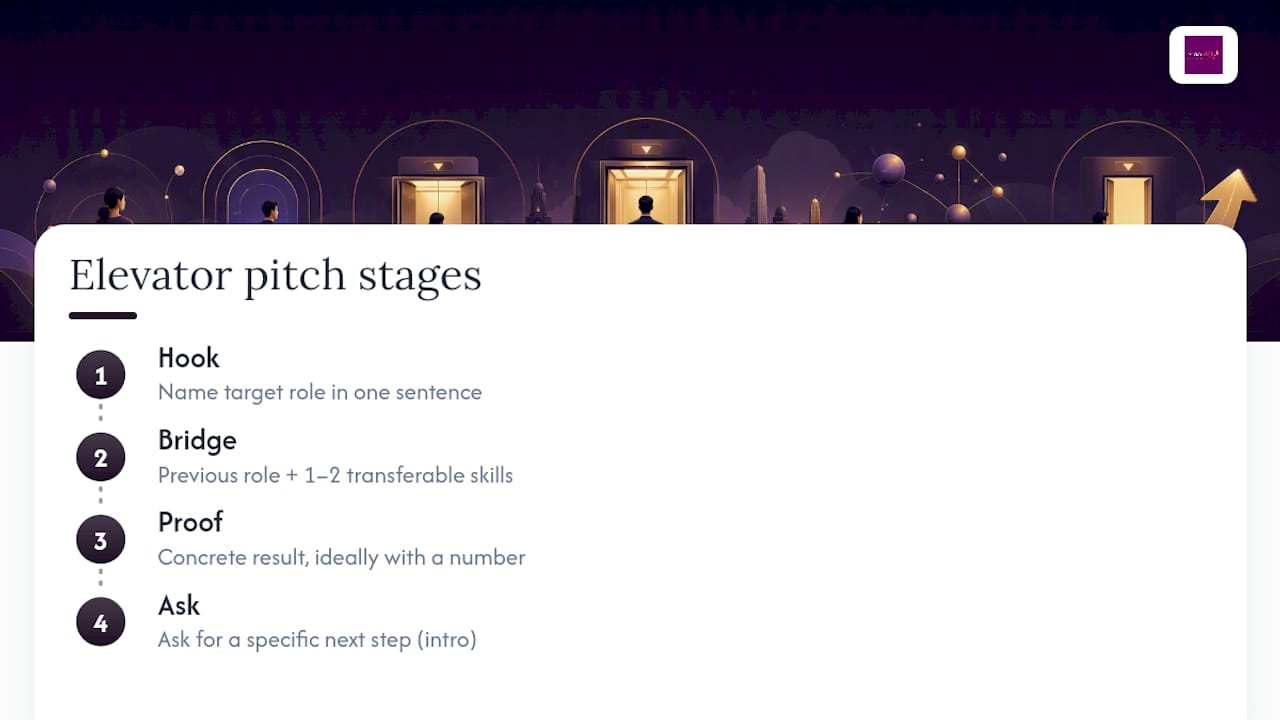
The Hook names your target role in one confident sentence. Not your old job, not your feelings about leaving it, your destination. "I'm moving into UX research" beats "I used to be a teacher but now I'm figuring out tech" every time. The Hook gives the listener a category to file you under before you've said anything else.
The Bridge is where most people panic and overexplain. Keep it to one sentence: your previous role plus one or two transferable skills, framed as preparation rather than baggage. Try language like "which is why this move makes sense" or "that experience taught me how to read a room fast and translate it into a plan." The Bridge should sound like a decision, not a defence.
Proof is a concrete result, ideally with a number attached. A veteran translating military logistics into supply chain management might say they coordinated deliveries for a team of 40 across three sites. A teacher moving into project management might cite running a £15,000 curriculum rollout on time. This is the moment scepticism turns into curiosity, and quantifying impact matters more here than almost anywhere else in the pitch.
The Ask closes with a specific next step. "Do you know anyone hiring for entry-level UX roles?" gets a far better response than "let me know if you hear of anything."
Strung together: "I'm moving into UX research. I spent six years teaching secondary school, which taught me how to read confused faces and turn them into clear explanations fast, a skill that's basically user testing in disguise. Last year I redesigned our department's onboarding process and cut new-teacher ramp-up time by a third. I'd love an introduction to anyone hiring junior researchers."
What are some elevator pitch examples for career change?
Three templates, each built on Hook, Bridge, Proof, Ask. Shorten the Bridge for 30 seconds; expand Proof with a second data point for 60 seconds.
-
Teaching to project management. Hook: "I'm transitioning into project management." Bridge: "Ten years teaching taught me how to run tight schedules under pressure." Proof: "I led a £15,000 curriculum redesign, delivered on time with zero budget overrun." Ask: "Could you point me towards a hiring manager on your PM team?" For 60 seconds, add a second proof point on stakeholder management with parents and governors.
-
Finance to sustainability consulting. Hook: "I'm moving into sustainability consulting." Bridge: "Eight years in corporate finance means I already speak the language boards care about, ROI." Proof: "I built the business case that got our first carbon-reduction budget approved." Ask: "Are you connected to anyone hiring on the sustainability side?"
-
Military to logistics management. Hook: "I'm pursuing logistics management in the private sector." Bridge: "I spent twelve years coordinating supply chains for units of up to 200 people." Proof: "I redesigned a distribution route that cut delivery delays by half." Ask: "Who on your team handles supply chain hiring?"
Swap the Bridge line depending on the room. For a recruiter, mention the industry. For a peer, mention the skill.
How do you adjust the pitch for different audiences?
The formula stays fixed, but the emphasis shifts.
- Recruiters want role clarity fast: lead the Hook with the job title exactly as it appears in listings, and keep Proof to one headline number.
- Technical leads want method: swap a general skill word for a specific tool or process ("I ran the retro process" rather than "I led the team").
- Peers and mentors want story: you can afford a warmer Bridge, mentioning motivation as well as skill, since they're assessing fit, not just competence.
Two swaps per audience: for recruiters, "managed" becomes the exact job title; for technical leads, "organised" becomes "used Agile sprints." For peers, add one sentence on why the switch excites you.
How do you rehearse and deliver the pitch with confidence?
Aim for 30 to 60 seconds, roughly 75 to 150 words, in line with Princeton's Career Development guidance on pitch length. Record yourself on your phone and time it. Then say it out loud to a friend or a ProspHER peer and ask what stuck. Rehearsal with feedback consistently strips out apologetic language faster than practising alone, according to Indeed's career advice research. Open with the Hook, never with "sorry, this is a bit random."
Pro Tip: Practise the Bridge line separately from the rest. It's the sentence most people fumble, so drill it until it comes out without a single "um."
What mistakes should you avoid in a career change pitch?
- Opening with "sorry" or "this might sound odd": start with your target role instead
- Overloading the Bridge with irrelevant history: pick one or two skills, not your whole CV.
- Ending without an Ask: a pitch with no request just fades out.
- Using jargon from your old industry: swap "KPIs" for "results" if your listener isn't in that world.
Quick fix: "I used to be in retail management, now I'm not sure" becomes "I'm moving into people operations, and running a 20-person retail team for six years taught me how to handle scheduling conflicts before they become resignations."
Can you draft your pitch in 15 minutes?
Fill in the blanks: "I'm moving into [target role]. My [past role] gave me [skill one] and [skill two], shown when I [proof/result]. Could you [specific ask]?"
Checklist:
- Target role named clearly
- Two transferable skills chosen
- One measurable proof point
- One specific Ask
- Timed under 60 seconds and practised aloud three times
Practise daily for a week before your first real conversation.
Why does this formula work for career changers?
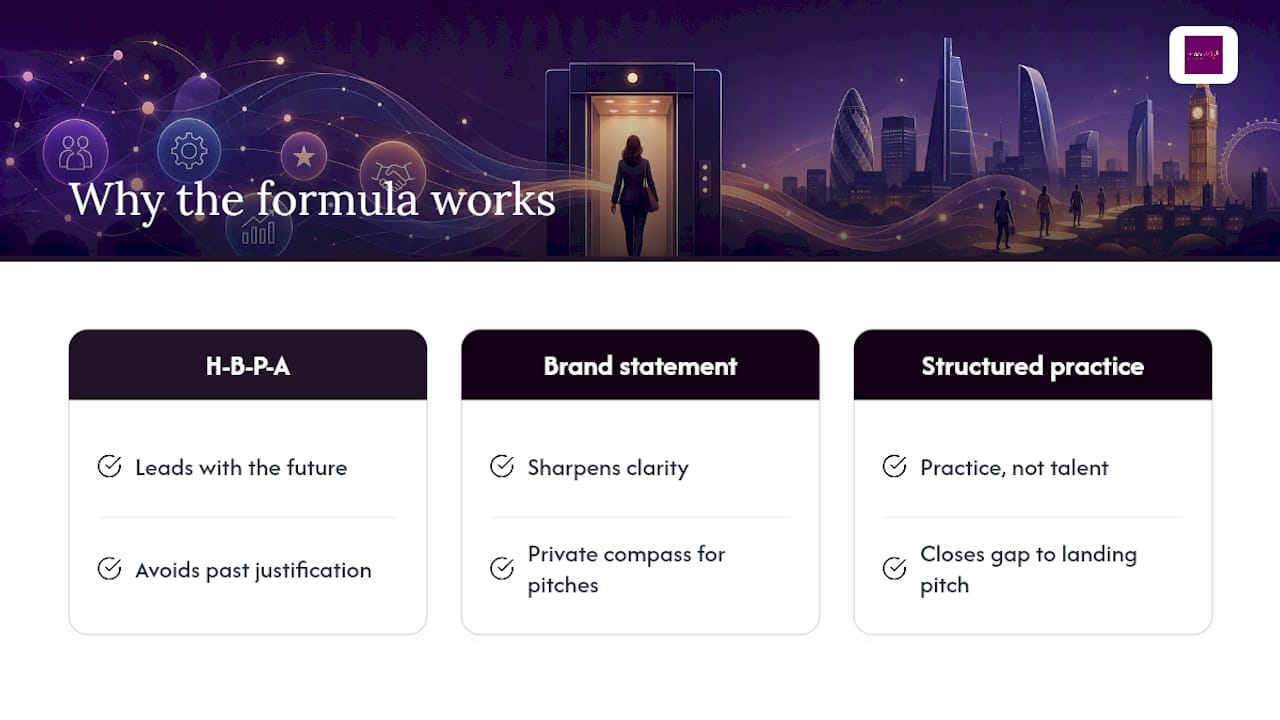
Career-advice publishers keep landing on Hook, Bridge, Proof, Ask because it forces you to lead with the future instead of justifying the past. A personal brand statement built the same way sharpens that clarity even further, giving you a private compass for every pitch you'll ever give.
Structured practice, not talent, is what closes the gap between a shaky first draft and a pitch that lands.
A quick note on confidence
Feeling awkward saying your new title out loud is normal. Nobody nails this on the first take, including us.
The fix isn't more thinking, it's more reps: say your pitch in a ProspHER practice session, get blunt feedback, adjust one line, say it again. Momentum comes from repetition, not perfection. Try the template above this week and see what shifts.
— ProspHER
Where to practise your pitch until it feels natural
Reading a formula is one thing; saying it out loud to someone who'll tell you the Bridge line sounds stiff is another. That's the gap ProspHER's coached practice sessions and peer feedback loops are built to close, with templates you can adapt on the spot and a community that's rehearsed this exact conversation hundreds of times over.
Members get structured practice slots, not just advice articles, so your pitch gets tested against real reactions before it matters in an interview or networking room. If you're building the wider picture around your pitch, our career roadmap for ambitious women connects it to your broader personal brand, and our guide on career change at 40 has more tailored framing if you're pivoting later in your career. Head to ProspHER's membership page to see which practice format fits where you are right now.
Sources
For more on structure, The Muse's guide to career change pitches breaks down the Hook and Bridge in detail. Indeed's elevator pitch examples offer more sample scripts. For personal branding, see Forbes on crafting your brand statement and CV Made Better's guide to brand statements.
- How to talk about your career change in your elevator pitch
- 3 elevator pitch examples (Plus how to structure your pitch)
- How to craft your personal brand statement — and why you must