
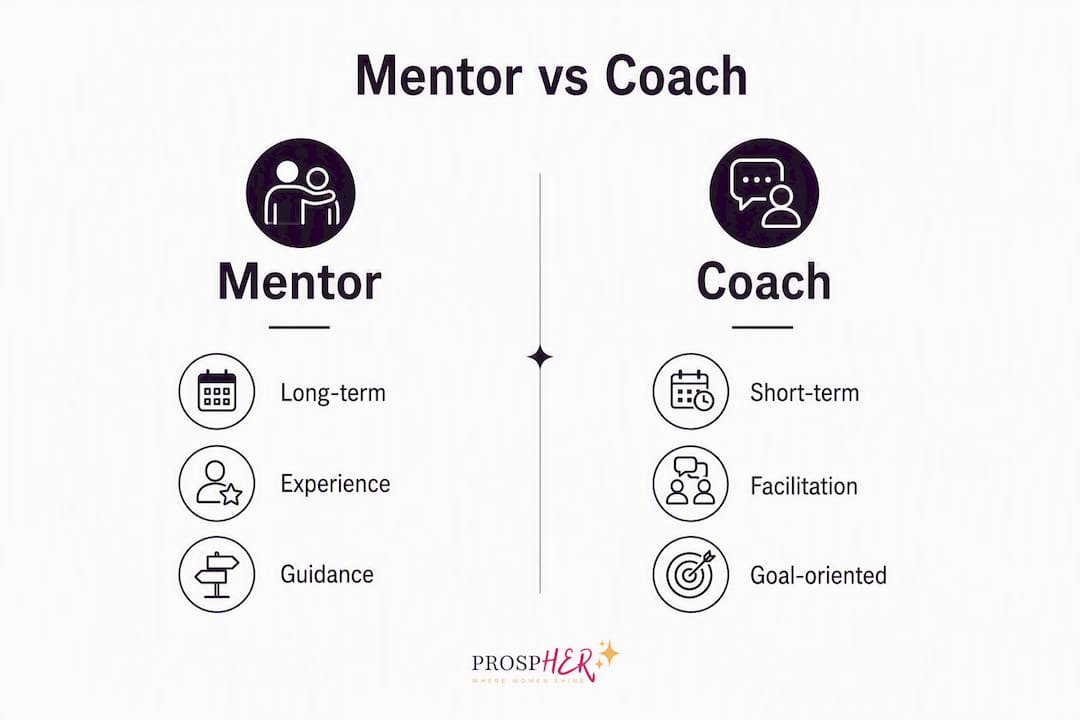
A mentor gives you direction from lived experience. A coach gives you discovery through skilled questioning. If you are facing a specific performance block or a short-term skill gap, choose a coach for a structured engagement of about three to six months. If you need long-term career navigation, sector knowledge, and guidance from someone with lived experience, choose a mentor for twelve months or more. For many ambitious women in the UK, the most powerful move is both.
- Mentor: relationship-driven, experience-led, mentee sets the agenda
- Coach: structured, goal-oriented, coach manages the session focus
- Standards to look for: ICF or EMCC credentials for coaches; documented sector seniority for mentors; CIPD guidance for both
- ProspHER combines mentorship pathways and group coaching in one membership, so you do not have to choose between the two
Table of Contents
- What mentoring actually is in a UK career context
- What coaching is and how it works for performance and capability
- Where mentoring and coaching genuinely overlap
- Mentor vs coach: a practical comparison
- When should you choose a coach, a mentor, or both?
- Common formats of coaching and mentoring you will encounter
- How to find, assess and work with a coach or mentor in the UK
- What the evidence says about timelines and realistic results
- The concrete benefits you can expect from each approach
- Key takeaways
- Why a blended approach often works best
- ProspHER: structured support for ambitious women
- Useful sources and further reading
What mentoring actually is in a UK career context
Mentoring is the transfer of experience from someone who has already navigated the territory you are entering. The relationship is long-term, usually informal in cadence, and driven by the mentee's agenda. A mentor does not follow a session script. They share judgement, open doors, and offer the kind of context-aware advice that only comes from having lived through similar situations.
In practice, a mentor might help you read the politics of a boardroom before your first executive presentation, introduce you to a senior contact in your sector, or talk you through a career decision they faced themselves a decade ago. That is qualitatively different from anything a structured coaching session can offer.
UK examples of authentic mentoring relationships include:
- An NHS clinician paired with a senior medical director through an NHS Leadership Academy scheme
- A junior solicitor mentored by a partner in a City law firm, gaining insight into client development and partnership track
- A woman founder mentored through a structured pathway on ProspHER, gaining access to a network of experienced entrepreneurs and sector-specific guidance
- Internal corporate mentoring schemes, common in finance and professional services, where a senior leader sponsors a high-potential employee
The signals that a relationship is genuinely mentoring: the meetings are irregular or set by the mentee's needs, the horizon is measured in years rather than weeks, and the mentor's value comes explicitly from their seniority and lived experience rather than a formal qualification. Agenda ownership sits with the mentee, not the mentor, which is one of the clearest practical markers.
What coaching is and how it works for performance and capability
Coaching is structured facilitation. A coach does not tell you what to do. They hold the thinking space, ask the questions that surface your own answers, and create accountability for the goals you set. The GROW model (Goal, Reality, Options, Will) is one of the most widely used frameworks in UK coaching practice, though experienced coaches draw on several methodologies depending on the client's situation.

Where a mentor's value is their expertise, a coach's value is often precisely that they are not the expert. They are not there to give you the answer. They are there to help you find it, test it, and commit to it. That distinction matters practically: a coach without your sector knowledge can still produce significant behavioural change, faster confidence, and measurable performance improvement.
Signs you are in a coaching engagement rather than a mentoring relationship:
- Sessions are contracted in advance, with a defined number and frequency
- Goals are written down and reviewed at each session
- The coach holds credentials from the ICF or EMCC
- Progress is measured against agreed outcomes, not just discussed
Pro Tip: Ask any prospective coach which framework they use and how they measure progress. A credentialled coach will answer this clearly. If they cannot, keep looking.
UK examples include executive coaching for a newly appointed director, a short series of career clarity coaching sessions before a major role change, or a six-session block to address a specific confidence or communication barrier.
Where mentoring and coaching genuinely overlap
The two approaches share more common ground than most people expect, which is partly why the terms get used interchangeably. Both are grounded in:
- Active listening: the quality of attention a mentor or coach brings is the foundation of both relationships
- Confidentiality: what is discussed stays between the two parties; this is non-negotiable in both contexts and should be agreed in writing
- Development focus: neither is a performance management tool; both exist to support the individual's growth
- Contracting and boundaries: good practice in both requires a clear agreement about scope, frequency, and what the relationship is not
- Improved decision-making and confidence: the most commonly reported outcomes across both approaches
The CIPD recommends that organisations treat coaching and mentoring as related but distinct practices, integrating both into a broader learning strategy rather than deploying either in isolation. That framing is useful for individuals too: the question is rarely "which one is better?" and more often "which one do I need right now, and what would the other add?"
One important caution applies to both: if your line manager acts as your coach or mentor, the power dynamic shifts. Performance management and development support are difficult to hold in the same relationship. An external coach or mentor, or one from outside your direct reporting line, protects the openness that makes either intervention work.
Mentor vs coach: a practical comparison
Coaching is typically structured for about three to six months; mentoring usually runs for twelve months or more. The table below maps the key differences across the dimensions that matter most when you are deciding.

| Dimension | Coach | Mentor |
|---|---|---|
| Primary aim | Unlock the client's own solutions; behavioural change | Transfer experience; career navigation and direction |
| Typical duration | About three to six months | Twelve months or longer |
| Structure | Formal: contracted sessions, agreed goals | Often informal: mentee-led cadence |
| Who leads the agenda | Coach manages session focus | Mentee drives the agenda |
| Source of expertise | Trained facilitation; ICF/EMCC credentials | Lived sector experience; career seniority |
| Session frequency | Fortnightly or monthly; around an hour | Monthly or ad hoc; variable length |
| Typical outcomes | Measurable skill change, confidence, performance | Network access, sector judgement, promotion readiness |
| Estimated UK cost | £75+ per session (varies by level) | Often voluntary; formal schemes vary |
Use-case guide:
- Early career pivot: a mentor with experience in your target sector will reduce execution risk and open doors faster than a coach alone
- Leadership transition: combine a coach for the behavioural shifts the new role demands with a mentor who has held a similar position
- Performance block: a coach is the right first call; the issue is usually specific and time-bounded
- Skill acceleration: short coaching blocks with clear goal-setting produce faster, measurable results than open-ended mentoring
When should you choose a coach, a mentor, or both?
The core decision filter is direction versus discovery. If you know roughly where you want to go but need someone to help you think through how to get there, a coach. If you are not sure where to go and need someone who has navigated similar territory to help you read the map, a mentor.
Run through this checklist before you decide:
- Do you have a specific, time-bounded goal? Yes → coach. No clear goal yet → mentor first.
- Do you need sector-specific knowledge or contacts? Yes → mentor. Generic skill development → coach.
- Is the barrier behavioural (confidence, communication, habits)? Yes → coach.
- Are you making a long-term career transition into a new field? Yes → mentor, ideally with sector experience.
- Do you need accountability over a short, intense period? Yes → coach.
- Are you preparing for a promotion or board-level role? Consider both: coaching for the behavioural readiness, mentoring for the political and strategic context.
Scenario examples: if you are preparing for a promotion interview in six weeks, a coach will help you articulate your value and rehearse under pressure. If you are considering moving from corporate finance into entrepreneurship, a mentor who has made that move will save you months of costly trial and error. If you are a senior leader stepping into your first C-suite role, lived experience and rapid, context-aware problem solving from a mentor is something no coaching framework can replicate on its own.
Pro Tip: Start with a short coaching block (3–6 sessions) to get clear on your goals, then bring in a mentor to help you execute over the longer term. The two compound: coaching sharpens your questions; mentoring gives you better answers.
Common formats of coaching and mentoring you will encounter
Mentoring formats:
- One-to-one: the most common; a single mentor and mentee meeting regularly over 12+ months
- Group mentoring: one experienced mentor works with a small cohort, useful for shared-context learning (common in ProspHER programmes)
- Peer mentoring: colleagues at similar career stages support each other; lower cost, high on relatability
- Reverse mentoring: a junior employee mentors a senior one, typically on digital skills or lived experience of underrepresented groups
- Formal organisational schemes: structured matching, often with training for both parties; common in NHS, law, and financial services
Coaching formats:
- Short-block coaching: 3–6 sessions focused on a single goal; the most accessible entry point
- Executive coaching retainers: ongoing monthly sessions for senior leaders; higher cost, longer commitment
- Group coaching: a coach works with a small group simultaneously; cost-effective and adds peer accountability
- Internal vs external coaches: internal coaches are cheaper but carry the same power-dynamic risk as line manager mentors
Delivery mode affects both cost and access. Remote coaching and mentoring, now standard across the UK, removes geography as a barrier and tends to reduce cost. In-person sessions suit relationship-building in early stages. Hybrid works well for established relationships where the connection is already strong.
How to find, assess and work with a coach or mentor in the UK
Step-by-step sourcing checklist:
- Clarify your objective before you search. Write one sentence: "I want to achieve X by Y date." This shapes every conversation that follows.
- Search professional bodies: the ICF UK directory and EMCC list credentialled coaches. For mentors, your professional association, sector networks, or platforms like ProspHER are strong starting points.
- Ask for references or documented outcomes. A credible coach or mentor will offer these without hesitation.
- Request a chemistry call before committing. Most coaches offer a free 20–30 minute introductory session.
- Check credentials: for coaches, look for ICF (ACC, PCC, MCC) or EMCC accreditation. For mentors, professional coaches are trained in formal frameworks and hold credentials; mentors rely on relevant career experience rather than a coaching qualification.
- Agree the contract in writing: scope, frequency, confidentiality, and what success looks like.
Key questions to ask a prospective coach:
- What framework do you use, and how do you measure progress?
- What experience do you have with clients at my career stage?
- How do you handle it if we are not making progress?
Key questions to ask a prospective mentor:
- What is your experience in my target sector or role?
- How do you typically structure our meetings?
- What do you expect from me as a mentee?
Red flags: a coach who cannot name their methodology; a mentor who dominates every conversation with their own story; anyone who promises specific outcomes without understanding your situation first. And, as noted earlier, be cautious about using a direct line manager in either role.
| Support type | Typical UK cost | Session cadence | Typical package |
|---|---|---|---|
| Career coach (mid-level) | £75+ per session | Fortnightly | 6 sessions |
| Executive coach (senior) | £200+ per session | Monthly | Typically twelve months or longer |
| Mentor (informal) | Usually voluntary | Monthly or ad hoc | Typically twelve months or longer |
| Group coaching (platform) | £30+ per month | Weekly or fortnightly | Ongoing membership |
What the evidence says about timelines and realistic results
Expect measurable change from coaching within a few months when goals are specific and sessions are regular. Mentoring typically requires a year or more before the full value of the relationship becomes apparent, partly because trust and context take time to build, and partly because career navigation plays out over longer cycles.
94% of ProspHER members report gaining clearer direction within 30 days of joining, which reflects the impact of structured support rather than open-ended networking.
The CIPD's coaching and mentoring factsheet confirms these timelines as standard benchmarks across UK organisations. Russell Reynolds Associates, writing on senior leadership development, notes that at C-suite level, mentoring's value comes specifically from the speed at which a seasoned mentor can apply context-aware judgement to complex situations, something that a coaching process alone, however well-structured, cannot replicate at pace.
Who benefits most from each? Coaching produces the strongest results when the client has a defined goal, is ready to act, and can commit to regular sessions. Mentoring delivers most when the mentee is navigating unfamiliar territory, needs network access, or is making a significant career transition where sector knowledge reduces risk.
The concrete benefits you can expect from each approach
From coaching:
- Faster, measurable skill change within a defined timeframe
- Accountability structures that keep you moving between sessions
- Improved confidence and communication, particularly for leadership roles
- Clarity on goals and the steps to reach them, especially useful before a major transition (see women career coaching for UK-specific examples)
From mentoring:
- Access to a sector network you could not build alone in the same timeframe
- Career navigation from someone who has made similar decisions and can share the consequences
- Long-term judgement that helps you avoid costly mistakes
- Sponsorship and advocacy, particularly relevant for women navigating male-dominated industries
Both approaches, when done well, produce improved decision-making and greater confidence. The difference is in the mechanism and the timeline. Coaching changes behaviour quickly. Mentoring builds the context and connections that sustain a career over years. For women preparing for senior roles, executive coaching communities increasingly combine both within a single structured programme.
Key takeaways
Coaching and mentoring are distinct interventions: coaching unlocks your own solutions through structured facilitation, while mentoring transfers lived experience and sector knowledge to guide your longer-term career direction.
| Point | Details |
|---|---|
| Direction vs discovery | Choose a mentor for long-term career navigation; choose a coach for specific, time-bounded goals. |
| Duration benchmarks | Coaching typically runs about three to six months; mentoring usually lasts twelve months or more. |
| Credentials matter | Look for ICF or EMCC accreditation in coaches; documented sector seniority in mentors. |
| Combine both | Short coaching blocks unblock immediate barriers; a long-term mentor supplies context and network access. |
| ProspHER membership | ProspHER offers mentorship pathways and group coaching in one platform, with 94% of members gaining clearer direction within 30 days. |
Why a blended approach often works best
Here is the honest truth: most articles on this topic treat the mentor vs coach question as binary, and that framing does not serve you well. The real question is sequencing and combination.
At ProspHER, we see this play out consistently. Members who arrive with a specific career block, a promotion they cannot seem to land, a business idea they cannot validate, often need coaching first. A structured short block gets them clear on what they actually want and what is getting in the way. Then, with that clarity, a mentor relationship becomes far more productive. The mentee arrives with better questions, sharper goals, and a clearer sense of what sector knowledge they need.
The CIPD's position supports this: both interventions work best when integrated into a broader development strategy, not deployed in isolation. Russell Reynolds Associates makes a similar point at the senior level: for complex, high-stakes roles, the combination of coaching's behavioural rigour and mentoring's contextual speed is more powerful than either alone.
What we would push back on is the idea that you need to wait until you are "senior enough" for a mentor or "stuck enough" for a coach. The women in our community who make the fastest progress are those who treat both as ongoing tools rather than emergency responses. Coaching sharpens the questions. Mentoring improves the answers. Used together, they compound.
ProspHER: structured support for ambitious women
If you have read this far, you are already thinking seriously about your development. That is the first step. The next one is finding the right structure to make it happen.
ProspHER brings together mentorship pathways, group coaching, and a community of over 2,400 ambitious women in one membership. You do not need to source a coach separately, find a mentor through cold outreach, and then hope the two approaches align. ProspHER structures that combination for you, with a personalised pathway built around where you are now and where you want to go.
The results speak clearly: 94% of members report gaining clearer direction within 30 days. Not after a year of networking. Not after six months of solo effort. Within a month of having the right structure around them.
Explore ProspHER membership and see which pathway fits your situation, or book a short discovery call to talk through whether coaching, mentoring, or a blended approach is the right starting point for you.
Useful sources and further reading
For verification, deeper context, and UK-specific guidance, these are the sources worth consulting:
- CIPD: Coaching and mentoring factsheet — the UK's leading HR professional body; sets the benchmark definitions, duration guidance, and ethical standards for both practices in UK organisations
- Russell Reynolds Associates: Mentor or coach? Key differences for C-suite leaders — authoritative perspective on how senior leaders should think about the distinction, with particular focus on contextual fit and blended approaches
- PMC/NIH: Do I need a mentor or a coach? — peer-reviewed article covering power dynamics, confidentiality, and the risks of using line managers in either role
- **ATD: Mentoring versus coaching — what's the difference?** — accessible overview of how the two approaches differ in focus, tools, and outcomes
- Open University: Coaching and mentoring overview — free learning resource covering similarities, differences, and practical applications in workplace settings
- ProspHER: Career clarity coaching guide — practical detail on short coaching engagements for career clarity, with UK context and programme examples