
Yes. Changing careers at 40 is realistic, and for many women it's the smartest move they'll make professionally. Experience, self-knowledge and a clearer sense of what actually matters to you are assets, not liabilities.
Before you go deeper into planning, do three things this week:
- Reflect: write down what's missing from your current role, not just what's wrong with it.
- Check your finances: work out how many months you could survive on savings alone.
- Test something small: a course taster, a coffee with someone in your target field, or a shadow day.
Then prepare three basics before serious planning starts: time you can realistically ring-fence each week, a rough financial runway, and early evidence of transferable skills you can point to.
Key Takeaways
Career change at 40 succeeds when women pair honest financial planning with small, testable experiments before committing to a full pivot.
| Point | Details |
|---|---|
| Start with a verdict, not a worry | Changing careers at 40 is realistic; begin with reflection, a financial check and one small test this week. |
| Follow a 7-step sequence | Clarify values, research the market, build a runway, test, reskill, reposition, then network and apply. |
| Use 3/6/12-month milestones | Discovery and triage by month 3, validation and reskilling by month 6, launch and income ramp by month 12. |
| Reframe experience deliberately | Rewrite CVs and LinkedIn profiles around tasks and outcomes, not old job titles. |
| Get structured support | ProspHER's mentoring and cohort coaching help members gain clearer direction within 30 days. |
Table of Contents
- Why many women reconsider careers around 40
- A concise 7-step roadmap to switch careers at 40
- Your 3, 6, and 12-month milestones for changing careers
- How do you market transferable skills at 40?
- Which retraining route works best after 40?
- What stops women changing careers at 40, and how do you get past it?
- How ProspHER supports your career change
- Frequently asked questions
- Sources
Why many women reconsider careers around 40
The shift rarely comes from nowhere. Values change, life events reshuffle priorities, and for many women hormonal and health changes around this age sharpen the question of how work should feel, not just what it should pay. Researchers describe this as moving from a Compromised Self, a career shaped by early pressures and other people's expectations, towards a True Self built around what you actually value now, a pattern documented in qualitative research on purpose-led career change. It's recalibration, not necessarily burnout, and that distinction changes what you should do next.
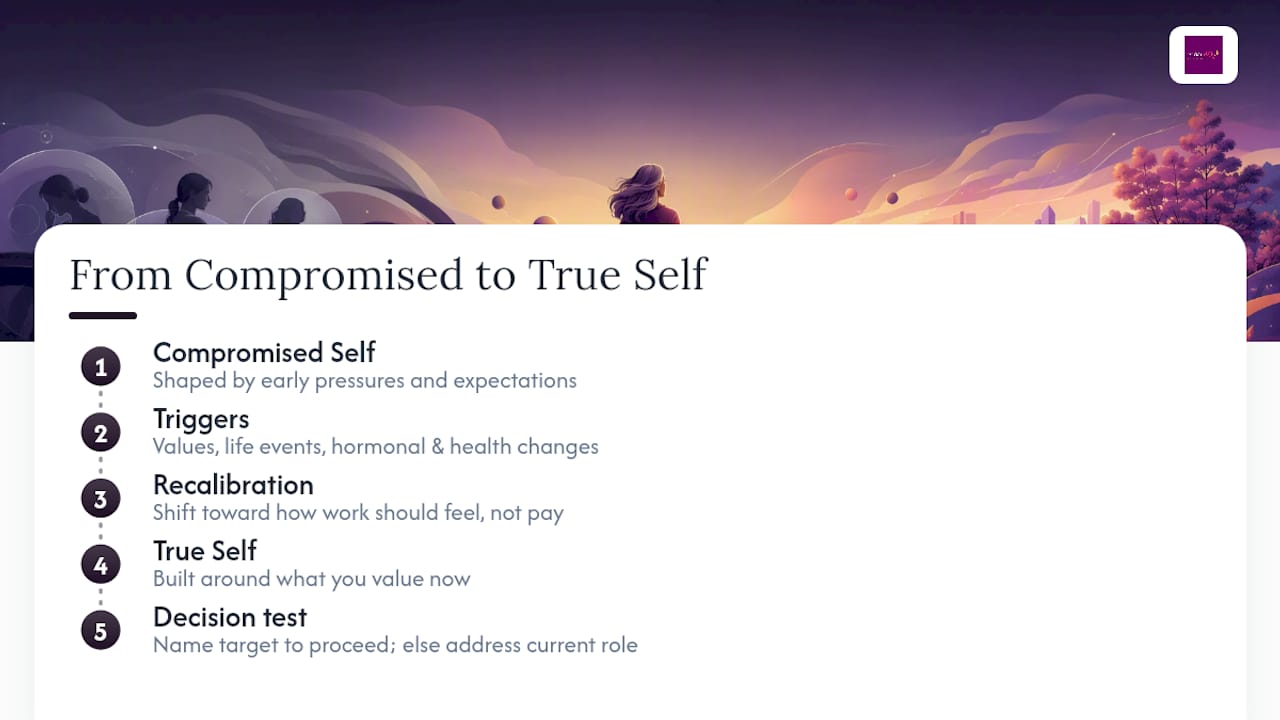
Pro Tip: If you can name the specific thing you're moving toward, even roughly, you're recalibrating. If you can only describe what you want to escape, park the career change and address the current role first.
A concise 7-step roadmap to switch careers at 40
You don't need a five-year plan. You need a sequence.
- Clarify your values and existing skills (1 to 2 weeks). List what you're good at and what you actually want more of.
- Research the market (2 to 3 weeks). Use sector job profiles from Prospects to check realistic entry routes and demand.
- Build a financial runway (ongoing from week one). Know your minimum monthly outgoings.
- Test and validate (4 to 8 weeks). A short placement, freelance project or volunteer role beats months of research.
- Reskill strategically (variable). Choose training that closes a specific, named gap, not a general one.
- Reposition your story (2 weeks). Rewrite your CV and LinkedIn around the new direction.
- Network and apply (ongoing). Reach out before jobs are advertised, not after.
Pro Tip: While still employed, prioritise steps 1, 2 and 4. Testing a direction while you still have income is the single biggest risk reducer in any career roadmap.
Your 3, 6, and 12-month milestones for changing careers
A phased plan turns intention into progress you can actually measure.
- By month 3: you've done initial discovery, run one small experiment (a course, a placement, a paid trial project), and completed a financial triage of income, savings and unavoidable costs.
- By month 6: you've validated interest through paid or volunteer work, started targeted reskilling, and strengthened at least two relevant professional connections.
- By month 12: you've applied for or launched your new direction, mapped an income ramp for the first year, and set contingency steps if progress is slower than expected.
Experts broadly agree a phased approach across these horizons gives meaningful career changes room to breathe, allowing for testing and, where needed, formal training. Track progress against these milestones in a goal-setting framework rather than a vague sense of "getting there."
How do you market transferable skills at 40?
Start with a task audit, not a job-title audit. List what you actually did day to day, then match those tasks to your target field rather than relying on your old job title to speak for itself.
Three quick rewrites:
- Professional services to product: "Managed client accounts" becomes "Owned the end-to-end client experience, from onboarding through renewal."
- Manager to project manager: "Led a team of eight" becomes "Coordinated cross-functional delivery against fixed budgets and deadlines."
- Operations to healthcare admin: "Ran office logistics" becomes "Managed scheduling, compliance documentation and stakeholder communication," which maps directly onto entry routes described on NHS healthcare careers.
For cover letters, use a bridge story: name the gap you noticed in your old field, and explain how it points directly to the new one. That's more persuasive than a generic "I'm passionate about change" line, and it gives hiring managers a reason rather than a hope.
Which retraining route works best after 40?
Not every route needs a career break or a loan. Here's how the main options compare:
- Short courses and microcredentials: quickest to job-readiness, often weeks rather than years, ideal for testing a direction cheaply.
- Professional certificates: moderate time investment, strong credibility in regulated or technical fields.
- Apprenticeships: slower but paid while you learn, useful if you need income during retraining.
- Part-time degrees: the biggest time and financial commitment, worth it for fields with formal entry requirements.
- Volunteering and placements: fast, low-cost proof of interest and aptitude before you commit to anything bigger.
The National Careers Service recommends applying for training and volunteering to gain experience as core planning steps, and the Lifelong Learning Entitlement overview sets out funding options worth checking before you pay for anything privately.
What stops women changing careers at 40, and how do you get past it?
Four barriers come up again and again, each with a practical fix.
- Ageism: lead your CV with recent, quantifiable impact rather than years of tenure. JobHelp's guidance for older applicants has specific wording tips for this.
- Finances: build a part-time or staged transition and use a strict budget checklist before you resign anything, covered in more depth in financial planning for women.
- Family commitments: batch job-search and study tasks into fixed weekly slots rather than trying to fit them around everything else.
- Confidence: small, low-stakes experiments rebuild belief faster than reflection alone, and peer or coaching support accelerates that.
Pro Tip: Don't announce a full pivot to your current employer or wider network until you've validated the direction. Test quietly, then disclose deliberately once you have evidence, not just intent.
Where targeted support helps you move faster
Structured support closes the gap between wanting change and executing it. ProspHER works with a sizeable community of women, and members report gaining clearer direction fast.

Many ProspHER members report gaining clearer direction within a short period of joining, a pace that manual reflection alone rarely matches. Mentoring, cohort coaching and a focused resource library map directly onto the roadmap above, from values clarification through to repositioning your story for applications.
A short note before you start
Ambivalence about this decision isn't a warning sign. It's normal. Pick one action from this roadmap and start it this week.
How ProspHER supports your career change
There are other routes into a career pivot: DIY research, generic online courses, ad hoc networking. All of them work eventually, but they tend to cost you the thing you have least of at 40, which is time spent figuring out what to do next rather than doing it.
ProspHER replaces that guesswork with a structured pathway built specifically for ambitious women, matched to where you are right now rather than a one-size content library. Mentoring, cohort coaching, financial planning guidance and a community of over 2,400 women mean you're testing your direction alongside people who've done it, not alone at 11pm with a spreadsheet. If you want career clarity coaching built around your specific circumstances, start by exploring ProspHER's membership and see which pathway fits your next twelve months.
Frequently asked questions
Is 40 too late to start a new career? No. Women in their forties often bring stronger self-knowledge and transferable skills than they did at 25, which speeds up, not slows, a successful pivot.
How long does a career change usually take at this age? Most structured transitions take 6 to 12 months from initial discovery to a first paid role, following the phased plan outlined above.
What if I can't afford to retrain full-time? Short courses, microcredentials, apprenticeships and volunteering all offer routes into a new field without a full-time study commitment or a career break.
How do I deal with ageism in job applications? Lead with recent, measurable impact rather than years of experience, and use CV wording guidance aimed specifically at older applicants.
Sources
- Managing your career later in life
- Older workers support — JobHelp
- Healthcare careers — NHS
- Gov
- Browse sector job profiles — Prospects