
Ask for a brief 15 to 20 minute conversation, name the exact reason you're reaching out, offer to meet by video call or in person, and suggest two or three specific times. That single sentence, adapted to your own situation, outperforms almost every longer, vaguer version of the same ask, because it removes the guesswork for the person reading it.
TL;DR:
- Using a specific, named reason and a clear time limit in your request increases the likelihood of a positive response and minimizes perceived burden.
- Prioritize alumni, mutual connections, and current role matches over strangers or senior figures to improve response rates and relevance of advice.
- Sending messages through email or LinkedIn with a short, specific subject line during Tuesday to Thursday mornings yields the best engagement.
- Structuring your request with a personal hook, purpose, time-boxed ask, flexible scheduling, and a brief sign-off maximizes response rates.
- Focusing your conversation on one clear objective and preparing targeted questions helps you walk away with actionable insights rather than vague small talk.
Table of Contents
- What is a coffee chat request, and why does a short ask win?
- Who should you ask first, and how do you prioritise?
- Which channel and timing get the best response?
- How to write the request: the anatomy and six templates
- How do you prepare for the actual conversation?
- What happens after the chat matters as much as the request
- Why setting a clear objective changes the entire conversation
- What makes a good impression during the coffee chat?
- ProspHER perspective: turning one coffee chat into real momentum
- Sources
What is a coffee chat request, and why does a short ask win?
A coffee chat is an informal, professional conversation, usually 15 to 30 minutes long, built around learning rather than landing a job. Nobody expects a CV review or a formal interview. They expect a focused, respectful conversation about someone's career path, their industry, or a decision you're trying to make yourself.
The reason 15 to 20 minutes works better than "whenever suits you" is simple psychology. A vague, open-ended request asks the recipient to do the scheduling work and absorb an unknown time cost. A time-boxed request does that thinking for them. It signals you respect their calendar, which makes saying yes feel low-risk rather than open-ended.
A strong coffee chat request tends to share three things:
- A specific, named reason for reaching out to this person, not a generic networking line
- A clear time limit, stated upfront, so the recipient knows exactly what they're agreeing to
- A flexible format, whether that's a video call, phone call, or an actual coffee
Miss any of these and the request starts to feel like a burden rather than an easy favour.
Who should you ask first, and how do you prioritise?
Not every contact is equally worth approaching, and not every approach needs the same level of formality. Start closer to home before working outward.
- Alumni from your university or former employer tend to respond faster because of the shared affiliation, even without a personal connection.
- Mutual connections are worth an introduction request before you cold message someone directly. A short note to the connector, explaining why you'd value the introduction, usually works better than asking them to forward a message verbatim.
- Recent speakers, authors, or people who've just published something give you a built-in, specific reason to reach out. Reference the actual talk or article.
- People whose current role matches your learning goal matter more than seniority. A peer two years ahead of you often gives more useful, current advice than someone a decade removed from entry-level decisions.
Aim for a mix. Peers are easier to reach and often more candid. Senior contacts take longer to land but can offer a wider view, particularly if your goal involves a career pivot or industry change.
Which channel and timing get the best response?
Email works well when you already have someone's address, particularly through an alumni database or a shared workplace directory. Without it, LinkedIn is the default, and the two-step approach performs best: send the connection request first, then follow up with your full message once they've accepted, rather than cramming your entire ask into the connection note. LinkedIn InMail is worth the credit only when you have no mutual connection and no other way to reach someone senior.
Timing matters more than people assume. Career services guidance points to Tuesday through Thursday mornings as the window when professionals are most likely to open and act on an unfamiliar message, before the day's meetings pile up and after the Monday inbox backlog clears.
Your subject line does a lot of the work before anyone opens the message. The winning formula is short, specific, and time-boxed:
- "Quick 15 min question about your move into [industry]"
- "Fellow [university] grad, 20 min chat?"
- "Loved your talk on [topic], quick question"
Pro Tip: Avoid subject lines that could belong to a sales email. "Following up" or "Quick favour" get ignored or deleted; specificity is what earns the open.
How to write the request: the anatomy and six templates
Every high-response coffee chat request follows the same underlying structure, whether it's going out on LinkedIn or by email. Get these five parts right and the wording almost writes itself.
- A personal hook. Open with something specific to the recipient, not a generic pleasantry. Reference their recent work, a talk, an article, or a shared connection in the first line, before you introduce yourself.
- A clear purpose. State in one sentence why you're reaching out to this person specifically, not just "networking."
- A time-boxed ask. Name the length upfront, 15 to 20 minutes, so there's no ambiguity about the size of the favour.
- Scheduling flexibility. Offer two or three windows and both video call and in-person options where relevant.
- A brief sign-off. Thank them for considering it and leave the message under roughly 150 words total.
Here are six templates built around that structure, each adapted for a different situation.
1. Cold LinkedIn message
"Hi [Name], I read your post on [specific topic] and it really shifted how I think about [related idea]. I'm exploring a move into [field] and would value 15 to 20 minutes to ask a few questions about your path. Would a quick video call work sometime next week, say Tuesday or Thursday morning? Happy to work around your schedule."
Personalise the opening line every time. Everything else can stay close to this shape.
2. Cold email
"Hi [Name], I came across your work at [company] through [source] and I'm currently [your situation]. I'd love 15 to 20 minutes of your time to ask about [specific aspect of their role]. I'm free [two or three specific slots] but happy to work around you, by phone or video call, whichever is easier."
Swap the source and the specific aspect for every recipient; a template that reads as mass-sent gets ignored.
3. Alumni approach
"Hi [Name], fellow [university] graduate here, class of [year]. I saw you're now at [company] in [role] and I'm curious about how you made that transition. Would you have 15 minutes for a quick call in the next week or two? Totally flexible on timing."
The shared university does the trust-building work here, so keep the rest short.
4. Referral or introduction request
"Hi [mutual connection], I hope you're well. I'm trying to learn more about [industry/role] and I noticed you're connected with [target person]. Would you be comfortable making an introduction, or happy for me to reach out directly and mention your name?"
Never ask the connector to forward a full pitch. Let them choose how they want to help.
5. Internal colleague request
"Hi [Name], I've been wanting to learn more about the [team/department] and how it fits into [company]'s bigger picture. Would you have 15 to 20 minutes over the next couple of weeks? Happy to grab a coffee near your desk or hop on a call."
Internal requests can be slightly warmer in tone since you already share context.
6. Polite follow-up reminder
"Hi [Name], just following up in case my last message got buried. Still very keen for 15 minutes of your time if it works, no worries at all if things are too busy right now."
Send this once, roughly a week after the first message, and stop there regardless of the outcome.
Across all six, avoid asking for a job in the first message, skip attachments unless specifically requested, and keep the tone warm rather than transactional. A request that reads like a job application gets treated like one, and most people don't have the authority or appetite to respond to that on a first message.
How do you prepare for the actual conversation?
Walk in with one sentence that defines what you want out of the 15 to 20 minutes. Something like "I want to understand how she moved from agency to in-house marketing" keeps the conversation from drifting into small talk that eats the clock.
From that objective, build out five to eight targeted questions, covering a mix of angles:
- What made you decide to move into this role, and what almost stopped you?
- What does a typical week actually look like, beyond the job description?
- What's one thing you wish someone had told you before you started?
- What skills mattered more than you expected once you were in the role?
- What's a common mistake you see people make trying to break into this field?
- How did you build the network that got you here?
- What would you do differently if you were starting again today?
- Who else would you suggest I speak to?
Prepare a 30-second version of your own story too. Cover where you are now, what you're exploring, and why this particular conversation matters to you. Keep it tight enough that it doesn't eat into their time, and close by offering something back, an introduction, a resource, or simply staying in touch, so the exchange doesn't feel one-directional.
Pro Tip: Write your questions in the order you'd hate to run out of time before asking. The most important question goes second or third, never last.
What happens after the chat matters as much as the request
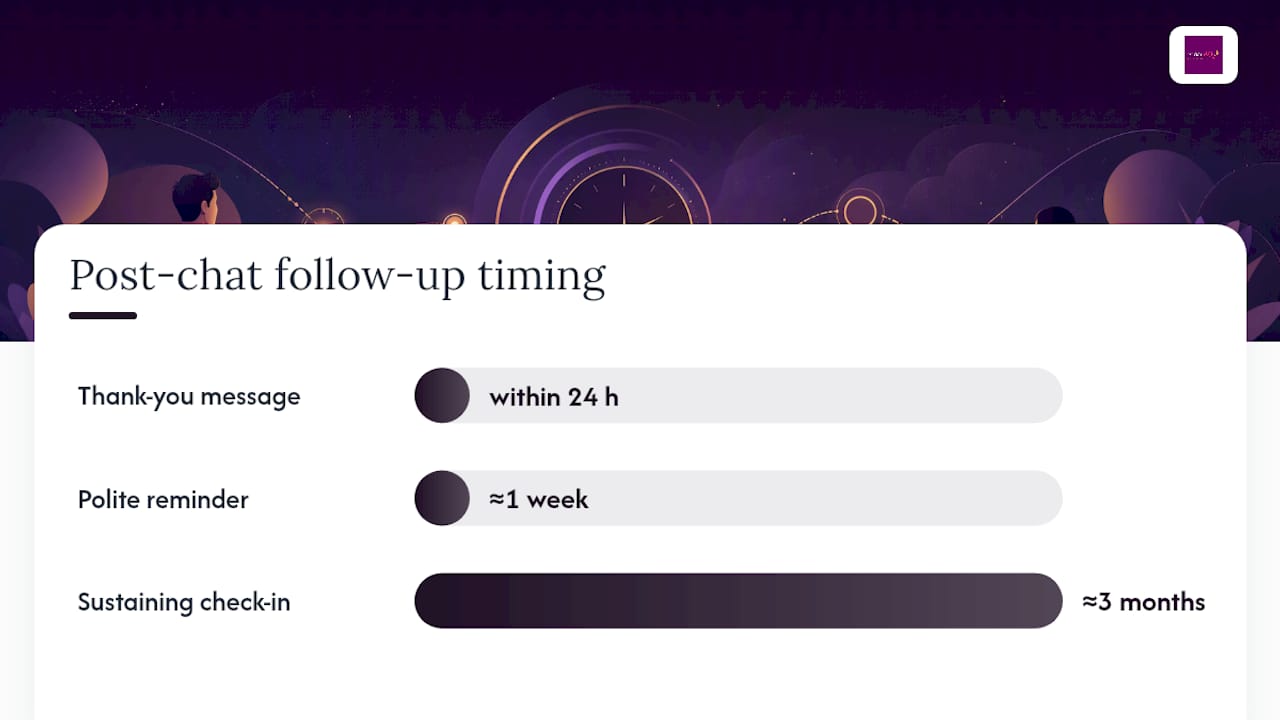
Send a thank-you message within 24 hours. Mention one or two specific things you took away and confirm any actions you agreed to, whether that's sending your CV or following up on an introduction they offered.
Beyond that first thank-you, follow-up cadence should stay light:
- One polite reminder if your original request goes unanswered after about a week
- A follow-up after any agreed milestone, such as "I applied for that role you mentioned"
- A check-in every few months if the relationship is one you want to sustain, not every few weeks
Careers guidance is consistent on this point: one follow-up is fine, two starts to feel pushy, and three reads as pressure. If someone hasn't responded after a single reminder, let it go gracefully rather than chasing.
If you're sending multiple requests, track a few simple numbers: requests sent, response rate, and how many turn into actual conversations. A response rate below roughly 20% is a signal to revisit your subject lines or personalisation, not a reason to send more generic messages faster. For longer-term relationships that grow out of a good chat, it's worth reading up on how to find a mentor and turn a single conversation into ongoing support.
Why setting a clear objective changes the entire conversation
A coffee chat without an objective drifts. You end up asking whatever comes to mind, the other person answers generically, and you leave with pleasant small talk instead of a decision you can actually act on.
Before you even send the request, decide what you're trying to learn. Are you weighing two career paths? Trying to understand if a specific industry suits you? Looking for a realistic picture of what a role involves day to day? Pick one, not three. A chat trying to cover career change, salary benchmarking, and industry gossip in 15 minutes will do none of them well.
Write that objective down in a single sentence before the call. It should be specific enough that a stranger reading it would understand exactly what you're hoping to walk away knowing. "I want to understand if my current skills transfer to product management" is usable. "I want career advice" is not.
That objective also shapes your questions, keeps the conversation from wandering, and gives you a natural way to close: summarise what you learned against what you set out to find, and you'll know immediately whether you got what you needed or whether a follow-up is worth requesting.
What makes a good impression during the coffee chat?
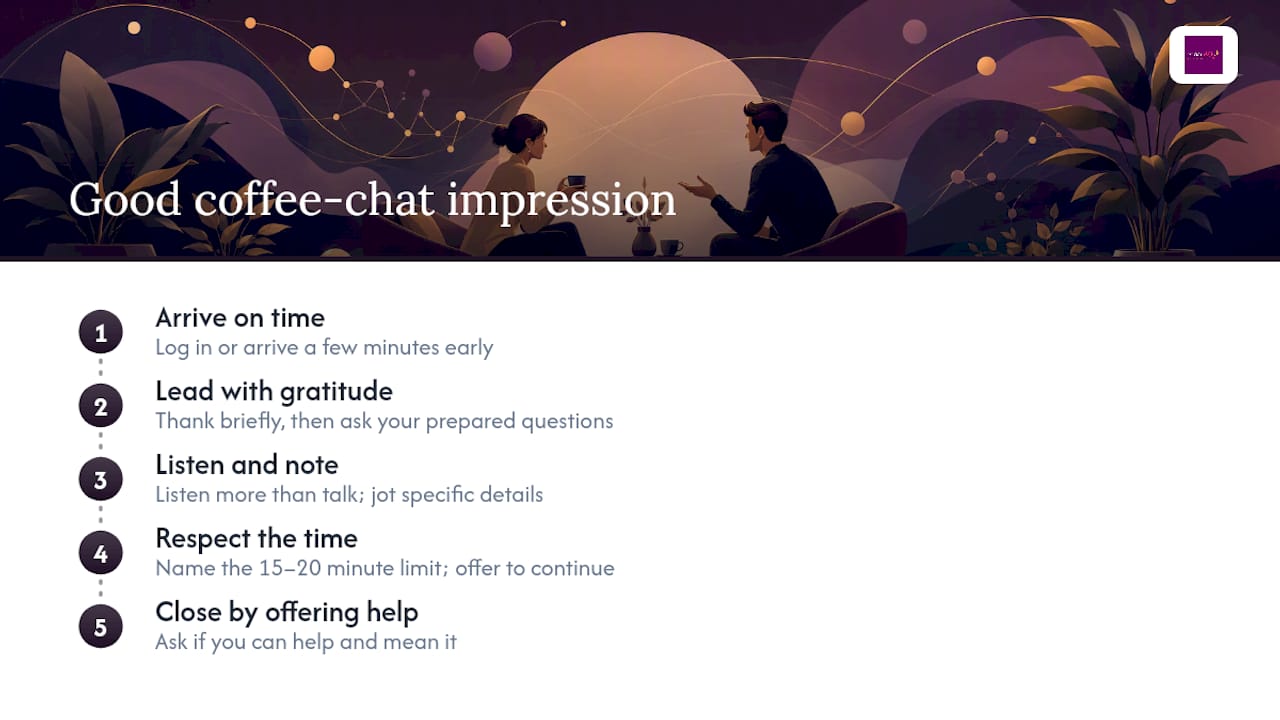
Show up on time, whether that's logging into the call two minutes early or arriving before your host at the café. Lateness on a favour someone is doing for free reads far worse than lateness for a paid meeting.
Lead with gratitude, briefly, then move straight into your prepared questions rather than filling the first five minutes with small talk you didn't plan for. People notice when a conversation has structure; it signals you value their time as much as you claimed to in the request.
Listen more than you talk. The instinct in a nervous conversation is to fill silence with your own story, but the value of the chat comes from what they say, not what you say. Take a note or two, either mentally or on paper, of specific details you can reference in your thank-you message later.
Watch the clock yourself. If you asked for 15 minutes, be the one to say "I know I asked for 15 minutes, and we're close to that, so I'll let you go unless you have time to continue." That single habit does more for your reputation than almost anything else in the conversation, because it proves the time-boxed ask in your original message wasn't just a line to get a yes.
Close by asking if there's anything you can do for them, and mean it. Even students and early-career professionals usually have something to offer, whether that's a resource, an introduction, or simply staying in touch and reporting back on where things land.
ProspHER perspective: turning one coffee chat into real momentum
Here's what we've noticed working with ambitious women across our community: the request is rarely the hard part. It's what happens in your head before you hit send, and after the chat ends, that determines whether it actually changes anything.
ProspHER exists because generic networking advice tends to add noise instead of clarity. We built our platform around personalised pathways instead, because 94% of our members report clearer direction within 30 days of getting structured support rather than another list of tips to sort through alone.
If you're about to send a coffee chat request, three things matter more than the wording. Rehearse your 30-second pitch out loud, not just in your head, so it doesn't wobble when you're nervous. Commit to one small follow-up action before the call ends, not five vague ones you'll forget by Friday. And don't do this in isolation. Community accountability, whether that's a friend, a mentor, or a group that expects you to report back, is what actually converts a good conversation into forward motion.
— ProspHER
Sources
- Employer coffee chats | Careers Service, University of Oxford
- How to write an effective informational interview request email | Forbes
- How to message someone on LinkedIn you don't know | DeftBrain
- Coffee Chat Request: Templates That Get a Yes | Resumly