
The follow-up that works is a short, specific message sent while the conversation is still fresh. Same day, or first thing the next morning. That is the single rule that separates professionals who build real momentum from those who collect business cards and wonder why nothing happens.
Here is a two-line template you can paste and send right now:
Subject line options to increase opens:
- After an event: "Following up from [Event name] — [your name]"
- After a panel: "Your talk on [topic] — quick question"
- LinkedIn connection: "Connecting after [Event] — [your name]"
- Warm intro: "[Mutual contact]'s introduction — following up"
According to Indeed, sending your first message soon after the event gives you the best chance of a reply. Waiting too long causes the conversation to fade for both of you.
Key takeaways
A great networking follow-up is a short, specific message sent within 24 hours that references one real detail from the conversation, offers something useful, and ends with a clear, low-friction next step.
| Point | Details |
|---|---|
| Send within 24 hours | Waiting beyond 48 hours significantly reduces your chance of a reply. |
| One specific detail | Reference the exact moment or topic you shared — generic openers are the single biggest reason follow-ups go unanswered. |
| Offer value first | Share a link, an introduction, or an insight before you make any ask. |
| Three touches maximum | First follow-up, then two more spaced 5–14 days apart — after that, a non-reply is an answer. |
| ProspHER membership | Gives you structured follow-up frameworks, mentoring access, and a community of 2,400+ women to practise and apply these skills with. |
Table of Contents
- How do you write a networking follow-up that actually gets a reply?
- Ready-to-use templates for common networking scenarios
- When should you send your follow-up, and what if they do not reply?
- How to personalise quickly so your message earns a reply
- Which channel should you use, and what does UK etiquette expect?
- What are the most common follow-up mistakes, and how do you fix them?
- ProspHER's view on why follow-up is where careers are actually built
- ProspHER gives you the structure to turn connections into real opportunities
- Sources
How do you write a networking follow-up that actually gets a reply?
Think of each line in your message as doing a specific job. Get those jobs right and you have a follow-up that reads like a natural continuation of the conversation, not a cold pitch.
Line 1: The reminder. One sentence. Who you are, where you met, and the one detail that anchors the memory. "We spoke after the panel on scaling a service business at the Women in Business Summit on Thursday." That is it. No lengthy preamble.
Line 2: The value offer. This is where most follow-ups fall flat. "Great to meet you" is not value. A link to the article you mentioned, an introduction to someone relevant, or a specific observation about their challenge — that is value. Networking For Awesome People puts it plainly: offer something useful before you make any ask. Even a single sentence that says "I found that report we discussed — here it is" changes the entire tone of the message.
Line 3: The CTA. Make it low-friction. "Would a 20-minute call work for you?" beats "Let me know if you'd ever like to connect sometime." Two specific times offered beats a vague open question. A yes/no question beats a request that requires the other person to do all the scheduling work.
Sign-off and length. Three to five sentences total. Professional but warm. "Best wishes" or "Kind regards" works well in a UK context. Avoid "Cheers" for a first message with someone you have just met professionally.
Pro Tip: Right after the event, before you check your phone or grab a drink, spend 60 seconds per person jotting four things: their role, the specific moment you connected on, what they might need, and anything you promised. Bl1nk recommends capturing these within 60 minutes — context decays fast, and a precise follow-up written from fresh notes is worth ten generic ones drafted the next afternoon.
Ready-to-use templates for common networking scenarios
These are copy-and-paste scripts. Swap the bracketed text, and you are done. Each takes under two minutes to personalise.
1. After an event or conference
When to use: Within 24 hours of meeting someone at a professional event.
Subject: Following up from [Event name] — [Your name]
Hi [Name],
It was great to meet you at [Event] yesterday. Your thoughts on [specific topic or comment they made] were genuinely useful — I have been thinking about [brief connection to your own work or situation].
I would love to stay in touch. Would a short call in the next fortnight work for you?
Best wishes, [Your name]
Tone note: Warm but professional. For senior contacts, replace "I would love to stay in touch" with "I would value the chance to continue the conversation."
2. Quick coffee follow-up
When to use: After an informal coffee or lunch meeting.
Subject: Great to catch up — next steps
Hi [Name],
Thanks so much for making time today. The conversation around [specific topic] was exactly what I needed to hear right now.
I will [specific action you committed to — e.g. send over that introduction / share the link]. Let me know if there is anything I can do from my side in the meantime.
Kind regards, [Your name]
Tone note: More relaxed. The specific action you committed to is the personalisation hook — replace it with whatever you actually said you would do.
3. LinkedIn connection message (no email)
When to use: When you met someone briefly and do not have their email address.
Hi [Name], we met at [Event] on [day] — you mentioned [specific detail]. I would love to connect and continue the conversation here. [Your name]
Tone note: Keep LinkedIn messages under 50 words. No pitch, no ask beyond the connection itself.
4. Referral or introduction request
When to use: When asking a contact to introduce you to someone in their network.
Subject: Quick favour — introduction to [Name]
Hi [Name],
I hope you are well. I have been following [person's work / company] and think there could be a genuine fit with what I am building. Would you be comfortable making a brief introduction?
Happy to send a short bio you could forward — makes it easy for you.
Many thanks, [Your name]
Tone note: Always make the ask easy to fulfil. Offering to write the intro email yourself is the single most effective tweak for this template.
5. Reconnecting / keeping in touch
When to use: Reaching out to someone you met months ago but have not spoken to since.
Subject: Checking in — [Your name]
Hi [Name],
I hope things are going well. I came across [article / news / event] and immediately thought of our conversation about [specific topic] at [Event].
No agenda — just wanted to share it and say hello. Would love to hear how [their project or goal] is progressing.
Best, [Your name]
Tone note: The "no agenda" line does real work here. It removes pressure and makes a reply feel natural rather than obligatory.
HubSpot's template guidance reinforces what these scripts demonstrate: the highest-performing follow-ups treat the message as a direct continuation of the conversation, not a fresh sales approach.
When should you send your follow-up, and what if they do not reply?
Timing is where good intentions collapse. You mean to send the message, then a day passes, then a week, and the moment is gone.
| Touch | When to send | Tone |
|---|---|---|
| First follow-up | Same day or within 24 hours | Warm, specific, low-friction ask |
| Second follow-up | 5 days after first, if no reply | Brief, add a small new piece of value |
| Final touch | 10 days after second | Short, gracious, no pressure |
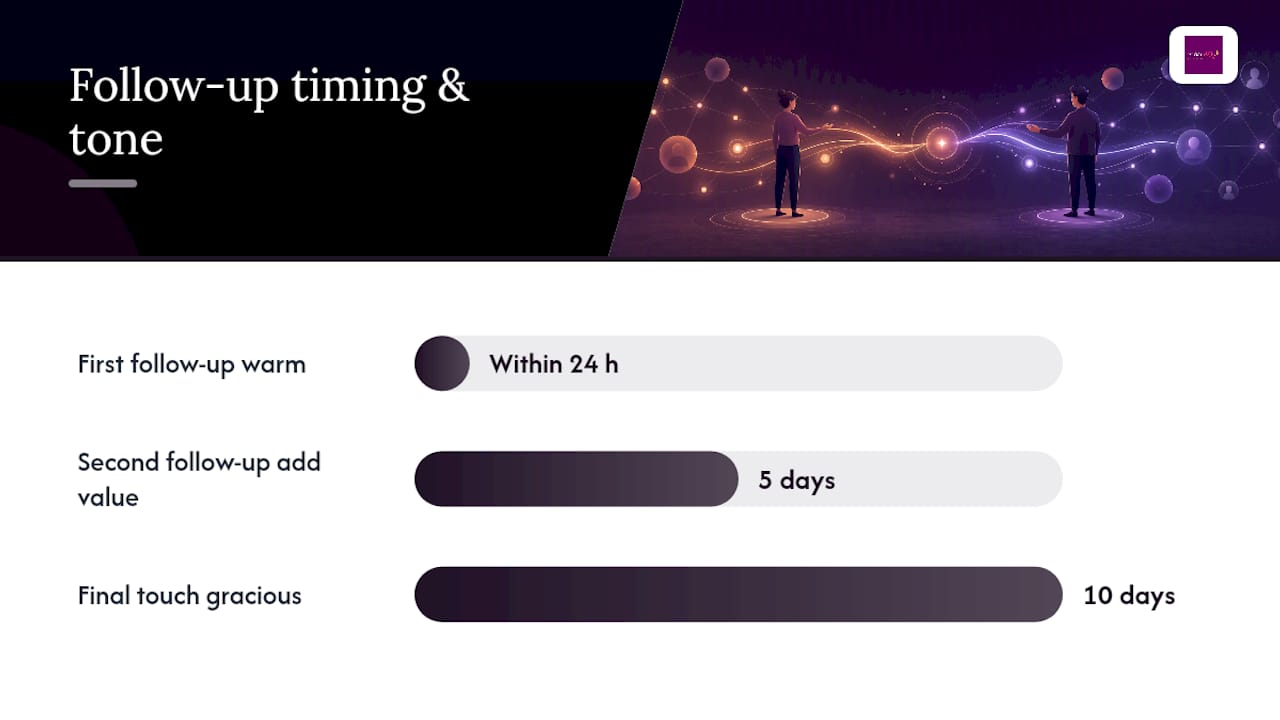
Hot contacts (someone who expressed clear interest or asked you to follow up): send the same day, reference the specific commitment they made, and propose a concrete next step with two time options.
Warm contacts (a good conversation but no explicit next step agreed): send within 24 hours, offer value first, keep the ask light.
Cold contacts (a brief exchange, no strong connection): send soon within a couple of days, keep it brief, and do not expect a reply to the first message.
The rule on stopping: two messages beyond your initial follow-up is the limit. Three touches total, spaced over two to three weeks, is standard practice for converting a networking contact into something real. After that, a non-reply is an answer. Move on without burning the bridge — a gracious final message leaves the door open.
Bl1nk's workflow suggests drafting your follow-ups the evening of the event while details are fresh, then scheduling them to send between 08:00 and 09:00 the next morning. You get the accuracy of fresh notes with the professional timing of a morning send.
How to personalise quickly so your message earns a reply
Generic messages underperform. That is not an opinion — it is the consistent finding across every piece of career guidance worth reading. HubSpot's research is direct on this: many follow-ups fail precisely because they are generic, and the highest-return tactic is treating the message as a continuation of the specific shared moment.
You do not need to spend 20 minutes personalising. You need one concrete detail. Here is what to capture and how long it takes:
- The shared moment (10 seconds): the specific comment, question, or laugh you both had. "Your point about pricing confidence" is a shared moment. "Great conversation" is not.
- Their current challenge (15 seconds): what did they mention they were working on or struggling with? One phrase is enough.
- A mutual contact or context (10 seconds): did someone introduce you? Were you both on the same panel? Name it.
- Something you promised (5 seconds): a link, an introduction, a resource. Write it down before you forget.
The difference in practice:
✗ "It was so lovely to meet you at the event. I would love to stay in touch and explore potential synergies."
✓ "Your comment about the gap between pitching to investors and pitching to clients really landed for me — I have been sitting with the same tension. I found the article I mentioned; linking it below."
The second version takes 30 seconds longer to write and is ten times more likely to get a reply.
Which channel should you use, and what does UK etiquette expect?
Channel choice shapes how your message lands before the recipient reads a single word. MindTools recommends matching the channel to the context: email for formal or business-first contacts, LinkedIn when you do not have an email address, and WhatsApp or text only for warm introductions where that channel has already been used.

In a UK professional context, a few additional conventions apply:
Email is the default for anyone you met in a formal business setting. Send during business hours (08:00–18:00 Monday to Friday). Open with "Hi [Name]" or "Dear [Name]" depending on seniority — "Dear" for senior or formal contacts, "Hi" for peers. Keep it brief; UK professionals tend to read long emails as a sign of poor preparation.
LinkedIn works well when you connected at an event and exchanged profiles rather than cards. Keep the initial message under 50 words. Once a conversation is established, suggest moving to email: "Would it be easier to continue this over email? Mine is [address]."
WhatsApp or text is only appropriate if the person shared their number with you and the introduction was warm. Even then, match the formality of their messages before you relax your own.
Pro Tip: If you want to move a LinkedIn conversation to email or a call, make the ask feel natural rather than transactional. Try: "I would love to share a few thoughts on this — would email work better for you?" It positions the channel switch as a benefit to them, not an admin request from you.
What are the most common follow-up mistakes, and how do you fix them?
Most follow-ups do not fail because of bad writing. They fail because of avoidable habits that signal low effort or poor timing.
- Sending a generic opener. "It was so great to meet you!" with nothing specific tells the recipient you could have sent this to anyone. Fix: open with the one detail that proves you were paying attention.
- Pitching too soon. A first follow-up is not a sales email. Lead with value or a genuine connection point before you make any ask. The ask can come in the second message if the first one gets a reply.
- A vague or missing subject line. "Following up" is not a subject line. It gives the recipient no reason to open the email. Fix: include your name, the event, or a reference to the conversation topic.
- Writing too much. A follow-up longer than five sentences reads as high-maintenance. If you have a lot to say, save it for the call. The email's job is to get the call booked.
- Waiting too long. Context decays rapidly. A follow-up sent four days after an event feels like an afterthought. The conversation has moved on for them, even if it has not for you.
- Sending a second message that is identical to the first. If there is no reply, your second touch needs to add something new — a resource, a question, a brief update. Repeating the same ask signals that you are not listening.
On persistence: a polite second follow-up is professional. A third is the limit. Beyond that, you are no longer networking — you are applying pressure, and that is the fastest way to close a door permanently.
ProspHER's view on why follow-up is where careers are actually built
Here is something we see consistently across the ProspHER community: the women who build the strongest professional networks are rarely the most confident in the room. They are the most consistent after they leave it.
Follow-up is not a courtesy. It is a professional signal. It tells the other person that you are reliable, that you were genuinely present in the conversation, and that you take your own momentum seriously. MindTools frames it well: follow-up demonstrates reliability and intent, not just message content. The 4 Cs and 5 Ps frameworks they reference are memory aids, but the underlying principle is simpler — show up after the event the same way you showed up during it.
What we notice in ProspHER's coaching work is that the follow-up script is often the missing piece. Members come to us having attended women's business networking events, made genuine connections, and then done nothing with them — not from lack of ambition, but from not knowing what to say next. Once they have a short, specific script they trust, the paralysis disappears. Mentoring relationships, client conversations, and co-founder introductions have all started from a three-sentence email sent the morning after an event.
With over 2,400 women in the ProspHER community and 94% of members reporting clearer direction within 30 days, we know that clarity and a concrete next step are what move things forward. A good follow-up is both.
ProspHER gives you the structure to turn connections into real opportunities
Most professionals leave networking events with good intentions and a pocket full of cards that go nowhere. The gap is not effort — it is structure.
ProspHER's membership gives ambitious women a practical framework for turning every conversation into a real professional opportunity. That means access to mentoring relationships you can follow up with confidence, a community of over 2,400 women across the UK who are actively building and connecting, group coaching that covers follow-up scripts and career development strategies, and a structured pathway that keeps your momentum going between events. No noise, no content overload — just the specific support you need at the stage you are at.
If you are ready to build a network that actually moves your career or business forward, join ProspHER today and get your first structured follow-up framework as part of your membership welcome.
Sources
The guidance in this article draws on the following resources:
- How to follow up after networking | MindTools
- 19 templates for follow-up emails after a meeting, conference, and more | HubSpot
- Indeed
- How To Follow Up After a Networking Meeting (And Actually Get Results) | Networking For Awesome People
- How to Follow Up After Networking (And Actually Get Results) | Bl1nk