
A peer coaching circle is a small, confidential group of professionals who use structured, timed "case clinic" rounds to help each other work through real challenges, using questions rather than advice. You use one when you want sustained leadership growth, sharper problem solving on issues you can't fully see from the inside, and a level of accountability that a solo development plan rarely delivers.
Circles work well for:
- Leaders navigating ambiguous, high-stakes decisions with no obvious playbook
- Professionals who want emotional intelligence and confidence to grow alongside technical skill
- Anyone who has tried "networking" and found it long on contacts, short on actual movement
If what you want is noise reduction and real direction, this is worth building. If you want passive inspiration with no commitment, it isn't.
TL;DR:
- Groups of four to five members are most resilient to dropouts and maintain trust, unlike pairs or triads which face challenges as members leave.
- Sessions should follow a strict sequence: presenting for 5-7 minutes, clarifying questions for 5-7 minutes, a 15-20 minute group discussion, and a 5-minute debrief.
- Enforcing presenter silence during the group discussion is critical and requires structural cues to prevent interruptions and ensure active listening.
- Most peer coaching programs last three to six months with monthly or bi-monthly meetings of around 90 minutes, fostering sustained leadership development.
- Using a facilitated, structured model like ProspHER’s improves attendance, progress, and measurement, reporting 94% of members gain clearer guidance within 30 days.
Table of Contents
- What is a peer coaching circle, and what makes it work?
- How does a case-clinic session actually run?
- What benefits do peer coaching circles actually deliver?
- How do you set up and run a peer coaching circle?
- Which format should you choose, and what commonly goes wrong?
- What does the evidence say about ProspHER's peer learning model?
- Facilitator viewpoint: what actually matters in the first three meetings
- How ProspHER can help you build one
- Key Takeaways
- Sources
What is a peer coaching circle, and what makes it work?
A peer coaching circle is a structured, reciprocal group, usually four to eight professionals, who meet on a set cadence to help each other think through live challenges. Nobody is the designated expert. Everybody takes a turn presenting a problem, and everybody takes a turn helping someone else think theirs through.
Three principles hold it together:
- Mutuality – every member is both a presenter and a "consultant" over time, so the group never tips into one-way mentoring.
- Inquiry over advice – the job is to ask good questions rather than hand out solutions, which is harder than it sounds and is exactly why the format builds sharper thinkers.
- Confidentiality and psychological safety – what's said in the room stays there, which is what makes people brave enough to bring their actual problems instead of a polished version.
You'll also hear these called mentorship circles, coaching peer networks, or collaborative coaching pods. Universities, the military, and companies like Google all run some version of the same model, just with different labels stitched on.
How does a case-clinic session actually run?
The format is a case clinic, and it lives or dies on timing. Here's the sequence most practitioner guides converge on:
- Presentation (5 to 7 minutes) – the presenter lays out a real, current challenge. No interruptions.
- Clarifying questions (5 to 7 minutes) – the group asks only questions that gather information, not thinly disguised suggestions.
- Consultant discussion (15 to 20 minutes) – the group talks through the problem, out loud, as if the presenter weren't in the room.
- Debrief (5 minutes) – the presenter reflects on what landed and what they'll do next.
That structure adds up to a session of roughly 60 to 90 minutes, which fits neatly into a lunch hour or a single evening block.
Three roles keep it honest: a facilitator to hold the process, a timekeeper to protect the boxes above, and a note-taker so insight doesn't evaporate the moment the meeting ends.
The rule that makes or breaks the whole thing is presenter silence during the consultant discussion. The presenter doesn't defend, explain, or correct. They just listen. It's the most commonly broken rule in the room, and enforcing it is what forces people to actually hear perspectives they'd otherwise talk over.

Pro Tip: Give the facilitator a physical cue, a raised hand or a card on the table, to signal "you're speaking as if the presenter isn't here." It sounds clumsy the first time. By the third meeting, nobody needs reminding.
What benefits do peer coaching circles actually deliver?
The individual gains show up fast: clearer direction on a specific problem, stronger emotional intelligence from practising real listening, and leadership skills that come from being asked to think analytically about someone else's situation every single session.
Organisationally, the case is just as strong. Peer coaching is a low-cost way to upskill employees, build engagement, and strengthen trust without commissioning a top-down training programme. It scales in a way that one-to-one executive coaching never quite manages, because every member is also a coach.
Programmes commonly run over three to six months and are cited for measurable gains in psychological safety and leadership readiness at a fraction of what formal training costs.
- Sustained problem-solving skill, not just one-off advice
- A support network that outlasts the formal programme
- The kind of accountability that a to-do list can't replicate
Coaching peer networks also benefit the person doing the coaching, not just the one presenting. Building the discipline to ask sharp questions instead of offering quick fixes is a leadership skill in its own right, one you carry into every meeting you sit in afterwards.
How do you set up and run a peer coaching circle?
Running one isn't complicated, but skipping steps is how circles quietly fall apart by month two.
- Recruit deliberately. Look for voluntary commitment, roughly similar seniority so nobody feels judged or judging, and enough diversity of role or industry that the questions stay fresh.
- Run a launch workshop. A 60 to 75 minute session to align on ground rules, confidentiality, and practise one mini case clinic before the real cadence starts.
- Set the ground rules explicitly. Confidentiality, presenter silence, and what happens if someone needs to miss a session. Write them down.
- Fix the cadence. Monthly 90-minute sessions, or twice-monthly if the group wants faster momentum, held to a strict clock either way.
- Choose the format. Decide early whether you're meeting in person, virtually, or hybrid, and pick one shared document for notes and follow-ups so nothing lives only in someone's head.
- Build in measurement. Ask each presenter to name one concrete action at debrief, then open the next session by checking what happened with it.
For structure and shared language on setting those actions, a framework like SMART goal setting works well inside the debrief stage. And where confidentiality needs teeth, it helps to borrow language from broader workplace boundary setting rather than inventing your own from scratch.
Pro Tip: Ask every member to commit to the full three to six months before the first session, not session by session. Circles that let people opt in meeting by meeting tend to lose momentum early in the programme.
Which format should you choose, and what commonly goes wrong?
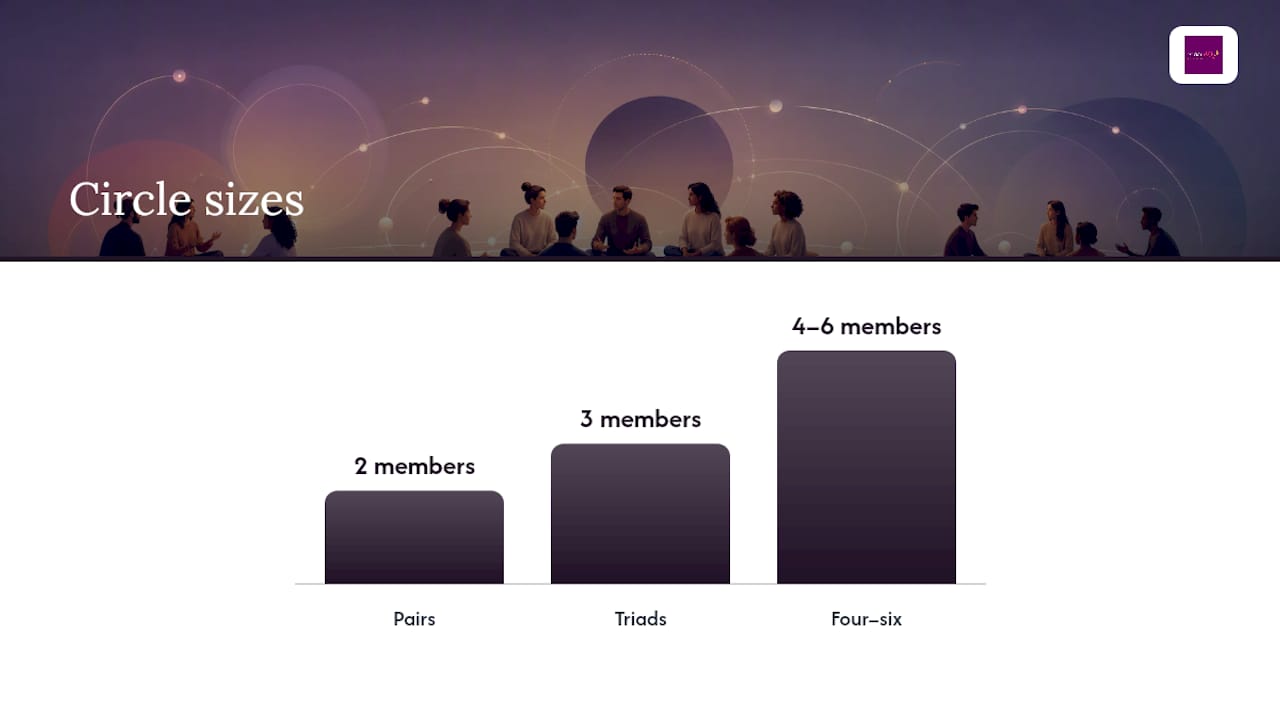
Pairs are the simplest format but offer only one perspective per problem. Triads add richness but carry a hidden risk: if one person drops out, you're not left with a smaller group, you're left with a broken one that needs rematching. Four to six person circles are the sweet spot most programme designs land on, because they stay intimate enough for trust while absorbing an occasional dropout without collapsing.
Common pitfalls, and how to head them off:
- Clarifying questions turning into advice – train the group to notice the difference; it's a real skill, not a formality.
- Presenter silence breaking down – enforce it structurally, not just as a suggestion.
- Attendance drifting – a written commitment contract at launch does more work than any reminder email.
- Group size shrinking below viability – design for 4–5 from the start rather than reacting after a dropout.
What does the evidence say about ProspHER's peer learning model?
ProspHER runs on the same principle that makes peer coaching circles work: structure and clarity beat noise. Across a community of over 2,400 women, 94% report clearer direction within 30 days, which mirrors what the case-clinic literature predicts, structured peer input moves people faster than unstructured networking ever does.
- Onboarding workshops set expectations before the first session, the same way a launch workshop does for a self-organised circle
- Facilitator support removes the burden of one member having to police timing and silence alone
- Built-in measurement means outcomes get tracked, not assumed
Pro Tip: If you've tried self-organising a circle twice and watched attendance fade both times, that's not a sign you did it wrong. It's a sign the facilitation layer is the piece worth outsourcing.
Facilitator viewpoint: what actually matters in the first three meetings
Timekeeping matters more than atmosphere in meeting one. Set the boxes, hold them visibly, and the trust follows. Meeting two is where presenter silence gets tested, expect someone to break it, and gently reset. By meeting three, rotate who presents first. If the group still feels stuck or uneven by then, bring in external facilitation rather than letting it limp along.
— ProspHER
How ProspHER can help you build one
If self-organising a circle from scratch feels like one more thing to manage on top of an already full plate, ProspHER offers a structured alternative: onboarding workshops, trained facilitator support, and built-in measurement, so you get the accountability of a case clinic without carrying the admin of running one — just as important as having a strong role headshots for executive coaching profiles that convert to help leaders present themselves confidently.
Membership pathways are built around where you actually are, not a generic curriculum, whether that's mentorship, group coaching sessions, or community events designed for exactly this kind of structured peer exchange. Self-organising remains entirely valid if you have the time and a committed group ready to go. But if you want the format without the setup risk, explore ProspHER's membership platform and see which pathway fits where you're headed next.
Key Takeaways
Structured timing, enforced presenter silence, and a committed group of four to five are what separate a peer coaching circle that lasts from one that quietly dissolves by month two.
| Point | Details |
|---|---|
| Definition | A peer coaching circle is a confidential, reciprocal group using timed case-clinic rounds, not one-way advice. |
| Session timing | Presentation 5 to 7 minutes, questions 5 to 7 minutes, consultant discussion 15 to 20 minutes, debrief 5 minutes. |
| Group size | Four to five members balances intimacy with resilience against dropouts better than triads or pairs. |
| Commitment | Most programmes run three to six months with monthly or twice-monthly 90-minute sessions. |
| ProspHER option | ProspHER's hosted model applies the same structure with onboarding, facilitator support, and measurement built in, and 94% of members report clearer direction within 30 days. |
Sources
- Peer coaching circles: a pathway to leadership growth through shared wisdom
- Peer Coaching Circle: Steps, Timing & Tips | Workshop Weaver