
Set one clear, written operating rule for client communication and enforce it every single time, as shown in local law firm marketing resources that support sustainable business practices. That one habit cuts scope creep faster than any lengthy policy document. Add a boundaries clause to your onboarding paperwork this week, and if a client has already drifted past your limits, send a single reset email restating the rule before you do anything else.
TL;DR:
- Clear, measurable boundaries in areas such as response times, revision limits, and payment terms prevent scope creep and establish enforceable rules.
- Reinforcing boundaries during screening and onboarding with written agreements and specific rules reduces misunderstandings and increases compliance.
- Consistency in enforcing boundaries and using a escalation path helps handle violations effectively and maintains professionalism.
- Setting explicit communication protocols, including designated channels and hours, prevents clients from assuming constant availability.
- Cultural sensitivities and individual client preferences should inform how boundaries are introduced, framed, and enforced to avoid friction.
Table of Contents
- What are boundaries with clients, and what types do you need?
- Why do clear boundaries matter for sustainability and quality?
- What are the signs your client boundaries are too weak?
- How do you set boundaries up front during screening and onboarding?
- What communication norms should you set for channels and hours?
- What scripts help you reset expectations without conflict?
- How do you enforce boundaries without inconsistency?
- How does hybrid work change client boundary expectations?
- What ethical benefit do boundaries give clinicians and therapists?
- How should cultural context shape your approach to boundaries?
- How do you handle boundary violations and client conflict?
- How do you balance empathy with professionalism?
- Publisher perspective: why ProspHER emphasises boundary work
- Where can you get support putting these rules into practice?
- Sources
What are boundaries with clients, and what types do you need?
A boundary with a client is not a values statement. It is an operating rule, something specific enough that both sides know when it has been crossed. "I value my time" is a sentiment. "Invoices are due within 14 days, and work pauses after 21" is a boundary you can actually enforce.
Most professionals need five categories of rule, each translated from a vague value into a measurable line:
- Time boundaries: fixed working hours, a defined response window, and no exceptions for "quick questions" outside them.
- Communication boundaries: one channel of record for approvals, with everything else treated as informal chat.
- Scope and revision boundaries: a fixed number of revision rounds per project, with anything beyond that billed separately.
- Financial boundaries: payment terms, late fees, and a clear rule on releasing deliverables only once payment clears.
- Emotional and role boundaries: what you will and will not absorb from a client's stress, urgency, or personal disclosures, particularly relevant if you're a therapist or coach.
Vague values fail because nobody can point to the moment they were broken. Measurable rules do not have that problem.
Why do clear boundaries matter for sustainability and quality?
Boundaries are not a self-care add-on. They are a quality control mechanism. Clients with clear expectations report fewer surprises, and professionals with clear rules report less resentment, which shows up directly in the standard of work delivered.
The HCPC states plainly that registered professionals carry responsibility for maintaining appropriate boundaries with the people they serve, framing it as a standard of practice rather than a personal preference. The American Psychological Association goes further, linking better boundaries in clinical practice directly to clinician wellbeing and the sustained quality of care a client receives over time.
Loose boundaries create a slow leak: a free extra here, a late-night reply there. None of it looks serious in isolation. Add it up over a quarter and you get burnout, resentment, and a client who has quietly learned that your rules are optional. Tight boundaries do the opposite. They protect the energy you need to do your best work, which is ultimately the thing the client is paying for.
What are the signs your client boundaries are too weak?
Porous boundaries rarely announce themselves. They show up as small, repeated compromises that feel individually reasonable and collectively exhausting. Run this audit against your current client list:
- After-hours messages get answered fast. If clients know you'll reply at 9pm, they'll message at 9pm. You trained that behaviour, even unintentionally.
- Unpaid extras are becoming routine. One free tweak is generosity. Five free tweaks on the same project is an unbilled service tier you never agreed to.
- Payments arrive late without consequence. No late fee, no pause in delivery, no friction. The client has learned your invoice date is a suggestion.
- Clients bypass your agreed channel. They text your personal number instead of emailing, or DM you on a platform you never designated for business.
- You feel dread, not neutrality, before a specific client call. That reaction is data. It tells you exactly where to look first.
Prioritise fixes by frequency and financial impact. A client costing you unpaid hours every fortnight outranks a one-off after-hours message.
How do you set boundaries up front during screening and onboarding?
Boundaries set after a relationship has already gone sideways are much harder to enforce than ones baked into the contract from day one. The work happens in three stages: screening, onboarding, and the paperwork itself.
Screening filters for fit before you sign anything. Ask direct questions: "What's your usual turnaround expectation?" and "How do you prefer to communicate day to day?" Green flags include a client who accepts your stated process without negotiation and who has a defined budget. Red flags include vague scope ("just make it good"), pressure for a decision within hours, and any hint that a previous provider was fired for "being too rigid" about boundaries.
Onboarding is where you play the rules back, not just state them. A short kickoff call or written summary that repeats your response windows, revision limits, and payment terms gives the client a chance to ask questions before work starts, and gives you a documented moment where they agreed. One operational guidance piece on setting boundaries with clients recommends confirming this at kickoff and designating a single primary channel for approvals, precisely because scattered channels are where misunderstandings breed.
Your contract should carry the weight, not your memory. Include:
- Scope definition, specific enough that "out of scope" has an obvious meaning.
- Revision rounds, capped at a number, with extra rounds billed at a stated rate.
- Payment terms, including a clause that deliverables release only after payment is confirmed.
- Cancellation and late-payment rules, with a concrete fee or pause trigger, not a vague "may incur charges."
Framing these as operating rules rather than personal restrictions tends to land better with clients, since research on client boundary-setting shows this framing reduces defensiveness compared with rules that sound like personal preferences. Record every agreement in writing, even a confirming email, so enforcement later is a matter of pointing at a document, not relitigating a memory.
What communication norms should you set for channels and hours?
Ambiguity is the enemy here. If clients don't know your hours, they'll assume you're always reachable. State the rules explicitly, in writing, before the first project kicks off.
- Email: acknowledge within one business day, resolve non-urgent items within two to three.
- Messaging platforms (Slack, WhatsApp, project tools): reserve for quick logistical questions, not approvals or scope changes.
- Phone calls: by appointment only, unless you have explicitly offered an open-line policy.
- System of record: one platform, usually email or a project management tool, holds every approval and change request. Anything agreed verbally gets confirmed there afterwards.
The system of record matters more than most professionals realise. Without one, a client can claim they "definitely mentioned" an extra request in a call you don't remember, and you have nothing to point to. With one, the paper trail settles the question in seconds.
Set an out-of-hours auto-reply that states your hours plainly: "I respond to messages within one business day, Monday to Friday. For genuine emergencies, please mark the subject line URGENT." Define what counts as urgent narrowly, ideally to situations with real time sensitivity, not "I'd like this sooner." Hybrid-work guidance from Carnegie Mellon University makes a similar point for internal teams: explicit synchronous versus asynchronous expectations prevent an implicit "always on" culture from forming by default, and the same logic protects you from client-side creep.
What scripts help you reset expectations without conflict?
Having the words ready beats improvising them under pressure. These are reusable, not confrontational.
- At the proposal stage: "This scope covers X and Y. Anything beyond that, we'll quote separately before starting." One sentence, no apology attached.
- Replying after hours: "Thanks for the message. I'm not working right now, but I'll pick this up tomorrow morning and reply by [time]."
- Responding to scope creep: "That's a great addition. It sits outside the current scope, so I'll send a short change note with cost and timeline before we start on it."
- Issuing a change note: state the new request, the added cost, the revised timeline, and a line confirming work pauses until the client approves.
- Resetting a drifted boundary: "I want to flag that we've moved outside our agreed [response time/revision limit/channel]. Going forward, let's stick to [the rule], so things stay on track for both of us."
Pro Tip: Keep the tone matter-of-fact, not apologetic. A boundary delivered like a favour invites negotiation; a boundary delivered like a fact rarely does.
The change-control approach mirrors what a practical guide to setting client boundaries recommends: document the request, quote the cost and timeline, pause until approved, then release new work only once payment for it is confirmed.
How do you enforce boundaries without inconsistency?
A boundary you enforce sometimes is a suggestion, not a rule. Consistency does more work than clever wording ever will, because one exception effectively creates a new expectation that the client will reasonably assume applies going forward.
Use a four-step escalation path:
- Reminder. A friendly nudge referencing the original agreement: "Just flagging our response window is 24 hours, so I'll get back to you by tomorrow."
- Documented reset. Written confirmation of the rule and the drift from it, sent through your system of record, creating a timestamped reference point.
- Pause or charge. Work stops, or an extra fee applies, exactly as your contract specifies. This is where the written clauses from onboarding earn their place.
- Termination. Reserved for repeated violations after a documented reset has already failed. Rare, but necessary to have on the table.
Before escalating, check your own paper trail. Did you confirm the rule in writing? Did you enforce it consistently with other clients? A one-off accommodation, such as waiving a late fee for a normally reliable client during a genuine crisis, is fine. A pattern of waived fees for the same client is a boundary that has quietly stopped existing.
How does hybrid work change client boundary expectations?
Hybrid schedules blur the line between "in the office" and "available." Clients who see you online at odd hours often assume that means reachable, even when you're simply catching up on your own terms.
Stanford's guidance on managing hybrid workplaces recommends clear core hours and explicit communication expectations, and the same principle protects client relationships. State core hours publicly, always include a remote-access link for meetings so no one assumes attendance means presence, and use status indicators honestly rather than leaving yourself permanently "available." Protecting a few hours of genuinely uninterrupted focus time each day is often the difference between a sustainable client load and a constantly interrupted one.
What ethical benefit do boundaries give clinicians and therapists?
For therapists, boundaries aren't just operational convenience, they're part of the professional frame itself. The HCPC's standards treat boundary maintenance as a duty tied to safe, effective practice, not a personal style choice.
The APA's position draws a useful distinction: some boundaries are ethical requirements (confidentiality, dual-relationship limits), while others are pragmatic (response times, session rescheduling rules). Both matter, but conflating them causes trouble. A therapist who blurs a pragmatic boundary, replying to texts at midnight, risks eroding the ethical frame too, because clients stop distinguishing between "my therapist is generous" and "my therapist has no limits." Holding the pragmatic line protects the ethical one.
How should cultural context shape your approach to boundaries?
Boundaries are not culturally neutral, and clients from different backgrounds may read the same rule in very different ways. A response-time policy that reads as "professional" to one client can read as "cold" to another, particularly in cultures where relationship building precedes business and quick, warm replies are read as a sign of respect rather than overavailability.
Directness itself varies too. Some clients expect a boundary stated plainly, upfront, in the contract. Others find that approach abrupt, and prefer boundaries introduced gradually, through conversation, with room for relationship context first. Neither preference is wrong, but assuming your own cultural default applies universally is where friction starts.
The practical fix isn't to have a different rulebook per culture, that's unworkable and borders on stereotyping. Instead, keep the rule fixed but adjust the framing. If a client seems to value relational warmth, introduce the boundary alongside a genuine statement of care: "I want to give your project proper attention, which is why I keep response windows consistent across all my clients." If a client is highly direct, the same rule can be stated flatly with no softening needed.
Watch for a specific trap: reading a client's cultural communication style as a personal challenge to your authority. A client who negotiates a deadline as a matter of course, in a way that would feel pushy from someone else, may simply be following a different norm around flexibility. Apply your rule consistently, but interpret the pushback through context before assuming bad faith.
How do you handle boundary violations and client conflict?
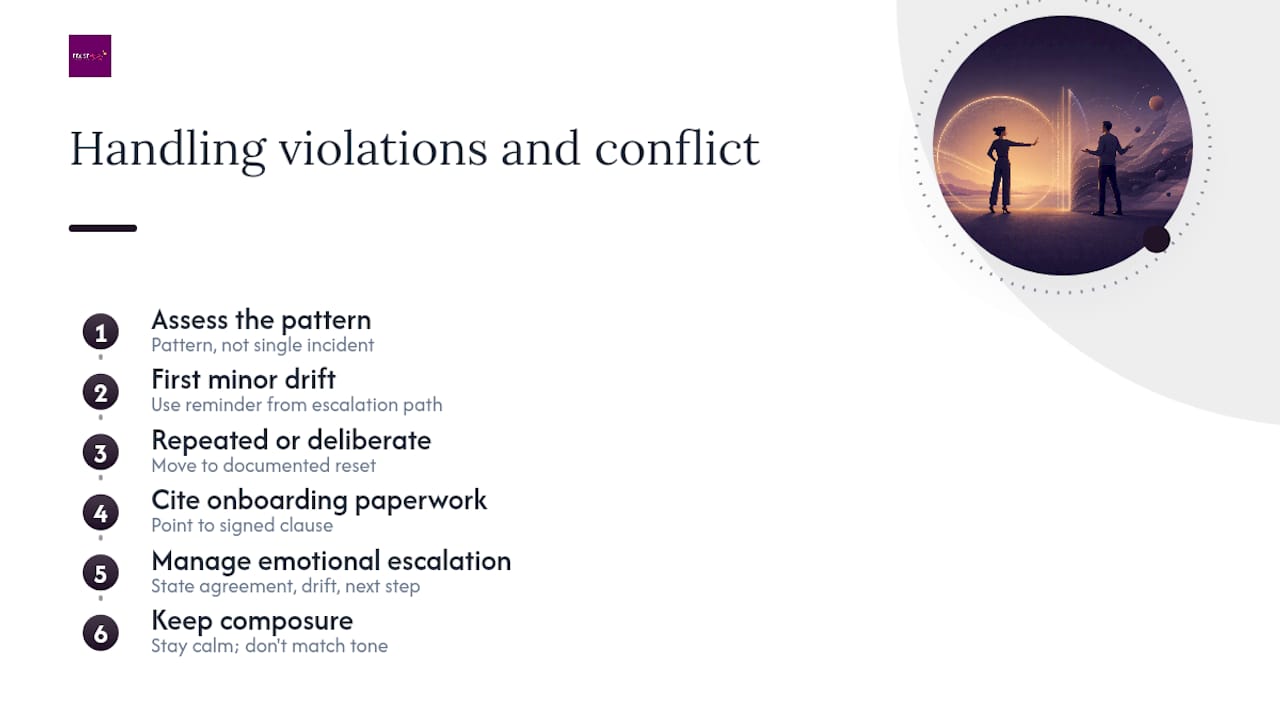
Not every violation deserves the same response. Calibrate the reaction to the pattern, not the single incident.
A first-time, minor drift, one late-night message, one missed payment date, usually warrants nothing more than the reminder step from your escalation path. Treating every small slip as a crisis burns goodwill you'll need later and makes you look rigid rather than professional.
A repeated or deliberate violation is different. If a client has been reminded once and does the same thing again within the same project, move straight to the documented reset. Skipping steps here isn't harsh, it's what keeps your rules meaningful.
Conflict tends to escalate fastest when a client feels caught off guard by enforcement they didn't see coming. This is why the paperwork from onboarding matters so much: pointing to a clause both sides signed defuses far more tension than asserting a boundary that sounds like it's being invented on the spot. Keep your language factual during the conversation itself: state the agreement, state the drift, state the next step. Avoid justifying the boundary's existence mid-conflict, that conversation should have happened at onboarding, not during a dispute.
If a client escalates emotionally, accusations, guilt, threats to leave, resist the urge to match the tone. A calm, consistent response, even one that ends the relationship, protects your reputation with every future client far more than winning the argument does.
How do you balance empathy with professionalism?
Empathy and boundaries are not opposites, despite how often that framing gets repeated. A boundary held with warmth is still a boundary. A boundary abandoned out of guilt just becomes an unpaid favour, which helps nobody, including the client, who's now learned your limits aren't reliable.
The failure mode worth watching for is treating every accommodation request as a referendum on whether you're a caring professional. It isn't. You can decline a scope-creep request and still care deeply about the client's outcome, the two aren't in tension. What actually damages the relationship is inconsistency: warmth on Monday, rigidity on Friday, with no visible logic connecting the two.
Practically, this means separating your tone from your terms. Your tone can flex, warmer with an anxious first-time client, brisker with a seasoned one, without your terms flexing at all. "I hear that this deadline feels urgent, and I want to help you hit it. Here's what that would need to look like given our current scope" delivers empathy and a boundary in the same breath. That's a more sustainable habit than choosing between being liked and being respected, because in professional relationships that last, you generally need both.
Publisher perspective: why ProspHER emphasises boundary work
Across our community of over 2,400 women, we've watched boundary work do more for career momentum than almost any other single skill, partly because 94% of members report gaining clearer direction within 30 days once they stop absorbing everyone else's demands by default. It's woven into our mentorship pathways precisely because clarity with clients and clarity with yourself tend to arrive together. This week, pick one client relationship and write down the one rule you'd enforce if you weren't worried about the reaction.
— ProspHER
Where can you get support putting these rules into practice?
Contracts and scripts handle the mechanics. What often breaks boundary practice down in real life is the moment of doubt, the "am I overreacting?" pause before you send the reset email. That's where a community built specifically for ambitious women closing that gap earns its place.
ProspHER gives you what a template pack alone can't: a mentor who's held the same boundary conversation before, an accountability partner who checks whether you actually sent that reset email, and workshops built around exactly this kind of operational confidence. Members use the career clarity pathways to turn a vague sense of being overextended into specific, written rules they can point to, the same way this article has walked through. None of this replaces a proper contract or legal advice on your specific terms, that's still worth getting from a solicitor. It does replace the isolation of figuring out boundary language alone at 11pm. Visit ProspHER to see which membership pathway fits where you are right now.
Sources
- Maintaining professional boundaries | The HCPC
- The benefits of better boundaries in clinical practice
- Setting boundaries with clients (operational guidance)
- Managing hybrid workplace (Stanford Online)
- Managing hybrid-work best practices (Carnegie Mellon University HR)