
The fastest way to find a mentor in the UK right now is to look inside your existing network first, then send one short, specific message asking for a short, specific amount of time on a single issue. Not "will you be my mentor?" Just: "I'm working through X — could we talk for 25 minutes?" That one shift removes most of the friction that stops people from reaching out at all.
Here is your immediate action plan:
- Identify one person in your workplace, alumni network, or LinkedIn connections who has navigated something you are facing now.
- Send a brief message today with your context, the specific issue, and a proposed meeting length (see templates in Section 4).
- If you want a structured, women-focused route, ProspHER offers a membership with built-in mentorship, community, and measurable outcomes for ambitious women.
GOV.UK guidance on business mentoring confirms that mentoring is one of the most practical ways to grow a business or career, and Forbes research reinforces that it is never too early to start gathering mentors, even while job hunting.
Table of Contents
- Where do you actually find mentors?
- How do you choose the right mentor?
- How to approach a potential mentor: scripts and outreach steps
- What mentoring formats work, and how do you set one up?
- What does research say about mentoring at different career stages?
- What does mentoring cost, and where can you find it free in the UK?
- How do you get the most from a mentor once you have one?
- Key takeaways
- Why structured mentorship changes the outcome for ambitious women
- ProspHER: a structured mentoring route built for ambitious women
- Useful UK sources and further reading
Where do you actually find mentors?
The channel you choose shapes the kind of mentorship you get. Here is a map of the six most productive channels and what each one typically delivers.
- Workplace or line manager network: Practical, context-specific guidance on navigating your organisation, sponsorship for internal opportunities, and onboarding support. Best for: early-career professionals and anyone in a new role.
- Alumni networks: Warm introductions into sectors and companies, peer solidarity, and credibility signals. Best for: career changers and those targeting a specific industry.
- Professional bodies and chartered institutes: Sector standards, CPD pathways, and access to senior practitioners. Best for: those seeking technical depth or regulated-profession credibility.
- Events and conferences: Network starters and serendipitous connections. Best for: building a broad network quickly, especially if you are new to an industry.
- Online platforms and communities: Quick expert access, asynchronous advice, and global reach. ADPList is a free platform where professionals offer mentoring sessions across disciplines.
- Membership communities: Structured pathways, accountability, and curated matching. Best for: women seeking consistent support with measurable outcomes, particularly for career advancement or entrepreneurship.
Matching channel to goal:
| Goal | Best channel |
|---|---|
| Career move or sector change | Alumni network, professional body |
| Technical skill development | Online platforms, professional body |
| Leadership development | Membership community, events |
| Entrepreneurship | Membership community, peer network |

Peer mentoring deserves a specific mention. Psychology Today research highlights lateral mentoring as a practical and durable approach: peers offer immediate, relevant advice and are far easier to access than senior leaders. Do not overlook the person two desks away or in the same online community.
Pro Tip: Warm introductions convert at a significantly higher rate than cold outreach. Before you message a stranger, ask yourself: does anyone in my current network know this person? A one-line introduction from a mutual contact can turn a cold email into a welcomed conversation.
How do you choose the right mentor?

Speed matters here. You do not need a lengthy evaluation process. You need a short checklist and the confidence to move on quickly when the fit is wrong.
Selection checklist:
- Does their experience align directly with your current goal (not just your industry)?
- Do they have genuine availability, not just goodwill?
- Is their mentoring style compatible with how you learn (direct feedback vs. exploratory questioning)?
- Do they bring a perspective that challenges yours, not just confirms it?
- Are they willing to be specific and honest, rather than only encouraging?
Priority rules by career stage:
- Early career: Prioritise someone who knows your specific context (sector, organisation type, or role level) and can help you navigate unwritten rules.
- Mid-career: Prioritise candid, action-oriented feedback over general encouragement. The mentor who tells you what is actually holding you back is worth more than one who validates your existing plan.
- Senior career: Prioritise someone who will challenge your thinking and test your decisions, not just affirm your authority.
Questions to ask in a first meeting:
- How do you typically structure a mentoring relationship?
- What do you expect from a mentee between sessions?
- Can you share an example of a challenge you helped someone work through?
- How do you prefer to give feedback?
Red flags to watch for:
- They redirect every conversation back to their own story.
- They are vague about availability or cancel repeatedly without rescheduling.
- They give only positive feedback, regardless of what you share.
- They push a specific outcome that serves their interests rather than yours.
The National Careers Service notes that a good mentor has knowledge and experience relevant to you, and crucially, the willingness and capacity to guide you. Both matter equally.
How to approach a potential mentor: scripts and outreach steps
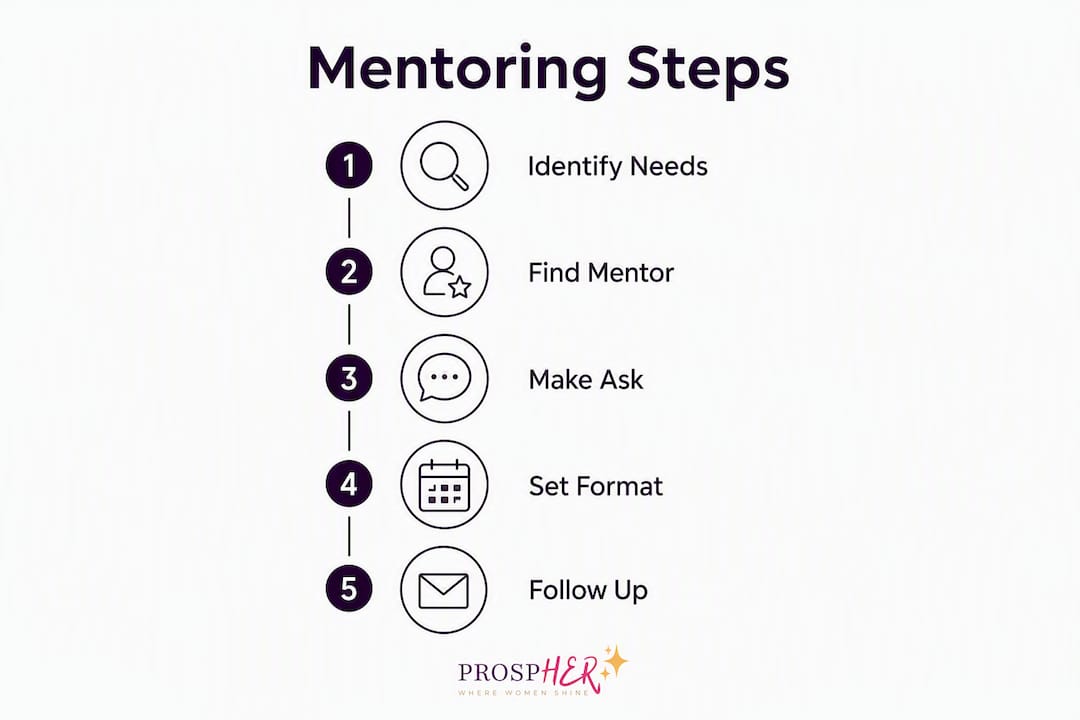
The single most common mistake is asking someone to "be your mentor" in a first message. It is a big, open-ended commitment that most busy people will quietly decline. Lead with a specific, time-limited ask instead.
Step-by-step outreach sequence:
- Research: Read their recent work, LinkedIn activity, or public talks. Find one specific thing that connects to your situation.
- First contact: Send a short message (see templates below). Keep it under 100 words.
- The ask: Request a short conversation on one specific issue, not an ongoing relationship.
- Follow-up: If no reply after 7–10 days, send one brief follow-up. After that, move on.
- After the meeting: Send a thank-you note within 24 hours. Summarise what you took away and propose a specific next step if the conversation warranted it.
Template 1 — LinkedIn or InMail:
Template 2 — Email (cold or warm introduction):
Template 3 — Event follow-up:
Research from UW Online Collaboratives confirms that messages with a clear background and a specific request tend to get better response rates. Applied developmental psychologist Deborah Heiser, cited by CNBC, adds that many mentoring relationships begin with small requests after a chance conversation, and cold emails are entirely acceptable when they are brief and specific.
Micro-practices that reduce friction for the mentor:
- Suggest two or three specific timeslots rather than asking them to propose one.
- State the agenda in one sentence before the meeting.
- Confirm the meeting length and stick to it.
What mentoring formats work, and how do you set one up?
Mentoring is not one thing. The format you choose should match your goal and your mentor's capacity.
- One-off advice session: A single 30–60 minute conversation on a specific decision or challenge. Low commitment, high value. Ideal as a first step or for a targeted question.
- Short issue-based mentoring: Three to six sessions over 6–12 weeks, focused on one defined problem (a promotion application, a business pivot, a leadership challenge). Structured programmes for women founders and executives often use this model, with minimum commitments and structured calls to ensure fit and results.
- Long-term mentoring or sponsorship: An ongoing relationship, typically six months to two years, where the mentor actively advocates for you as well as advising you. Requires significant trust and mutual investment.
- Peer mentoring: Regular exchanges with a peer at a similar career stage. Highly accessible and often more candid than senior mentoring. Psychology Today identifies this as a durable approach that many professionals underuse.
Sample mentoring agreement (adapt as needed):
- Scope: We will focus on [specific goal or challenge] over the next [X weeks/months].
- Meeting cadence: [Frequency, e.g. fortnightly, 45 minutes per session].
- Preparation: Mentee brings a specific question or update to each session; mentor reviews any shared materials in advance.
- Confidentiality: All conversations remain confidential unless otherwise agreed.
- Review point: We will assess progress and decide whether to continue at [agreed date].
- Exit: Either party may end the arrangement with one session's notice.
For readers exploring women's business mentoring in more depth, ProspHER's guide covers UK membership-based options in detail.
What does research say about mentoring at different career stages?
Forbes is clear: mentorship needs differ significantly by career stage, and short, focused engagements tend to outperform vague long-term arrangements. The table below maps what each stage typically needs.
| Career stage | What you need most | Best-fit mentor type |
|---|---|---|
| Early career | Context, navigation, unwritten rules | Internal senior colleague, alumni peer |
| Mid-career | Candid strategic feedback, visibility | External senior leader, peer group |
| Senior/executive | Decision-testing, challenge, vision alignment | Executive coach, peer board, structured programme |
Short, issue-based mentorships are often more effective than open-ended arrangements. Defining the problem first and proposing a time-limited engagement gives both parties clarity and makes outcomes measurable.
The practical implication: match your request type to your stage. Early-career professionals benefit most from asking for help navigating a specific situation (a first performance review, a new team dynamic). Mid-career women gain most from mentors who give direct, promotion-relevant feedback rather than general support. Senior leaders need someone willing to challenge their assumptions, which is why high-touch frameworks combining strategic advisory with practical implementation tools are recommended at that level.
For women over 50 navigating a career transition, career advice tailored to that stage addresses the specific mentor types and engagement models that work best.
What does mentoring cost, and where can you find it free in the UK?
Free mentoring exists in the UK, and it is genuinely good. Paid mentoring adds structure, accountability, and often speed.
Free options:
- GOV.UK business mentoring: — The GOV.UK guidance signposts government-backed and voluntary mentor programmes for business owners.
Paid options and what they include:
Realistic timeline from first contact to an established rhythm:
Paid mentoring often offers more structure and accountability compared to volunteer arrangements. For readers weighing the options, women's career coaching providers in the UK offers a useful comparison of paid routes.
How do you get the most from a mentor once you have one?
The mentee owns the agenda. That is the single principle that separates productive mentoring from pleasant but directionless conversations.
30–45 minute session agenda:
- Opening (5 minutes): Brief update since last session. What has changed?
- Objective (5 minutes): State the one thing you want to leave the session having resolved or progressed.
- Current evidence (10 minutes): Share what you have tried, what you know, and where you are stuck.
- Options (10 minutes): Explore two or three possible paths with your mentor's input.
- Next steps (5 minutes): Agree one to three specific actions before the next session.
Progress metrics to track:
- Decisions taken since the last session (and the outcome).
- Skills practised or applied in the real world.
- Confidence indicators: situations you handled differently because of the mentoring.
- Feedback received and acted on.
On feedback: Ask for it directly. "What would you have done differently?" is more useful than "What did you think?" When you receive critical feedback, resist the urge to explain or defend. Note it, sit with it, and return to it at the next session with a response.
When to renegotiate: if sessions feel repetitive, the original issue has been resolved, or your goals have shifted, say so. A brief review conversation ("I feel we've covered X well — should we shift focus to Y?") keeps the relationship productive and respects both parties' time. Peer mentoring, as Psychology Today notes, works particularly well when both parties commit to this kind of honest, agenda-led exchange.
Key takeaways
Finding the right mentor comes down to three things: knowing where to look, making a specific low-commitment ask, and owning the agenda from the first session.
| Point | Details |
|---|---|
| Start inside your network | Warm contacts convert far better than cold outreach; check your workplace and alumni connections first. |
| Lead with a specific ask | Request 20–30 minutes on one issue, not an open-ended mentoring relationship. |
| Match mentor type to career stage | Early career needs context; mid-career needs candid feedback; senior level needs challenge and decision-testing. |
| Own the session agenda | Prepare a specific question for every meeting; the mentee drives the value, not the mentor. |
| ProspHER for structured support | ProspHER's membership gives ambitious women built-in mentorship, community, and measurable outcomes, with 94% of members reporting clearer direction within 30 days. |
Why structured mentorship changes the outcome for ambitious women
Here is something most mentoring advice glosses over: the quality of a mentoring relationship depends almost entirely on the structure around it, not the seniority of the mentor.
We see this pattern repeatedly. A woman secures a coffee chat with an impressive senior leader. The conversation is warm, inspiring, and completely unstructured. Six weeks later, nothing has changed. Not because the mentor was unhelpful, but because there was no framework to turn that conversation into momentum.
The conventional wisdom says: find the most senior person willing to talk to you. We would push back on that. A peer who gives you direct, specific feedback within a clear framework will move you further than a high-profile name who meets you twice a year with no agenda. The research backs this up: short, issue-based engagements with clear objectives consistently outperform open-ended arrangements, regardless of the mentor's seniority.
This is why ProspHER was built the way it was. Not as a directory of impressive names, but as a structured environment where ambitious women get clarity, community, and a pathway that is specific to where they are right now. 94% of ProspHER members report gaining clearer direction within 30 days. That outcome does not come from access alone. It comes from structure.
The women who get the most from mentoring are not the ones who found the most impressive mentor. They are the ones who showed up prepared, asked specific questions, and held themselves accountable between sessions. If you build that habit, the mentor almost becomes secondary.
ProspHER: a structured mentoring route built for ambitious women
Clarity in 30 days, not six months of vague conversations. That is what ProspHER delivers for ambitious women who want mentorship with direction built in.
ProspHER is a membership platform for women who are serious about career advancement or building a business, and who want more than a one-off coffee chat. Membership includes structured mentorship, group coaching, community events, a content library, financial literacy programmes, and mindset training. Everything is designed to give you a personalised pathway, not a pile of content to wade through.
Three things ProspHER gives you that informal mentoring often cannot:
- Structured matching and measurable goals: your development pathway is tailored to your current stage and ambitions, with clear milestones.
- Community accountability: over 2,400 women in the same community, many navigating the same challenges you are facing right now.
- Consistent momentum: regular touchpoints, events, and resources that keep you moving between sessions rather than waiting for the next coffee chat.
Ready to find your direction? Join ProspHER and see what a structured, women-focused membership can do for your career or business.
Useful UK sources and further reading
- GOV.UK: Work with a mentor — the government's own guidance on finding a business mentor in the UK, including signposts to supported programmes.
- National Careers Service: Getting the most out of mentoring — practical advice on what to expect from a mentoring relationship and how to make it work.
- Forbes: How to find the right mentor at every career stage — research-backed guidance on matching mentor type to career stage, with a strong case for short, issue-based engagements.
- CNBC: How young professionals can build mentor relationships — expert tips on early outreach and making cold contact work.
- Psychology Today: Forget what you know about mentoring — the case for peer and lateral mentoring as a practical, underused alternative to senior-only relationships.
- ADPList — a free global platform where professionals offer mentoring sessions; useful for quick expert access across disciplines.
- ProspHER: Women's business mentoring guide — a UK-focused guide to membership-based mentoring options for women in business.
- Windsor Fellowship — a UK-based organisation running structured development and mentoring programmes, particularly for underrepresented professionals.
- Networking in sustainable finance — for readers in the sustainable finance sector, a practical guide to initiating contact and building mentor relationships within that specialism.