
A career values assessment identifies the small set of non-negotiable priorities, whether that's autonomy, security, impact, or financial reward, that determine whether a job will feel genuinely fulfilling for you. It's a diagnostic tool, and it works: research on person–organisation values fit shows this alignment is strongly linked to job satisfaction and organisational commitment. Get the diagnosis right, and everything else, negotiations, applications, that nagging feeling you should quit, gets easier to act on. Here's what we cover:
- What career values assessments actually measure and where to find one
- The core values that shape workplace happiness, with real examples
- A three-phase method for taking an assessment properly
- How to turn your results into a 30/60/90-day plan
Key Takeaways
Career values assessments work because they turn vague dissatisfaction into named, testable gaps that can be fixed, negotiated, or acted on within 90 days.
| Point | Details |
|---|---|
| Define your top three | Narrow a full values list to three genuinely non-negotiable priorities before scoring your current role against them. |
| Use the trade-off test | If you wouldn't sacrifice pay, time, or comfort for it, it's a preference, not a core value. |
| Follow the three-phase method | Select, force trade-offs, then anchor each value with a specific recent incident as evidence. |
| Score before you quit | Classify each value as thriving, adequate, or starving, and test a fix over 30/60/90 days before assuming the role is unfixable. |
| Get structured support | ProspHER pairs assessment insight with mentorship and community accountability to keep a 90-day plan from stalling. |
Table of Contents
- What does a career values assessment measure?
- Common career values, and how they actually show up at work
- How to take a career values assessment properly
- Turning your results into a plan that actually works
- What the research says, and where ProspHER fits in
- Getting ready before you sit down with the questions
- Where people get their results wrong
- Editorial perspective: values are decision rules, not feelings
- Ready to act on what you've learned?
- Sources
What does a career values assessment measure?
A career values assessment sorts your priorities into three buckets: intrinsic (the work itself, mastery, meaning), extrinsic (pay, title, recognition), and lifestyle (flexibility, location, hours). Most tools ask you to rank or trade off items across these three dimensions rather than treating them as one long list.
You'll find several formats once you start looking:
- Quick quizzes — five minutes, a handful of questions, a snapshot rather than a diagnosis
- Structured scales — rate 15 to 20 values on importance, useful for spotting patterns
- Card sorts — physically or digitally sort values into piles (must have, nice to have, don't care)
- Forced trade-offs — pick between two values repeatedly until a hierarchy emerges
Free versions range from five-minute quizzes to fifteen-minute diagnostics, and they're genuinely useful for personal reflection. Professional assessments, the kind a coach might run with you, go deeper: they produce a written report, often cross-reference your values against your current role, and give you language to use in a difficult conversation with your manager. Neither is "better" outright. It depends on whether you need a nudge or a full recalibration.
Common career values, and how they actually show up at work
Reading a values list in the abstract rarely tells you anything. Seeing how each one plays out at your desk does.
- Autonomy — you decide how a task gets done, not just what the outcome should be. Shows up as: choosing your own working hours, or being trusted to run a project without check-ins every two days.
- Security — predictable income and stable structure. Shows up as: preferring a permanent contract over a higher-paid freelance gig with no guarantees.
- Work–life balance — clear boundaries between job and home. Shows up as: leaving at 5:30pm without guilt, or refusing weekend emails.
- Impact — seeing your work change something real. Shows up as: caring more about outcomes for clients than about your own title.
- Mastery — getting genuinely better at a skill. Shows up as: choosing the harder, more technical project over the easier, higher-visibility one.
- Financial reward — pay as the primary driver. Shows up as: taking the higher-salary offer even when the culture feels average.
- Recognition — visible credit for your contribution. Shows up as: caring who presents the results, not just that the project succeeded.
- Variety — no two days looking the same. Shows up as: dreading a role that repeats the same four tasks on a loop.
The full list of common career values groups these into the intrinsic, extrinsic, and lifestyle categories mentioned earlier.
Pro Tip: Run the price test on anything you're unsure about. Would you take a pay cut to get more of it? A shorter commute to lose it? One British values exercise uses exactly this logic: if you wouldn't trade anything for it, it's a preference, not a value.
How to take a career values assessment properly
Most people rank a list once and call it done. That's the weakest version of this exercise. A proper career values assessment runs in three phases.
- Select. Start from a research-backed list, ideally 20 to 30 items, and cut it down to your top eight or ten. Card sorting works well here because moving physical or digital cards forces a decision, rather than letting you rate everything a 4 out of 5.
- Force the trade-offs. Take your shortlist and compare items in pairs: autonomy versus security, impact versus pay. This is where the real hierarchy appears. Forced trade-offs and evidence anchoring produce more reliable results than simple rank-ordering, because ranking lets you dodge the hard choices.
- Anchor with evidence. For each of your top three, write down a specific recent incident that proves whether it's being met. Not "I value autonomy" but "last Tuesday my manager rewrote my proposal without asking, and it stung."
Free quizzes cover phase one reasonably well but rarely push you through phases two and three. That gap is exactly where professional assessments earn their keep, and it's also something you can do yourself with fifteen focused minutes and a notebook. The correlation between values fit and organisational commitment sits at a substantial .51 in meta-analytic research, which is a strong enough signal to justify doing this properly rather than rushing phase one and skipping the rest.
Turning your results into a plan that actually works
Once you have your top three values and the evidence behind them, score your current role against each one: thriving, adequate, or starving. This is the same framing used by practical values-based tools, and it works because it forces a decision rather than a vague sense of unease.
A starving value doesn't always mean quit. Sometimes it means:
- Negotiating your hours if work–life balance is starving but the job itself is fine
- Requesting a project swap if mastery is starving but the team is strong
- Asking for a title change or public credit if recognition is the gap
Structural gaps are different. If autonomy is starving because your manager micromanages by nature, or security is starving because the company is visibly unstable, no amount of negotiation fixes it.
Pro Tip: Give any fix a genuine 30/60/90-day trial before deciding it hasn't worked. Note the starving value on day one, agree a specific change, then check back at each milestone rather than judging it after one bad week. A structured goal-setting approach makes these checkpoints concrete instead of aspirational.

If, at day 90, the same value is still starving and you've tried a genuine fix, that's your signal to start looking rather than keep negotiating.
What the research says, and where ProspHER fits in
Values fit isn't a soft, feel-good metric. It's one of the stronger predictors of whether you'll stay in a job and how satisfied you'll be while you're there.
Person–organisation values fit correlates strongly with organisational commitment, at a level meta-analytic research places around .51, stronger than most single factors including pay alone.
Values also aren't fixed; understanding your evolving priorities can be supported by resources like workplace fulfillment guides that explore the alignment between your values and job satisfaction. What you prioritised at 25 rarely matches what you prioritise at 45, which is why reassessment after major life changes matters more than doing this once and filing the result away. ProspHER's community includes many women who find that clarity on values means nothing without a structure to act on it, mentorship, coaching, and accountability that turns a diagnosis into a plan.
Getting ready before you sit down with the questions
The quiz itself takes minutes. The thinking beforehand is what makes the answers honest.
Before you open any career values quiz, spend ten minutes with a blank page and two questions: what moments at work have felt genuinely good in the last six months, and what moments have made you want to quit on the spot. Write three or four of each, with enough detail that you remember the context. This matters because most people walk into an assessment answering from memory of who they were five years ago, not who they are now.
Set an intention before you start. Are you doing this because something feels wrong and you can't name it, or because you're weighing two live offers? The two situations call for different honesty. If you're comparing offers, answer as your ambitious, forward-looking self. If something feels wrong, answer as the version of you sitting at your desk on a bad Tuesday, resentment and all. Blending the two produces a muddled result that satisfies neither question.
Resist the urge to answer as your "ideal professional self." If you tell yourself you value impact above all because it sounds admirable, but you've turned down three high-impact, lower-paid opportunities in a row, the evidence disagrees with the self-image. Career values work only when the answers match your actual behaviour, not your aspirational one. Treat contradictions as data, not failure.
Where people get their results wrong
The most common mistake is confusing a skill with a value. Being good at public speaking doesn't mean you value recognition, and being competent at spreadsheets doesn't mean you value mastery. A value is about what you want from work; a skill is about what you're capable of doing. Conflate the two, and you'll chase roles that use your strengths but starve your actual priorities.
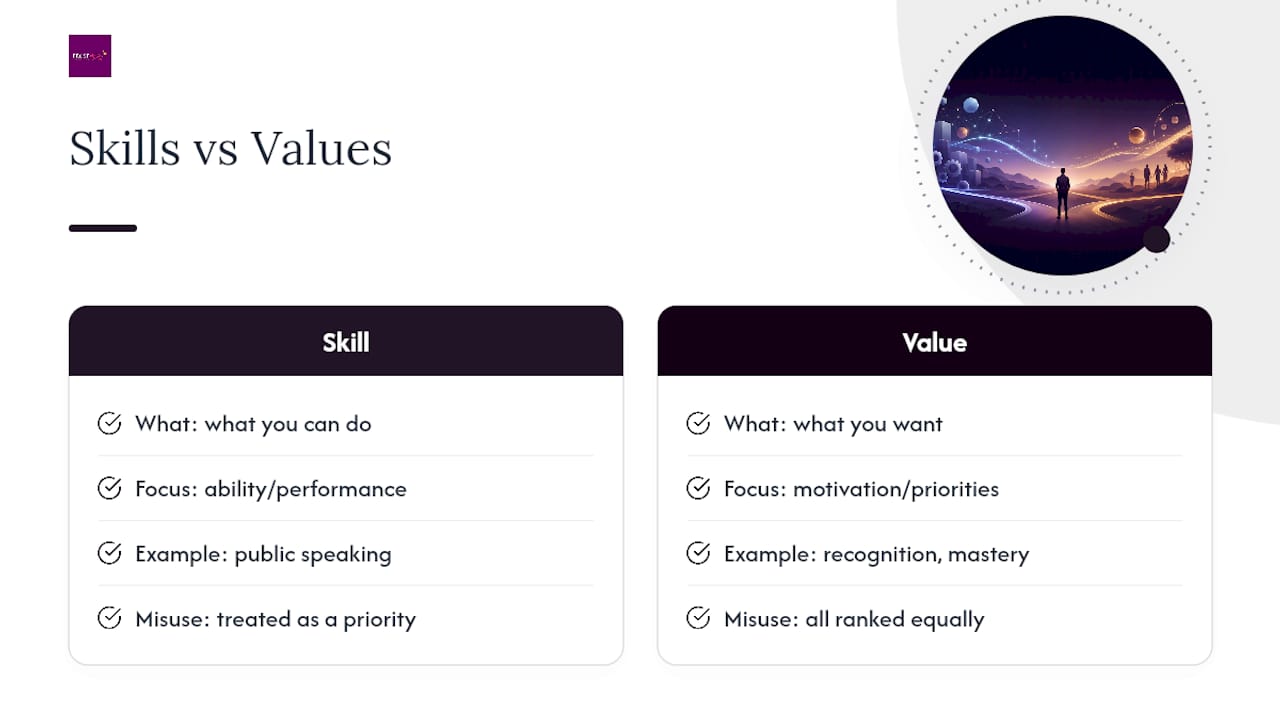
The second mistake is treating every top-ranked value as equally urgent. Most assessments surface eight to ten meaningful values, but only two or three are genuinely load-bearing, the ones that make a job intolerable when missing. Trying to satisfy all ten at once, in one role, sets you up to reject perfectly good offers over minor gaps.
Context contamination is the third trap. Answering a values quiz the week after a brutal appraisal, or the week you got a surprise bonus, skews results towards whatever just happened rather than your stable priorities. If your results feel oddly extreme, wait a fortnight and retake it before trusting the output.
Finally, people forget that a starving value calls for diagnosis before action. Seeing "work–life balance: starving" on a report and immediately handing in your notice skips the step where you check whether it's fixable, a policy change, a manager conversation, a role adjustment, before assuming the whole job is the problem. Career changers navigating transitions later in their career often find the gap was situational, not structural, once they actually tested it.
Editorial perspective: values are decision rules, not feelings
Values work best as decision rules, not sentiments. Career capital, the leverage you've built through experience, buys you the version of a value you actually want, rather than a vague approximation of it. Reassess after redundancy, a promotion, or becoming a parent. And don't mistake enjoying a task for valuing what it represents. Skill and interest are not the same as a value.
— ProspHER
Ready to act on what you've learned?
Knowing your top three values is progress. Building a plan around them without a support structure is where most people stall, three weeks in, back to old habits, no accountability in sight. ProspHER exists for exactly that gap: personalised pathways that match where you actually are, whether that's negotiating flexibility in your current role or plotting an exit, backed by mentorship, group coaching, and a community of over 2,400 women who ask the follow-up question you'd otherwise avoid.

Members report gaining clearer direction within 30 days, not because the platform floods them with content, but because it focuses on the handful of resources relevant to their specific starving values. If your assessment surfaced a structural gap, ProspHER's career roadmap guidance turns that diagnosis into a working 30/60/90-day plan rather than leaving it as a document you never reopen. Explore membership on the ProspHER platform and take the next concrete step while your results are still fresh.
Sources
- Person–organization fit and job outcomes | Taylor & Francis
- Work values assessment | Values Institute