
You can begin measurable recovery from burnout by reducing the single biggest ongoing drain in your life and protecting your sleep. Start today by creating one firm boundary, whether that means declining a non-urgent request, leaving work at a set time, or asking someone to take one task off your plate. Recovery is not a single act of rest. It is a structured process, and the sooner you begin it, the faster your nervous system can stabilise.
If you are in crisis right now: if you are having thoughts of suicide or self-harm, call Samaritans on 116 123 (free, 24/7) or NHS 111. You can also go to your nearest A&E. Please do not wait.
- Today: identify the one commitment draining you most and communicate a limit around it.
- This week: protect seven to eight hours of sleep for at least five consecutive nights and tell one trusted person what you are going through.
Gallup data cited in population-level analyses suggests close to 31% of women report frequent burnout, a rate consistently higher than their male counterparts. That gap is not a coincidence. It reflects caregiving loads, workplace inequities and hormonal factors that a generic recovery plan simply does not account for. This guide is built around those realities.
Pro Tip: Write down the one thing consuming the most energy right now. Not a list. One thing. That is your first boundary target.
Key takeaways
Burnout recovery for women requires reducing the primary stressor, stabilising sleep, accessing evidence-based therapy, and making structural changes to prevent relapse.
| Point | Details |
|---|---|
| Start with one boundary | Identify the single biggest drain and communicate a limit around it today. |
| Therapy has strong evidence | CBT, ACT, and MBSR are all supported by peer-reviewed evidence for reducing burnout symptoms. |
| Recovery takes time | Mild burnout may improve in weeks; moderate to severe cases typically take several months of consistent effort. |
| Structural change prevents relapse | A workload audit and negotiated role adjustments are often required for durable recovery, not just rest. |
| ProspHER offers community support | Over 2,400 women, mentorship, and resilience workshops provide structured non-clinical support alongside therapy. |
Table of Contents
- What are the signs of burnout in women?
- Why are women more likely to experience burnout?
- What are the most effective evidence-based recovery steps for women?
- What does a realistic burnout recovery timeline look like?
- When should you seek professional help, and how do you access UK services?
- How do you audit your workload and prevent burnout from returning?
- How do community and career support help you recover?
- ProspHER: structured support for women rebuilding after burnout
- Sources
What are the signs of burnout in women?
The WHO classifies burnout as an occupational phenomenon, not a medical diagnosis, defined by three markers: energy depletion, growing mental distance from work, and reduced professional effectiveness. That distinction matters for how you seek help. Burnout is rooted in sustained occupational stress; depression is a clinical condition with broader causes. The two can overlap, and burnout can raise the risk of depression, but they are not the same thing. Stress is temporary pressure that lifts when the stressor eases. Burnout is what happens when that pressure never eases and your capacity to cope erodes entirely.
How do you know which one you are dealing with? Burnout tends to improve somewhat when you step away from work. Depression typically does not. If you feel better on holiday but collapse again within days of returning, burnout is the more likely primary driver.
Common signs of burnout in women include:
- Physical: persistent exhaustion that sleep does not fix, frequent illness, headaches, digestive problems, muscle tension, disrupted appetite
- Emotional: emotional numbness or flatness, irritability, feeling detached from people you care about, crying without knowing why, dread before work
- Cognitive: brain fog, difficulty concentrating, forgetting things you would normally remember, inability to make decisions, loss of creativity
- Behavioural: withdrawing from friends and family, neglecting self-care, increased reliance on alcohol or caffeine, reduced performance despite longer hours, procrastination on tasks you previously managed easily
Quick self-assessment: if five or more of the above have been present for more than two weeks and are affecting your ability to function at work or at home, treat that as a meaningful signal. Duration and functional impairment are the two factors that shift concern from ordinary stress to burnout requiring active intervention.
Pro Tip: Keep a five-day symptom log before your GP appointment. Note sleep hours, energy level (1–10), and one emotional observation per day. It takes three minutes and gives your doctor something concrete to work with.
Why are women more likely to experience burnout?
The short answer: women carry more. Not because of any inherent weakness, but because of structural and biological realities that stack on top of each other.
Structural and social drivers:
- Women still perform a disproportionate share of unpaid domestic and caregiving work, adding hours to an already full working day
- Emotional labour at work, managing team morale, absorbing others' stress, smoothing conflict, falls disproportionately on women and is rarely recognised or rewarded
- Workplace inequities including pay gaps, limited progression, and the pressure to prove competence repeatedly create a chronic low-grade stress that accumulates over years
- High-achiever and perfectionist patterns, often reinforced from childhood, make it harder to stop, delegate, or ask for help
Research from the APA highlights that many women interpret rest as failure, a belief that delays recovery and deepens the cycle. Reframing rest as a professional necessity, not a reward for finishing everything, is one of the most clinically significant mindset shifts in recovery.
Biological and hormonal factors:
Hormonal fluctuations across the menstrual cycle, perimenopause, and menopause affect cortisol regulation, sleep quality, and emotional resilience. During the luteal phase (the week before a period), many women experience heightened anxiety and fatigue that can amplify burnout symptoms. Perimenopause brings sleep disruption, mood volatility, and cognitive changes that are frequently misread as burnout alone, or vice versa. Pregnancy and the postpartum period add physical depletion to an already demanding period.

A PMC review on biological markers confirms that severe, prolonged burnout dysregulates the HPA axis (the body's stress-response system), increasing allostatic load and affecting physical health. This is why recovery timelines for women navigating hormonal transitions tend to be longer and require more structural support.
Neurodivergence and intersectional factors:
Women with ADHD are at particularly high risk. Masking neurodivergent traits in professional environments is cognitively exhausting, and many women reach their thirties or forties before receiving a diagnosis, having spent years compensating without support. Cultural pressure, particularly for women from communities where asking for help carries stigma, adds another layer. For women in leadership, the specific pressures of that role compound the picture further.
Pro Tip: Track your energy and mood alongside your menstrual cycle for one month using a simple app or notebook. Patterns often emerge within a single cycle, giving you data to share with a GP or therapist and to plan your workload around.
What are the most effective evidence-based recovery steps for women?
The highest-leverage moves, in order: reduce the primary stressor, stabilise sleep, secure consistent social support, and start therapy when symptoms are moderate or severe. Everything else builds on those four.
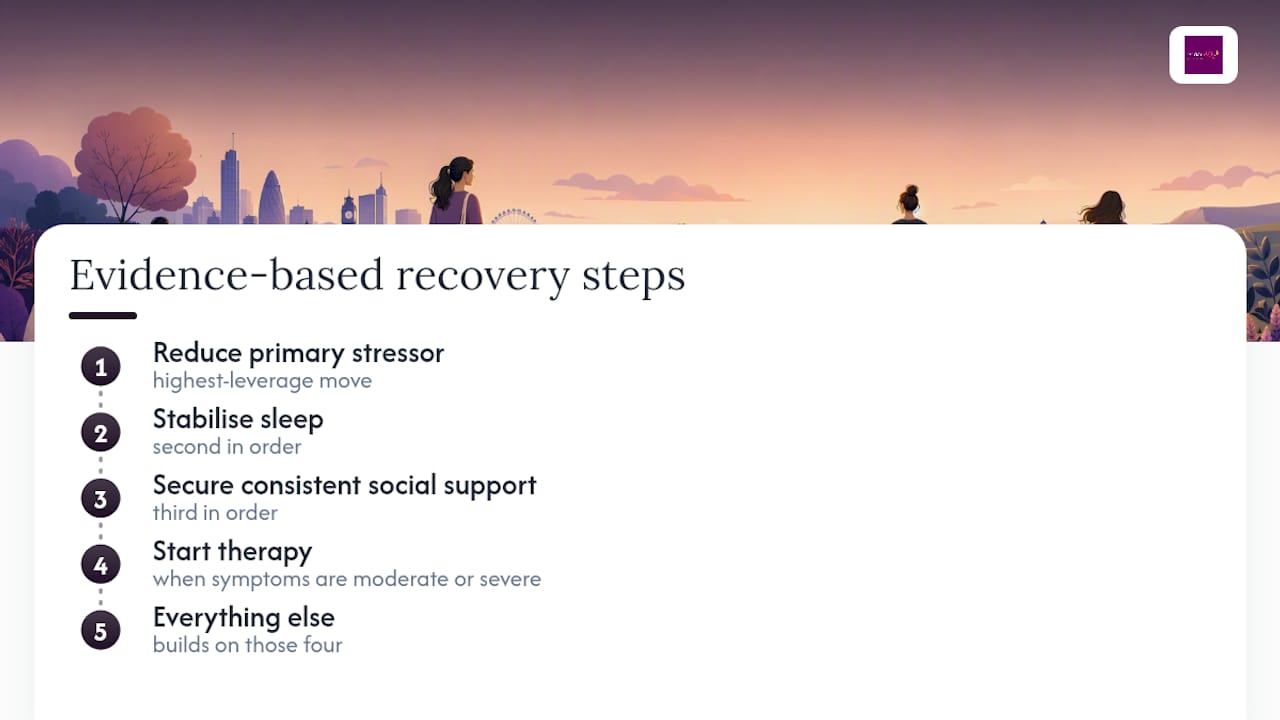
Step 1: stop the main drain
Before any other intervention, identify the single biggest source of depletion and reduce it. This might mean a conversation with your manager, stepping back from a voluntary commitment, or delegating one recurring task. You cannot recover while the wound is still open.
Step 2: regulate your nervous system (orient → activate → rest)
Many women in burnout enter a state of functional freeze, a dorsal vagal shutdown where the nervous system has gone into conservation mode. Rest alone can worsen this state. The sequence that works is: orient (gentle sensory grounding, a short walk, noticing five things around you), then gentle activation (light movement, a brief creative task, connection with a friend), then rest. Jumping straight to rest when you are in freeze often deepens the shutdown rather than lifting it.
Step 3: protect sleep
Sleep is the single most restorative intervention available without a prescription. Aim for a consistent wake time first, even before you fix bedtime. Reduce screens for 60 minutes before sleep, keep the bedroom cool, and avoid alcohol, which fragments sleep architecture even in small amounts.
Step 4: gentle movement
Vigorous exercise can spike cortisol in an already dysregulated system. Start with walking, yoga, or swimming. Fifteen minutes daily is more effective than one intense session per week.
Step 5: nutrition and blood sugar
Skipping meals and relying on caffeine to function are common in burnout and worsen the cortisol cycle. Prioritise protein at breakfast, reduce refined sugar, and eat at regular intervals. This is not about weight. It is about giving your nervous system stable fuel.
Step 6: social connection
Isolation accelerates burnout. Even one honest conversation per week with someone who does not need anything from you is protective. Workplace social support specifically reduces burnout risk, and having at least one close workplace friendship increases resilience.
Step 7: therapy
A peer-reviewed synthesis confirms that psychological interventions reduce burnout symptoms in occupational samples. The main options:
- CBT (Cognitive Behavioural Therapy): targets the thought patterns (perfectionism, catastrophising, difficulty saying no) that sustain burnout. Available via NHS IAPT (now NHS Talking Therapies) or privately.
- ACT (Acceptance and Commitment Therapy): helps you clarify values and act in alignment with them rather than reacting to fear. Particularly useful when burnout has caused identity confusion.
- MBSR (Mindfulness-Based Stress Reduction): an eight-week structured programme with strong evidence for reducing physiological stress markers. Available privately and through some NHS trusts.
- Somatic and trauma-informed approaches: address the body-level dysregulation that talking therapies alone may not reach, particularly useful for women with a history of trauma or those in functional freeze.
Mayo Clinic guidance recommends that when burnout has raised depression risk, clinical assessment should not be delayed. If you are unsure whether what you are experiencing is burnout or depression, a GP appointment is the right first step.
UK access routes: refer your GP to NHS Talking Therapies (formerly IAPT) for self-referral or GP referral. Mind (mind.org.uk) offers a therapist directory and local services. The British Association for Counselling and Psychotherapy (BACP) directory lists accredited private therapists. Costs for private therapy typically range from £50–£120 per session depending on location and therapist level.
Pro Tip: When choosing a therapist, ask one question before booking: "Do you have experience working with occupational burnout in women?" A yes narrows the field immediately. A hesitation tells you something too.
What does a realistic burnout recovery timeline look like?
Recovery timelines vary considerably. Mild burnout with active intervention often improves within weeks. Moderate burnout typically takes several months of consistent effort. Severe burnout, particularly where structural causes have not changed, can take many months to years and usually requires role modification or a period of reduced hours.
These are not guarantees. They are ranges. Your hormonal context, support network, whether the stressor has actually reduced, and whether you are in therapy all affect pace.
| Phase | Timeframe (approximate) | Focus | Signs of progress |
|---|---|---|---|
| Phase 1: Stop the bleeding | Weeks 1–2 | Reduce primary stressor; set one firm boundary; begin sleep hygiene | Slightly less dread; one task feels manageable |
| Phase 2: Stabilise | Weeks 3–6 | Nervous-system regulation; gentle movement; start therapy | Sleep improving; emotional numbness easing |
| Phase 3: Rebuild capacity | Months 2–4 | Increase activity gradually; deepen therapy work; reconnect socially | Energy returning in windows; concentration improving |
| Phase 4: Structural resilience | Months 4+ | Workload audit; renegotiate role; build relapse-prevention habits | Sustained function without crash cycles |
Warning signs you need to escalate care:
- Symptoms worsening after six weeks of active effort
- Suicidal thoughts or thoughts of self-harm at any point
- Inability to perform basic daily functions (eating, washing, leaving the house)
- Significant weight loss or gain, or severe sleep disruption persisting beyond two weeks
- Increasing reliance on alcohol or other substances
If any of these apply, move to the next section now.
When should you seek professional help, and how do you access UK services?
Seek professional help immediately if you are having thoughts of suicide or self-harm. Seek it urgently if you have experienced functional collapse, prolonged worsening despite rest, severe sleep or appetite disruption, or increasing substance use. These are not signs of weakness. They are clinical signals.
UK access routes, step by step:
- GP first: book an appointment and describe your symptoms, duration, and functional impact. Bring your symptom log if you have one. Ask specifically about a referral to NHS Talking Therapies and whether a fit note (formerly sick note) is appropriate.
- NHS Talking Therapies (IAPT): you can self-refer without a GP in most areas at nhs.uk/mental-health/talking-therapies-medicine-treatments/talking-therapies-and-counselling/nhs-talking-therapies. Waiting times vary by area, typically four to twelve weeks.
- Mind: mind.org.uk offers local Mind services, a helpline (0300 123 3393), and a side-by-side online community.
- Samaritans: 116 123, free and available 24 hours a day, seven days a week. You do not need to be suicidal to call.
- NHS 111: for urgent mental health concerns outside GP hours.
- Crisis teams: your GP or NHS 111 can refer you to a local crisis resolution and home treatment team if you need more intensive support.
What to say at your GP appointment: "I have been experiencing persistent exhaustion, [name two or three specific symptoms], for [duration]. It is affecting my ability to [specific function]. I would like to discuss a referral for talking therapy and whether a fit note is appropriate."
Pro Tip: If your GP dismisses your symptoms, you are entitled to ask for a second opinion or to see a different GP at the same practice. You know your body. Advocate for yourself.
A note on prevalence: population-level data suggests close to 31% of women report frequent burnout. NHS Talking Therapies services exist precisely for this level of need. You are not taking a resource from someone more deserving.
How do you audit your workload and prevent burnout from returning?
Recovery without structural change is fragile. If the conditions that caused burnout remain unchanged, relapse is likely. The most effective single action is a workload audit: a clear-eyed look at what you are doing versus what is actually possible in the hours available.
Workload audit: what to collect
- A list of every recurring task and its approximate weekly time cost
- Decision authority: which tasks only you can do, which could be delegated or deferred
- Outcomes: which tasks directly affect your key responsibilities, which are low-value additions
- Invisible labour: emails, coordination, emotional support to colleagues that does not appear in a job description
Once you have that data, identify one high-leverage change: one task to stop, one to delegate, one deadline to renegotiate.
How to present it to your manager:
- Frame it around output, not personal struggle: "I want to make sure I am delivering on [priority A and B] consistently. To do that, I need to reduce time on [lower-priority task]."
- Propose a solution, not just a problem: "I could hand [task] to [colleague/team] or defer it until [date]."
- If you need formal adjustments, use the language of reasonable adjustments. Under the Equality Act 2010, employers have a legal duty to make reasonable adjustments for employees with a disability or health condition. Burnout-related mental health conditions may qualify. HR or occupational health can advise.
Boundary scripts that work:
- "I can take that on after [date] when [current project] is complete."
- "I want to do this well. Can we agree a realistic deadline together?"
- "I am at capacity this week. Who else could handle this?"
Workload auditing is identified as one of the highest-leverage managerial actions for burnout prevention, precisely because burnout is often structural rather than personal.
Pro Tip: Involve occupational health early if your employer has access to it. An occupational health report carries more weight with HR than a personal request and can recommend specific adjustments formally.
How do community and career support help you recover?
Recovery is not a solo project. Isolation is one of burnout's most reliable accelerants, and structured community support addresses it directly.
Research on workplace social support confirms that having strong relational support reduces burnout risk and supports recovery. The mechanism is partly practical (shared problem-solving, reduced cognitive load) and partly physiological: co-regulation with trusted others genuinely calms the nervous system.
For women specifically, community that does not require performance is protective. A space where you can be honest about capacity, ask for help, and receive it without judgment reduces the identity cost of recovery.
What structured support can offer:
- Peer accountability that keeps recovery actions consistent without adding pressure
- Mentorship from women who have navigated similar experiences and rebuilt capacity
- Clarity on career direction, which reduces the existential anxiety that often accompanies burnout
- Practical resources (financial planning, workload tools, coaching frameworks) that address the structural causes
ProspHER's community of over 2,400 women offers exactly this kind of structured, non-clinical support. Notably, 94% of members report gaining clearer direction within 30 days, which matters during recovery because ambiguity about the future is itself a stressor.
| ProspHER signal | Detail |
|---|---|
| Community size | Over 2,400 professional women |
| Member outcome | 94% report clearer direction within 30 days |
| Support type | Mentorship, group coaching, community events, resilience workshops, content library |
| Clinical role | Non-clinical peer and career support; not a substitute for therapy or medical care |
Community and structured career support accelerate recovery by reducing isolation and helping women renegotiate role expectations without having to do it alone. The combination of peer accountability, mentorship, and practical resources addresses the structural causes of burnout in ways that therapy alone often cannot reach.
Important: ProspHER is a career and community platform, not a clinical service. If you need therapy, a GP referral, or crisis support, please use the NHS and charity routes described above. Community and clinical care work best together, not as substitutes for each other.
For women considering a coaching-based approach alongside therapy, the combination of structured career clarity and therapeutic support tends to produce faster, more durable recovery than either alone.
What recovery actually feels like, and the one shift that changes everything
The hardest part of recovery is not the exhaustion. It is the identity crisis underneath it. When you have built your sense of worth around output and reliability, stopping feels like disappearing.
The shift that tends to unlock progress is not a grand restructuring. It is one small, consistent act of self-authority: saying no to one thing, once, and surviving it. Not thriving immediately. Just surviving it and noticing that the world did not end. That moment, repeated, is how identity begins to shift from "person who never stops" to "person who knows her limits and respects them."
If you are in the middle of recovery right now, the most useful thing you can do this week is not to fix everything. It is to protect one hour that belongs entirely to you, with no output expected from it, and to treat that hour as non-negotiable.
ProspHER: structured support for women rebuilding after burnout
Burnout recovery needs clinical care, structural change, and community. The first two are covered by your GP, therapist, and employer. The third is where ProspHER comes in.
ProspHER is a membership platform built for ambitious women who are rebuilding capacity and reclaiming direction. Where generic networking adds noise, ProspHER offers a personalised pathway: mentorship from women who have navigated similar pressures, resilience workshops designed for professional women, group coaching, and a community of over 2,400 members who understand what it means to rebuild without losing momentum.
This is not therapy, and it does not replace it. It is the structured peer and career support that makes the structural changes stick.
Ready to rebuild with a community behind you? Explore ProspHER membership and find the pathway that fits where you are right now.
Sources
These are the primary sources behind this guide. Share them with your GP or therapist if you are seeking professional support.
- Burn-out an ‘occupational phenomenon’: International Classification of Diseases (WHO)
- Job burnout: How to spot it and take action — Mayo Clinic
- Workplace burnout prevention — SimplyPsychology
This article provides general information and is not a substitute for professional medical or psychological advice. If you are concerned about your mental health, please speak to your GP or contact NHS 111.