
The most effective resilience workshops for women combine cohort-based learning, embodied practice, and structured post-workshop accountability. If you want a ready-made option, ProspHER offers tailored pathways built around exactly that model. Before you book anything, here is one preparation step that makes a measurable difference: write down two or three specific stress triggers you want to work through. Participants who arrive with concrete scenarios gain significantly more from practical tools and personalised blueprints.
Who benefits most: ambitious women navigating career transitions, business growth, or leadership pressure who want clarity and momentum, not just a motivational day out.
Pro Tip: Book a discovery call or read the facilitator's bio before you commit. A credible facilitator will name their coaching or clinical qualification, their leadership training background, and their embodied-practice methodology. If they cannot, keep looking.
Table of Contents
- What does a high-quality resilience workshop for women actually cover?
- Why does cohort composition shape your results?
- How do you choose the right resilience workshop?
- What outcomes can you realistically expect?
- What formats and costs look like in the UK
- How do you turn workshop gains into real career results?
- How ProspHER builds resilience into its pathways
- Key takeaways
- Why cohort design is the part most programmes get wrong
- ProspHER: a tailored resilience pathway built for ambitious women
- Sources and further reading
What does a high-quality resilience workshop for women actually cover?
The best programmes treat resilience as a leadership capability that can be trained before disruption hits, not a personality trait you either have or lack. That reframe changes everything about the curriculum.
A substantive programme covers five core modules:
- Leadership reframing — shifting resilience from a reactive survival skill to a proactive tool you embed in how you lead and decide.
- Nervous-system regulation and embodied practice — breath, movement, and body-based techniques that help you process stress in real time rather than intellectualising it away.
- Decision-making under pressure — scenario simulations that build the muscle memory to stay clear-headed when stakes are high.
- Boundary-setting and energy management — practical frameworks for protecting capacity without guilt.
- Peer problem-solving — structured group work where participants bring live challenges and leave with tested solutions.
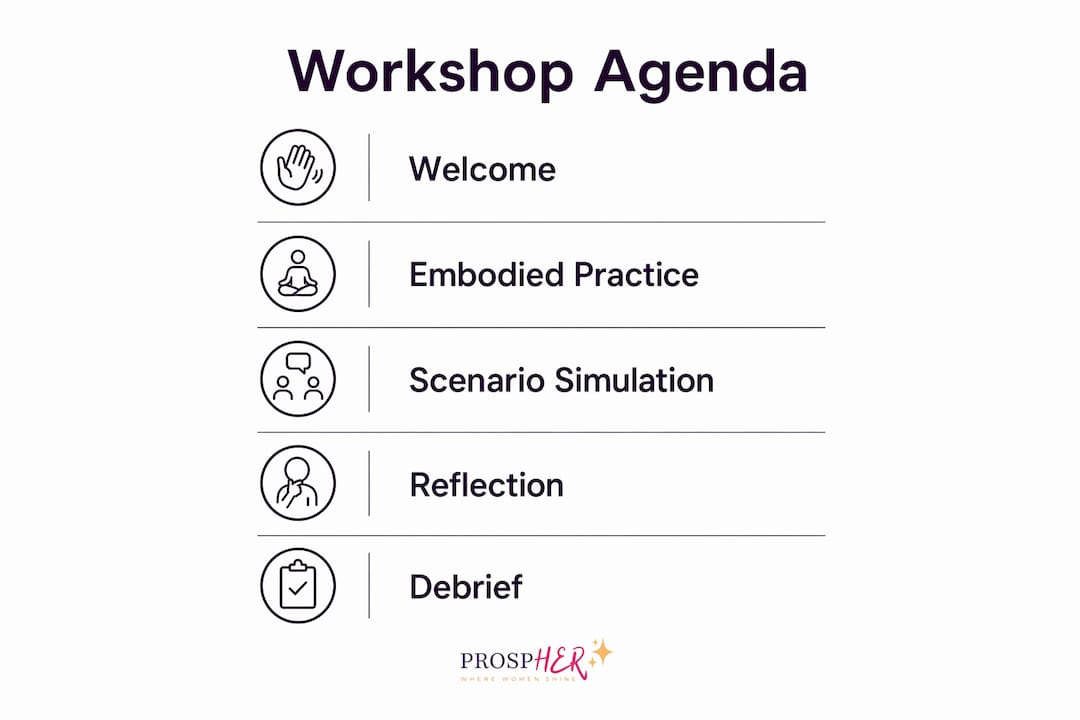
A well-sequenced one-day agenda runs: welcome and diagnostic → embodied practice session → scenario simulation → reflection and action planning. Multi-day formats add deeper scenario work, physical training, and extended peer-coaching rounds.
Facilitator credentials matter. Look for a combination of a recognised coaching or clinical qualification (ICF-accredited, BPS-registered, or equivalent), demonstrable leadership training experience, and specific embodied-practice training. Ask for evidence: a published methodology, a case study, or a named modality (somatic coaching, Krav Maga-based stress inoculation, breathwork certification).
Pro Tip: Ask the facilitator: "Can you describe one embodied exercise from your programme and the research behind it?" A vague answer is a red flag. A specific answer — naming the technique, its origin, and what it produces — signals genuine expertise.
Why does cohort composition shape your results?
The people in the room matter as much as the content on the slides. Intentional cohort design — mixing women of different ages, industries, seniority levels, and life stages — is a deliberate success factor, not a happy accident.
Here is why it works:
- Women at different career stages bring different problem-solving strategies. A founder three years in sees a corporate director's challenge differently, and that cross-pollination produces solutions neither would reach alone.
- Mixed backgrounds dismantle the isolation that often accompanies high-achieving women. Hearing that someone in a completely different field faces the same internal pressure normalises the experience and reduces shame.
- Diverse cohorts build psychological safety faster, because no single professional tribe dominates the room.
What a healthy cohort looks like in practice: cohort sizes of roughly 8–20 participants, clear sharing norms set by the facilitator at the outset, and explicit psychological safety protocols (confidentiality agreements, opt-in sharing, no unsolicited advice). A facilitator who skips this setup is cutting corners on the most important infrastructure of the day.

How do you choose the right resilience workshop?
Use these five criteria to evaluate any programme before you pay:
- Format and duration — does the length match your learning goal? A three-hour masterclass builds awareness; a multi-day or multi-week programme builds habits.
- Cohort composition — is the group intentionally mixed, or is it whoever signed up?
- Embodied methods — does the programme include nervous-system regulation alongside mindset work, or is it purely cognitive?
- Facilitator credentials — coaching or clinical qualification, leadership experience, embodied-practice training.
- Post-programme accountability — action plans, peer check-ins, or follow-up coaching sessions.
Questions to ask organisers before you book:
- What follow-up structure is included after the workshop ends?
- What is the evidence base for your methods?
- How do you prepare participants before the day?
- What safeguarding and psychological safety measures are in place?
- What is your refund or transfer policy if I cannot attend?
Red flags to walk away from: a one-off talk with no practice component; vague facilitator credentials ("experienced coach" with no named qualification); no post-workshop accountability whatsoever; promises of immediate transformation with no mention of ongoing practice.
On price versus outcomes: a higher price does not guarantee better results, but a very low price often signals no follow-up, no small cohort, and no personalised blueprint. Weigh what is included, not just the headline figure.
Pro Tip: Ask for a sample agenda or a previous participant's action plan (anonymised). Programmes confident in their outcomes will share this without hesitation.
What outcomes can you realistically expect?
Resilience training for women produces both short-term and medium-term shifts. Short-term: clearer decision-making, reduced reactivity in high-pressure moments, and a named set of micro-practices you can use immediately. Medium-term: new habits around boundary-setting, faster recovery from setbacks, and a written plan with accountability built in.
Practical metrics worth tracking:
- Self-reported clarity within 30 days — did you make a decision you had been avoiding?
- Boundary conversations completed — how many times did you hold a boundary you previously would have dropped?
- Follow-up actions from your workshop plan — what percentage did you complete within four weeks?
- Reactivity reduction — do you notice a gap between trigger and response that was not there before?
94% of ProspHER members report gaining clearer direction within 30 days of joining — a concrete benchmark for what a well-structured programme with accountability can produce.
| Outcome | Timeframe | How to measure |
|---|---|---|
| Clearer decision-making | — | Self-report: decisions made vs. deferred |
| Reduced reactivity | 2–4 weeks | Journal: trigger-to-response gap |
| Boundary conversations | 4–8 weeks | Count: conversations initiated and held |
| Action plan completion | 4 weeks post-workshop | Percentage of planned actions completed |
What formats and costs look like in the UK
UK resilience workshops for women span a wide range of formats and intensities:
- Half-day or three-hour masterclass — awareness-building, introductory tools, typically lower cost. Good for testing a facilitator before committing to more.
- Single full-day intensive — covers core modules end-to-end; suits women who cannot commit to multi-week programmes.
- Multi-week cohort programme — weekly sessions over four to eight weeks; builds habits through repetition and peer accountability.
- Residential retreat — two to seven days, immersive, often includes physical training and shared accommodation. Athena21's seven-day programme is one example of this intensive format.
- Hybrid or online — live virtual sessions with asynchronous resources; accessible regardless of location.
Pricing in the UK varies considerably by format and what is included. Short masterclasses tend to sit at the lower end; multi-day residential retreats at the higher end, with accommodation and meals often included. Multi-week cohort programmes typically fall in between, sometimes including follow-up coaching.
| Format | Typical duration | What is usually included |
|---|---|---|
| Masterclass | 3 hours | Facilitated session, workbook |
| Full-day intensive | 1 day | Facilitated sessions, action plan template |
| Multi-week cohort | 4–8 weeks | Weekly sessions, peer accountability, follow-up |
| Residential retreat | 2–5 days | Facilitation, accommodation, meals, certificate |
| Online/hybrid | Varies | Live sessions, resource library, community access |
Before you pay, confirm: refund and transfer policy, minimum participant numbers (cancellation risk), accessibility provisions, and safeguarding policy.
How do you turn workshop gains into real career results?
A workshop is a catalyst, not a destination. The women who see lasting career and business impact are the ones who build a personalised resilience blueprint immediately after.
- Identify your top three stress triggers — the specific situations that derail your decision-making or drain your energy fastest. Write them down within 48 hours of the workshop.
- Test one micro-practice daily for two weeks — breath regulation before a difficult meeting, a two-minute body scan before a pitch, or a written boundary statement before a negotiation.
- Schedule a 30-day accountability check-in — with a peer from your cohort, a coach, or a structured community. Accountability is what converts insight into habit.
Aligning resilience practice with career goals means being specific. If you are working towards a promotion, your resilience blueprint should address the pressure points of that role. If you manage clients, it should cover reactivity in conflict. If you are a founder, it should address decision fatigue and financial confidence under uncertainty.
Two things you can do this week: join a peer accountability group (a women's coaching community works well for this), and use a DISC-based behavioural profile to understand how your default stress responses show up in leadership situations.
Pro Tip: Resilience practice compounds. Two minutes of breath regulation done daily for three weeks produces more durable change than a single two-hour session done once. Build the habit small and consistent before you scale it.
How ProspHER builds resilience into its pathways
ProspHER does not offer a standalone workshop and leave you to figure out the rest. The platform builds resilience-focused development into a structured, personalised pathway that adapts to where you are right now — whether you are navigating a career pivot, scaling a business, or rebuilding confidence after a setback.
The approach combines group coaching, mentorship, community events, and a content library, with mindset training and accountability built into the structure rather than bolted on as an afterthought. Cohorts are intentionally mixed across industries, career stages, and business models, which means the cross-pollination of perspectives is a feature of every session, not a lucky coincidence.
- ProspHER has built a substantial community of women members.
- 94% of members report clearer direction within 30 days of joining.
- Pathways include financial literacy, confidence-building, and practical resources alongside resilience and mindset work.
- Events and retreats extend the learning beyond the screen.
Key takeaways
The most effective resilience workshops for women combine cohort diversity, embodied practice, and post-workshop accountability — and ProspHER's structured pathways deliver all three in one place.
| Point | Details |
|---|---|
| Reframe resilience as leadership | Choose programmes that treat resilience as a proactive capability, not a reactive coping skill. |
| Cohort composition drives outcomes | Mixed-stage, mixed-industry groups produce better results than homogeneous cohorts. |
| Embodied practice is non-negotiable | Nervous-system regulation alongside mindset work produces durable behavioural change. |
| Measure outcomes within 30 days | Track decision clarity, boundary conversations, and action plan completion after any workshop. |
| ProspHER as your ready-made pathway | 94% of ProspHER members report clearer direction within 30 days — a structured, tailored option for ambitious women in the UK. |
Why cohort design is the part most programmes get wrong
Most resilience programmes focus almost entirely on content: the right frameworks, the right facilitator, the right number of hours. What they underestimate is that the group itself is the intervention. When you put a founder navigating her first funding round in the same room as a senior leader managing a team restructure and a woman returning to work after a career break, something happens that no curriculum can manufacture. They solve each other's problems. They normalise each other's fears. They hold each other accountable in a way that a workbook simply cannot.
At ProspHER, cohort design is not an administrative detail. It is a deliberate choice that shapes every pathway. The women's leadership research is clear: community and accountability are what convert a good workshop into a lasting shift. If you want to test that for yourself, the community is open.
ProspHER: a tailored resilience pathway built for ambitious women
Clarity within 30 days is not a marketing line. It is what ProspHER members consistently report, and it is the result of a structured pathway that combines resilience training, group coaching, mentorship, and a community of over 2,400 women who are all moving forward with purpose.
Unlike a standalone workshop, ProspHER gives you a personalised route through the noise: the right support at the right stage, whether that is mindset work, financial literacy, or peer accountability. Your first 30 days include access to structured pathways, community events, and a cohort built to challenge and support you in equal measure.
Ready to move from insight to momentum? Join ProspHER and start your first pathway today.
Sources and further reading
- ProspHER | Career & Business Growth Platform for Ambitious Women — ProspHER membership data, including the 94% clarity metric cited throughout this guide.
- The Resilient Leader: Leading with Clarity in Uncertainty — Wharton Executive Education — supports the case for resilience as a proactive leadership capability taught through experiential learning.
- Our Programs | Athena 21 — evidence for intentional cohort composition as a core design principle in women's resilience programmes.
- Resilience in Practice Tickets — Eventbrite — illustrates the blend of nervous-system regulation, movement, and mental performance in a women's resilience workshop format.
- Bouncing Forward: Developing a Resilient Approach — Women's Workshop — source for the reframing of resilience away from chronic endurance.
- Resilience Reset programme sign-up — B-Untethered — supports the preparation guidance on arriving with specific stress triggers.
- Resilience Workshop — LeaderShift Insights — frames resilience training as intentional preparation rather than reactive recovery.
- DISC Profiles in Leadership Development Coaching — practical context for using behavioural profiling to understand stress responses in leadership.