
Book a formal meeting, state your figure, and back it with three concrete outcomes that prove your case. That is the entire strategy in one sentence. Everything else is preparation.
Your next move happens in the next 24 to 72 hours: send your manager a short email requesting a dedicated meeting, not a five minute add-on to a catch-up. Give it a clear agenda line so nobody is caught off guard.
Before that meeting, gather:
- Three to five measurable achievements from the last 6 to 12 months
- Two or three UK market salary benchmarks for your role and region
- A specific percentage or figure you're asking for, not a vague "more"
We'll walk through exactly how to build each of these, when to time your ask, and what to say when the answer isn't an immediate yes.
Key Takeaways
A successful pay-rise request combines the right timing, three to five quantified achievements, current UK market data, and a specific, defensible figure delivered in a dedicated meeting.
| Point | Details |
|---|---|
| Time it around wins | Ask after a finished project, a promotion moment, or a documented achievement, not during a downturn. |
| Bring quantified evidence | Gather three to five measurable achievements with dates and figures before the meeting. |
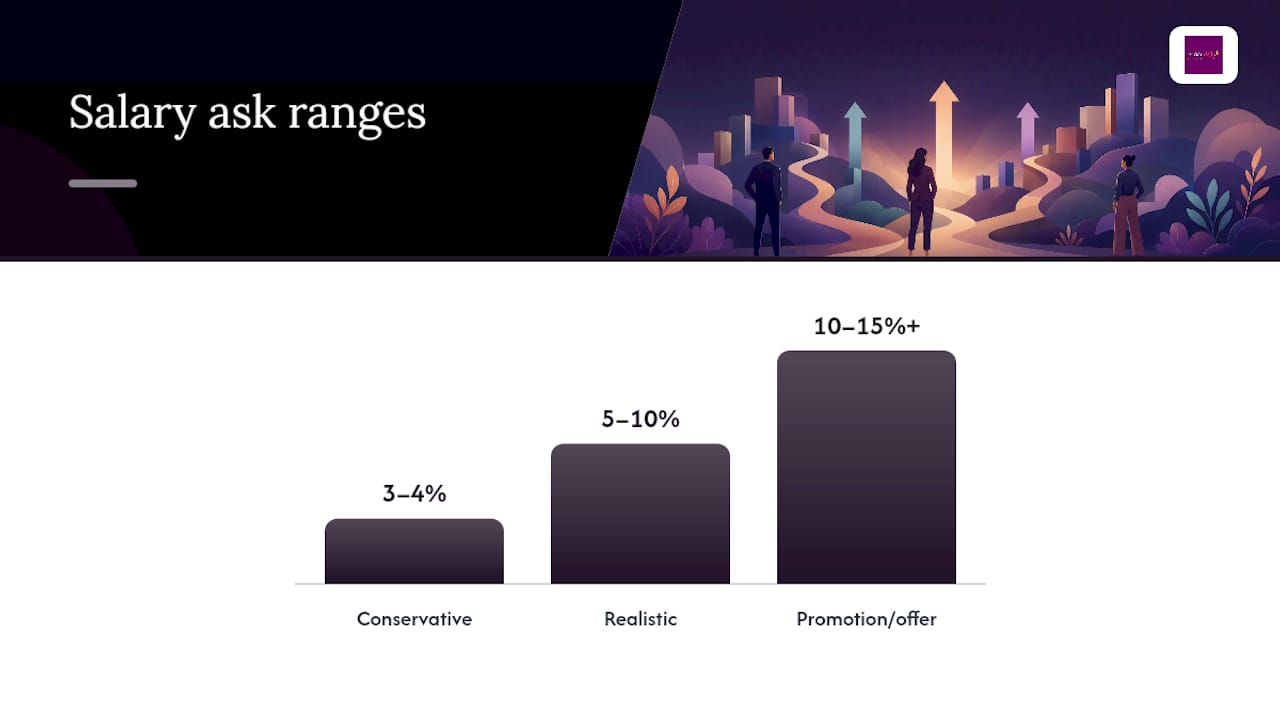
| Anchor to a realistic band | Aim for 5 to 10 percent with solid evidence; reserve 10 to 15 percent for promotion or a competing offer. |
| Check your legal position first | Confirm contract terms and equal pay rules, since there's no automatic right to a rise in the UK. |
| Use ProspHER for rehearsal | Mentorship and templates through ProspHER help you refine your script and evidence before the real conversation. |
Table of Contents
- When to ask for a pay rise UK: timing that actually works
- How do you prove you deserve a pay rise?
- How much should you ask for in the UK?
- What should you say when asking for a raise?
- What are your legal rights when asking for a pay rise?
- What do you do if your pay rise is refused?
- Negotiate the total package, not just your salary
- Your 7 to 30 day action checklist
- Why ProspHER helps you prepare for this conversation
- Does your employer's financial health change your approach?
- A short note on the nerves before the meeting
- Ready to prepare your pay rise conversation properly?
- Frequently asked questions
- Sources
When to ask for a pay rise UK: timing that actually works
Timing decides half the outcome before you've said a word. Annual review windows are the obvious moment, but they're not the only one. The strongest asks tend to follow a finished project, a client win, or the moment you've absorbed extra responsibility that hasn't been reflected in your pay.

Promotion conversations carry particular weight here. Internally promoted employees typically see the largest increases of any negotiation type, because the leverage has shifted. You're not asking for more of the same job. You're being asked to do a different one.
Avoid raising it during a company downturn, right before Christmas shutdown, at a leaving party, or in the scramble of end-of-quarter reporting. Your manager's headspace matters as much as your evidence does.
Before you send that email, confirm your employer's actual pay cycle:
- Check your contract for a stated review date or pay-review clause
- Look in the staff handbook for any documented pay policy
- Ask HR directly if a formal cycle isn't published anywhere
Pro Tip: If your company runs annual reviews in April, don't wait until March to build your case. Start gathering evidence in January so you're not scrambling when the invite lands.
How do you prove you deserve a pay rise?
Your case lives or dies on specifics. "I've worked hard this year" convinces nobody. "I closed three accounts worth £180,000 in new revenue and cut onboarding time by two weeks" does the job on its own.
Build your evidence in three moves.
- List your strongest wins with numbers and dates. Revenue generated, costs saved, deadlines hit, processes you improved, people you trained or managed. Pick three to five, not fifteen. Quality beats volume every time.
- Pull UK market data from multiple sources. Check live Reed and LinkedIn job adverts for your exact role and region, cross-reference with Glassdoor's reported ranges, and use Acas guidance to understand how employers typically frame pay decisions. ONS earnings data adds useful context if your sector has published figures.
- Convert that research into one defensible number. Not a range you'll negotiate down from apologetically, a figure you can justify line by line if your manager pushes back.
Practical, evidence-based approaches consistently outperform vague requests: researching market rates, documenting achievements, timing the ask well, and requesting a formal meeting with an agenda rather than an ambush conversation.
Three job adverts for near-identical roles, all sitting £4,000 above your current salary, is a stronger opening line than any amount of self-praise. Numbers travel further than adjectives in this conversation.
How much should you ask for in the UK?
There's no single "right" number, but there are defensible bands, and knowing which one you're in changes how you frame the whole conversation.
- 3 to 4 percent sits close to inflation and matches what many employers already budget for standard incremental rises. Use this when you're asking for fair maintenance of your value, not a step change.
- 5 to 10 percent is realistic territory when you've got solid performance evidence or can show a genuine gap against market rate. This is where most successful pay-rise conversations land.
- 10 to 15 percent or more is ambitious and usually needs real leverage: a promotion, a competing job offer, or clear proof you've been underpaid against the market for some time.
Job-offer negotiations in the UK typically lift an offer by 5 to 15 percent, and that same range holds roughly true for internal pay-rise requests. Ask for 5 to 10 percent with solid research behind you, and you're asking for something reasonable. Ask for 10 to 20 percent without a competing offer or clear evidence of market underpaying, and you're relying on goodwill rather than leverage.
Pick your band before the meeting, not during it. Walking in with "somewhere between 5 and 15 percent" invites your manager to anchor low.
What should you say when asking for a raise?
Start with the email. Keep it short, direct, and free of any hint of apology.
Subject: Quick chat about my role and compensation
Hi [Manager's name], could we find 30 minutes this week or next to talk through my current role and compensation? I'd like to bring some thoughts on recent projects and market rates. Happy to work around your diary.
That's it. No essay, no justification in the email itself. Save the substance for the room.
In the meeting, follow a three-part structure:
- Open by naming the purpose plainly. "I wanted to talk about my salary and where it sits against my current contribution."
- Present your evidence before your number. Walk through your three to five achievements, then your market data, then state your figure clearly: "Based on this, I'd like to discuss moving my salary to £X."
- Close with a concrete next step. Ask what would need to happen for that number to work, and agree a date to follow up either way.
You'll almost certainly hit resistance. Have your replies ready:
- "We can't afford it right now." Ask what timeframe would make it possible, and whether a partial increase or a review date could be agreed instead.
- "We need to think about it." Fair enough. Ask for a specific date you'll hear back, in writing if possible.
- A counteroffer below your ask. Don't accept on the spot. Say you'd like to consider it and confirm your response within a couple of days.
Journalist and expert commentary converges on the same three levers repeatedly: timing, evidence, and phrasing predict better outcomes far more reliably than confidence alone.
What are your legal rights when asking for a pay rise?
Here's something most guides skip past too quickly: you don't have an automatic legal right to a pay rise in the UK. There's no general legal entitlement, except in specific circumstances.
Those exceptions matter, so check them before your meeting:
- National Minimum Wage or National Living Wage increases are mandatory. If a rate rise pushes your pay below the legal minimum, your employer must lift it regardless of any conversation.
- Contractual pay-review clauses create a genuine obligation if your contract states a specific review date or formula.
- Collective bargaining agreements, where a union has negotiated sector-wide terms, may set pay rises your employer must honour.
- Equal pay rules under the Equality Act 2010 mean you're entitled to equal pay for equal work regardless of sex, and this is worth flagging if you suspect a colleague in a comparable role earns more.
Repeated informal practice, such as an employer who has given every employee a rise every January for a decade, can start to create what's known as an implied contractual term through custom and practice, though this is rarely straightforward to prove alone.
If you suspect discrimination or a breach of contract behind a refusal, Sprintlaw's guidance for UK employees is a sound starting point, and Acas offers free, confidential advice before things escalate formally.
What do you do if your pay rise is refused?
A no isn't the end of the conversation. It's a checkpoint.
- Ask for specific, measurable objectives. What exactly would need to change, and by when, for the answer to be different? Vague reassurance helps nobody.
- Agree a firm date to revisit it. Three months, six months, whatever's realistic, but get a date, not a "we'll see."
- Confirm everything by email afterwards. A short "just to confirm what we agreed" message protects you and gives you something to reference at the follow-up.
- Set yourself a reminder to raise it again on that date without needing to be prompted.
- Escalate only if something's genuinely wrong. If you suspect the refusal is discriminatory or breaches your contract, that's when HR, Acas conciliation, or a new job search become the sensible next steps rather than repeated asking.
Negotiate the total package, not just your salary
Base pay isn't the only lever your employer can pull, and it's often not the easiest one for them to move. Many organisations run fixed salary bands but have separate budget lines for training, bonuses, or flexible working that clear approval far more easily, and cost less structurally over time.
Consider trading toward:
- A one-off performance bonus if base pay is genuinely frozen
- Extra annual leave days
- Flexible or hybrid working arrangements
- A training or qualification budget
- A higher employer pension contribution, which you can explore further through salary sacrifice arrangements
Frame these as trade-offs rather than fallback prizes. "If base pay isn't possible this cycle, could we look at [specific alternative] instead?" reads as flexible negotiation, not disappointed settling.
Whatever you agree, ask for written confirmation of any non-salary change. Verbal promises about extra holiday or pension contributions have a habit of quietly disappearing without a paper trail.
Your 7 to 30 day action checklist
- This week: Schedule your meeting and send the short agenda email.
- This week: Assemble your three to five strongest achievements with dates and figures.
- Next 7 days: Gather two to three comparable UK job adverts as market evidence.
- Next 7 days: Draft your opening lines and your specific figure.
- After the meeting: Confirm any agreement, or next steps, in writing.
- Ongoing: Set a calendar reminder for your agreed review date.
Pro Tip: Rehearse your script out loud with a mentor or trusted peer, and record yourself if you can. Hearing your own voice say the number out loud, before you're in the room, makes the real conversation far less daunting.
Why ProspHER helps you prepare for this conversation
Preparing alone is harder than it needs to be.
- Tailored pathways matched to your current career stage
- Mentorship for rehearsing your pitch before the real meeting
- Templates and practice sessions built around real negotiation scenarios
Does your employer's financial health change your approach?
Your case doesn't exist in a vacuum. A company mid-restructure, fresh off redundancies, or missing quarterly targets is working with a different budget reality than one reporting record growth, and reading that context well shapes how you pitch, not whether you ask.
If your employer is visibly under pressure, lead with the alternatives conversation early rather than pushing hard on base pay alone. Asking "what would need to be true for a salary increase to be possible right now?" often gets you further than pressing for an immediate yes, because it puts the decision-maker's constraints on the table instead of against you.
If the company is doing well, your evidence carries more weight, because there's less friction between your ask and the budget available to meet it. Either way, your manager isn't usually the final decision-maker on salary. They're often building a case upward to HR or a finance director, so give them evidence solid enough to make that case on your behalf, not just to you.
Reading the room isn't about lowering your ask out of guilt. It's about pitching the right ask, in the right format, to someone who has to sell your case to somebody else.
A short note on the nerves before the meeting
Feeling nervous before this conversation is normal, not a sign you're unprepared. Try a five-minute script rehearsal beforehand, and lean on mentorship if you want a second voice to practise against.
Ready to prepare your pay rise conversation properly?
ProspHER exists for exactly this moment: ambitious women who want a clear, structured pathway rather than another generic careers article to scroll through alone. Where most advice leaves you to translate vague tips into your own script, ProspHER members get mentorship to rehearse their exact pitch, templates built for real negotiation scenarios, and a community that's already had this conversation and can tell you what actually worked.

Members preparing a pay-rise or promotion case typically use ProspHER's mentorship sessions to stress-test their figure and their phrasing before the real meeting, and the platform's practical resources to fill any gaps in their evidence dossier. If your ask involves pension contributions as part of a wider package, our guide to salary sacrifice pensions is worth reading alongside your prep.
Visit ProspHER to see which pathway fits your current stage, and start building your case with proper support behind you rather than a blank document and a deadline.
Frequently asked questions
When is the best time to ask for a pay rise in the UK? The strongest windows are annual review periods, immediately after a completed project or measurable win, or during a promotion conversation. Avoid company downturns, budget crunch periods, and social occasions.
How much should I ask for when negotiating salary in the UK? Three to four percent is conservative and inflation-aligned, 5 to 10 percent is realistic with solid evidence, and 10 to 15 percent or more usually needs a promotion or competing offer to succeed.
Do I have a legal right to a pay rise in the UK? No, there's no general legal entitlement to a pay rise unless it's required by your contract, a collective bargaining agreement, or a minimum wage increase.
What should I do if my employer refuses my pay rise request? Ask for specific, measurable objectives and a firm date to revisit the conversation, confirm the agreement in writing, and escalate to HR or Acas only if you suspect discrimination or breach of contract.
What can I negotiate instead of a base salary increase? Common alternatives include a one-off bonus, extra holiday days, flexible working arrangements, a training budget, or a higher employer pension contribution.
This article is general information, not a substitute for advice from a qualified financial advisor. Consult a qualified financial professional about your own circumstances before acting on anything here.
Sources
- Pay rises — Acas
- Negotiating a salary — Jobs.ac.uk career advice
- How to legally request a pay rise — Sprintlaw