
Yes, LinkedIn is worth it for women professionals. Start by fixing three things today: your headline, your About section opening line, and the note you send with every connection request. Those three elements decide whether a stranger becomes a conversation or a missed opportunity.
The evidence backs this up. Personalised connection messages achieve reply rates of 30–40% compared to 8–12% for generic templates. That gap is not marginal. It is the difference between a network that grows and one that stagnates. LinkedIn is also investing directly in women's access to the platform: its Link Women initiative with UN Women was launched specifically to upskill and connect women, with AI literacy as a priority skill for 2026.
Your first three actions:
- Rewrite your headline using the formula: Role + who you help + what changes for them
- Replace your About section's opening line with a direct claim about the value you create
- Draft a personalised connection note for the next five people you want to reach
The rest of this guide shows you exactly how.
Key takeaways
LinkedIn networking for women works when it is treated as a relationship-curation practice, not a numbers game: personalised outreach, consistent engagement, and the 5 Ps framework consistently outperform volume-based approaches.
| Point | Details |
|---|---|
| Fix your profile first | Rewrite your headline and About opening before sending a single connection request. |
| Personalise every message | Personalised notes achieve reply rates of 30–40% versus 8–12% for generic templates. |
| Use the 10–80–10 rule | Spend 10% on new connections, 80% on nurturing relationships, and 10% on direct asks. |
| Track conversations, not views | Measure replies, calls booked, and introductions received — not impressions or follower counts. |
| ProspHER accelerates the process | With 94% of members gaining clearer direction within 30 days, ProspHER offers structured support alongside your LinkedIn strategy. |
Table of Contents
- How to make your LinkedIn profile convert visitors into connections
- How to find the right people on LinkedIn
- Message templates you can adapt for every stage
- How the 5 Ps framework builds real relationships on LinkedIn
- Where UK women professionals find their best connections
- How to find sponsors and mentors on LinkedIn
- Common mistakes women make on LinkedIn (and the quick fix)
- How to measure your LinkedIn networking results
- Your 30-day LinkedIn networking plan
- A note from ProspHER
- What ProspHER offers women who are ready to build momentum
- Sources
How to make your LinkedIn profile convert visitors into connections
Your profile is not a CV. It is a landing page. Every section either earns a connection request or loses one.
Headline
Your headline has roughly three seconds to answer one question: "Why should I connect with this person?" Generic titles such as "Marketing Manager at XYZ Ltd" answer the wrong question. They describe your employer, not your value.
Two formulas that work:
Formula 1: [Role] helping [audience] achieve [specific outcome]
Formula 2: [Expertise] + [industry] + [differentiator] Example: "Commercial Finance | SaaS | Ex-KPMG | Helping founders read their numbers"
About section
Open with a claim, not a career history. The first two lines appear before the "see more" fold, so they carry disproportionate weight.
Structure:
- Opening claim (one sentence): what you do and for whom
- Proof points (two to three lines): specific results, roles, or recognition
- Call to action (one line): what you want the reader to do next ("Connect if you're a UK founder navigating your first funding round")
Photo and banner
Your photo should be well-lit, professionally framed, and current. A plain or softly blurred background keeps the focus on your face. For UK professionals, a banner image that signals your sector or values (a city skyline, a relevant quote, your company's visual identity) adds immediate context without requiring the reader to read a word.
Featured content and recommendations
Pin two or three pieces of featured content: a post that performed well, a published article, or a short video. These show visitors what you sound like before they connect. Recommendations from colleagues or clients carry more weight than self-description; aim for three to five that speak to specific skills rather than general praise.
Before/after example:
| Element | Before | After |
|---|---|---|
| Headline | "Senior HR Manager at Acme Ltd" | "HR Director helping UK tech firms retain top talent through inclusive culture" |
| About opening | "I have 12 years of experience in human resources…" | "I help fast-growing UK tech companies keep the people they worked hard to hire." |
Pro Tip: Post one piece of content per week that answers a question your target connections are already asking. Posts with active comments generate around 29% higher reach than passive posts, so write to provoke a response, not just to inform.
How to find the right people on LinkedIn
Knowing who you want to reach matters more than how many people you reach. Build a target list of 20–40 people before you send a single message.
Search tactics
LinkedIn's search filters are more powerful than most people use them. Combine these:
- Use Boolean keywords in the search bar:
"Head of People" AND "fintech" AND "London"surfaces specific roles in specific sectors. - Apply filters for location (United Kingdom), industry, current company, and school simultaneously.
- Look at second-degree connections first. A shared contact is a warm introduction waiting to happen.
- Check who has commented on posts in your field. Commenters are active, engaged, and receptive.
Alumni, associations, and conference lists
Your university alumni network is one of the most underused warm pools on LinkedIn. Filter by school, graduation year range, and current industry to find people who share your background and are already in the roles you are targeting. The same logic applies to professional associations: if you are a member of the Chartered Institute of Personnel and Development or the Chartered Management Institute, search for fellow members by name or filter by company.
Warming your outreach before sending a request by commenting on a target's posts first raises acceptance rates materially. Spend a week engaging with their content before you send anything.
Hashtags and groups
Follow three to five hashtags relevant to your sector (#UKTech, #WomenInFinance, #SocialEnterprise) and check them weekly. The people posting under those tags are signalling their interests publicly. Groups are slower but useful for visibility: post a genuinely helpful comment or question once a week and you become a recognisable name before you ever send a direct message.
Pro Tip: Use LinkedIn's "People Also Viewed" sidebar on a target's profile to discover adjacent contacts you had not considered. It is a free recommendation engine.
Message templates you can adapt for every stage
The goal of a LinkedIn message is not to close a deal. It is to open a door. Keep every message short, specific, and about them.
Connection request notes (300 characters maximum)
Alumni scenario: "Hi [Name], I noticed we both studied at [University] and now work in [sector]. I'd love to connect and hear how your career has developed since then."
Event attendee: "Hi [Name], I saw your comment at [Event/Webinar] last week and it resonated. Would love to connect and stay in touch."
Commenter on a post: "Hi [Name], your point about [specific topic] in [Name]'s post was exactly what I needed to read today. Connecting to follow your thinking."
First message after connection
Do not pitch. Open a conversation.
"Hi [Name], thanks for connecting. I've been following your work on [topic] and found [specific post or article] genuinely useful. Are you still focused on [area]? I'm navigating something similar and would value your perspective."
Follow-up sequence
- Day 7 after no reply: "Hi [Name], just following up in case my message got buried. No pressure at all — I'd genuinely love to hear your thoughts on [topic] when you have a moment."
- Day 21: Share a relevant article or resource with a one-line note: "Thought of you when I read this — [link]. Hope things are going well."
- Day 35: A brief, low-friction ask: "I know you're busy, but would a 20-minute call work at some point? Happy to work around your schedule."
Meeting ask
"I've really enjoyed our exchange on [topic]. Would you be open to a 20-minute call? I'd love to ask you about [specific question]. I can work around your diary — just let me know what suits."
Dos and don'ts:
- Do personalise every message with one specific detail from their profile or content
- Do keep messages under 150 words
- Do not pitch your services in the first three messages
- Do not send a follow-up the next day; space them out
- Do not copy-paste the same note to 50 people; personalised messages achieve far higher reply rates than templates sent at volume
How the 5 Ps framework builds real relationships on LinkedIn
The 5 Ps — Purpose, Presence, Personalisation, Persistence, Patience — give you an operating rhythm that replaces the exhausting "post every day and hope" approach with something sustainable.

What each P means in practice
Purpose: Know why you are connecting before you reach out. Are you looking for a mentor, a collaborator, a referral source, or a sponsor? Your purpose shapes every message you send.
Presence: Show up consistently in your target's feed before you ask for anything. Comment thoughtfully on their posts two or three times over a fortnight. A comment that adds a specific insight ("This mirrors what I saw in the NHS procurement data last year — here's what changed") is worth ten generic "Great post!" responses.
Personalisation: Reference something real. A specific post, a shared experience, a mutual contact. Generic outreach signals that you have not done the work.
Persistence: Most meaningful connections require three to five touchpoints before a conversation happens. That is not rejection; it is normal. Space your follow-ups over four to six weeks.
Patience: Sponsorship and mentorship relationships develop over months, not days. Treat each interaction as a deposit, not a transaction.
The 10–80–10 rule (an operational guide for sustainable LinkedIn networking)
The 10–80–10 rule (an operational guide for sustainable LinkedIn networking) is the clearest operational guide for sustainable LinkedIn networking: spend roughly 10% of your effort on new connection requests, 80% on engaging and building existing relationships, and 10% on direct asks. Most people invert this ratio and wonder why their response rates are low.
A practical weekly schedule:
- Monday: Comment on three posts from your target list
- Wednesday: Send one personalised connection request or follow-up message
- Friday: Share or post one piece of content that invites a response
This takes 15–20 minutes a day and keeps you present without burning out.
Where UK women professionals find their best connections
The most powerful introductions often come from communities, not cold outreach. Here is where to look.
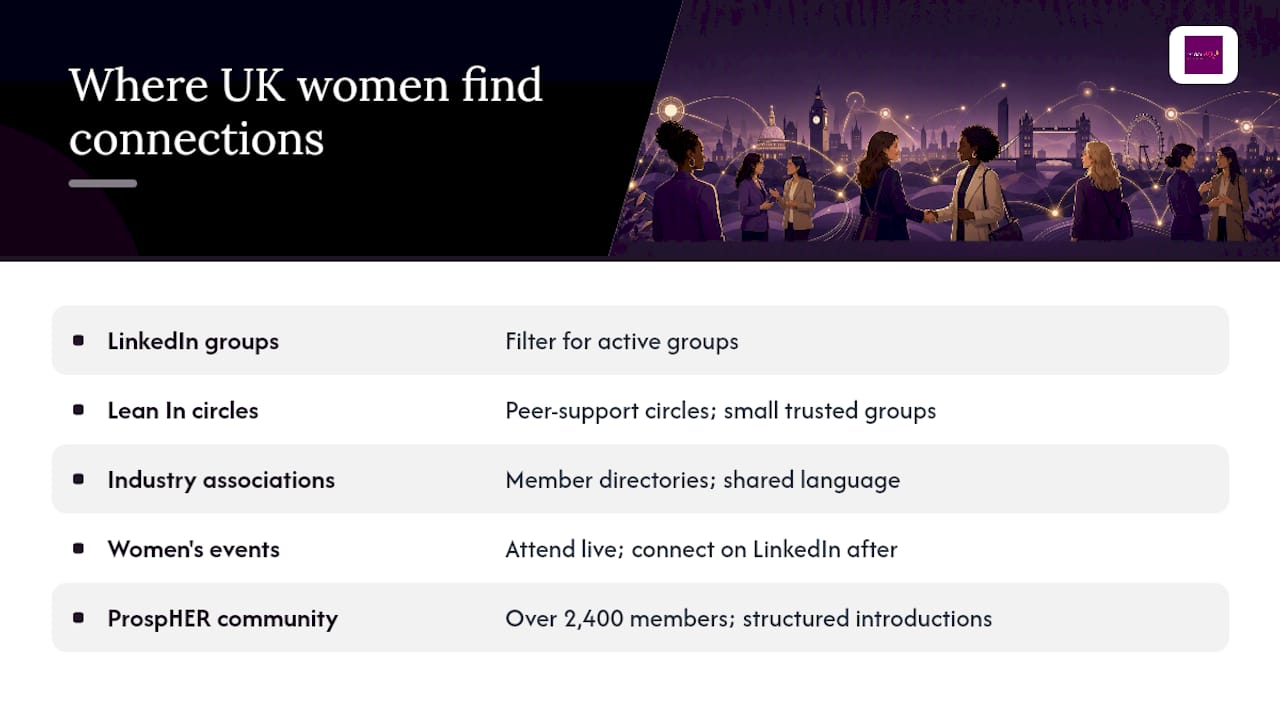
LinkedIn groups: Search for "Women in [your sector] UK" and filter for active groups (those with recent posts). Lurk for a week, then contribute a specific question or resource. Visibility inside a group compounds over time.
Lean In circles: Lean In runs peer-support circles globally, including across the UK. Joining a circle gives you a small, trusted group of women at similar career stages — the kind of candid conversation that rarely happens in a LinkedIn DM.
Industry associations: The Chartered Management Institute, Women in Finance Charter signatories, and sector-specific bodies all have LinkedIn presences and member directories. These are warm pools with a shared professional language.
Women's networking events: Attending a live event and then connecting on LinkedIn immediately afterwards is one of the highest-conversion networking moves available. The shared experience gives you a genuine, specific reason to reach out.
ProspHER community: With over 2,400 members, ProspHER offers structured introductions, group coaching, and community events designed specifically for ambitious UK women. The platform removes the guesswork from finding the right peer or mentor.
When a LinkedIn relationship reaches the point where you are exchanging voice notes or meeting regularly, move it off-platform. A WhatsApp group, a shared document, or a monthly call cements the relationship in a way that a LinkedIn thread cannot.
Pro Tip: Post inside a community group before you DM anyone from it. Being a recognisable contributor means your message arrives warm, not cold.
How to find sponsors and mentors on LinkedIn
Mentors give advice. Sponsors use their influence to open doors. Both matter, but sponsorship is rarer and more career-defining. Understanding how to find and approach both is one of the highest-leverage skills you can develop.
Recognising a potential sponsor
A sponsor is typically someone two to three levels above you who:
- Publicly advocates for others (you can see this in their posts and comments)
- Has influence over hiring, promotion, or funding decisions in your field
- Has engaged with your content or responded positively to a previous message
A mentor, by contrast, is often a peer or someone one level ahead who has navigated a challenge you are currently facing.
Approaching a potential sponsor
- Spend four to six weeks engaging with their content before reaching out directly.
- When you do message, lead with a specific observation about their work, not a request.
- Ask for a short, low-stakes conversation: "I'd love 20 minutes to hear your perspective on [specific topic]."
- In that conversation, demonstrate your work and your ambition clearly. Sponsors back people who show momentum.
- Follow up with a brief thank-you note that references one specific thing they said.
Converting a mentor into a sponsor
The shift from mentorship to sponsorship happens when your mentor sees an opportunity to advocate for you and trusts that doing so will reflect well on them. Signal your readiness by sharing specific wins, asking for introductions rather than advice, and being explicit: "I'm actively looking for my next senior role — if you hear of anything that fits, I'd be grateful to be considered."
Red flags to watch for:
- Anyone who asks for payment in exchange for introductions or advocacy
- Requests for personal information beyond what a professional conversation requires
- Pressure to meet outside professional settings without a clear business rationale
Trust your instincts. LinkedIn's messaging system keeps a record; use it.
Common mistakes women make on LinkedIn (and the quick fix)
Most of these mistakes are invisible until you know to look for them.
Generic connection notes: "I'd like to add you to my professional network" is LinkedIn's default text. Sending it signals zero effort. Fix: write one sentence that references something specific about the person.
Pitching immediately after connection: Sending a sales message within 24 hours of connecting is the fastest way to get ignored or blocked. Fix: wait at least a week and open with a question, not an offer.
Posting without a clear audience in mind: Content that tries to speak to everyone reaches no one. Fix: write each post for one specific person — the kind of professional you want to attract — and let the algorithm find more like them.
Treating views as success: Post views are vanity metrics. Conversations are the signal. Fix: measure replies, connection requests received, and meetings booked, not impressions.
Imposter syndrome and the "who am I to post?" paralysis: This is the most common blocker for women on LinkedIn, and it costs real career momentum. Fix: your lived experience is expertise. You do not need a title or a credential to share what you have learned. Start with one observation from your working week and post it as a question.
Over-polishing to the point of silence: Waiting until a post is perfect means it never goes out. Fix: done is better than perfect. A genuine, slightly imperfect post outperforms a polished one that never gets written.
How to measure your LinkedIn networking results
Tracking the right numbers keeps you honest and motivated. Views and follower counts feel good but tell you very little about whether your networking is working.
Metrics that matter
| Metric | What it tells you | Realistic target (12 weeks) |
|---|---|---|
| Personalised requests sent | Outreach volume | 5–10 per week |
| Acceptance rate | Profile and note quality | 30–40% |
| Meaningful replies received | Message relevance | 2–4 per week |
| Conversations leading to a call | Relationship depth | 1–2 per month |
| Introductions received | Network activation | 1 per month |
Realistic timelines
Weeks 1–4 are about foundations: profile optimisation, building your target list, and warming up through comments. Do not expect meetings yet.
Weeks 5–8: you should be seeing replies and a handful of real conversations. One or two calls is a strong result at this stage.
Weeks 9–12: introductions and sponsorship signals start to appear if you have been consistent. A structured 8–10 week programme of targeted outreach meaningfully increases recruiter and peer visibility for professionals at all career stages.
The 10–80–10 engagement rule applies here too: if you are spending more than 10% of your LinkedIn time on new connection requests and less than 80% on nurturing existing ones, your conversion rate will reflect it.
Your 30-day LinkedIn networking plan
This calendar assumes 15–20 minutes on weekdays and one slightly longer session (30–45 minutes) per week. Adjust the depth, not the frequency, if time is tight.
Week 1: profile and foundations
- Rewrite your headline using one of the two formulas above
- Revise your About section opening line to lead with a direct claim
- Update your photo and banner if either is more than two years old
- Pin two pieces of featured content
- Build your target list of 20–40 people using Boolean search and alumni filters
- Follow five relevant hashtags and join one active LinkedIn group
Week 2: warm engagement
- Comment on three posts from your target list (Monday, Wednesday, Friday)
- Share one piece of content with a question at the end
- Identify five people whose content you have now engaged with twice
- Research each of the five: note one specific detail to reference in a message
Week 3: personalised outreach
- Send five personalised connection requests (one per day, Monday to Friday)
- For anyone who accepts, send a first message within 48 hours
- Continue commenting on your target list (three per week)
- Post one piece of content mid-week
Week 4: nurture and deepen
- Follow up with anyone who has not replied to your first message (Day 7 template)
- Send a meeting ask to one person you have had a genuine exchange with
- Join one women-focused community or Lean In circle and introduce yourself
- Review your metrics: acceptance rate, replies, conversations started
- Adjust your target list based on who has been responsive
For women with limited time (carers, part-time workers, jobseekers):
- Reduce outreach to three personalised requests per week instead of five
- Prioritise commenting over posting; it takes less time and builds visibility faster
- Use the female entrepreneur network resources and women in leadership guides to find communities that match your specific situation
A note from ProspHER
We built ProspHER because we kept hearing the same thing from ambitious women: "I know I should be networking, but I don't know where to start, and I don't have time to figure it out alone." The 30-day plan above, the 5 Ps framework, and the message templates in this guide all came from working directly with our community of over 2,400 women across the UK. 94% of ProspHER members report gaining clearer direction within 30 days of joining — not because the platform does the networking for them, but because it removes the confusion about what to do first.
The guidance here reflects what we see working consistently: quality over volume, personalisation over automation, and relationships built on genuine curiosity rather than transactional asks.
What ProspHER offers women who are ready to build momentum
Knowing the tactics is one thing. Having the right people around you while you execute them is another.
ProspHER gives ambitious UK women a structured path through exactly the work this article describes: a personalised onboarding that identifies where you are now and what to prioritise, group coaching sessions where you can practise outreach and get real feedback, mentorship matching with women who have navigated the same challenges, and a live community of 2,400+ peers who are actively networking, not just scrolling. Unlike a generic professional network, ProspHER is built around clarity. You will not be handed a library of content and left to work out what applies to you. Every member gets a pathway tailored to their current circumstances, whether that is a career pivot, a leadership step-up, or building a business from scratch.
Privacy and boundaries matter here too. ProspHER's community operates with clear guidelines around professional conduct, so you can build relationships without the boundary-testing that can make open platforms feel unsafe.
Join ProspHER and start your first 30 days with a community that already knows what works.
Sources
- How Women Are Using LinkedIn to Land Clients Without Posting Every Day - WMN Magazine
- UN Women and LinkedIn launch Link Women — UN Women Asia-Pacific
- Connectsafely
- Linkedgrow
- Business