
An accountability partner will reliably raise your follow-through — but only when meetings are scheduled, structured, and mutually binding. The mechanism is straightforward: a public commitment to another person creates social pressure that intention alone cannot replicate, and recurring check-ins compound that effect into genuine behavioural change. Start this week. Pick one goal, find one person, and schedule a 15-minute check-in for the same time every week.
- Choose one specific goal (not three)
- Identify one potential partner from your existing network
- Send an invitation message this week (template in Section 7)
- Block a recurring 15-minute slot in both calendars before the week ends
Table of Contents
- What is an accountability partner, and what are they not?
- Why accountability partners work: the real benefits
- What types of accountability partners are available to you?
- Where to find an accountability partner in the UK
- How to set up an effective accountability partnership
- Copy-ready scripts and message templates
- Tailoring accountability for ADHD and neurodiversity
- When an accountability partnership isn't working
- What the research says about accountability partners
- Key takeaways
- Why community-based accountability is what we recommend
- ProspHER: structured accountability for ambitious women in the UK
- Useful sources for further reading
What is an accountability partner, and what are they not?
An accountability partner is a peer who agrees to check your progress on a stated goal at regular intervals, and whose own progress you check in return. They are not a therapist, not a mentor, and not a manager. The relationship is horizontal and mutual: both people show up, both people report, and both people hold the other to what they said they would do.
That distinction matters in practice. Mentors provide wisdom and career guidance; accountability partners are peer teammates focused on follow-through. A mentor might advise you on which direction to take your career. Your accountability partner asks whether you sent the three applications you committed to last Tuesday. An accountability coach is a paid professional who specialises in this function, offering structured sessions for a fee. A peer partner costs nothing but requires reciprocity.
What accountability partners do:
- Ask "Did you do what you said you would?" at every check-in
- Help you set the next commitment before the session ends
- Share their own progress and commitments in return
- Flag when your goals seem vague or unrealistic
What they do not do:
- Offer career strategy or life advice (that is mentoring or coaching)
- Provide emotional counselling or crisis support
- Make decisions for you
- Carry the relationship alone if you stop showing up
A useful shorthand is the 5 C's framework: clarity, commitment, consistency, candour, and channels. A partnership that scores well on all five tends to last. One that lacks candour or consistency usually dissolves within a month.
| Role | Primary function | Mutual? | Cost |
|---|---|---|---|
| Accountability partner | Progress check-ins and commitment | Yes | Free (peer) |
| Accountability coach | Structured professional accountability | No | Paid |
| Mentor | Wisdom, guidance, career direction | Rarely | Free or paid |
| Therapist | Emotional and psychological support | No | Paid |
Why accountability partners work: the real benefits
The behavioural science behind this is not complicated. When you tell another person what you plan to do, you create a social contract. Breaking it carries a psychological cost that breaking a private promise does not. Add a recurring meeting date and that cost becomes predictable and immediate, which is exactly the kind of pressure that shifts behaviour.
Scheduled, recurring check-ins substantially increase follow-through, moving people from occasional intention to high completion rates. The lift is not marginal. Intent alone produces low follow-through; committing to another person raises it; scheduled recurring check-ins raise it further still.
Statistic to know: HabitBox summarises ASTD-style research showing that scheduled check-ins with an accountability partner are associated with approximately 95% follow-through on stated commitments.
The practical benefits extend beyond raw completion rates:
- Clearer deadlines. Knowing you will report on Friday forces you to define what "done" looks like by Thursday.
- Better planning. You cannot commit to a vague goal in front of another person without it sounding hollow. Partners naturally push you toward specificity.
- Reduced procrastination. The next check-in functions as a soft deadline that keeps tasks from drifting indefinitely.
- Emotional support. A good partner celebrates progress and normalises setbacks without letting you off the hook.
- Skill development. At work, regular structured check-ins accelerate skill development by creating a feedback loop that solo effort rarely generates.
Pro Tip: Choose a partner who has their own active goals, not someone who simply wants to help you. Ayelet Fishbach, a behavioural scientist at the University of Chicago, notes via NPR that the most effective partners are those with their own distinct goals and consistent attendance. Mutual investment is what makes the relationship sustainable.
What types of accountability partners are available to you?
Not every pairing looks the same, and the right format depends on your goal, your schedule, and how much structure you need.
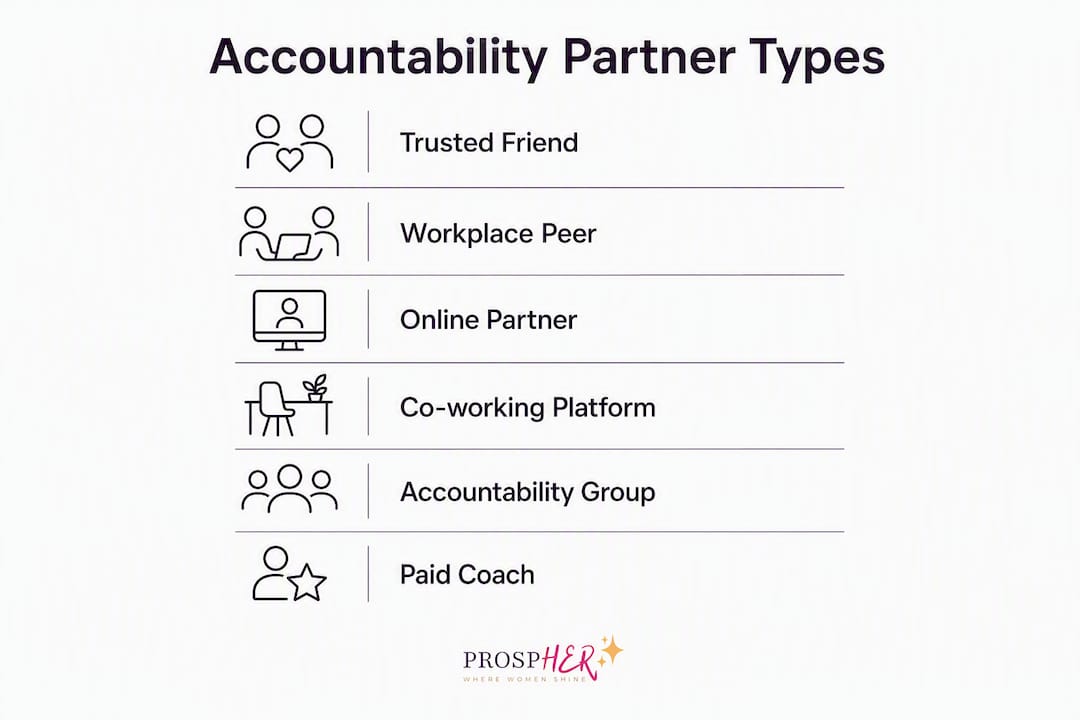
Trusted friend or family member. The easiest to recruit, the hardest to keep honest. Social warmth can soften the candour you actually need. Works well when both people are genuinely committed to their own goals and agree upfront to skip the pleasantries.

Colleague or workplace peer. A natural fit for career-focused goals. You share context, you see each other regularly, and professional norms tend to keep sessions on track. Accountability partnerships at work can improve focus, encourage healthy boundaries, and accelerate skill development. The risk is that work politics can make honest feedback awkward.
Online partner. Matched through Reddit communities (r/GetMotivated, r/DecidingToBeBetter), Discord servers, or dedicated platforms. Geography is irrelevant, which widens your pool considerably. Consistency of meetings predicts long-term success, so move any online match to a scheduled video call within the first two weeks.
Structured co-working platform. Services like Focusmate pair you with a stranger for a timed work session. Focusmate reports a substantial increase in productivity among users, with the vast majority agreeing the service helps them stay focused. This format suits deep-work goals more than long-term habit building.
Accountability group. Three to six people checking in together, often weekly. Local running clubs, business masterminds, and community groups like those found through women's business coaching communities all function this way. Groups add social energy but reduce the one-to-one depth that makes individual pairings powerful.
Paid accountability coach. The highest-structure option. A professional coach brings frameworks, experience, and no personal stake in sparing your feelings. The cost is the obvious trade-off; expect to pay professional coaching rates in the UK.
Where to find an accountability partner in the UK
The best partner is often closer than you think. Start with your existing network before looking further afield.
- Friends and colleagues. Send a direct message to someone you respect who is also working toward a goal. You are not asking for their time indefinitely — propose a four-week trial.
- Classes and clubs. Running clubs, writing groups, evening courses, and local business networks all contain people with active goals. A conversation after a session is a natural opening.
- LinkedIn. Post that you are looking for a peer accountability partner for a specific goal. You will be surprised how many people respond.
- Reddit and Discord. Communities like r/DecidingToBeBetter and r/GetMotivated have regular accountability-partner threads. Discord servers for writers, founders, and fitness communities often have dedicated pairing channels.
- Co-working spaces. Many UK co-working spaces host community events where peer pairings form organically.
- Structured platforms. Focusmate offers virtual co-working sessions. ProspHER offers structured community pairings for members working on career and business goals.
Invitation message template:
Safety note for online partners: keep early sessions on video rather than phone, use a platform with a public profile (LinkedIn, a named Discord server), and do not share personal contact details until you have had at least two sessions.
Match on commitment intensity, not on identical goals. A founder tracking revenue milestones and a writer tracking daily word counts can be excellent partners. What matters is that both people show up at the same level of seriousness.
How to set up an effective accountability partnership
Week zero is where most partnerships succeed or fail. Spend 30 minutes on setup and you will save hours of drift later.
-
Define one clear goal. Not a theme ("get fitter") but a specific outcome ("complete three 5K runs per week for the next eight weeks"). Use SMART criteria: Specific, Measurable, Achievable, Relevant, and Time-bound. Both partners define their own goal before the first session.
-
Agree the duration and cadence. A four-week trial with a weekly 15-minute check-in is the standard starting point. Decide whether you will also do a midweek micro-update (a two-sentence text message works well).
-
Sign a short partnership contract. Write down: meeting day and time, communication channel, what counts as a cancellation (and what happens when one occurs), permission to give blunt feedback, and a confidentiality agreement. One shared Google Doc is sufficient.
-
Set up your shared document. A simple table with columns for "Commitment," "Deadline," and "Done?" gives both partners a visual record. Update it before each session.
-
Choose your communication channels. One primary channel (video call) and one backup (WhatsApp or email). Single-channel dependency is one of the most common reasons partnerships dissolve.
-
Run a trial month with explicit re-evaluation. At the end of week four, both partners answer: Is the cadence right? Are we being honest enough? Do we want to continue? Build this review into the contract from day one.
Meeting agenda template (15 minutes):
- Minutes 1–2: What did you commit to last week?
- Minutes 3–5: What did you actually do?
- Minutes 6–8: What got in the way, and what will you do differently?
- Minutes 9–12: What are you committing to before next week?
- Minutes 13–15: Partner two repeats the same four questions
Alternate who goes first each week. This prevents the second speaker from unconsciously mirroring the first's report and keeps both reflections independent.
For professional goal-setting, the ProspHER guide to goal setting at work offers a practical framework for applying SMART criteria to career milestones specifically.
Copy-ready scripts and message templates
Use these as-is or adapt them. The goal is to remove the friction of drafting from scratch.
15-minute weekly check-in script (alternate who speaks first):
- "What did you commit to last week?"
- "What did you actually complete — and what percentage of your commitment does that represent?"
- "What got in the way, and what will you change this week?"
- "What are you committing to before we speak again — and by what date?"
Both partners answer all four questions. The person who spoke first last week goes second this week.
Invitation message (to send this week):
Midweek micro-update (text or email):
Renegotiation or pause message:
The renegotiation message is the one most people avoid sending. Sending it early is almost always better than letting a partnership quietly dissolve.
Tailoring accountability for ADHD and neurodiversity
ADHD affects time perception, working memory, and the ability to initiate tasks — all of which interact directly with how accountability partnerships function. A standard weekly check-in may not be enough structure for someone whose executive function makes the gap between sessions feel abstract.
Practical adaptations:
- Shorten check-ins to 10 minutes and increase frequency to twice weekly. Smaller gaps reduce the window for drift.
- Use a timer during sessions. Knowing the session ends in exactly 10 minutes creates urgency and prevents tangents.
- Add redundancy to reminders: calendar alert plus a text message from your partner the evening before. Single-channel reminders fail more often for people with ADHD.
- Break commitments into micro-tasks. "Write the introduction" is too large. "Write 200 words of the introduction by Wednesday at noon" is a commitment you can actually report on.
- Celebrate small wins explicitly. Progress reinforcement matters more, not less, when executive function is inconsistent.
Dos and don'ts for partners supporting someone with ADHD:
- Do: confirm commitments in writing immediately after the session
- Do: ask "What is the very first physical action you will take?" rather than accepting a vague plan
- Don't: interpret missed commitments as lack of effort or motivation
- Don't: give vague encouragement ("You've got this!") without a concrete next step attached
Pro Tip: Structure the environment, not just the intention. If your partner has ADHD, agree that they will set a phone alarm labelled with their commitment immediately during the check-in call — before the session ends. This converts a verbal commitment into a physical prompt.
When an accountability partnership isn't working
Most partnerships do not fail dramatically. They fade. Recognising the early signs gives you time to fix the structure before the relationship dissolves.
Common failure modes and fixes:
- Schedule drift. Sessions start shifting, shortening, or being cancelled without rescheduling. Fix: reinstate the recurring calendar invite and add a backup channel reminder. If drift continues after two weeks, the cadence is probably wrong — adjust it rather than persisting.
- Symmetry mismatch. One partner is highly committed; the other is inconsistent. Fix: have an explicit conversation about commitment intensity. If the mismatch persists, re-evaluate the partnership structure quickly rather than waiting for it to resolve itself.
- Venting instead of structure. Sessions drift into emotional processing rather than progress reporting. Fix: use the four-question script from Section 7 and keep a visible timer. If one partner consistently needs emotional support beyond the scope of accountability, signpost them to appropriate professional help.
- The politeness trap. Both partners are too kind to give honest feedback. Fix: revisit the partnership contract and explicitly restate the blunt-feedback permission. Sometimes naming the pattern aloud is enough to break it.
- Single-channel dependency. The partnership lives entirely in one WhatsApp thread or one calendar slot. When that channel breaks, the partnership breaks. Fix: add a backup channel from week one.
Pro Tip: If a partnership has been passive for more than three weeks, do not wait for the other person to raise it. Send the renegotiation message from Section 7. The worst outcome is that you both agree to end it cleanly, which is far better than a slow fade that leaves both people feeling vaguely guilty.
Exit criteria. If you have tried two structural adjustments and the partnership still does not produce consistent check-ins, end it without guilt. Thank your partner, acknowledge what worked, and begin recruiting again. A stalled partnership is not a failed person — it is a mismatched format.
What the research says about accountability partners
The evidence base for accountability partnerships is consistent across several lines of research. The core finding is that the combination of a stated commitment to another person and a scheduled follow-up produces substantially higher follow-through than either element alone.
Columbia GSAS guidance.pdf) recommends SMART goals as a core requirement for effective check-ins, with progress defined explicitly before each session. Vague goals produce vague reports and vague reports produce no behavioural change.
Ayelet Fishbach, cited by NPR, identifies mutual investment as the critical variable: partners who each have their own active goals show up more consistently and give more honest feedback than those who are simply helping the other person.
| Commitment level | Typical follow-through |
|---|---|
| Personal intention only | Low |
| Commitment stated to another person | Moderate |
| Commitment with scheduled recurring check-in | High (approximately 95%) |
Key figure: HabitBox's summary of ASTD-style research places follow-through at approximately 95% when commitments are paired with scheduled, recurring check-ins — compared to substantially lower rates for unstructured intention.
Focusmate's data on structured co-working sessions adds a complementary data point: 97% of users agree the service helps them stay focused, and the platform reports a 143% productivity increase among its user base. These figures reflect a specific format (timed co-working rather than goal-tracking check-ins), but the underlying mechanism is the same: a scheduled social commitment raises output.
The 5 C's framework from ITD World — clarity, commitment, consistency, candour, and channels — maps neatly onto what the research identifies as predictors of partnership success. Partnerships that score poorly on candour tend to produce polite but ineffective sessions; those that score poorly on consistency dissolve before any behavioural change can take hold.
Key takeaways
An accountability partner reliably increases follow-through when meetings are scheduled, structured around SMART goals, and supported by a mutual commitment from both partners.
| Point | Details |
|---|---|
| Schedule first | A recurring 15-minute weekly check-in is the single highest-leverage action you can take this week. |
| Use SMART goals | Define commitments as Specific, Measurable, Achievable, Relevant, and Time-bound before each session. |
| Alternate who speaks first | Rotating the speaking order prevents passive mirroring and keeps both partners' reflections independent. |
| Add redundancy | Use a primary channel and a backup to prevent single-channel failure from dissolving the partnership. |
| ProspHER for structured support | ProspHER offers community pairings, group check-ins, and coaching for women seeking an organised accountability route in the UK. |
Why community-based accountability is what we recommend
There is a version of accountability that looks good on paper but quietly fails in practice. Two people agree to check in, the first few sessions go well, and then life intervenes. Without a surrounding structure, the partnership has nothing to fall back on. That is the gap we see most often.
At ProspHER, we favour community-based accountability not because peer pairings are unreliable, but because they are more resilient when they sit inside a community with shared values, shared language, and a shared sense of what progress looks like. When a pairing stalls, a member can re-pair. When motivation dips, the group carries some of the weight. That is not a replacement for the one-to-one commitment — it is the scaffolding that keeps it standing.
Our internal data reflects this: many members report gaining clearer direction within 30 days of joining. That figure is not about any single feature. It reflects what happens when structured pairings, group check-ins, and coaching exist in the same space.
We also want to be clear about boundaries. Accountability partnerships are a tool for progress on stated goals. They are not a substitute for professional mental health support, medical advice, or financial guidance. Where a member's needs extend beyond goal-tracking, we signpost them to qualified professionals. That is not a limitation of the model — it is an ethical baseline we hold to without exception.
Use the system as an aid. Build the habit. And when you need more than a peer check-in can offer, reach for the right kind of help.
ProspHER: structured accountability for ambitious women in the UK
Finding a good accountability partner on your own takes time, and keeping the partnership alive takes structure most people have to build from scratch. ProspHER removes both problems.
Membership gives you access to structured community pairings, weekly group check-ins, one-to-one coaching options, and a network of over 2,400 women who are actively working on career and business goals. There are no cold-message threads to navigate and no guesswork about whether your partner will show up. The career clarity coaching built into the membership means your accountability sits alongside real strategic support, not just encouragement.
Membership is subscription-based, with events and retreats available as add-ons. If you want to see whether the community is the right fit before committing, the website sets out current membership options and any available introductory routes.
The concrete next step: visit ProspHER today, review the membership options, and choose the one that matches where you are right now. Structured accountability, a community that shows up, and a clear pathway forward — it is all in one place.
Useful sources for further reading
The sources below underpin the evidence and frameworks in this article. Each one is worth reading in full if you want to go deeper on a specific aspect.
- Accountability Partners: A short guide (Columbia GSAS, updated April 2023).pdf) — University guidance on SMART goals and structured check-ins; the most academically grounded resource in this list.
- Having trouble reaching your goals? Try working with an 'accountability group' (NPR) — Includes Ayelet Fishbach's commentary on mutual goals and consistency; practical and accessible.
- Accountability Partner: Find One & Make It Work (HabitBox Blog) — Summarises the ASTD-style follow-through research and offers practical setup advice; the source for the ~95% figure.
- Finding a virtual accountability buddy: dos and don'ts (Focusmate blog) — Focusmate's own data on productivity uplift from structured co-working sessions.
- What Is an Accountability Partner and How Can They Help You Stay on Track at Work (The Muse) — Workplace-focused use cases and the mentor-vs-partner distinction.
- 5 C's of Effective Accountability Partners (ITD World) — A compact practitioner framework for evaluating and building partnerships.
- ProspHER | Career & Business Growth Platform for Ambitious Women — UK-based structured accountability, community pairings, and coaching for women in career and business development.