
If you took 26 weeks or less of maternity leave, you have the right to go back to exactly the same job, on the same terms. Take more than 26 weeks and you're still entitled to that same job, unless your employer can show it's genuinely not reasonably practicable, in which case they must offer a suitable alternative on terms no worse than before. Your immediate move: confirm your return date in writing and ask for a return-to-work meeting.
TL;DR:
- Returning during the first 26 weeks guarantees you go back to the same job on the same terms without exception.
- After 26 weeks, your employer can only avoid reinstatement if it is genuinely not reasonably practicable, otherwise offering a suitable role with no worse conditions.
- You can work up to 10 keeping in touch days without risking your maternity leave or pay, but pay for these days must be agreed in writing.
- Giving at least 8 weeks' written notice is mandatory for changing your return date or pay, and early returns may affect SMP calculations.
- Employers must continue pension contributions based on your pre-leave salary during Statutory Maternity Pay periods, and holiday entitlement continues accruing throughout maternity leave.
Table of Contents
- Your legal right to return: same job, suitable alternative and timeframes
- Keeping in touch (KIT) days: how to use them without risking entitlements
- Changing your return date, notice periods and pay implications
- Redundancy, discrimination and suitable alternative work
- Health, safety and breastfeeding at work after maternity
- Practical return-to-work plan and checklist (ProspHER‑sourced)
- Employee rights related to pension contributions during maternity leave
- Impact of maternity leave and return on annual leave entitlement and holiday accrual
- Support options for mental health and wellbeing when returning to work after maternity
- Options and rights regarding part-time work and job sharing upon return
- A short emotional and practical roadmap
- An alternative for tailored planning and confidence: ProspHER
- Sources
Your legal right to return: same job, suitable alternative and timeframes
Here's the part most new mums get wrong: they assume maternity leave is one single block with one set of rules. It isn't. It splits into two legal phases, and which one you fall into decides how much protection you have.
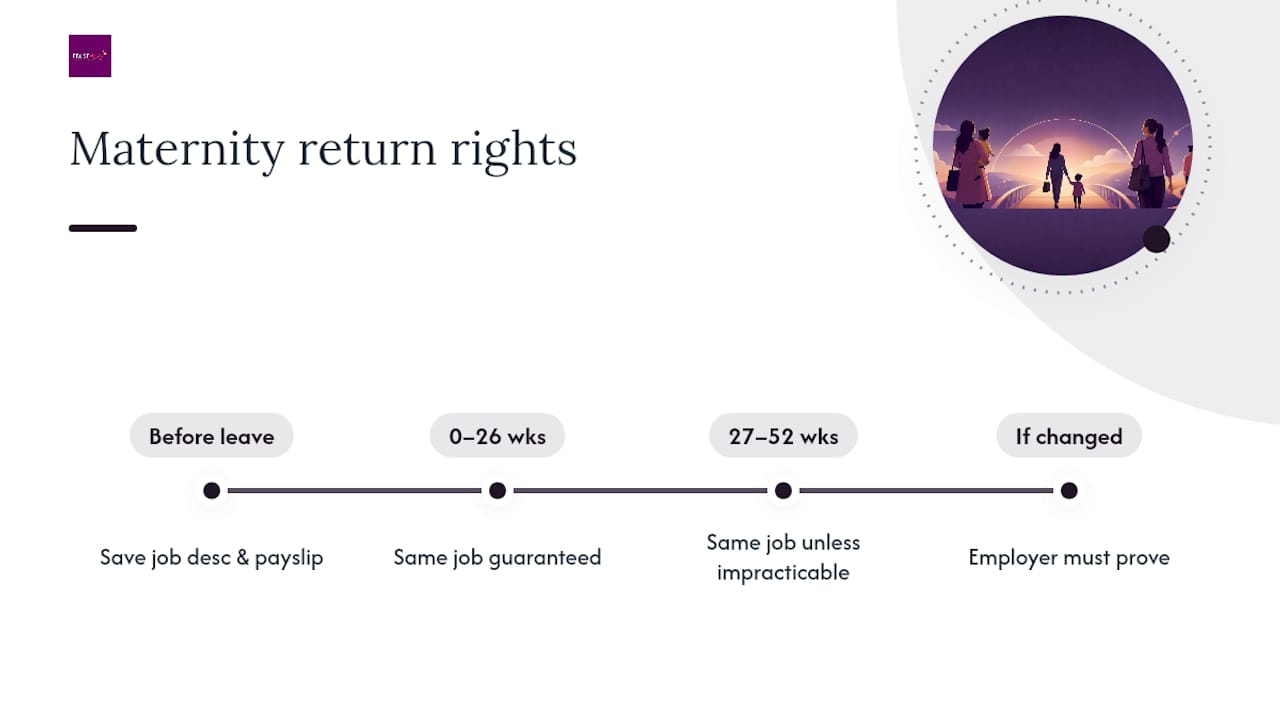
Ordinary Maternity Leave covers your first 26 weeks. Come back within that window and your employer has no wiggle room. You return to the exact same job, same duties, same status, same pay and same location. There's no "reasonably practicable" test here. It's absolute.
Additional Maternity Leave runs from week 27 to week 52. Return after 26 weeks and the standard is slightly different: your employer must still put you back into your old job unless it's not reasonably practicable, for example if the role was genuinely restructured away while you were off. If that happens, you're entitled to a suitable alternative role, and "suitable" is doing real legal work in that sentence. It has to match your skills and status, and the terms, including pay, benefits, seniority and pension, must be no less favourable than your old contract.
That last point matters more than people realise. The Employment Rights Act 1996 puts the burden of proof on the employer, not you. They have to demonstrate why your role couldn't be reinstated. You don't have to prove anything.
Pro Tip: Before you go on leave, save a copy of your job description, your latest pay slip, and anything showing your reporting line or seniority. If your role quietly shifts while you're away, that paper trail is your strongest evidence that terms have changed unfavourably.
Keeping in touch (KIT) days: how to use them without risking entitlements
Keeping in Touch days let you work up to 10 days during your 52-week leave without ending it or losing Statutory Maternity Pay. They're entirely voluntary. Your employer cannot force you to do them, and you can't be penalised for declining.
Pay isn't automatic; it has to be agreed and confirmed in writing, and it must sit at or above National Minimum Wage, though you can negotiate a fuller rate reflecting your actual role.
Typical uses include:
- A training day ahead of a system or process change at work
- A team meeting or handover session before your return date
- A half-day shadowing your cover, which still counts as one full KIT day
Pro Tip: Any part of a KIT day, even an hour, counts as a full KIT day. Agree the schedule and pay by email before you go in, so there's no confusion at payroll later.
Changing your return date, notice periods and pay implications
Plans change. Maybe you want to go back sooner than agreed, or you need more time. Either way, the process is the same.
- Give 8 weeks' written notice. This applies whether you're returning earlier or later than the date originally set, and it's a statutory minimum, not a courtesy.
- Expect a possible short delay for an early return. If you try to return with less than 8 weeks' notice, your employer can postpone you, but only until that 8-week notice period has run its course.
- Check your SMP position. Returning early can affect how much Statutory Maternity Pay you've received versus what you're due, so confirm the numbers with payroll before you hand in your notice.
- Document who you told and when. Email HR and your line manager together, and keep the reply confirming receipt.
Redundancy, discrimination and suitable alternative work
Employees on maternity leave, or who have recently returned, hold some of the strongest job protection in UK employment law. If your role is genuinely redundant, Acas guidance confirms you must be offered any suitable alternative vacancy ahead of employees not on leave. That's a priority right, not a courtesy.
"Suitable and appropriate" has a real legal test behind it. The EHRC is clear that the alternative role must match your skills and experience, and the terms, pay, hours, location, and status, must be no less favourable than before. A quieter desk with a smaller title doesn't meet that bar.
Employers can still make genuine business cases for redundancy. What they can't do is use your leave as cover for a decision that was really about convenience. If you suspect that's happening, keep every email, meeting note and job advert you can find. Contact Acas for free early conciliation advice, and speak to a solicitor if the pattern looks like discrimination rather than a genuine restructure.
Health, safety and breastfeeding at work after maternity
Employers carry a legal duty to run individual risk assessments for anyone who has given birth within the last six months, and for anyone breastfeeding. This isn't optional guidance; it's a formal requirement under HSE rules.
Reasonable adjustments might include changed hours, temporary changes to duties, or, in rarer cases, suspension on full pay if no safe adjustment can be made. Ask that your midwife or GP's advice be factored into the assessment if you have specific concerns.
On breastfeeding, your employer must provide somewhere private, not a toilet cubicle, to express milk, along with somewhere suitable to store it and reasonable breaks to do so. The NHS has practical guidance on timing this around your working pattern.
Quick action: request your risk assessment in writing before your return date, and get any agreed adjustments confirmed by email.
Practical return-to-work plan and checklist (ProspHER‑sourced)
Legal rights are one thing. Actually walking back through the door with your head held high is another. Acas recommends treating your return as a negotiated transition, not a reset button, and we'd add: plan it like one.
- Confirm your return date in writing and request a return-to-work meeting
- Save your job description and last pay slip before anything changes
- Agree KIT days and pay terms in writing
- Request your individual risk assessment
- Submit a flexible working request if you need one
Pro Tip: Trial your commute and childcare drop-off once, at real rush hour, before your actual first day, using tips from navigating daycare and sleep challenges for babies and toddlers to ease the transition. It removes one entire category of first-morning panic.
Set small goals for weeks one to twelve rather than trying to feel "back to normal" instantly. A phased return with mentoring support tends to rebuild momentum faster than diving straight back into a full week.
Employee rights related to pension contributions during maternity leave
Your pension doesn't pause just because your pay changes. During any period you receive Statutory Maternity Pay, your employer must continue making pension contributions based on your normal, pre-leave salary, not your reduced SMP rate. That's a rule many payroll teams get wrong, so it's worth checking your payslips against it.
Your own contributions, if you're on a contributory scheme, are usually calculated on the actual pay you receive during leave. That means your contribution might drop while you're on SMP, but your employer's contribution shouldn't.
Once any unpaid portion of maternity leave begins, typically weeks 39 to 52 if you're not topped up by contractual pay, the automatic employer contribution requirement can lapse unless your contract says otherwise. Check your scheme rules or ask HR directly rather than assuming.
If contributions have quietly stopped or dropped incorrectly during a paid period, raise it with payroll immediately and ask for a written correction. Pension errors are easy to make and easy to fix early, but far harder to unwind two or three years down the line.
Impact of maternity leave and return on annual leave entitlement and holiday accrual
Holiday doesn't stop building just because you're on maternity leave. You continue to accrue your full statutory annual leave, currently 5.6 weeks for a full-time employee, throughout your entire maternity leave, including any unpaid weeks. This applies whether you take the standard 52 weeks or return earlier.
Because Bank Holidays and your normal working days fall during your leave, most people finish maternity leave with a substantial stack of unused holiday. You cannot be forced to take it during your leave itself; it sits waiting for you.
Practically, you have two options. Take the accrued leave immediately after your maternity leave ends, effectively delaying your actual return date, or carry some of it forward and use it in shorter bursts once you're back, which many women use deliberately to soften a full-time return into something closer to phased. Some employers allow carry-over into the next holiday year for leave accrued during maternity that couldn't reasonably be taken; check your contract, because this is often more generous than the statutory minimum.
Either way, get the final number confirmed by HR in writing before your return date. It's a common point of payroll error and an easy one to correct if you catch it early.
Support options for mental health and wellbeing when returning to work after maternity
The emotional side of returning rarely gets the same airtime as the legal side, and that's a mistake. Sleep deprivation, identity shift and sheer logistical load don't switch off because you've signed a return-to-work form.
If you're struggling, your GP is the first port of call, and postnatal depression and anxiety remain treatable and common well beyond the first weeks after birth. Many workplaces also offer an Employee Assistance Programme, a confidential counselling benefit that's often underused simply because nobody mentions it exists. Ask HR directly if you're not sure your organisation has one.
Beyond clinical support, structured peer networks make a measurable difference to how manageable the transition feels. Talking to other women who've navigated the same identity wobble, the guilt, the fog, the feeling of being behind at a job you used to know inside out, tends to normalise what can otherwise feel isolating. That's precisely where community-based support, rather than generic wellbeing leaflets, earns its place. If burnout symptoms are creeping in before you've even properly restarted, it's worth reading about recovering from burnout before it compounds.
Small, deliberate goal-setting in your first six to twelve weeks back tends to help more than any single big gesture. Progress, not perfection, is the actual target.
Options and rights regarding part-time work and job sharing upon return
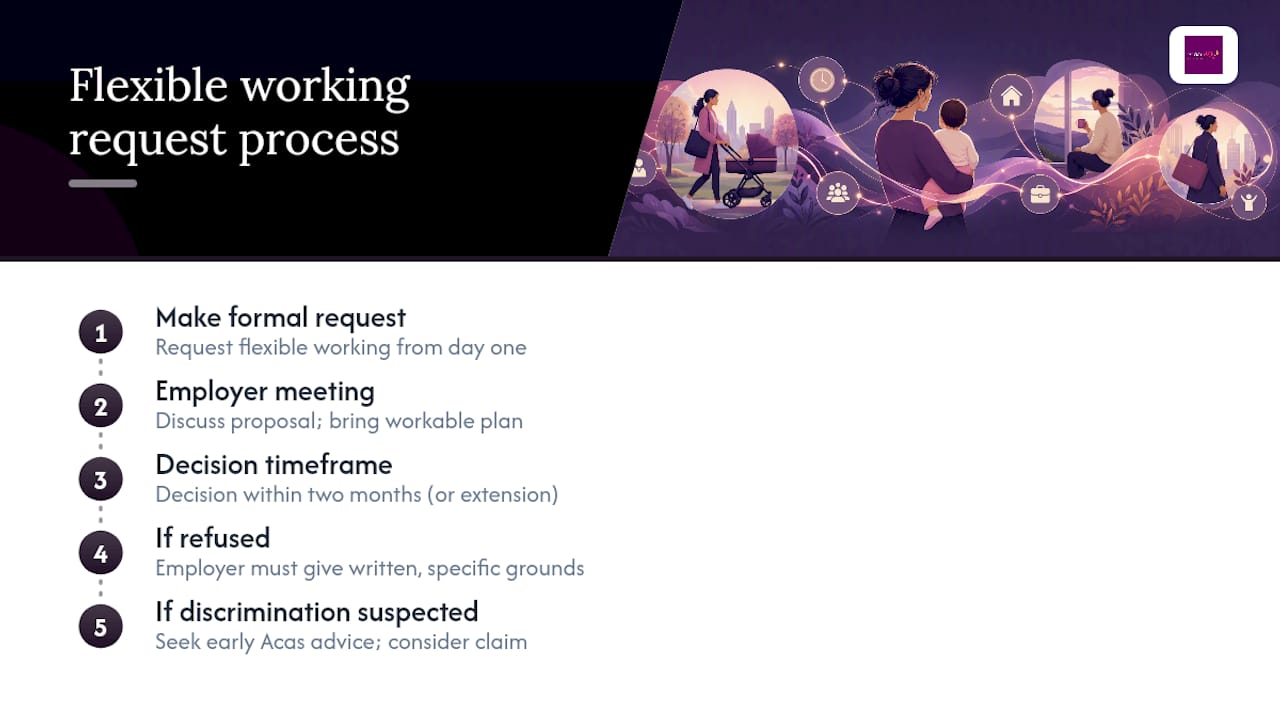
You have a statutory right to request flexible working, including part-time hours or a job share, from day one of employment under current UK law. Your employer must consider it seriously and can only refuse on specific business grounds, such as cost, inability to reorganise work among existing staff, or a negative effect on quality or performance.
A request doesn't guarantee approval, but it does guarantee a proper process: a meeting to discuss it, a decision within two months unless you agree to an extension, and a written explanation if refused. Refusals dressed up as blanket policy, "we don't do part-time in this team", rarely survive scrutiny if challenged.
Job sharing sits in a slightly greyer area. It's not an automatic statutory right in the same way part-time hours are, but it falls under the same flexible working request mechanism, so it's worth proposing formally rather than raising it casually in conversation. Come with a practical structure already sketched out, split days, shared handover notes, named cover, because employers respond far better to a workable plan than an open-ended ask.
If your request is refused and you believe maternity or sex discrimination played a part, for instance if male colleagues' flexible requests have been approved more readily, that crosses from an employment relations issue into a potential discrimination claim, and it's worth getting early advice from Acas.
A short emotional and practical roadmap
Feeling torn, guilty or oddly like a stranger at your own desk in week one is normal, not a sign you've made the wrong choice. The mental load doesn't vanish; it just moves.
Three steps carry most women through: prepare (trial the commute, confirm childcare, sort paperwork early), communicate (get every adjustment agreed in writing, no verbal promises), and stabilise (small weekly goals, plus people around you who've done this before).
You don't have to work this out alone.
— ProspHER
An alternative for tailored planning and confidence: ProspHER
Statutory rights get you back through the door. They don't tell you how to actually feel steady once you're there, and that gap is exactly where most return-to-work plans quietly fall apart. ProspHER exists for that second half of the problem.
Inside the community, you'll find structured mentoring, phased-return planning, and practical goal-setting built specifically for women rebuilding momentum after time away, not generic wellbeing content bolted onto a career platform. Members use it to rehearse tricky return-to-work conversations, map realistic first-90-day goals, and connect with others who've actually done this transition rather than just written about it. If you're deciding between a mentor relationship and formal coaching for this stage, our guide on choosing between mentoring and coaching is a useful starting point.
Visit the ProspHER platform to see current membership options and find the resource that fits where you are in your return.
This article is general information, not a substitute for advice from a qualified lawyer. Consult a qualified legal professional about your own circumstances before acting on anything here.
Sources
- Gov
- Returning to work – Statutory maternity leave and pay - Acas
- Health and safety for new or expectant mothers - HSE
- Breastfeeding and returning to work - NHS