
Run a diagnosis-first, two-day planning session before every quarter. Day one reviews the scorecard and surfaces the real bottleneck. Day two sets three to five priorities, each with an owner and a weekly action. That's the whole system: a two-day planning cycle feeding a 90-day execution sprint, backed by a weekly cadence that members of a career and business growth platform for women use to stay accountable between sessions.
TL;DR:
- Weekly leading indicators should be limited to one or two per priority to ensure focused tracking and better follow-through throughout the quarter.
- A maximum of three to five priorities, each with a clear owner and specific outcome, prevents dilution of effort and maintains strategic clarity.
- Authentic diagnosis, including honest scoring of last quarter's goals and understanding the real bottleneck, is essential before setting new priorities.
- Regular cadence check-ins, such as weekly reviews and mid-quarter pivot decisions, help keep plans adaptive and prevent drift.
- External accountability, like mentorship or peer check-ins, significantly increases the likelihood of sticking to the plan and achieving key outcomes.
Table of Contents
- Why quarterly planning for founders beats monthly or annual cycles
- Pre-work to run two weeks before your planning session
- Day one: diagnosis before decisions
- Day two: commitments, owners and leading indicators
- What the two-day plan actually produces
- Cadence between quarters: what keeps the plan alive
- Common failure modes and how to defend against them
- How founders and ProspHER members make the quarter work in practice
- Involving key stakeholders and effective communication during the planning process
- Tools and software recommendations to facilitate quarterly planning
- Adjusting quarterly plans in response to unexpected changes or market conditions
- Best practices for tracking progress and measuring success during the quarter
- Case studies or examples of successful quarterly planning implementations for founders
- Author's checklist: what to do in the next 48 hours
- Where ProspHER fits into your next quarter
- Sources
Why quarterly planning for founders beats monthly or annual cycles
Ninety days is the sweet spot. It's long enough to actually ship something meaningful, short enough that you're never more than three months from correcting course. Annual plans age badly. By month four, half your assumptions are wrong and nobody's updated the deck. Monthly cycles, meanwhile, keep you in permanent firefighting mode. You barely get momentum before you're back in a planning room.
There's also a rhythm match worth noting: most investor updates, product roadmaps, and revenue reviews already run on a quarterly beat. Aligning your internal planning to that same cadence means fewer translation problems when you're explaining progress to a board or a co-founder.
Use this quick check to decide if you're ready to adopt it now:
- You've made at least one full sales cycle or product release since your last plan.
- You can name three metrics that matter more than the rest.
- Nobody on your team can currently tell you what "done" looks like this quarter.
If two of those are true, you need this system now, not next month.
Pre-work to run two weeks before your planning session
The two-day cycle only works if everyone walks in with facts, not opinions. Distribute three artefacts at least two weeks out, and set a hard deadline for each.
- The scorecard. List last quarter's three to five priorities and score each honestly on a simple scale, hit, partial, or missed. Skip the diplomatic middle ground. If a goal was 60% done, write 60%, not "mostly there."
- Function memos. Each function lead (sales, product, ops) writes a two-page memo covering what worked, what didn't, and what they'd fight for next quarter. Two pages is the ceiling. If it runs longer, they haven't distilled the point yet.
- The customer and market update. The founder or CEO writes this one, not a junior analyst. It should cover shifts in buyer behaviour, competitive movement, and anything in the market that changes the calculus since last quarter. Circulate it 48 hours before day one so nobody's reading it cold in the room.
This groundwork turns your quarterly business review into an evidence-based session rather than a guessing exercise.
Day one: diagnosis before decisions
Resist the urge to jump straight to "what should we do next quarter." That question, asked too early, produces a wish list dressed up as a strategy. Diagnosis comes first, and it should feel uncomfortable if you're doing it properly.
Structure the metric conversation around three prompts:
- What surprised us this quarter, positively or negatively?
- What did we predict would happen that didn't?
- What do we genuinely not know yet, and who's closest to finding out?
Timebox this to half a day. Anyone with direct ownership over a metric needs to be in the room, but keep the group tight, five or six people maximum, or the conversation dissolves into status updates instead of honest analysis.
By the end of day one, you should be able to name the single biggest constraint holding the business back, whether that's a sales bottleneck, a product gap, or founder bandwidth itself. You should also have a short list of projects to pause or kill outright. Stopping something is often the most useful decision a founder makes in a planning session.
Pro Tip: If the room can't agree on the bottleneck within an hour, that disagreement is itself the finding. Write it down as the first item to resolve next quarter.
Day two: commitments, owners and leading indicators
Day two converts yesterday's honesty into a short, executable list. The discipline here is ruthless narrowing: two to three major objectives, never more than five.
Phrase each priority as an outcome, not a task list. "Grow monthly recurring revenue to £40,000" is a priority. "Improve the sales process" is an activity with no finish line. Outcomes force clarity; activities let people feel busy without moving anything forward.
For every priority:
- Name one owner. Shared ownership means no ownership.
- Attach one or two leading indicators, metrics you can check weekly, not just at quarter close.
- Set a single weekly execution action. One, not three. Diffusing effort across several actions is how good plans quietly die.
This is where most founders overcorrect and add complexity back in. Resist it. A priority with one owner, one number to watch, and one weekly action is far more likely to survive contact with a busy quarter than a beautifully detailed roadmap nobody actually opens.
What the two-day plan actually produces
The output isn't a slide deck. It's a small set of working documents that get published within 24 hours of the session ending.
- The scored plan. Last quarter's objectives with honest scores attached, filed where the whole team can see it.
- The commitments list. Three to five priorities, each with an owner, its leading indicators, and the weekly action tied to it.
- The weekly plan. A cascade from quarterly priority to monthly milestone to weekly task, so the first Monday after planning has a concrete agenda, not a blank page.
By the second half of the quarter, every employee should be able to answer three questions without checking a document: What's the company's top priority this quarter? Who owns it? What number tells us if it's working? If people are guessing at any of those, the cascade broke somewhere between the planning room and their desk.
Cadence between quarters: what keeps the plan alive
A plan without a rhythm is a document. The four-touchpoint system is what keeps yours operational for the full 90 days.
- Weekly review (15 to 30 minutes). Ask three questions: What moved this week? What's blocked? What's the one action for next week? Keep it short enough that it never gets skipped.
- Monthly check. Around week four, read the leading indicators properly. This is your pivot-or-hold moment, decide whether a priority needs more resource, less, or a different approach entirely.
- Week-six pivot decision. Halfway through, if a priority clearly isn't landing, this is the point to change course rather than wait out the quarter hoping it corrects itself.
- Quarter close (60 to 90 minutes). Score everything honestly, extract the lessons, and schedule the next quarter's four review dates before anyone leaves the room.
That last point matters more than it sounds. Booking the next quarter's touchpoints immediately prevents the slow calendar drift where reviews quietly stop happening by month two. Quarterly business reviews that spend roughly 70% of their time on future direction and 30% on scoring the past tend to keep teams looking forward rather than relitigating last quarter.
Common failure modes and how to defend against them
Three patterns kill more quarterly plans than any external market shock ever does.
- Too many priorities. Eight objectives means zero focus. Enforce the bottleneck rule: identify the single constraint holding growth back, and let that shape which three to five priorities make the cut.
- Skipping the pre-work. Walking into day one without a scorecard or function memos turns diagnosis into guesswork. Insist on the artefacts two weeks out, no exceptions, even if that means pushing the session back a week.
- No follow-through. A plan with no named owner and no weekly cadence is a wish list with better formatting. Name the owner, protect the weekly review slot, and where possible, add an external accountability anchor, a mentor, an accountability cohort, or a co-founder who checks in independently of you.
Pro Tip: If you're planning solo, pick one accountability anchor outside your own head, someone who'll ask "how's the priority going?" without being told to.
How founders and ProspHER members make the quarter work in practice
Structure only helps if someone's checking whether you actually used it. Inside ProspHER's community of over 2,400 women, 94% of members report gaining clearer direction within 30 days of engaging with a structured pathway, which is roughly the window a first quarterly cycle needs to prove itself.
In practice, that looks like members using shared templates for the scorecard and function memos during pre-work, running peer accountability check-ins that mirror the weekly review habit, and leaning on mentorship conversations to pressure-test which priority is genuinely the bottleneck versus which one just feels urgent. Monday reviews land better with a second person expecting an update.
[Author credentials and verified member outcome data to be inserted by the editorial team.]
Involving key stakeholders and effective communication during the planning process
A quarterly plan built in isolation, even a well-diagnosed one, tends to fall apart the moment it meets the rest of the company. Stakeholder involvement isn't a courtesy step. It's what determines whether the commitments survive week three.
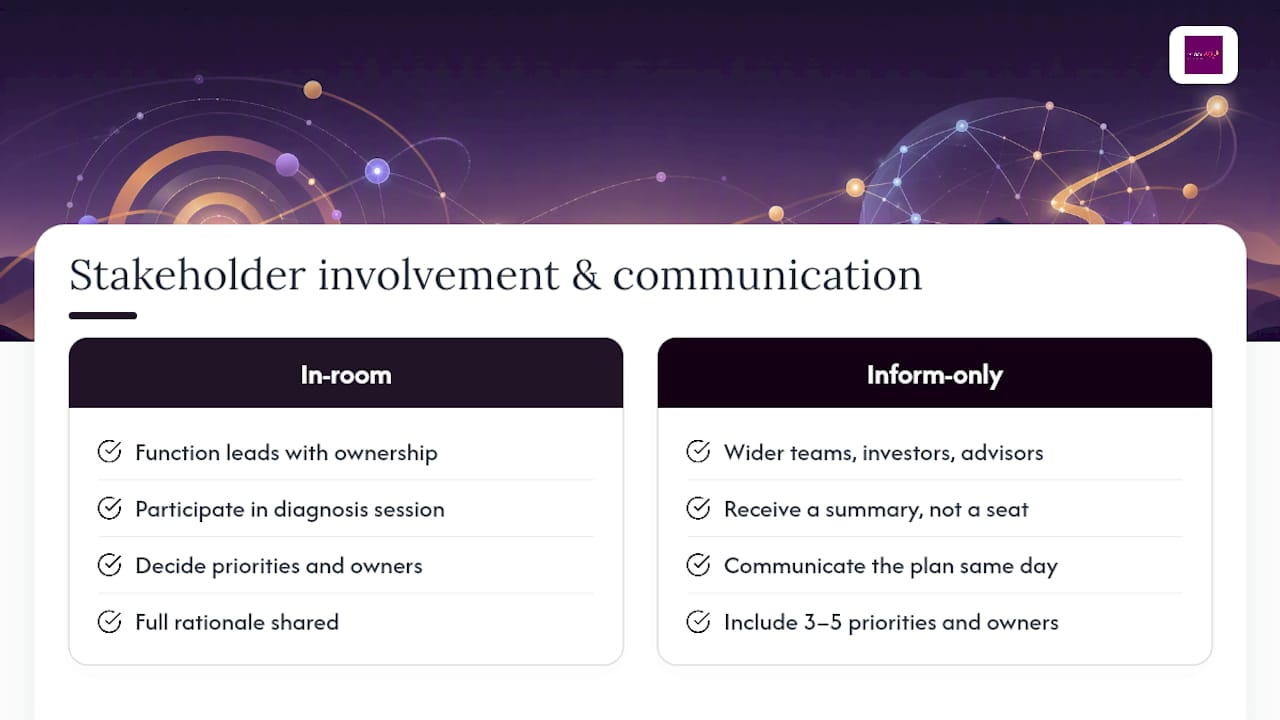
Before day one, identify who actually needs a voice in the room versus who just needs the outcome communicated afterwards. Function leads with direct ownership over a priority belong in the diagnosis session. Wider teams, investors, and advisors typically need a summary, not a seat.
Communicate the finished plan the same day it's set, not the following week once it's been polished into a deck. A same-day Slack message or short memo covering the three to five priorities, owners, and why the bottleneck was chosen carries more weight than a beautifully formatted document that arrives after people have already guessed at the priorities themselves.
For investor updates, translate the plan into the language they already expect: what changed, what you're betting on, and what number will tell you if it's working. Board members rarely need the full diagnosis. They need the conclusion and the confidence behind it.
Internally, over-communicating the "why" behind a priority matters more than most founders expect. Teams tolerate a hard priority far better than an unexplained one. If the bottleneck decision was contested in the room, say so. It builds more trust than pretending the choice was obvious all along.
Tools and software recommendations to facilitate quarterly planning
You don't need elaborate software to run this system well, a shared document and a calendar cover the basics, but a few categories of tool make the cadence easier to sustain once the founder isn't the only one holding it together.
For the scorecard and commitments list, a lightweight OKR or goal-tracking tool works better than a spreadsheet buried in a shared drive, mainly because it forces visible, dated updates rather than a document nobody reopens until quarter close. Whatever you choose, the requirement is simple: it needs to make the weekly leading indicators visible to the whole team without a founder having to chase updates manually.
For the weekly review itself, a recurring calendar block with a fixed three-question agenda beats any dedicated app. The discipline lives in the habit, not the interface.
Resource and capacity decisions, particularly when a priority conflicts with existing delivery workload, benefit from a more structured look at where time is actually going. AI-assisted resource allocation tools can help founders see capacity gaps before committing to a fourth priority the team doesn't actually have hours for.
Function memos and pre-work artefacts don't need dedicated software at all. A shared folder with a firm two-week deadline solves that problem more reliably than any project management platform. The tool matters far less than whether someone enforces the deadline.
Adjusting quarterly plans in response to unexpected changes or market conditions
A 90-day plan isn't a contract with reality. It's a working hypothesis, and the week-six pivot check exists precisely because hypotheses need revisiting.
The difference between a founder who adjusts well and one who abandons the plan entirely comes down to what triggers the change. A single disappointing week isn't a market shift, it's noise, and reacting to it undermines the whole point of committing to priorities in the first place. A genuine trigger looks like a leading indicator moving consistently for three or more weeks, a major customer or competitor move that changes the underlying assumption behind a priority, or a cash position that materially changes what's affordable this quarter.
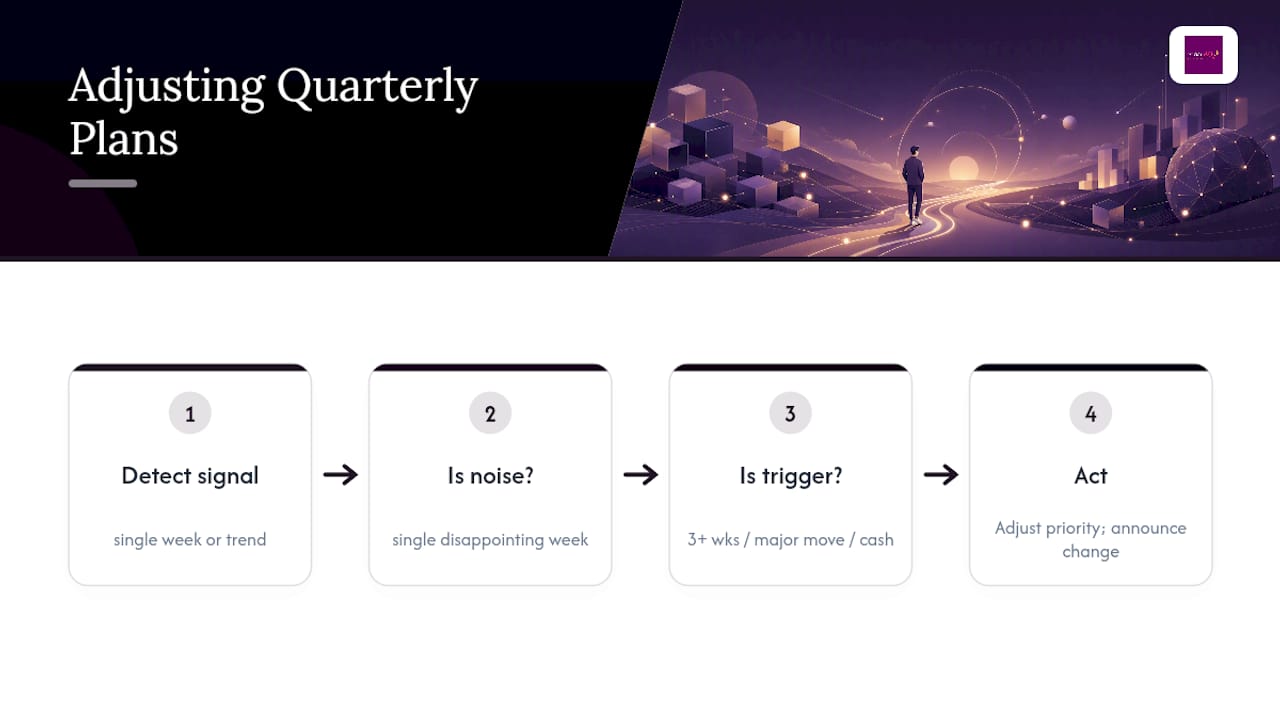
When a genuine trigger appears, don't rebuild the whole plan. Revisit the specific priority it affects, using the same diagnosis-first logic from day one: what changed, what did we assume that turned out wrong, and does the bottleneck still hold. Often only one of the three to five priorities needs adjusting, not the full set.
Communicate any mid-quarter change the same way you communicated the original plan, quickly and plainly. Teams handle a changed priority far better than a silently abandoned one they find out about weeks later. If a priority is dropped, say so explicitly and explain why, rather than letting it quietly disappear from the weekly review.
Best practices for tracking progress and measuring success during the quarter
Tracking only works if it happens on a rhythm shorter than the quarter itself. Waiting until week twelve to check whether a priority is on track is not tracking, it's a postmortem with worse timing.
The leading indicators set on day two are the backbone of this. They need to be visible weekly, not just referenced at the monthly check, and they need to be specific enough that a "yes, on track" or "no, off track" answer is obvious without debate. A vague indicator like "improve customer satisfaction" invites disagreement about what counts as progress. A specific one, "reduce support response time to under four hours," doesn't.
Score progress the same way you scored last quarter's plan: honestly, and against the original commitment rather than a softened version of it. If a target was £40,000 in new recurring revenue and the quarter closes at £28,000, that's a miss worth examining, not a near-success worth rounding up. The honesty in scoring is what makes the diagnosis phase of the next quarter actually useful.
Beware vanity progress, activity that looks like momentum but doesn't move the outcome. Ten sales calls booked means nothing if the priority was revenue, not call volume. Phrasing priorities as outcomes at the outset, rather than activities, is what prevents this measurement drift from creeping in over the 90 days.
Case studies or examples of successful quarterly planning implementations for founders
The pattern that separates plans that ship from plans that quietly evaporate isn't unique to any one industry. It's the presence of the four-touchpoint rhythm and a narrow set of priorities, applied consistently.
A common example: a founder team with six competing initiatives going into a quarter, none clearly owned, all loosely tracked in a shared document nobody opened after week one. Applying the bottleneck rule during diagnosis typically surfaces that most of those six initiatives were symptoms of one underlying constraint, often founder bandwidth itself, or a single broken step in the sales process. Narrowing to three priorities with named owners and weekly actions, rather than adding a seventh initiative, is usually what unlocks progress.
Solo founders face a distinct version of this problem: no team to enforce the weekly check-in. The solo founder quarter framework addresses this directly by requiring one primary 90-day outcome, a fixed weekly reckoning with yourself, and crucially, an external accountability anchor, someone outside the business who asks how the priority is going. Without that anchor, the "drift window," the gap between deciding a priority and actually working on it week to week, tends to widen unnoticed.
The through-line across working examples is consistent: fewer priorities, named owners, and a weekly cadence that doesn't depend on motivation to survive.
Author's checklist: what to do in the next 48 hours
Here's what I'd do before this week is out. Get the two-day planning slot on the calendar now, and set pre-work deadlines two weeks out from that date, not "sometime before." Pick one primary 90-day outcome you'd bet the quarter on, and message it to whoever's going to hold you accountable, today, not after you've polished it. Then open your calendar and block a recurring 30-minute weekly review slot before anything else fills that space.
None of this requires perfect information. It requires the slot existing before the excuses do.
**
Where ProspHER fits into your next quarter
A specialised membership platform offers founders the structure a two-day planning cycle needs without building it from scratch, templates for the scorecard and function memos, mentorship to pressure-test which priority is the real bottleneck, and accountability cohorts that replace the external anchor a solo founder often lacks.
Inside such platforms, members typically have access to personalised pathways rather than generic content libraries, allowing support to match where they actually are this quarter instead of a one-size-fits-all programme. Members use the community's weekly rhythm the same way this article describes the Monday review: a fixed check-in that doesn't depend on willpower to happen.
If you're heading into your next planning session without a clear pre-work process or a peer who'll ask how the priority is going, explore ProspHER's membership and see which pathway, mentorship, cohort accountability, or practical templates, fits where your business is right now.
Sources
- Mastering the 90 Day Execution Sprint: A Practical Guide to Success
- Quarterly planning (Atlassian guidance)