
The most practical alternatives to women-focused support programmes in the UK are: ProspHER (integrated membership with coaching, community, and financial literacy), Innovate UK Women in Innovation grants (non-dilutive, up to £50,000), the NatWest Accelerator (bank-backed, equity-free), Crowdfunder (community-led capital), and revenue-based financing providers active across the UK. For most aspiring female founders who need clarity, coaching, and connections alongside capital, ProspHER is the recommended starting point. 94% of ProspHER members report clearer direction within 30 days, which is a result that isolated funding channels rarely match on their own.
Female-founded teams in the UK receive a disproportionately small share of venture capital despite performing comparably to male-founded ventures. That gap is precisely why female founders, rise alternatives matter: the right combination of capital, coaching, and connections can close it faster than chasing VC alone.
- ProspHER: personalised pathways, mentoring, community events, financial literacy, retreats
- Innovate UK Women in Innovation: non-dilutive grants for high-potential female founders
- NatWest Accelerator: free workspace, coaching, and expert networks for early-stage businesses
- Crowdfunder: community-backed campaigns with no equity required
- Revenue-based financing (RBF): flexible repayment tied to monthly revenue, no equity lost
Table of Contents
- Which UK alternative fits your stage and goals?
- How do you choose the right alternative for your business?
- How does each funding route actually work in practice?
- Which route suits your founder profile right now?
- Why community and mentorship matter as much as capital
- What are the realistic timelines and costs for each route?
- What is the recommended route based on your priorities?
- Key takeaways
- Why integrated support outperforms isolated funding channels
- ProspHER: your next step starts here
- Useful sources for your next steps
Which UK alternative fits your stage and goals?
Scan this before reading further. Every option below is available to UK founders.
| Option | Best for / stage | What you get | Equity impact | Cost / fees | Eligibility & timeline |
|---|---|---|---|---|---|
| ProspHER | Idea to growth | Coaching, mentoring, community, financial literacy, retreats, content library | Non-dilutive | Monthly membership subscription | Open to women; join within days |
| Innovate UK Women in Innovation | Early-stage, high-potential | Grant funding, coaching, investor connections | Non-dilutive | Free to apply | Female-founded UK business; competitive rounds |
| NatWest Accelerator | Early revenue to growth | Workspace, expert coaching, peer network | Non-dilutive | Free | NatWest business account; rolling intake |
| Crowdfunder | Idea to early revenue | Community capital, market validation, PR | Non-dilutive | Platform fee on funds raised | Open; campaign live within days |
| RBF providers | Early revenue to growth | Growth capital | Non-dilutive (revenue repaid) | Factor rate on revenue | Minimum monthly revenue threshold; 2–6 weeks |
A few things worth noting before you choose:
- Grants reward impact narratives; RBF rewards revenue predictability.
- Bank accelerators offer credibility and networks but require existing business registration.
- Membership platforms like ProspHER work at any stage because the value is structural, not transactional.
How do you choose the right alternative for your business?
Start with two questions: How much equity are you willing to give up? and What do you need most right now: capital, coaching, or connections? Your answers narrow the field immediately.
Decision checklist:
- Do you have monthly recurring revenue? If yes, RBF becomes viable.
- Is your idea in a STEM, creative, or social impact sector? Innovate UK grants prioritise these.
- Do you need structured accountability alongside funding? A membership platform or accelerator beats a standalone grant.
- How long can your runway sustain a 3–6 month application process?
- Does your business have an existing customer base or community? Crowdfunding works best when it does.
Red flags to avoid:
- Opaque fee structures with no published repayment terms
- Mentorship programmes that cannot name measurable outcomes for past participants
- Accelerators that take equity without offering genuine investor introductions
- Platforms that promise community but deliver only content
Pro Tip: When evaluating mentorship quality, ask for the programme's cohort outcomes, not testimonials. Specific metrics (revenue growth, funding raised, time to first customer) tell you far more than a quote.

How does each funding route actually work in practice?
Understanding the mechanics prevents costly mistakes. Here is what each route actually requires from you.
A substantial proportion of female founders cite lack of access to capital as the number one barrier to starting a business, and nearly half cite lack of access to coaches and mentors as a major barrier.
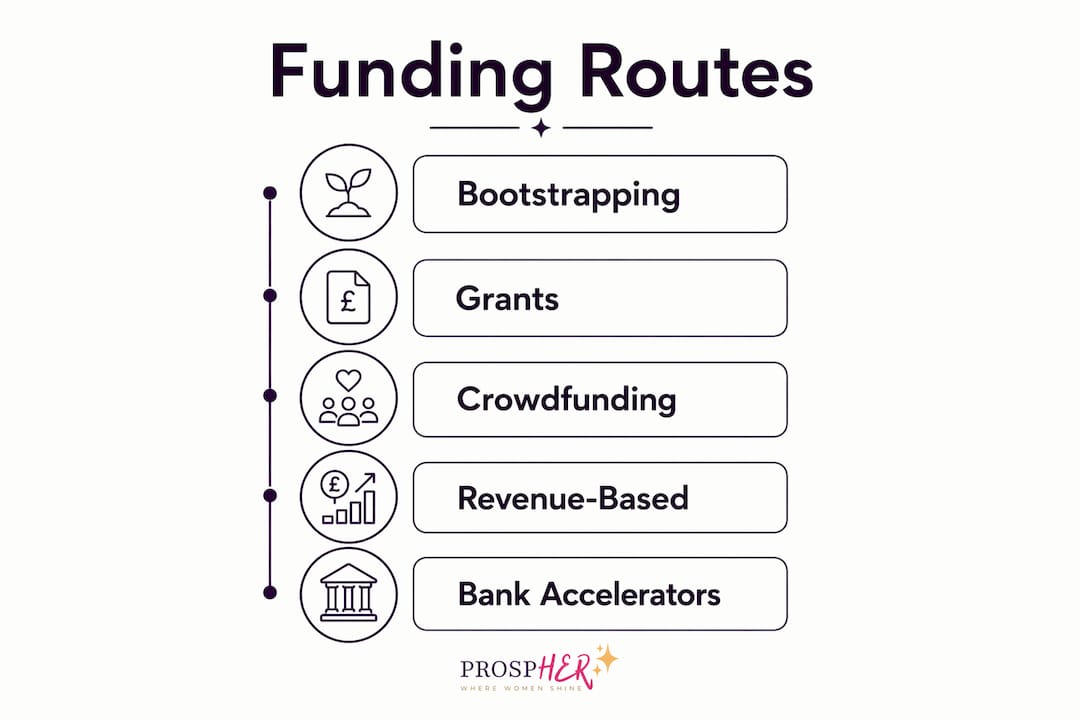
Revenue-based financing advances a lump sum in exchange for a fixed percentage of your monthly revenue until a pre-agreed total is repaid. No equity changes hands. The repayment flexes with your revenue, which protects you in slower months. You typically need a minimum of £5,000–£10,000 in monthly recurring revenue to qualify, and decisions arrive in 2–6 weeks.
Grants (including Innovate UK Women in Innovation) award non-dilutive capital, often with a co-contribution requirement. Selection is competitive and narrative-driven: impact, innovation, and scalability are scored. Timelines run 3–6 months from application to award.
Crowdfunding via platforms like Crowdfunder raises community capital through public campaigns. You keep equity, validate demand, and build an audience simultaneously. Success depends on pre-existing community momentum and a compelling story. Campaigns typically run 30–60 days.
Bank accelerators (NatWest Accelerator) offer workspace, coaching, and expert networks at no cost and with no equity taken. Entry requires an existing business and, usually, a NatWest business account.
Bootstrapping means funding growth from your own revenue. It preserves full equity and forces lean discipline, but growth is slower. It pairs well with a membership platform that builds your skills and network while you scale.
| Route | Repayment model | Equity impact | Typical amount | Best-for stage |
|---|---|---|---|---|
| RBF | % of monthly revenue | None | £10k–£50k | Early revenue to growth |
| Innovate UK grant | None | None | Up to £50,000 | Early-stage, high-potential |
| Crowdfunding | None | None | £1k–£50k+ | Idea to early revenue |
| NatWest Accelerator | None | None | Non-cash support | Early revenue |
| ProspHER membership | Subscription | None | Structured support | Any stage |
For practical guidance on preparing your ARR figures and non-traditional financing applications, the ProspHER blog covers each route in detail.
Which route suits your founder profile right now?
The honest answer: your stage matters more than your sector.
Pre-revenue founders benefit most from grants and crowdfunding. Both reward narrative and community over financial track record. Innovate UK Women in Innovation is the strongest UK grant route for founders with a clear innovation angle.
Early-revenue founders (£3k–£15k monthly revenue) are the natural fit for RBF and bank accelerators. Revenue predictability is the asset; use it. A membership platform running alongside either route builds the financial literacy to manage repayments confidently.
Scaling founders with proven unit economics can approach selective investor introductions via accelerator networks or explore venture debt. Building investor-facing visibility on LinkedIn before those conversations matters more than most founders realise.
- Idea stage: Apply for Innovate UK Women in Innovation or launch a Crowdfunder campaign; join ProspHER for structured coaching while you build.
- Early revenue: Assess RBF eligibility (monthly revenue, burn rate, customer acquisition cost); use the NatWest Accelerator for expert networks.
- Growth/scale: Combine RBF or venture debt with an accelerator network; ProspHER's community and retreats support the leadership development that scaling demands.
UK founders outside London should note that regional grant schemes (Innovate UK has UK-wide coverage) and remote-friendly accelerators mean geography is rarely a barrier. ProspHER operates fully across the UK.
Why community and mentorship matter as much as capital
Harvard Kennedy School research documents persistent gender bias in venture capital, including pattern-matching that disadvantages women founders in pitch settings. Structured mentoring and investor-readiness programmes directly address this by improving pitch metrics and narrative framing.
Capital alone does not fix the problem. Coaching and connections are equally decisive. ProspHER is built around exactly this model: capital literacy, structured coaching, and a community of over 2,400 women working through the same challenges.
ProspHER's features map directly to what female founders need most:
- Capital literacy: financial literacy programmes, ARR and burn-rate workshops, practical resources
- Coaching: group coaching sessions, one-to-one mentoring, mindset training
- Connections: community events, retreats, peer network of 2,400+ women, corporate partnerships
94% of ProspHER members report clearer direction within 30 days. That is not a soft metric. Clarity at the early stage determines whether a founder pursues the right funding route or wastes six months on the wrong one.
What are the realistic timelines and costs for each route?
Speed and cost trade-offs are real. Crowdfunding can generate capital within weeks but demands significant upfront effort. Grants are free to apply for but slow to award.
| Route | Typical application timeline | Decision / funding timeline | Upfront work required |
|---|---|---|---|
| ProspHER membership | Minutes | Immediate access | None |
| Innovate UK grant | 4–6 weeks to prepare | 3–6 months | Impact narrative, financials |
| NatWest Accelerator | 1–2 weeks | Rolling intake | Business plan, account |
| Crowdfunder campaign | 1–2 weeks to set up | 30–60 days live | Community, video, rewards |
| RBF providers | 1–2 weeks | 2–6 weeks | Revenue data, forecasts |
Scheduling checklist:
- Check Innovate UK's current open rounds before committing time to an application.
- Confirm NatWest Accelerator intake dates for your region.
- Build your Crowdfunder audience for at least four weeks before launching a campaign.
- Prepare 6 months of revenue data before approaching RBF providers.
What is the recommended route based on your priorities?
- Retain full equity and build skills: ProspHER membership plus an Innovate UK grant application.
- Fast access to growth capital: RBF, with ProspHER's financial literacy programme running alongside.
- Deep coaching and peer accountability: ProspHER as the primary platform, NatWest Accelerator for expert networks.
For most aspiring female founders in the UK, the clearest path is to join ProspHER first. It costs less than most grant application consultants, delivers structured support immediately, and builds the financial literacy that makes every other route more viable. Then layer in the funding channel that matches your revenue stage.
Key takeaways
The most effective approach for UK female founders is to treat capital, coaching, and connections as one integrated system rather than pursuing each in isolation.
| Point | Details |
|---|---|
| Stage determines route | Pre-revenue founders suit grants and crowdfunding; early-revenue founders suit RBF and accelerators. |
| Non-dilutive options are strong | Innovate UK grants, RBF, crowdfunding, and bank accelerators all preserve your equity. |
| Coaching accelerates capital outcomes | 94% of ProspHER members report clearer direction within 30 days, directly improving funding readiness. |
| Timelines vary significantly | Grants take 3–6 months; RBF takes 2–6 weeks; ProspHER membership is immediate. |
| ProspHER as your foundation | ProspHER combines mentoring, financial literacy, and community for female founders at any stage across the UK. |
Why integrated support outperforms isolated funding channels
The conventional wisdom says: raise capital first, build later. For most female founders, that sequence is backwards.
Chasing external capital before you have clarity on your unit economics, your narrative, and your network is one of the most common and costly mistakes we see. The funding gap for female-founded businesses in the UK is real, and VC gender bias is documented. But the answer is not simply to apply for more funding. It is to build the foundation that makes every funding conversation more credible.
Founders who invest in structured coaching and peer community before approaching investors or lenders arrive better prepared, pitch more confidently, and make smarter decisions about which capital is worth taking. Integrated support is not a consolation prize for founders who cannot raise VC. It is the smarter starting position for most founders, at most stages. For more on building that foundation, the ProspHER blog on female entrepreneur support covers the practical steps in depth.
ProspHER: your next step starts here
If you have read this far, you already know that capital alone is not the answer. What moves the needle is the combination: clarity on your direction, a structured pathway to build on, and a community that holds you accountable.
ProspHER gives you all three. With personalised growth pathways, group coaching, one-to-one mentoring, financial literacy programmes, and a community of over 2,400 ambitious women, it is built for female founders at every stage. Across the UK, 94% of members gain clearer direction within 30 days. The membership is accessible, the support is immediate, and there is no equity to give up.
Join ProspHER today and build the foundation that makes every other funding route more achievable.
Useful sources for your next steps
- ProspHER | Career & Business Growth Platform for Ambitious Women: Start here if you are at any stage and want structured, personalised support. Immediate access, UK-wide.
- Female founders: your 2026 guide to launching and growing: Open first if you are preparing an RBF application or exploring non-traditional financing routes.
- Financial planning for women: your practical UK guide: Essential reading before approaching any revenue-based financing provider; covers ARR, burn rate, and customer acquisition cost.
- Top 3 communities for top female business coaches: Useful if you are evaluating mentorship and coaching communities alongside ProspHER.
- IFundWomen | About Us: Background on the Capital, Coaching, and Connections model and the funding barriers female founders face globally.
- Growth Lending | The female founders' hub: UK-specific data on the VC funding gap for female-founded businesses; useful context for grant and RBF applications.
- Harvard Kennedy School | Venture Capital and Entrepreneurship: Academic evidence on VC gender bias and the value of structured investor-readiness programmes; open this if you are preparing for investor conversations.