
Customer discovery interviews are evidence-focused, 30-minute conversations that surface whether a problem is real by asking about past behaviour rather than hypothetical intentions. Run one this week and you will know more than three months of assumption-building can tell you.
Here is the timed template you can use immediately:
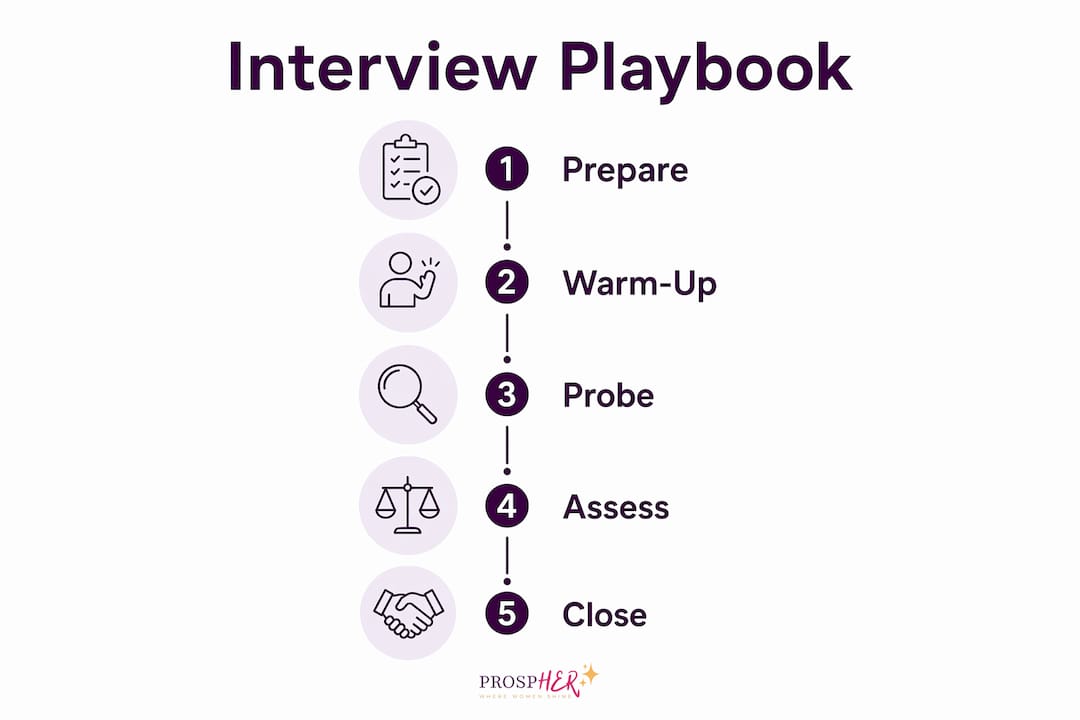
- 0–3 minutes: Frame the conversation, confirm consent, and start recording.
- 3–20 minutes: Probe one recent incident in detail ("Tell me about the last time this happened").
- 20–27 minutes: Quantify impact and workarounds (time lost, money spent, tools cobbled together).
- 27–30 minutes: Wrap up, ask for referrals, and close with a commitment question.
The principle behind this structure comes from Rob Fitzpatrick's The Mom Test: ask about what people already did, not what they might do. "Would you use a coaching programme?" tells you nothing. "What did you do the last time you needed career clarity?" tells you everything. In a mentoring or coaching context, this means mapping mentee pain points through real incidents, not wishful projections.
Table of Contents
- What do you need before your first customer discovery interview?
- Your ready-to-use 30-minute script and question bank
- How do you run the interview well?
- How do you turn interview notes into decisions?
- What are the most common mistakes in discovery interviews?
- Recording and storing interview data: UK GDPR basics
- Key takeaways
- Why discovery interviews matter for ambitious women
- ProspHER: structured support for your next step
- Useful sources and further reading
What do you need before your first customer discovery interview?
Define one clear hypothesis before you recruit anyone. For example: "Ambitious women in mid-career transitions would pay for a structured, coached clarity session." That single sentence shapes every question you ask.
Who to recruit. Target people who already show the problem through their behaviour: they have Googled solutions, paid for adjacent tools, or built their own workarounds. Aim for 8–12 interviews in your first round per segment. That is enough to spot reliable patterns without drowning in data.
Where to find them. LinkedIn title search is the most direct channel. Send a short direct message that names the specific problem, not your idea. Niche Slack groups, alumni networks, and coaching communities are equally productive. Cold outreach works when the message names the pain and positions you as a researcher, not a seller.
Consent and recording checklist (UK-compliant):
- State the purpose of the interview and how data will be used.
- Ask verbal permission to record before you start.
- Confirm the recording is for internal research only and will not be shared externally.
- Store recordings in a password-protected folder; delete after your retention period.
- Anonymise notes before sharing with any third party.
Pro Tip: Avoid interviewing friends or colleagues who already support your idea. Recruiting wrong people is the single most common cause of wasted discovery. Prioritise strangers who can show you behavioural receipts: they have already tried to solve the problem.
Your ready-to-use 30-minute script and question bank
Minute-by-minute script
0–3 minutes (framing and consent) "Thanks so much for your time. I'm researching how [type of person] deals with [problem area]. There are no right or wrong answers. I'm here to listen and learn, not to pitch anything. Is it okay if I record this for my own notes? The recording stays with me and won't be shared."

3–20 minutes (incident probing) "Tell me about the last time you dealt with [problem]. Walk me through what happened from the beginning." Follow every answer with: "And then what did you do?" or "Who else was involved?"
20–27 minutes (impact and workarounds) "What did you try to fix it? How much time did that cost you? Did you pay for anything to solve it?"
27–30 minutes (close) "Is there anything important I haven't asked? Who else do you know who deals with this?"
Question bank: do/don't rewrites
| Phase | ✗ Hypothetical (avoid) | ✓ Past-behaviour rewrite |
|---|---|---|
| Warm-up | "Would you use a career coaching app?" | "What did you do the last time you needed career direction?" |
| Incident | "Do you find it frustrating when X happens?" | "Tell me about the last time X happened. What did you do?" |
| Impact | "Would you pay for a solution?" | "What have you already spent, in time or money, trying to fix this?" |
| Workaround | "Would a structured programme help?" | "What are you currently doing instead? How is that working?" |
| Close | "Do you think this is a real problem?" | "Who else do you know who has tried to solve this?" |
Past-behaviour questions surface receipts: money already spent, workarounds already built, time already lost. Those are the signals that survive contact with a real purchasing decision.
Pro Tip: Use the reverse-pitch prompt near the close: "I'm honestly not sure this is a real problem. Talk me out of it." If the interviewee shrugs, the hypothesis is weak. If they push back with specific stakes and named consequences, you have found something worth pursuing.
How do you run the interview well?
The interviewer's job is to listen, not to perform. If you are speaking more than roughly 20% of the time, you are at risk of pitching rather than researching. Keep the focus on eliciting stories, not sharing your thinking.
Do:
- Follow up every answer with "And then what?" or "Can you tell me more about that?"
- Ask for specifics: names, dates, amounts, steps taken.
- Use silence deliberately. After a surface answer, pause. People fill silence with the more honest, more detailed second answer.
Don't:
- Mention your product or idea. Once you do, the interview becomes a pitch and the signal is contaminated.
- Ask leading questions ("Do you find it frustrating when...?"). They hand the interviewee the answer.
- Interrupt or finish their sentences.
Note-taking template fields: verbatim quote | incident description | workaround used | frequency | impact (time/money) | stakeholders involved.
For remote interviews, test your recording tool before the call, confirm the interviewee's audio is clear, and position your camera at eye level to build rapport. In-person sessions produce richer context but require the same consent process.
Pro Tip: Bring a second person to take notes so you can focus entirely on listening and probing. Splitting attention between note-taking and active listening is one of the fastest ways to miss the most useful detail.
How do you turn interview notes into decisions?
Run your synthesis within 48 hours of completing a batch of interviews, while the detail is still fresh.
- Transcribe or review recordings. Pull exact quotes, not paraphrases.
- Affinity map. Group quotes and incidents by theme on a whiteboard or digital tool.
- Apply frequency × severity. How often does each theme appear? How much does it cost the person in time or money?
- Build a decision log. For each theme: representative quote, number of mentions, evidence weight (receipts vs. opinions), recommended next experiment.
- Identify saturation. After 8–10 interviews, repeated themes should emerge. If you are still hearing entirely new information, narrow your segment or adjust your questions.
- Define next experiments. Each validated theme should produce one concrete action: a pricing test, a pilot session, a prototype, or a programme adjustment.
For a mentoring context, a discovery insight might reveal that members want structured accountability rather than content. That single finding could reshape a coaching curriculum before a single session is built.
Pro Tip: Write a one-page summary: the top three pain points ranked by frequency and intensity, the most common current workaround (your real competition), and what you still do not know. That last item becomes your next round of questions.
What are the most common mistakes in discovery interviews?
Most discovery interviews produce false confidence rather than real signal. Here is where things go wrong and how to fix each one.
- Pitching instead of listening. The moment you describe your solution, the interview is over as a research exercise. Stop. Redirect to their experience.
- Asking hypothetical questions. "Would you pay £50 a month?" is worthless. "What have you already paid for trying to solve this?" is not.
- Interviewing friends and supporters. They want to encourage you. Use a screener and recruit strangers who match your target profile.
- Stopping after three interviews. Three opinions are not a pattern. Run at least five before drawing any conclusions.
- No screener. Ten well-matched interviews beat twenty mediocre ones every time.
- Talking too much. Keep your share of the conversation to roughly 20% or less.
- Recruiting only easy-to-reach people. The people hardest to reach are often your actual audience.
- Ignoring silence. Silence is a probe. Use it.
If your first three interviews show no patterns at all, refine your ideal customer profile, adjust your recruitment channel, and retest your opening question. For unresponsive interviewees, shift to a different incident question or offer an email follow-up.
Pro Tip: Distinguish true receipts from false positives. Money already spent, a documented workaround, and repeated independent stories from strangers are receipts. Enthusiasm, compliments, and "great idea" responses are not.
Recording and storing interview data: UK GDPR basics
The Information Commissioner's Office (ICO) is the primary UK guidance body for data protection. Any recording or storage of personal data from interviews falls under UK GDPR.
| Requirement | What to do |
|---|---|
| Lawful basis | Use informed consent as your lawful basis; document it. |
| Consent script | Read a brief permission statement before recording begins. |
| Storage | Password-protected folder; limit access to the researcher only. |
| Retention period | Set a defined period and delete on schedule. |
| Anonymisation | Remove names and identifying details before sharing themes. |
| Data sharing | Share themes and representative quotes only; not full transcripts. |
Within a membership community or mentoring group, share findings as anonymised themes rather than verbatim quotes. Redact names and any detail that could identify a participant before presenting to colleagues or mentors. Recording with permission also lets you focus on listening during the call and extract exact language for positioning later.
Key takeaways
Customer discovery interviews produce reliable signal only when they are grounded in past behaviour, run with the right strangers, and synthesised within 48 hours.
| Point | Details |
|---|---|
| Use the 30-minute template | Structure every session: 0–3 min framing, 3–20 min incident probing, 20–27 min impact, 27–30 min close. |
| Ask about last week, not next quarter | Past-behaviour questions surface receipts; hypothetical questions surface compliments. |
| Recruit 8–12 strangers per segment | Avoid friends and supporters; use a screener to protect interview quality. |
| Synthesise within 48 hours | Affinity map, apply frequency × severity, and write a one-page decision log. |
| ProspHER supports the next step | Use discovery insights to shape your coaching or mentoring plan with structured guidance from ProspHER. |
Why discovery interviews matter for ambitious women
At ProspHER, we have seen what happens when women build programmes, pitches, and career pivots on assumption rather than evidence. The momentum stalls. The offer misses. The confidence dips.
Discovery interviews change that. They give you commercial confidence grounded in real stories, not guesswork. When you ask the right questions of the right strangers, you stop building what you hope people need and start building what they have already tried to find. That shift is not small. It is the difference between traction and stagnation.
Our community of many women has shown us that career clarity rarely comes from more content. It comes from better questions. Discovery interviews are those questions, structured and repeatable. A large majority of ProspHER members who report gaining clearer direction within a short period are not passive consumers of advice. They are women who have done the work of understanding their own situation and the needs of the people they want to serve.
Run five interviews this week. Synthesise within 48 hours. Let the receipts tell you what to build next.
ProspHER: structured support for your next step
You now have the template, the questions, and the synthesis process. The harder part is knowing what to do with what you find, and that is where structured support makes the difference.
ProspHER is built for ambitious women who want to convert clarity into momentum. Whether you are refining a mentoring offer, validating a career pivot, or building a coaching programme from scratch, the platform gives you a personalised pathway, access to mentors who have done it, and a community that holds you accountable. Not more content to wade through. A clear next step, matched to where you actually are.
Join ProspHER to access structured mentorship, group coaching, and a community of over 2,400 women who are building with evidence, not assumption.
Useful sources and further reading
- The Mom Test by Rob Fitzpatrick: the definitive guide to asking questions that surface honest answers rather than polite encouragement.
- The Four Steps to the Epiphany by Steve Blank: the original framework that named and codified customer discovery as a discipline.
- Customer Discovery Interviews: The Startup Founder's Complete Guide — Koji: practical guide covering interview counts, synthesis cadence, and segment targeting.
- How to Interview Customers: The Complete Guide for Startup Founders — Lumi Studio: timed template and screener guidance.
- Customer Discovery Interview Guide — Verdikt: recruitment, consent, and recording best practice.
- How to Interview Customers (Honest Answers) — Groundwork: outreach scripts and behavioural signal hierarchy.
- Customer Discovery Interview Questions That Get Receipts — No BS Startup Coach: question rewrites and the receipts framework.
- Information Commissioner's Office (ICO) at ico.org.uk: primary UK guidance on consent, data retention, and GDPR compliance for research activities.