
Choose one mentor for one specific goal, and test the match within 90 days. That's the whole strategy. Not a lifelong guru. Not someone you'll outgrow and never quite manage to leave. A mentor matched to a defined outcome, with a clear point at which you both decide whether to continue.
Here's why this beats the open-ended search most people run: it's focused, it's measurable, and it dramatically cuts your risk of a bad match dragging on for months out of politeness. When the goal is vague ("I want a mentor"), so is your ability to tell whether it's working.
In your next 10 minutes:
- Write down one outcome you want in the next 30 to 90 days.
- Name two people who've achieved something close to it.
- Draft one sentence describing the specific help you need.
This works, and the data backs the shape of it: mentoring genuinely advances careers through networks, perspective and accountability, but only when the person asking for it knows precisely what they're asking for.
Key Takeaways
Choosing a mentor works best when it's treated as a time-boxed engagement built around one measurable goal, not an open-ended search for a lifelong guide.
| Point | Details |
|---|---|
| Define one goal first | Write a specific, testable 30–90 day objective before approaching anyone. |
| Match mentor to career stage | Early-career, mid-career and transition needs call for different mentor profiles. |
| Vet before committing | Check experience, communication, availability, candour and conflicts of interest directly. |
| Use a 30–60–90 review | Confirm fit at 30 days, measure progress at 60, decide to continue or close at 90. |
| Consider ProspHER | Its structured pathways and 2,400-member community help you shortlist and run a mentorship faster than going it alone. |
Table of Contents
- How to choose a mentor that actually fits your goal
- Where to find a mentor worth approaching
- What to check before you commit to a mentor
- How to ask someone to be your mentor
- Structuring your first mentoring meetings
- Signs a mentorship isn't working, and how to end it well
- Why ProspHER is a practical route to mentorship for ambitious women
- What most mentorship advice gets wrong
- Get matched with mentorship that fits your goal
- Sources
How to choose a mentor that actually fits your goal
The mentor you need at 26 is not the mentor you need at 40, and pretending otherwise wastes everyone's time. Someone early in their career usually needs technical grounding and visibility. Someone mid-career, according to career-stage mentoring research, needs less cheerleading and more candour. That's a real distinction: mid-career mentees benefit from someone willing to challenge a strategic decision, not just nod along to it.
Someone navigating a transition (new industry, new function, founding something) needs a mentor who's made that exact jump, not simply someone senior.
Start by writing a single, testable objective. Not "grow professionally" but:
- "Prepare for promotion to senior manager within 90 days."
- "Get two client introductions before Q3."
- "Rehearse and refine my pitch before three investor meetings."
Once that's written, work out which kind of support actually gets you there: strategic advice, accountability check-ins, direct introductions, or rehearsal and feedback. Each calls for a slightly different mentor profile, and knowing which one you need before you go looking saves you from choosing on charisma alone.
Where to find a mentor worth approaching
Your existing network is still the fastest route, and most people underuse it. Ask contacts specifically. Not "do you know any mentors?" but "I'm working on X, do you know anyone who's done it?" The specificity does the work for them.
- Ask two or three trusted contacts for one introduction each, framed around your written goal.
- Look into professional associations and structured mentoring schemes in your field. These are worth prioritising when you want vetted candidates rather than a cold approach, though formal programmes still need a verification step before you commit. A blind match from a scheme is a starting point, not a guarantee of fit.
- Use LinkedIn actively, not passively. Comment thoughtfully on posts by people whose careers you admire, share your own progress on the goal you've defined, and let visibility do some of the introducing for you.
- Don't ignore offline options: industry events, alumni networks and conferences still produce some of the strongest matches, partly because a face-to-face conversation reveals fit faster than a profile ever will.
What to check before you commit to a mentor
A profile looks good. A conversation tells you the truth. Before agreeing to anything, run through a short checklist and verify each point rather than taking it on faith.
- Relevant experience — has this person actually solved the problem you're facing, recently enough to matter?
- Communication clarity — do they explain their thinking, or just hand you conclusions?
- Availability — can they realistically commit to regular sessions for 90 days?
- Willingness to be candid — will they tell you something you don't want to hear?
- No conflict of interest — are they positioned to help you, or to benefit from steering you somewhere specific?
Verify these in the actual conversation. According to guidance on choosing a mentor, the strongest signal isn't seniority. It's whether they ask you clarifying questions, walk through their reasoning, and admit when they're uncertain. Someone who claims total confidence on everything is usually the least useful person in the room.
Watch for red flags too: vague, non-specific feedback; poor follow-through between conversations; and, most tellingly, any pressure to buy a paid service before the relationship has even started.

Pro Tip: Ask one deliberately hard question in your first conversation, something like "what would you have done differently?" How they answer tells you more than ten profile checks ever could.
How to ask someone to be your mentor
Open-ended requests get open-ended answers, usually a polite decline. Specific, time-bound asks perform far better, because they let the other person say yes to something concrete rather than an undefined obligation.
A short template that works:
- Context — who you are and why you're reaching out to them specifically.
- The ask — the exact goal and the time frame ("30 minutes a month for three months").
- Your preparation — what you'll bring to each session so their time isn't wasted.
- Next step — a specific proposal, such as a 20 minute call next week.
If they don't reply within a week, one polite follow-up is reasonable. Beyond that, let it go gracefully. A "no" or silence isn't rejection of you. It's usually just capacity, and pushing harder rarely changes that.
Pro Tip: Send the ask on a weekday morning. Response rates for professional outreach tend to drop sharply once a request sits in a weekend inbox.
Structuring your first mentoring meetings
Your first three meetings set the tone for everything after. Keep them tight:
- Meeting one — confirm the goal, agree what success looks like, and set the cadence.
- Meeting two — bring evidence of progress and ask for a specific decision or piece of feedback.
- Meeting three — review what's changed and agree the next concrete action.
Run this against a 30–60–90 day plan. At 30 days, confirm the relationship is functioning: are sessions happening, is feedback specific? At 60 days, measure actual progress against your original goal. At 90 days, decide together whether to continue, reset the scope, or close it out. This kind of structured review point gives both people a low-pressure way to reassess without awkwardness.
Keep ownership of the agenda yourself and send a short follow-up note after each session. It creates accountability without you having to nag anyone, including yourself.
Signs a mentorship isn't working, and how to end it well
Some matches simply don't land, and that's fine. Watch for these signals:
- No measurable progress against the goal you set, after two or three sessions.
- Feedback that stays vague no matter how directly you ask.
- Boundaries that feel off, whether that's cancelled meetings or mismatched expectations about what the relationship is for.
If it's salvageable, reset the scope or change the format before abandoning it entirely. If it isn't, a short, warm message closes things professionally: thank them, note what you gained, and leave the door open. Goodwill outlasts most individual mentorships.
Why ProspHER is a practical route to mentorship for ambitious women
Finding the right mentor through cold outreach alone can take months. ProspHER shortens that path with structured pathways, vetted mentors, and a community built specifically for career-minded women rather than a generic networking feed.
- A large community of women, so you're not starting from zero contacts.
- Structured programmes that match support to where you actually are, not a one-size pathway.
- Group coaching and events that surface mentors and peers you'd never meet through cold LinkedIn messages alone.
Within 30 days, 94% of ProspHER members report gaining clearer direction, which matters if you've spent months circling a vague sense that you need "more support" without knowing what kind. You can use the templates in this article, the ask script, the 30–60–90 plan, directly inside ProspHER's mentoring pathways to shortlist and structure a relationship with far less guesswork than going it alone.
What most mentorship advice gets wrong
Most advice on this topic still sells the idea of finding "the one." One perfect mentor, forever, who somehow anticipates every career problem you'll ever have. That framing sets people up to either settle for a mediocre match because ending it feels disloyal, or to hold out indefinitely for someone who doesn't exist.
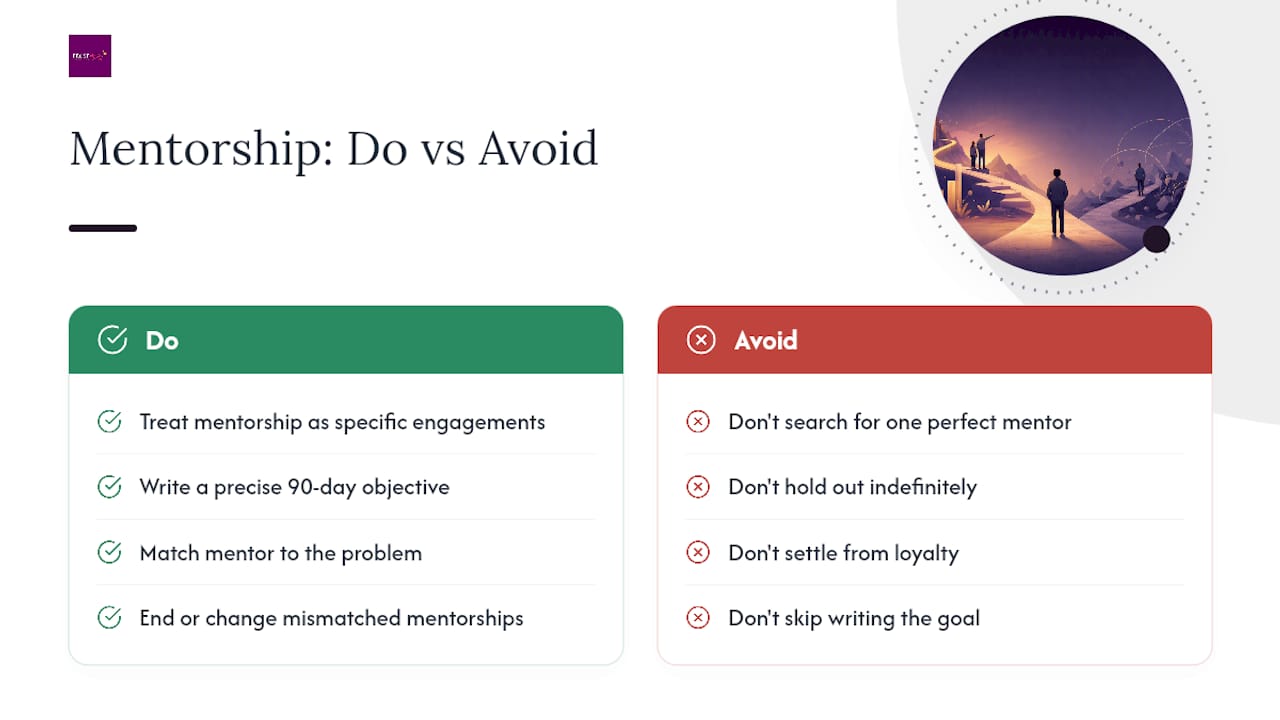
The evidence points somewhere more useful: treat mentorship as a series of specific engagements tied to specific problems. A mentor who's brilliant on negotiation might be the wrong person for a career pivot. That's not failure, that's just scope.
What we'd prioritise first, above finding a mentor at all, is writing the goal down properly. Most people skip this because it feels like a delay before the "real" work starts. It isn't. A precise 90 day objective does more to determine whether a mentorship succeeds than the seniority or charisma of the person you approach. Get that right, and the rest, the finding, the asking, the running of it, gets considerably easier.
— ProspHER
Get matched with mentorship that fits your goal
Building your own shortlist, drafting outreach messages, and running a 90 day review cycle solo takes real effort, and most people abandon it halfway through. ProspHER removes that friction by giving you a structured pathway rather than a blank inbox and a hope that someone replies.
Instead of cold-emailing strangers and hoping for the best, you get access to a vetted community of over 2,400 women, structured mentoring pathways matched to your stage and goal, and group coaching that fills the gaps a single mentor can't. If you're weighing a formal mentoring platform against something more tailored, it's worth comparing the clinical rotation matching model used in other fields against ProspHER's career-specific approach before deciding which fits your situation.
If you've read this far, you already know your 90 day goal. The next step is simple: explore ProspHER's membership and see which pathway matches the outcome you wrote down at the start of this article.
Sources
- How To Find The Right Mentor At Every Career Stage
- How to choose a mentor
- How to find the perfect mentor for your career goals
- How to Choose a Mentor: Practical Checklist