
Yes, a career retreat is worth considering if you're an ambitious woman craving clarity, confidence or a career reset. The evidence backs it up:
- Professionals who attended structured offsites saw 24% more collaboration requests in the two months afterwards, and 17% of those new working relationships lasted at least two years.
- Within ProspHER, members widely report gaining clearer direction within just 30 days of engaging with structured support.
If you're stuck, stretched thin, or quietly ambitious for more, a well-designed retreat tends to work. If you just need a holiday, book a holiday instead.
Key Takeaways
Career retreats deliver measurable gains in visibility, clarity and momentum when they prioritise inward work and structured follow-up over packed itineraries.
| Point | Details |
|---|---|
| Visibility gains are real | Offsite attendees saw 24% more collaboration requests within two months. |
| Clarity often arrives fast | ProspHER members report clearer direction within 30 days of structured support. |
| Definition matters | A true retreat prioritises solitude and small groups over conference-style content. |
| Follow-up decides the outcome | Accountability partners and 30 to 90-day check-ins prevent gains from fading. |
| Choose deliberately | ProspHER designs retreats around inward work, coaching hours and measurable follow-up, not filler agendas. |
Table of Contents
- What is a career retreat, and how is it different from a holiday?
- What career benefits does the evidence actually show?
- Who benefits most, and is now the right time?
- What does a typical career retreat programme actually look like?
- How do you choose the right retreat, and what should you avoid?
- What actually changes after a focused retreat?
- How ProspHER builds retreats around clarity, not noise
- Frequently asked questions
- Sources
What is a career retreat, and how is it different from a holiday?
A career retreat is a structured period of inward focus. You're not sightseeing or ticking off a bucket list. You're examining what's working, what's draining you, and where you actually want to go next, usually with a facilitator holding the process and a plan for what happens once you're home.
That distinction matters because the word "retreat" gets borrowed a lot. Here's the real breakdown:
- Retreat vs vacation: a holiday restores energy; a retreat redirects it, often through guided reflection rather than downtime alone.
- Retreat vs conference: conferences fill your calendar with content; retreats deliberately leave space, because authentic retreat design depends on solitude and small groups, not packed speaker line-ups.
- Retreat vs micro-retirement: a micro-retirement is a longer, self-directed pause, often four weeks or more, built for transformation rather than a few days of focused work.
Pro Tip: Before booking anything, ask the organiser what percentage of the schedule is unstructured.
What career benefits does the evidence actually show?
The clearest, most repeatable benefit is visibility. Attendees of structured offsites made roughly one new professional connection per month more than colleagues who skipped them, and generated 24% more requests to collaborate on client work in the following two months. That's not networking theatre. That's people actively being sought out.
Separate research on offsites found the same pattern from another angle: participants were markedly more likely to reach out to colleagues they'd never previously worked with, breaking down the silos that remote and hybrid work quietly reinforce. If your working world has shrunk to the same five names on every email thread, this is the mechanism that reopens it.
Beyond visibility, the benefits cluster into a few honest categories:
- Clarity: a structured pause forces you to name what you actually want, rather than reacting to what lands in your inbox.
- Confidence: articulating your direction out loud, to people who challenge it constructively, tends to sharpen conviction fast.
- Renewed energy: in-person retreats improve creativity and morale in ways video calls consistently fail to replicate.
- Skill integration: reflection time lets you actually absorb what you've learned recently, instead of stacking new information on top of unprocessed old information.
- Momentum: the exit point of a good retreat is a plan, not just a feeling.
Within the ProspHER community, that clarity effect shows up quickly. Ninety four percent of members say they gain clearer direction within 30 days of starting structured work, a timeline that matches what the research on offsites suggests: the shift in visibility and confidence tends to happen fast, and then compounds.
Who benefits most, and is now the right time?
Career retreats tend to work best for women hitting a plateau, navigating a transition, or feeling quietly depleted despite outward success. Early-stage leaders wanting more visibility also see strong returns, since that's precisely what the collaboration data captures.
Ask yourself honestly:
- Have you felt stuck on the same decision for months?
- Does burnout keep resurfacing despite rest?
- Has your progression stalled even though your effort hasn't?
Two or three "yes" answers suggest now is the moment, not next year.
Pro Tip: If you can only spare a weekend, choose a short, structured retreat over a sprawling micro-retirement. Depth beats duration when your calendar is tight.
What does a typical career retreat programme actually look like?
Formats vary. You'll find solo deep-retreats, small-group facilitator-led programmes, and employer-run offsites, typically running from three days to two weeks, with micro-retirements stretching further still. A practical, low-cost model built around staged reflection and homework questions can work almost as well as an expensive residential programme, provided the structure is genuinely there.
A focused four-day retreat often runs something like this:
- Day one: arrival, disconnection from work tools, intention-setting.
- Day two: deep work blocks on values, strengths and current frustrations, followed by coached reflection.
- Day three: peer feedback sessions and scenario planning for the next 12 months.
- Day four: integration planning, accountability partnerships, and a written 90-day plan.
| Element | What to expect |
|---|---|
| Duration | 3 to 7 days, or 4+ weeks for a micro-retirement |
| Group size | Small, usually under 25 |
| Follow-up | Accountability partner plus 30 to 90-day check-ins |
| Realistic timeline | Clarity often lands immediately; momentum builds over 1 to 3 months |
How do you choose the right retreat, and what should you avoid?
Start with a short checklist before you hand over any money:
- Check facilitator credentials. Ask specifically what training they have in holding group process, not just delivering content.
- Look at group size. Anything over 20 to 25 starts to lose the intimacy that makes inward work possible.
- Weigh inward work against networking time. A retreat that's 80% panel discussions is a conference.
- Confirm follow-up support exists. No 30 or 90-day check-in structure means you're likely to lose the gains within weeks.
- Ask for evidence of outcomes. A credible provider should be able to point to real participant results, not just testimonials.
Questions worth asking any provider directly: "What does a typical day look like, hour by hour?" "How much unstructured time is built in?" "What happens after day four, does anyone follow up with me?"
Red flags to walk away from:
- A packed, speaker-heavy itinerary rebranded as a "retreat."
- No stated integration or accountability plan.
- Vague or unverifiable facilitator qualifications.
- Marketing that emphasises the venue far more than the process.
On cost, expect a wide range depending on format and length. A short, well-structured group retreat sits at the more accessible end; residential or highly personalised programmes cost more but typically bring deeper facilitation and more follow-up. Judge value against the outcomes that matter: clearer direction, stronger visibility, and a workable plan, not the quality of the hotel.
What actually changes after a focused retreat?
The pattern is fairly consistent. In the first week, most women report sharper clarity. Within one to three months, the real shift is behavioural: a habit of weekly reflection, a clearer set of goals written down somewhere visible, and a follow-up message sent to someone new instead of avoided.

The habits that tend to stick are simple: brief journalling, a recurring calendar block for reflection, and a standing check-in with an accountability partner. None of it is glamorous. All of it compounds.
How ProspHER builds retreats around clarity, not noise
Most retreat marketing sells you an experience. We'd rather give you a pathway. ProspHER retreats are built around small groups, genuine inward work, and facilitators trained to hold that process, not just fill a schedule with speakers.
Every retreat includes structured coaching hours, peer accountability partnerships, and a defined follow-up window, because clarity that fades after week two isn't clarity, it's a nice weekend. If you'd rather book a specific, women-focused programme than compare a dozen generic offsites, explore ProspHER's membership and retreat options and see which pathway fits where you are right now.
Frequently asked questions
Do career retreats actually work, or is this just marketing? The evidence for the visibility and collaboration effects is genuine: 24% more collaboration requests followed structured offsites in one study. Outcomes depend heavily on design, though. A retreat with real inward work and follow-up support performs very differently to a conference wearing a retreat's branding.
How long should a career retreat be? Three days is generally the minimum for meaningful reflection, with many effective programmes running four to seven days. Micro-retirements extend to four weeks or more and serve a different purpose: broader life redesign rather than focused career clarity.
What's the difference between a career retreat and a vacation? A vacation restores energy through rest. A retreat uses structured reflection, coaching and peer work to redirect that energy toward specific decisions, usually producing a written plan by the end.
How much does a career retreat typically cost? Prices vary widely by format and length. Shorter, group-based retreats sit at the more accessible end of the market, while longer or highly personalised programmes cost more, generally reflecting deeper facilitation and extended follow-up.
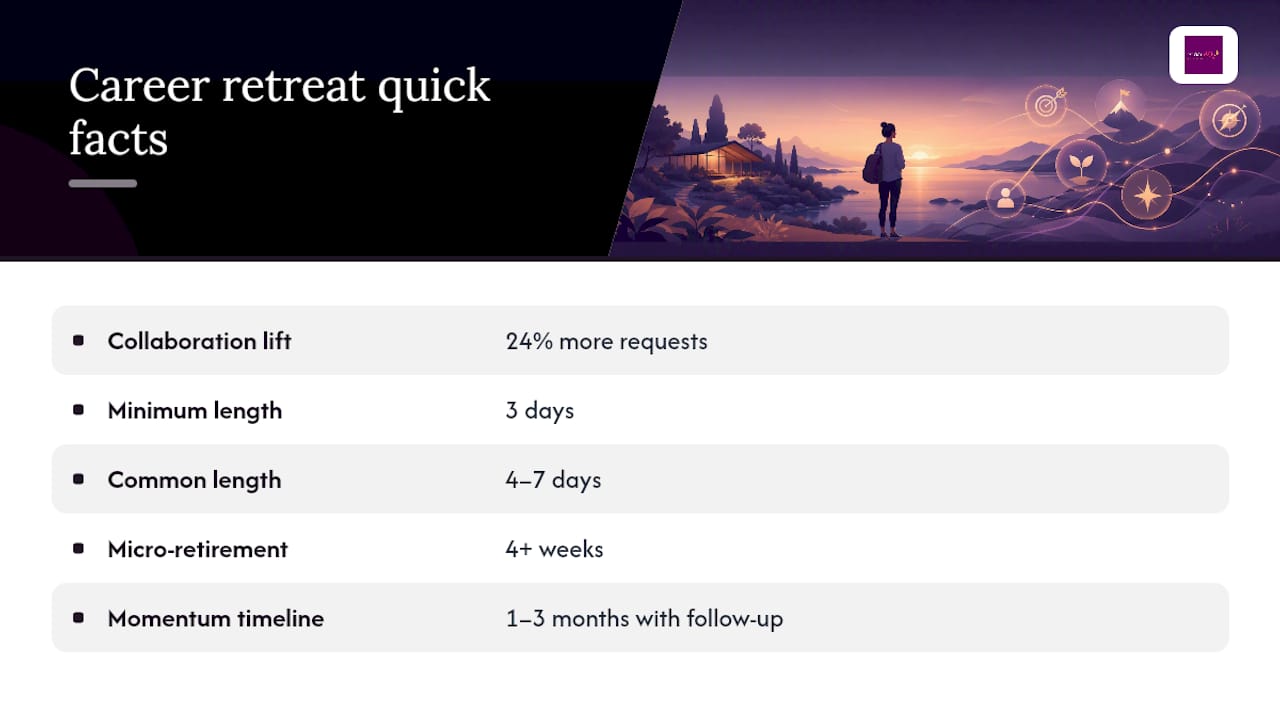
How soon will I see results after a retreat? Clarity often shows up within days. Momentum, the harder outcome to sustain, typically builds over one to three months, particularly when the retreat includes accountability check-ins during that window.
Sources
- The Conversation: offsites help forge new professional connections
- Forbes: how micro-retirements can catapult your career
- US Chamber: eight benefits of hosting a company retreat
For practical next steps, ProspHER's career clarity coaching guide covers what follow-up support looks like after a retreat ends, and readers comparing retreat formats or hunting for venue expertise may find Luana Inn's events and retreats page a useful reference point.