
A 90-day career plan splits your first quarter into three phases: learn (Day 1 to 30), apply (Day 31 to 60), and lead (Day 61 to 90). Pick a small number of priorities, turn each into a measurable weekly action, and book your first short check-in before the week ends. That single move separates people who drift through a new role from those who own it by day 90.
TL;DR:
- Limiting your priorities to one to three focuses ensures your 90-day plan remains manageable and measurable with clear KPIs.
- Conducting stakeholder interviews and mapping decision influences early on helps avoid the common mistake of skipping essential information gathering.
- Weekly check-ins and an explicit day-45 review with actionable metrics keep your progress on track and enable course corrections.
- Turning each priority into specific behaviors, time commitments, and numeric KPIs increases accountability and likelihood of achieving tangible results.
- Successful day-90 outcomes typically involve a received deliverable, improved process, or recognition from your manager, not dramatic changes.
Table of Contents
- What is a 90-day career plan, and when do you need the 12-week year too?
- Your month-by-month 90-day job strategy checklist
- How do you turn priorities into measurable KPIs?
- What does the weekly check-in and day-45 review actually involve?
- Can you show me a fillable 90-day plan template?
- How does ProspHER help you turn a plan into follow-through?
- What does success at day 90 actually look like?
- ProspHER: your accountability partner for the first 90 days
- Sources
What is a 90-day career plan, and when do you need the 12-week year too?
A 90-day career plan is a structured roadmap that turns your first quarter in a role into three deliberate phases rather than one long blur of meetings and guesswork. The 30-60-90 structure most professionals use breaks down like this:
- Day 1 to 30: learn. Map stakeholders, absorb how decisions actually get made, and resist the urge to fix things before you understand them.
- Day 31 to 60: apply. Take visible ownership of something small, gather feedback, and start producing measurable work.
- Day 61 to 90: lead. Ship a result, consolidate what worked, and set the stage for your next sprint.
That's the skeleton. If your role is outcome-heavy, sales, delivery, anything with numbers attached, layer in the 12-week year discipline: weekly scorecards, protected performance time, and an execution score that tells you honestly whether you're doing what you said you'd do, not just thinking about it.
Your month-by-month 90-day job strategy checklist
Here's where the plan stops being theory and starts being a Tuesday-morning task list.
Day 1 to 30: learn and map the terrain
This month isn't about proving yourself. It's about building the intelligence you'll need to be useful later.
- Set up one-to-ones with your manager, your closest peers, and two people outside your immediate team.
- Build a stakeholder map: who decides, who influences, who you'll need onside by day 90.
- Identify three quick wins, small, low-risk fixes that show competence without overreaching.
- Write down two learning goals tied to skills your new role actually demands.
- Read every process document, then ask the questions the documents didn't answer.
Career guidance from Harvard Business School alumni resources backs this sequence almost exactly: detail what/why/how, identify stakeholders, run interviews, synthesise, then share a working plan. Skipping the interview stage to look productive early is the single most common misstep new hires make.
Weekly milestones, Day 1 to 30:
- Week 1: complete onboarding logistics, schedule five stakeholder meetings.
- Week 2: finish stakeholder map, draft your first quick win.
- Week 3: deliver quick win one, start quick win two.
- Week 4: deliver quick wins two and three, write your 30-day summary for your manager.
Day 31 to 60: apply and show your working
Month two is where you trade observation for output.
- Take ownership of one visible task or workstream, something with a name and a deadline attached to you.
- Gather structured feedback from your manager and at least one peer, specifically on how you're operating, not just what you've delivered.
- Begin measurable project work: pick metrics before you start, not after.
- Flag early where a priority might need adjusting, better now than at week 12.
Weekly milestones, Day 31 to 60:
- Week 5 to 6: define scope and success metrics for your owned task.
- Week 7: mid-point feedback conversation with your manager.
- Week 8: publish a progress update, however small, to the people who need to see it.
Day 61 to 90: lead and consolidate the win
By month three, you should be operating, not just observing.
- Consolidate your visible wins into a short narrative: what changed because you were there.
- Lead a small initiative, even something modest, that others can point to as evidence of ownership.
- Present outcomes and a clear proposal for what comes next to your manager.
- Set your priorities for the following quarter before this one ends.
Weekly milestones, Day 61 to 90:
- Week 9 to 10: run your small initiative, document results as they come.
- Week 11: prepare your outcomes presentation.
- Week 12: deliver the presentation and agree your next 90-day focus.
Pro Tip: Don't wait until week 12 to write your outcomes summary. Draft it in week 9 and update it weekly. You'll write a sharper document, and you'll never be scrambling the night before a review.
How do you turn priorities into measurable KPIs?
Most 90-day plans fail not from lack of ambition but from having too many priorities and no way to measure them. The most effective plans limit focus to one to three priorities, each converted into a specific behaviour, a weekly time commitment, and a number you can check.
Run every candidate priority through three quick filters before it earns a place on your plan:
- Impact: does this move something your manager or team actually cares about, not just something that keeps you busy?
- Readiness: can you realistically start this in month one, or does it depend on access, tools, or trust you don't have yet?
- Ownership: is there a clear "yes" to the question, is this mine to drive, or will you be waiting on someone else the whole time?
Once a priority survives that filter, give it three things: a behaviour (what you'll actually do), a weekly time commitment (how many hours, which day), and a numeric KPI (what result proves it worked).
Two examples make this concrete. If your priority is a promotion signal, the behaviour might be "lead the weekly cross-team sync," the time commitment is two hours a week, and the KPI is "zero missed deliverables across eight consecutive weeks." If your priority is project delivery, the behaviour is "own the client reporting workflow," the commitment is four hours weekly, and the KPI is "reporting turnaround cut from five days to two by week 10."
Pro Tip: If you can't attach a number to a priority, it's not ready for your 90-day plan yet. Park it as a learning goal instead and revisit it once you have more data.
Our guide to setting clear objectives walks through this conversion in more depth if you want to build the habit beyond your first quarter.
What does the weekly check-in and day-45 review actually involve?
A plan without a review rhythm is just a wish list. The weekly check-in is the operational heartbeat of a 90-day sprint, and it should take no longer than 20 minutes.
Here's a simple weekly template:
- What did I plan to do this week? List it plainly, three to five items.
- What actually got done? Be honest, not generous.
- Calculate your execution score: leading indicators completed divided by leading indicators planned.
- What's blocking me, and who can unblock it?
- What's the single priority for next week?
The 12-week year framework treats an 85% weekly execution score as the practical benchmark for staying on track.
At day 45, roughly the midpoint, run a longer review with three decision rules:
- If a priority's impact has dropped since week one, cut it rather than dragging it to day 90 out of stubbornness.
- If your KPI was set too easily, tighten it. Too hard, adjust the number, not the ambition.
- If a deadline no longer makes sense given what you've learned, move it, and tell your manager why in the same conversation.
Can you show me a fillable 90-day plan template?
Yes, and it should fit on one page. Career planning research consistently favours short, single-page templates over dense multi-page documents nobody revisits.
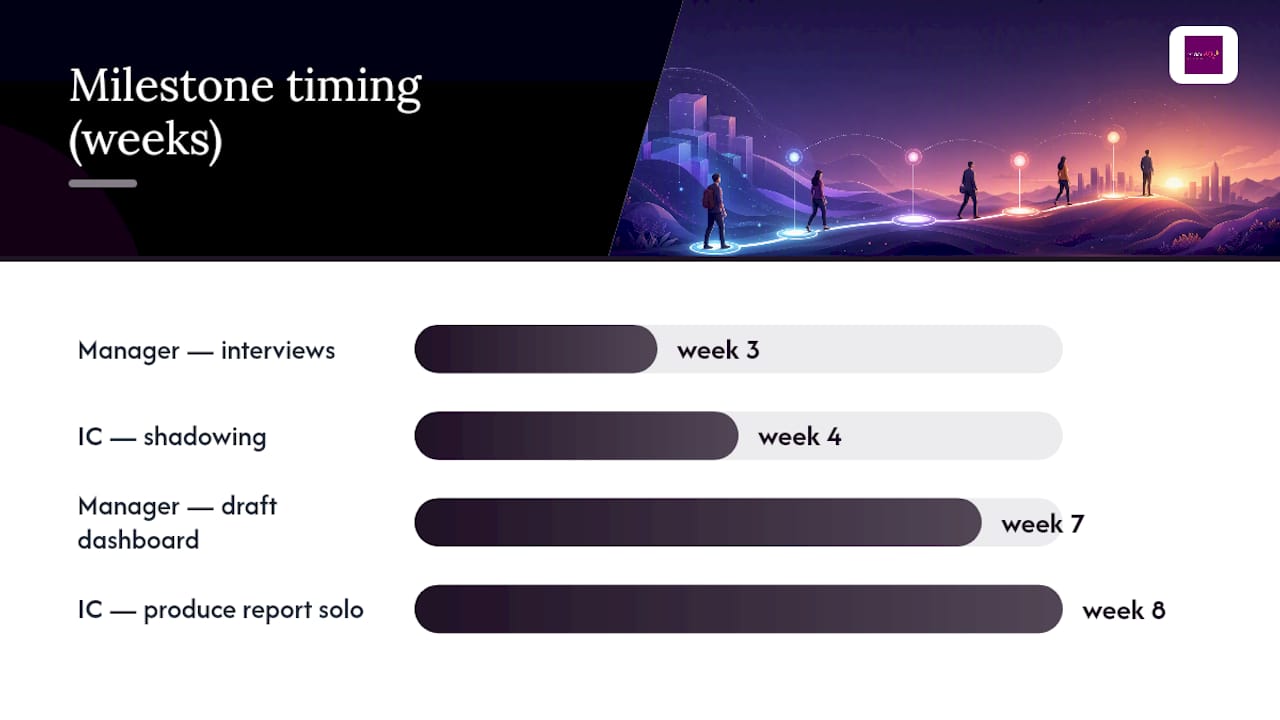
A compact template needs four fields per priority: the priority itself, its KPI, four weekly milestones, and your check-in schedule (weekly day/time plus the day-45 review date).
Example A, individual contributor:
| Field | Detail |
|---|---|
| Priority | Build proficiency in the team's reporting tool |
| KPI | Independently produce weekly report by week 8 |
| Weekly milestone (week 4) | Shadow two report cycles |
| Weekly milestone (week 8) | Produce report solo, reviewed by manager |
| Check-in | Fridays, 20 minutes; day-45 review with manager |
Example B, mid-level manager:
| Field | Detail |
|---|---|
| Priority | Align two teams on a shared cross-functional metric |
| KPI | Joint dashboard live and reviewed weekly by day 90 |
| Weekly milestone (week 3) | Stakeholder interviews complete across both teams |
| Weekly milestone (week 7) | Draft dashboard shared for feedback |
| Check-in | Mondays, 20 minutes; day-45 review with both team leads |
If you're detail-oriented, add a fifth column for risks. If you tend to lose momentum on admin, keep it lean and put the whole thing on a sticky note instead. The format should serve your habits, not fight them. Readers in structured professional environments, accounting and finance in particular, may find it useful to pair this with sector-specific guidance on early role expectations.
How does ProspHER help you turn a plan into follow-through?
Plans stall without accountability, and that's where targeted support can make a difference. Instead of offering another content library to wade through, some platforms provide personalised pathways matched to individual situations, offering mentorship, community accountability, or practical templates for the first quarter.
For someone running a 90-day plan, that clarity often shows up exactly where it matters most: in week four, when the "learn" phase should be turning into a defined set of priorities. If you'd rather run your sprint with a mentor checking your execution score than alone with a spreadsheet, a guided cohort or a mentoring check-in gives you that structure from week one.
What does success at day 90 actually look like?
Success at day 90 rarely looks dramatic. It looks like one published deliverable, one visibly improved process, or one conversation where your manager mentions you unprompted as someone stepping up. That's the promotion signal, not a grand announcement.
Use your day-90 review to name what worked, then set one to three priorities for the next quarter before momentum drops. Our career roadmap guide picks up exactly there. For now, the only task that matters is scheduling this week's 15-minute review.
— ProspHER
ProspHER: your accountability partner for the first 90 days
There's no shortage of ways to plan a first quarter alone: spreadsheets, journals, a note stuck to your monitor. What ProspHER gives you that a solo plan can't is a pathway matched to your actual situation, with a mentor and a community checking that your weekly milestones turn into real momentum instead of good intentions.

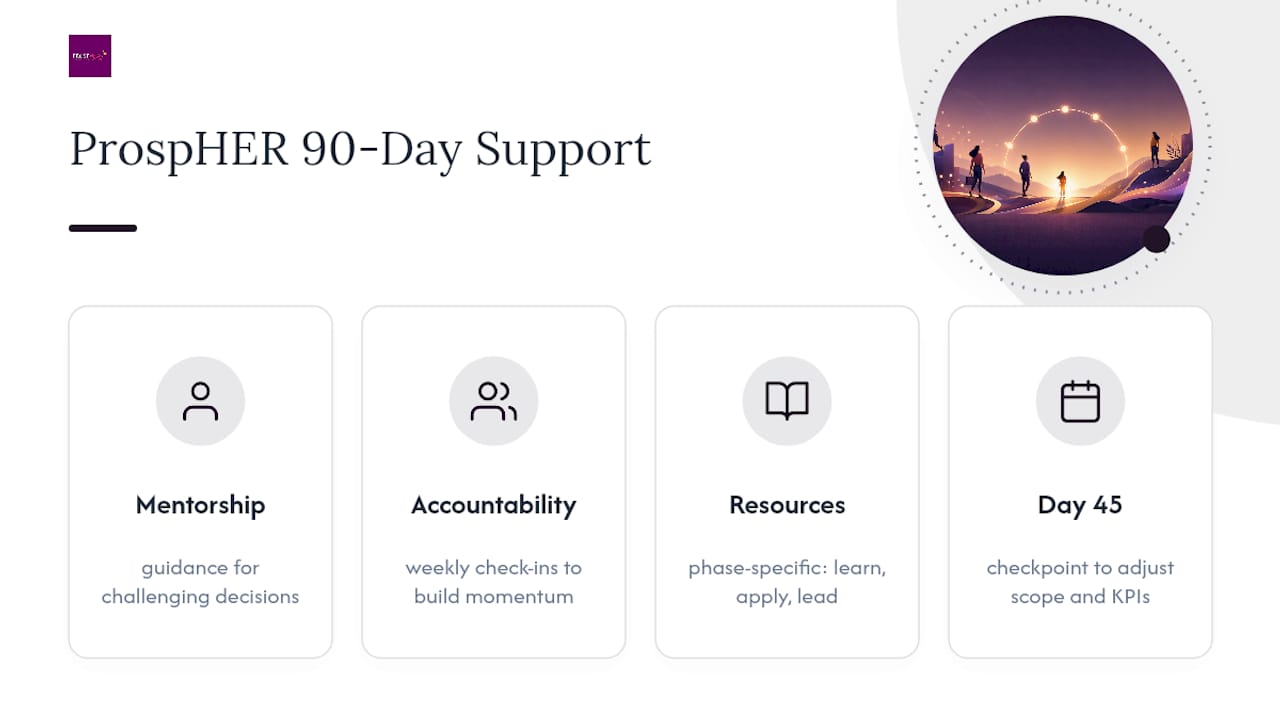
A structured platform might map your plan onto a framework including mentorship for challenging decisions, accountability groups for weekly check-ins, and tailored resources for each phase such as learning, applying, or leading. Many users find the day-45 review a useful checkpoint to adjust scope or tighten KPIs with accountability from others.
If you're starting a new role, or you're 30 days into one that's starting to feel unclear, visit ProspHER and book an intro call to see which pathway fits your first quarter. Establishing credibility early matters just as much as hitting your numbers, and our guide to building executive presence is worth reading before you start month three.
Sources
This plan draws on the 30-60-90 day framework, Harvard Business School alumni guidance on stakeholder mapping in a new role, Mirrai Careers' five-element career development framework, and the 12-week year execution system.
For further reading, SHRM's research on why the first 90 days predict retention and Yourdec's breakdown of the quarterly goal system both add useful depth to the weekly cadence covered above.
- First 90 days template: how to succeed in a new job 2026
- Tackle the First 90 Days of Your Next Role: A 5 Step Process for Success on the Job
- Career Development Plan: 5 Elements + 90-Day Framework | Mirrai Careers