
Focus on one mindset shift and one daily habit: reframe every talk as service to your audience, not a test of you, and rehearse a 60-second version of your key point out loud every day. Gendered bias shapes how audiences judge women speakers, so the tactics that follow are designed to counter that, not just to make you clearer. A community backs this practice-first approach with mentorship and mock Q&A.
TL;DR:
- Women face structural challenges such as more frequent interruptions, harsher tone judgments, and fewer speaking opportunities which increase pre-talk anxiety.
- Adopting physical and vocal habits like projecting loudly, controlling gestures, and repeating core messages can improve perceived authority during talks.
- Building confidence requires deliberate practice routines, recording oneself, and seeking feedback in low-stakes environments rather than relying solely on innate talent.
- Handling interruptions with scripts and claiming leadership in Q&A sessions helps maintain authority and steer discussions back to your key points.
- Tracking vocal health, especially around hormonal fluctuations, and warming up properly supports sustained voice quality during high-stakes speaking.
Table of Contents
- The common challenges women face when speaking in public
- Practical delivery techniques that increase perceived authority
- How do you structure a talk that proves ownership?
- How do you handle interruptions and hostile questions?
- Practice routines and resources that build lasting confidence
- The ProspHER perspective: pathways that accelerate speaking confidence
- Mindset shifts that actually calm pre-speech nerves
- Strategies to build confidence specifically for women in public speaking
- Role models and lessons from successful female public speakers
- Navigating cultural expectations and gender norms
- Techniques to overcome gender-based feedback and criticism
- Vocal health and voice care tailored for women
- Why this works: an honest take on public speaking for women
- Continue building speaking confidence with ProspHER
- Sources
The common challenges women face when speaking in public
Some of what makes public speaking for women harder is structural, not personal. You are not imagining the double standard. Research from Lean In found women speakers were rated as less entertaining and expressive than men even when delivering identical material, and that gap alone feeds a cycle of higher speaking anxiety.
The recurring obstacles show up in patterns you have probably lived through:
- Interruptions during talks and meetings, often more frequent than colleagues experience.
- A "likeability penalty" that punishes assertive delivery more harshly in women than in men.
- Harsher tone judgements, where confident becomes "abrasive" and calm becomes "flat."
- Fewer invited speaking opportunities, which means less practice time on the clock that actually counts.
Women are consistently marked down on entertainment value and expressiveness in audience evaluations, a pattern researchers link directly to elevated pre-talk anxiety.
None of this means you should try to speak like someone else. It means your delivery choices need to work harder for authority, not just for clarity, because the audience's default settings are already tilted against you.
Practical delivery techniques that increase perceived authority
Presence is trainable. You do not need a different personality. You need a handful of physical and vocal habits that signal competence before anyone processes a single word of content.
Start with the voice. Speak louder than feels natural, slow your pace by roughly 10%, and use deliberate pauses instead of filler words. Uptalk (that rising pitch at the end of statements) reads as a question mark on every sentence, so drop it and let your sentences land flat and final.
Physical presence matters just as much:
- Claim your space deliberately. Stand with feet hip width apart, plant your weight, and resist the urge to shrink.
- Control your gestures. Purposeful, chest height movements read as composed; fidgeting reads as nervous.
- Work the room with your eyes. Hold each section of the audience for a full sentence before moving on, rather than scanning nervously.
- Open with a question or a short story. A single sharp question in your first thirty seconds does more work than any slide of context.
- Repeat your core phrase. Say your central message at least three times across the talk, in slightly different words, so it survives the memory filter.
Warmth is not the enemy of authority here. Presentation research summarised by MindTools found women leaders who paired confidence with warmth faced less backlash than those who projected confidence alone. Smiling once you have made your point, or acknowledging a good question before answering it, does not weaken your authority. It makes the authority land.
Pro Tip: Record yourself delivering your opening thirty seconds on your phone, three times, before any high-stakes talk. Watch it back muted first, for posture and gesture, then with sound, for pace and uptalk.
How do you structure a talk that proves ownership?
Build your talk around a single key question, answered by a one-line thesis you could say in an elevator. Everything else exists to support that thesis.
Slide priority follows a clear order, according to guidance built for high-stakes professional presentations aimed at women establishing authority:
- Key question slide, shown in your first three minutes, framing exactly what the audience needs answered.
- Our data slide, even if the data set is small or local. Ownership of a data point, however modest, signals expertise faster than credentials do.
- Practice-change slide, spelling out what the audience should stop doing, start doing, or reconsider.
Rehearsal ratio matters more than most people admit. Spend far more time practising delivery aloud than you spend writing and rewriting slides. A 7/3/1 day checklist keeps that discipline manageable:
- Seven days out: finalise your thesis and key question, draft slides, book one mock Q&A session.
- Three days out: rehearse full delivery twice, once recorded, and revise based on pace and filler words.
- One day out: run the mock Q&A, sleep on feedback, do one final read-through aloud, then stop rehearsing.
Building this kind of executive presence over weeks, not the night before, is what separates talks that land from talks that merely happen.
How do you handle interruptions and hostile questions?
Interruptions and status undermining happen often enough that you need scripts ready before you need them, not while you are standing exposed at the front of a room.
Three reclaim moves cover most situations:
- Calm continuation. Keep your sentence going at the same volume and pace, without acknowledging the interruption. Silence from you signals it did not land.
- Direct reclaim. Say "let me finish this point" or "I'll take questions in a moment," flat and unapologetic, then continue exactly where you stopped.
- Bridge-back phrasing. "That's related to what I was just covering, which is..." turns an interruption into a segue you control.
Lecture-style "questions" that are really mini speeches need a different move: validate briefly, then anchor back to your point. "That's a fair perspective, and it connects to the data I showed on slide three" does the job in one sentence, without ceding the floor.
In Q&A itself, control your opening by taking the first question yourself rather than waiting to be picked. Explicitly claim your contributions ("as lead on this project, I found...") rather than defaulting to "we," and brief one or two allies beforehand to redirect credit your way if a question misattributes your work.
Pro Tip: Agree a single word or hand signal with an ally in the room beforehand, something that means "back me up on this one." It costs nothing and works more often than you'd expect.
Know when to manage client relationships effectively by deferring rather than escalating. A hostile question from a senior stakeholder in a small internal meeting often calls for a professional, measured response now and a private follow-up later, preserving the relationship without conceding the point.
Practice routines and resources that build lasting confidence
Confidence in public speaking for women builds the same way fitness does: short, repeated sessions beat occasional heroics.
Try these on a weekly rhythm:
- 60 second talks. Pick any topic and deliver a tight, structured minute, daily if possible.
- Meeting-first habit. Volunteer to speak first in low-stakes meetings, purely to build the muscle of starting.
- Recorded rehearsals. Track one specific metric each time, filler words, pace, or eye contact, and improve it incrementally.
- Mock Q&A with colleagues. Brief them to ask at least one genuinely difficult question, not just friendly ones.
For structured confidence building and events designed for practice in front of real audiences, women's leadership conferences offer lower-stakes stages than a boardroom.
The ProspHER perspective: pathways that accelerate speaking confidence
This platform exists precisely because generic advice rarely fits your actual circumstances. Members get structured pathways matched to their goals, mentorship from experienced speakers, and community-run mock Q&A sessions where the hard questions get asked in a room that wants you to succeed.
Reported outcomes back the model: 94% of members say they gain clearer direction within thirty days. For speaking confidence specifically, that clarity translates into knowing exactly which micro-practice to run this week, rather than drowning in generic tips. If you want to apply the checklists above with feedback attached, that structured pathway is the practical next step.
Mindset shifts that actually calm pre-speech nerves
The nerves rarely disappear. What changes is what you do with them.
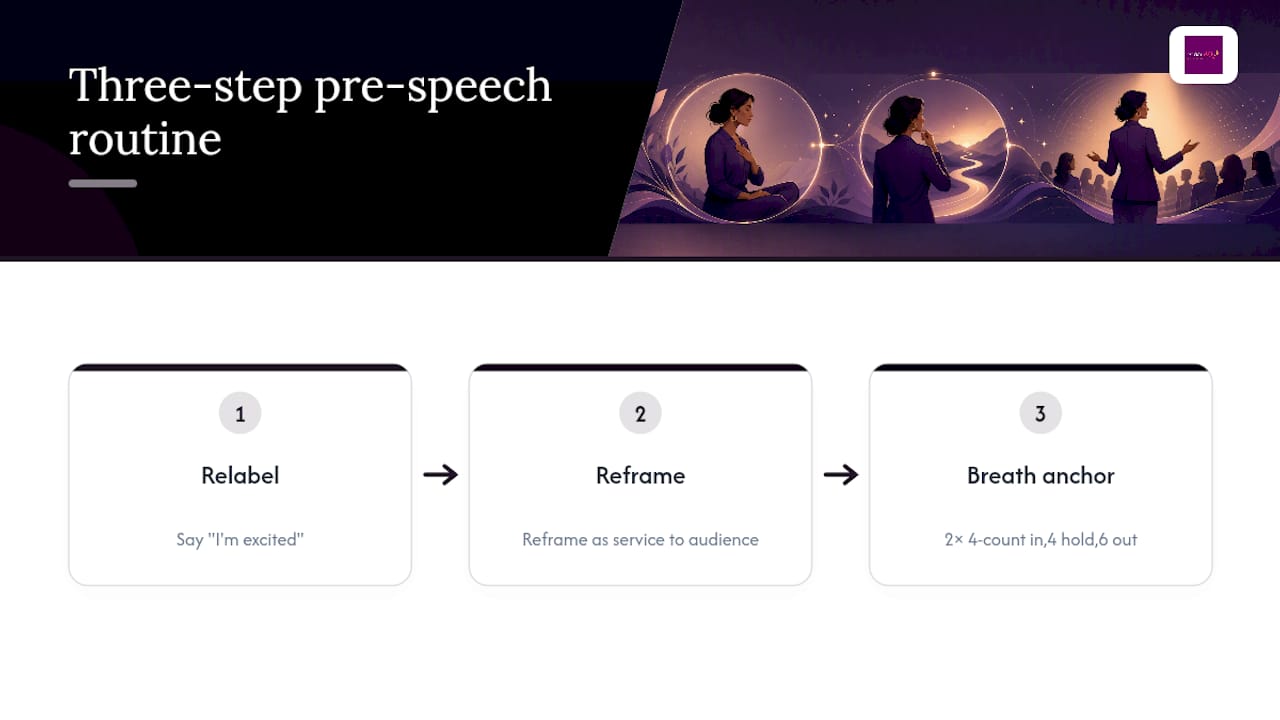
Anxiety reappraisal, the simple act of telling yourself "I am excited" instead of "I am anxious," shows up repeatedly in performance research on speakers as one of the most reliable pre-speech routines available. The physical sensations of anxiety and excitement are nearly identical: racing heart, dry mouth, restless energy. Relabelling them shifts your brain from threat mode into performance mode without requiring you to actually calm down first, which is often the harder task.
A second shift works alongside it. Reframe the talk itself as service to the audience rather than a personal evaluation. The question stops being "how am I being judged?" and becomes "what does this room need from me right now?" That single reframe reduces self-consciousness because it moves your attention outward, onto the audience's problem, instead of inward, onto your own performance.
Breathing anchors give the reframe somewhere to live physically. A slow four count inhale, four count hold, six count exhale, run twice before you walk on, resets your nervous system enough to access the reframe rather than just knowing it intellectually.
None of this requires eliminating nerves. It requires directing them somewhere useful, and doing that on purpose, every single time, until it becomes automatic rather than effortful.
Strategies to build confidence specifically for women in public speaking
Confidence for women speakers needs a different starting point than generic advice usually offers, because the gap you are closing is not always a skills gap.
Start by separating competence from confidence. You can be highly competent and still feel under confident, because confidence is shaped heavily by feedback loops women receive less often and less generously than men do. Building confidence deliberately means manufacturing those feedback loops yourself: tracking small wins, keeping a written log of talks that went well, and returning to it before high-stakes moments.
Language matters more than it seems. Framing your contributions as "we" when the room is watching for credit dilutes your authority, but stating outright "as lead on this, I..." carries the ownership without triggering the likeability penalty that blunt individual claims sometimes provoke, according to guidance from Lean In on self-promotion for women.
Rehearsal volume builds confidence faster than talent does. Speakers who log more repetitions, particularly recorded ones, report steadier delivery under pressure regardless of how nervous they started. Confidence compounds with visible evidence: a recording you can point to that shows improvement over three weeks does more for your nerves than any pep talk.
Finally, curate your practice room. Rehearsing in front of people who ask hard questions but clearly want you to succeed builds a different kind of confidence than rehearsing alone ever can.
Role models and lessons from successful female public speakers
Watching how established women speakers handle a room teaches more than any checklist, because you see the tactics applied under real pressure.
Notice how the strongest speakers open. Few of them start with "thank you for having me." Most open with a question, a statistic, or a short story that puts the audience inside a problem within the first thirty seconds, exactly the structure that authority-focused presentation guidance recommends for establishing expertise quickly.
Notice, too, how they handle interruptions on stage or in televised debates. The calmest ones rarely raise their volume to match an interrupter. They hold their pace, finish the sentence, and let the contrast between their composure and the interruption's aggression do the persuading.
Look for the "our data" habit as well. Speakers who cite even a small piece of original research, a case they worked on, a number specific to their own experience, come across as owners of the topic rather than commentators on it. That distinction is learnable, not innate, which is exactly why studying it in others works.
Case studies do not need to come from famous names to be useful. Watch a colleague who handles Q&A well in your own organisation, note the specific phrase they used to redirect a hostile question, and borrow it. Role models are most useful when they are close enough to study repeatedly.
Navigating cultural expectations and gender norms
Public speaking norms shift depending on where you are standing, and pretending otherwise sets you up to misjudge a room.
In some professional cultures, directness reads as competence by default. In others, particularly ones with stronger deference to hierarchy or seniority, the same directness can read as overstepping, regardless of your gender. Read the room's existing norms before you decide how hard to push against the gendered ones.
Sector matters as much as geography. A pitch room expects confident brevity. A clinical or legal setting often rewards measured caution alongside authority, because the audience is trained to distrust anyone who sounds too certain too fast. Adjust your pace and hedging language to the room's expectations for expertise, without abandoning the core authority tactics.
Seniority in the room changes the calculus too. Presenting to peers allows more warmth and informality. Presenting to senior stakeholders, particularly in a first meeting, often calls for the "our data" slide to appear earlier, since unfamiliar audiences grant less benefit of the doubt on expertise than familiar ones do.
The through line across every context is the same: the core tactics, key question first, data ownership, calm continuation under interruption, hold. What shifts is the dial on warmth versus directness, and reading that dial accurately is a skill worth practising as deliberately as your delivery.
Techniques to overcome gender-based feedback and criticism
Feedback aimed at women speakers often targets things male speakers get complimented for: assertiveness read as aggression, brevity read as coldness, enthusiasm read as unprofessional.
The first move is diagnostic. Before reacting, ask whether the feedback addresses your content or your delivery style. "Your argument lacked evidence" is actionable and worth acting on immediately. "You came across as too intense" deserves more scrutiny, because it frequently reflects the evaluator's bias rather than a genuine delivery flaw, the same double standard documented in audience evaluation research.
Keep a written log of feedback across multiple talks rather than reacting to any single instance. Patterns across five or six pieces of feedback tell you something real. One comment from one person after one talk usually tells you more about that person than about you.
When criticism does land unfairly, a short, unemotional response often closes the loop better than a defensive one: "I hear that, and I'll keep it in mind," delivered flatly, ends the exchange without conceding ground you do not need to concede.
Finally, build a small panel of trusted reviewers, ideally including at least one woman who has faced similar critique before, to sanity check feedback that feels gendered. Their read on whether a comment reflects genuine skill gaps or old bias is often clearer than your own in the moment.
Vocal health and voice care tailored for women
Your voice is the instrument carrying every tactic in this article, and it needs maintenance most speakers ignore until it fails them mid-talk.
Hormonal fluctuation affects vocal fold swelling for many women across the menstrual cycle, which can make certain days harder for sustained projection or higher pitch ranges. If you have a high-stakes talk scheduled, tracking your cycle alongside your rehearsal calendar lets you plan extra vocal warm up on days your voice may need it.
Hydration matters more than most speakers budget for. Water taken steadily through the two hours before a talk does more than a large glass swallowed five minutes beforehand, since vocal folds need sustained moisture, not a last-minute flush.
Warm up before speaking, always, even for a five-minute update in a team meeting. Gentle humming, lip trills, and a few descending scales for two minutes loosen the vocal folds enough to prevent the strained, higher-pitched tone that creeps in when you speak cold.

Avoid clearing your throat repeatedly when nervous. It irritates the vocal folds further and creates a habit loop that worsens under pressure. A small sip of water or a swallow does the same job with far less strain.
Rest matters between back-to-back speaking commitments. Vocal fatigue accumulates across a day of meetings and talks, and pushing through it with more volume rather than more rest is how voices crack at exactly the wrong moment.
Why this works: an honest take on public speaking for women
We have watched enough women transform their relationship with the podium to know the pattern: it is never one big breakthrough. It is the fortieth 60 second talk that finally feels easy, not the first.
Try this today: record yourself explaining, in sixty seconds, the one thing you most want your next audience to remember. Watch it back once. That is the whole exercise, and it is enough to start.
— ProspHER
Continue building speaking confidence with ProspHER
This platform exists for exactly this moment: when you know the tactics but need a room, a mentor, and a mock Q&A panel that will actually challenge you before the real one does. Members get matched to a pathway built around their specific goals, whether that is a first conference talk or a board presentation, alongside mentorship from experienced speakers.

Unlike a generic course you complete once and forget, membership gives ongoing access to mock Q&A sessions, a community that briefs each other before high-stakes talks, and structured resources that build on each other rather than repeating generic tips. If interruption scripts and rehearsal checklists are useful in theory, the mock Q&A room is where they become reflexes.
Start by visiting the ProspHER platform to see the current pathways on offer, or join an introductory session to find the one matched to where you are right now.
Sources
- Grand rounds presentations: authority-building tactics for women speakers | ResidencyAdvisor
- Fearless public speaking: 7 essential tips for women leaders | Rise by Her
- A practical guide on how to turn nerves into excitement | CoComms