
A leadership identity is the internal sense of yourself as a leader, backed by outside evidence that others see you the same way. You build it by acting first and reflecting after, not the other way round. The single best first move is a small, visible experiment, the kind Herminia Ibarra calls "outsight".
TL;DR:
- Women tend to develop leadership identity through actions like collaborative claiming rather than formal authority, which builds influence more slowly but more genuinely.
- Acting on small, visible experiments such as leading meetings or proposing projects accelerates identity formation by generating real evidence of leadership.
- Building relationships outside your usual network and seeking specific feedback quickly create outsight data to shape your leadership self-view.
- Combining relational and authoritative traits through strategic claiming reduces backlash and strengthens your position in male-dominated environments.
- Mentorship, sponsorship, and peer communities significantly speed up leadership identity development by providing feedback, role models, and repeated opportunities to demonstrate leadership.
Table of Contents
- What does research say about how women develop a leader identity?
- How can you start acting like a leader this week?
- How do you manage the tension between being a woman and being a leader?
- Why do mentors and communities speed up your leader identity?
- What is a realistic 30-day plan to test your leadership identity?
- How do you handle the emotional side of becoming a leader?
- How does intersectionality shape leadership identity?
- How do you assert leadership in a male-dominated room?
- Which women leaders show what different leadership identities look like?
- How does leadership identity fit into your long-term career plan?
- What happened when one member tried this?
- Why acting first beats waiting to feel ready
- How ProspHER helps you build this identity faster
- Sources
What does research say about how women develop a leader identity?
Most women don't wake up feeling like a leader and then start acting like one. It works the other way round, and the evidence on how it works is where things get interesting.
A daily-diary study tracking 77 leaders across 579 surveys found women were significantly less likely than men to use "legitimating claiming", leaning on formal title or authority to assert leadership. Collaborative claiming, building leadership through shared decisions and relationships, showed no gender gap at all. That difference matters for your career, because legitimating claiming tends to get noticed and rewarded faster in traditional hierarchies, while collaborative claiming builds influence more slowly and often less visibly.
Two frameworks explain what to do about it:
- Outsight (Ibarra): act through new projects, relationships, and stretch tasks first; let the identity catch up to the behaviour.
- Centred leadership (McKinsey): build across five dimensions, meaning, managing energy, positive framing, connecting, and engaging, rather than chasing confidence as a single fixed trait.
Pro Tip: A positive, affirmed sense of your gender identity reduces the friction between "woman" and "leader" as separate categories in your head. It's not about choosing one identity over the other. It's about holding both without the tension.
How can you start acting like a leader this week?
Waiting to feel ready is the trap. Outsight means generating the evidence first, then letting your self-view catch up. Here's how to run that in practice, not theory.
- Redesign one piece of your job. Pick a task nobody owns and claim it publicly, even something as small as chairing a recurring meeting or proposing a 90-minute cross-team workshop.
- Run a public-but-safe experiment. Volunteer to present a project outcome, pitch a small idea to a wider group, or lead a short workshop. Low stakes, real visibility.
- Diversify your contacts. Speak to three people outside your usual circle this month. New networks generate new reputational data about you.
- Ask for one piece of actionable feedback. Not "how am I doing?" Ask something specific: "What made you trust my judgement in that meeting?"
- Identify a possible sponsor. Someone senior who could speak for you in a room you're not in. Note their name. Plan one conversation.
- Track your reactions. Who responded well? Who offered you another opportunity afterwards? That's your outsight data.
Structured routes work well for this too. A women in leadership apprenticeship or a targeted leadership conference gives you a built-in reason to experiment publicly, with a room full of people primed to notice.
Pro Tip: Keep a running note of every reaction to your experiments, not just outcomes. "Colleague asked me to lead the next one" is worth more data than a formal appraisal.
How do you manage the tension between being a woman and being a leader?
You don't have to choose between "warm" and "authoritative." Identity hybridization research shows women build coherent leader identities by combining, not swapping, gender and leadership traits. A useful script is "firm but relational": stating a decision plainly, then immediately naming the shared goal behind it. "We're going with option B, because it protects the timeline we all agreed on."
Collaborative claiming should usually be your default; it draws less backlash and plays to how women are already perceived. But pure collaboration can read as indecisive in rooms that expect authority signals. The fix isn't to abandon it, it's to supplement it with brief legitimating moves: cite the policy, cite the data, cite your sponsor's backing. A short "the board has asked me to lead this" does more work than an hour of persuasion.
- Use collaborative claiming as your baseline tone.
- Add a legitimating phrase when a decision needs to stick.
- Set one boundary each week and hold it without over-explaining.
- Notice micro-resistance (talked over, credit reassigned) and name it calmly, in the moment, once.
Pro Tip: Compassion paired with decisiveness isn't a soft compromise. It's a documented leadership asset. Stop treating your relational instincts as something to override.
Why do mentors and communities speed up your leader identity?
Identity doesn't form in isolation. It forms in rooms, conversations, and feedback loops with other people watching how you handle pressure. Mentorship gives you a model to test yourself against; sponsorship puts your name in rooms you can't yet access yourself. Both accelerate the outsight cycle by manufacturing more chances for others to see you lead.
Peer communities do something mentorship alone can't: repetition. A single mentor gives you one perspective. A community gives you dozens of small feedback moments, a place to rehearse a pitch before the real meeting, a group that notices when you go quiet and asks why.
This is where ProspHER's numbers are worth naming directly. Across a community of more than 2,400 women, 94% report gaining clearer direction within 30 days, not years. That speed comes from curated pathways rather than generic content: mentorship matched to your stage, practical resources, and events built around real progression, not passive networking.
- Find one mentor and ask a specific, bounded question, not a vague "can you mentor me."
- Join a community that curates rather than floods you with content.
- Use group settings to rehearse the assertive version of yourself before you need it live.
Structured programmes such as those listed in this guide to UK women's leadership communities can widen this further if you want more than one network running in parallel.
What is a realistic 30-day plan to test your leadership identity?
You don't need a five-year plan to start. You need four weeks of deliberate small bets and honest tracking.
- Week 1: Choose one experiment. Pick a stretch task, a presentation, or a cross-team pitch. Write down what "success" looks like before you start.
- Week 2: Run it. Execute the experiment publicly. Don't soften it into invisibility.
- Week 3: Gather feedback. Ask two people what they noticed. Ask one person what they'd want to see more of.
- Week 4: Iterate and scale. Adjust based on feedback, then repeat the experiment at a slightly larger scale, more people, more visibility, more stakes.
Track three simple metrics as you go:
- Visibility moments (times you were seen leading, not just doing).
- Feedback received (specific comments, not vague praise).
- New connections made (people who now know your name for the right reasons).
End each week with two journal prompts: "What did this experiment tell me about how others see me?" and "What would I do differently next time?" By day 30, you'll have a small but real evidence base, proof, not guesswork, that your leadership identity is already forming. If you want a longer runway after that, a 90-day executive presence plan picks up exactly where this one ends.
How do you handle the emotional side of becoming a leader?
Imposter syndrome doesn't disappear once you're "senior enough." It just changes shape. The discomfort you feel taking on a stretch assignment isn't proof you're unqualified, it's a normal side effect of doing something your identity hasn't caught up to yet.

This is where the order of operations matters most. Waiting for confidence before acting keeps you stuck, because confidence is usually the result of evidence, not its precondition. Every small experiment that goes reasonably well becomes proof you can point back to on the days doubt creeps in.
Two things help more than affirmations. First, separate the feeling from the fact: feeling uncertain in a new leadership moment is universal, not a personal flaw. Second, a settled sense of your own gender identity measurably lowers the friction between "who I am" and "who a leader is supposed to be," which is often where imposter syndrome actually lives, not in competence, but in perceived mismatch.
Energy management matters here too. McKinsey's centred leadership model treats "managing energy" as its own dimension precisely because burnt-out women don't build confident identities, they build depleted ones that happen to still be performing. Protecting your energy isn't separate from leadership development. It's part of it.
How does intersectionality shape leadership identity?
There is no single template for "woman leader," and treating it as one erases real differences in how identity forms. A Black woman navigating both racial and gender bias faces a different set of legitimating hurdles than a white woman in the same room. Class background shapes how comfortable someone feels claiming authority in the first place, particularly for first-generation professionals without inherited models of what leadership "looks like" in their family.
Cultural background changes the calculus too. Collaborative claiming, already the more common route for women, can be an even stronger cultural fit for women from collectivist backgrounds, while direct legitimating claiming may carry different social costs depending on cultural norms around hierarchy and deference. None of this means the frameworks above don't apply. It means applying them requires reading your own specific context rather than copying a generic playbook.
The practical takeaway is to be deliberate about who you learn from. If every mentor and case study you're exposed to shares your background, you're missing signals about how leadership identity forms differently elsewhere. Seek out role models whose intersecting identities differ from yours, not just ones whose job titles you want.
How do you assert leadership in a male-dominated room?
Volume isn't the same as authority. The evidence on collaborative claiming suggests women are already skilled at building influence through consensus, the gap isn't ability, it's that consensus-building alone can go unnoticed in rooms that reward louder, faster claims to authority.
The fix is layering, not replacing. Open with the collaborative frame, then close with a legitimating statement that anchors the decision. "We've talked this through as a team, and I'm making the call to go with option B" does both jobs in one sentence. It signals inclusion and finality.
Body language and framing matter as much as words. Speak in complete statements rather than trailing off into questions. Pause before answering rather than filling silence apologetically. And when interrupted, a calm "let me finish that point" reasserts the floor without escalating the tension.
Which women leaders show what different leadership identities look like?
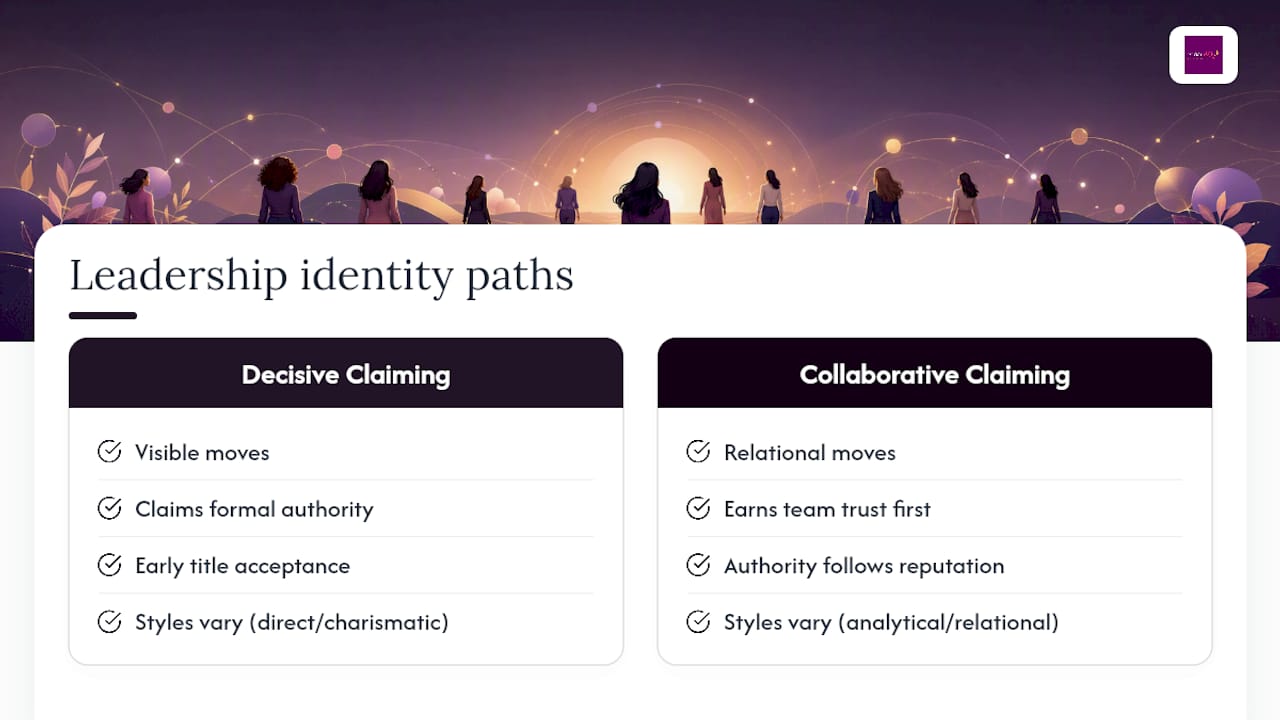
There's no single mould, and that's the point worth remembering when you're building your own. Some leaders build identity through visible legitimating claiming, stepping decisively into formal authority early and often. Others build it almost entirely through collaborative claiming, becoming known as the person a team trusts before they ever hold the title that makes it official.
What separates women who successfully build a leader identity from those who stay stuck isn't a personality type. It's the willingness to run the outsight experiment even when the outcome is uncertain, then adjust based on what actually happened rather than what they feared would happen. The specific style varies enormously, quietly analytical, openly charismatic, fiercely direct, deeply relational, but the mechanism underneath is consistent: action generates evidence, and evidence rebuilds identity.
If you're looking for a model to study, look for someone whose route into leadership resembled the constraints you're working with, not just someone whose title you admire. A leader who built her identity through collaborative claiming in a hierarchical, male-dominated industry offers you more usable lessons than a leader operating in an environment where authority was handed to her early and often.
How does leadership identity fit into your long-term career plan?
Leadership identity work isn't a one-off project you finish and then move past. It compounds. The experiments you run in your thirties shape the reputation and network you draw on in your forties, and the identity you build now becomes the evidence base for every promotion conversation, board application, or founder pitch that follows.
Build this into your actual career planning, not as a soft add-on but as a structural input. Ask, for each major decision ahead, whether it will generate more outsight evidence or simply keep you comfortable. A lateral move that puts you in front of new stakeholders often builds identity faster than a promotion that keeps you doing familiar work at a higher pay grade.
Revisit your centred leadership dimensions, meaning, energy, framing, connection, engagement, every six to twelve months, because the balance shifts as your career does. What builds meaning at 28 rarely looks the same at 45. Treat mentorship and sponsorship as long-term infrastructure rather than a one-time favour: the sponsor who backs you this year should be someone you're still in dialogue with three years from now, watching how your leadership identity has evolved and vouching for it accordingly.
What happened when one member tried this?
One ProspHER member started with a single experiment: volunteering to lead a cross-team update she'd normally have sat quietly through. She expected to feel like a fraud. Instead, two colleagues asked her opinion unprompted the following week. Small signal, real evidence. She scaled it the next month by proposing the workshop herself.
The takeaway isn't the specific task. It's that the reaction came before the confidence did, exactly as the outsight model predicts.
Why acting first beats waiting to feel ready
The uncomfortable truth about leadership identity is that most advice gets the sequence backwards. Confidence-building exercises, affirmations, "believe in yourself" content, all assume identity comes first and behaviour follows. The research says the opposite: behaviour generates the evidence that identity is built from.
What's underrated in most guidance aimed at women specifically is how much the claiming style gap matters more than a confidence gap. Women aren't lacking self-belief in some uniform way. Many are simply using collaborative claiming in environments still calibrated to notice legitimating claiming faster. That's a structural mismatch, not a personal deficiency, and it's fixable with specific, learnable moves rather than a personality overhaul.
The other thing worth saying plainly: community isn't a nice-to-have wrapped around the "real" work of leadership development. It's the mechanism that generates the outsight loop faster than solo effort ever could, because other people are the ones whose perceptions actually shift when you act differently. You can't fully outsight yourself in a vacuum.
— ProspHER
How ProspHER helps you build this identity faster
ProspHER exists for exactly the gap this article describes: the space between knowing you should run leadership experiments and actually having somewhere structured to run them. Membership gives you matched mentorship, curated resources instead of an endless content feed, events built for real practice, and a pathway shaped around your specific stage rather than a generic curriculum.
The proof points are worth repeating in your own case: across a community of more than 2,400 ambitious women, 94% report gaining clearer direction within just 30 days. That's not a vague promise of eventual clarity, it's a fast, structured path from uncertainty to a concrete next move, backed by mentors and peers who notice your progress in real time. If you're ready to stop running these experiments alone, explore ProspHER's membership pathways and see which one matches where you are right now.
Sources
- Am I a leader? Examining leader identity development over time
- How to act and think like a leader — INSEAD
- Centered leadership: How talented women thrive — McKinsey
- Women can lead with both heart and mind — The Conversation