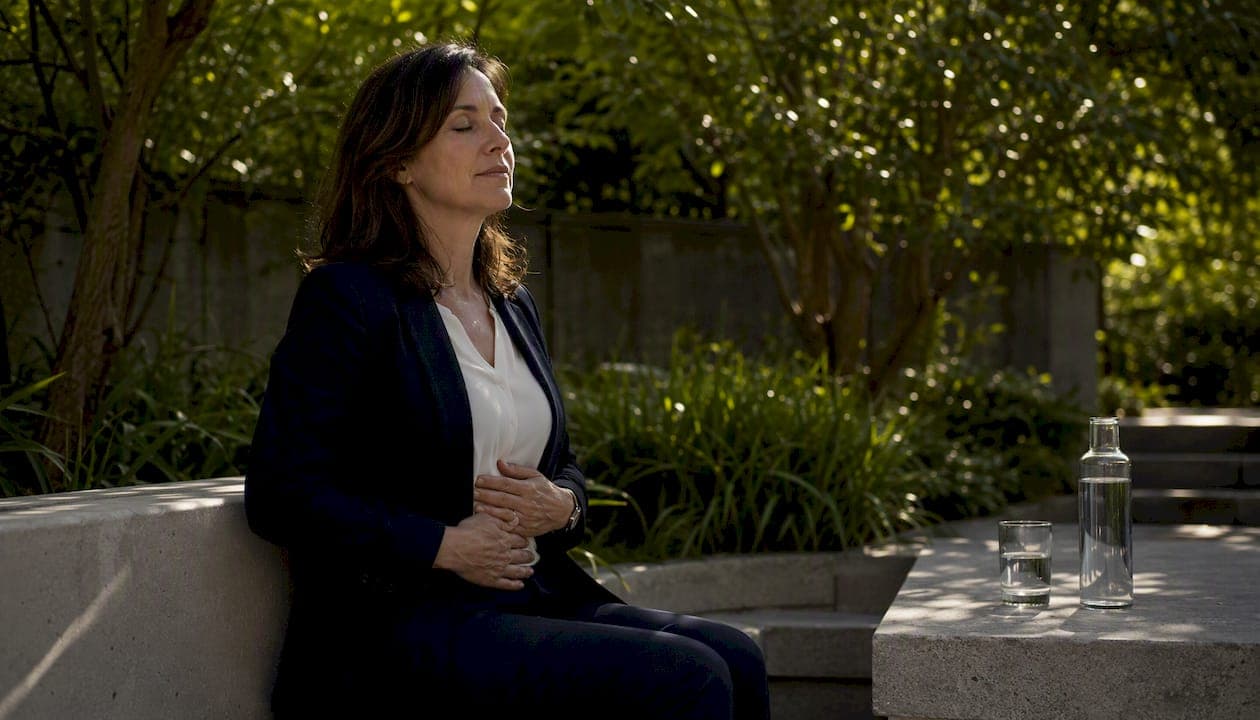
Public speaking anxiety, also known as glossophobia, is a fear response triggered by the prospect of speaking in front of others, and it is treatable through evidence-based methods rather than something you simply have to endure. The single most useful thing you can do right now is a short breathing anchor: inhale for four seconds, hold for four, exhale for six, repeated four times. It slows your heart rate and gives your thinking brain a chance to catch up with your body's alarm system.
Do this before your next talk starts, and pair it with one small exposure task this week, such as recording yourself speaking for two minutes on your phone.
- Do: breathe slowly before you speak, and focus your attention on your message rather than your nerves.
- Do: rehearse out loud, not just in your head.
- Don't: rely on avoidance. Skipping the meeting feels like relief but it strengthens the fear.
- Don't: wait for the fear to disappear before you start practising. It usually shrinks after you begin, not before.
Over 70% of people report a fear of speaking in public, so if your palms sweat before a presentation, you are in the overwhelming majority, not the exception.
Key Takeaways
Public speaking anxiety responds to graded exposure and evidence-based techniques far more reliably than it responds to willpower or reassurance alone.
| Point | Details |
|---|---|
| Start with breathing | Use a 4-7-8 breathing script before any talk to lower physical arousal within two minutes. |
| Distinguish nerves from disorder | Frequency, avoidance and impairment mark the line between normal jitters and a treatable problem. |
| Build a graded exposure plan | Progress from a two-minute chat with a friend to a recorded clip, then a small meeting. |
| Know your escalation warning sign | Watch for rushed speech; it often signals rising anxiety before a freeze happens. |
| Seek accredited help when needed | Contact a BABCP-registered therapist, an NHS GP, Mind or Anxiety UK if avoidance is costing you real opportunities. |
| Consider structured coaching support | ProspHER's membership offers guided practice and community accountability alongside, not instead of, clinical treatment. |
Table of Contents
- What is public speaking anxiety, and when does it become a bigger problem?
- Recognising the symptoms of public speaking anxiety
- Why public speaking anxiety happens in the first place
- Evidence-based treatments that actually work
- Practical tools to calm nerves before, during and after you speak
- How to build a graded exposure plan that actually rebuilds confidence
- When to seek professional help, and how to find it
- What changes, and what doesn't, when you work on this
- Build your confidence with structured practice and real accountability
- Where to find further help and reading
- Sources
What is public speaking anxiety, and when does it become a bigger problem?
Glossophobia describes the fear response, physical, emotional and mental, that activates when you anticipate or begin speaking to an audience. For most people, it shows up as the classic "butterflies": a flutter of nerves that fades once you get a few sentences into your talk. That pattern is normal. It does not need fixing. It needs managing.
The line into a bigger problem is drawn by frequency, avoidance and impairment, not by intensity alone. Someone who feels anxious for ten minutes before a wedding speech and then relaxes is having a normal stress response. Someone who turns down promotions, avoids meetings, or cancels talks because the anticipatory dread feels unbearable is dealing with something that meets a clinical threshold. The ADAA notes that public speaking fear can cause avoidance that damages work and study, and that treatment needs to address the underlying beliefs driving the fear, not just the surface symptoms.
- Normal nerves: tension before you start, which eases once you're speaking.
- A disorder pattern: dread for days beforehand, physical symptoms severe enough to disrupt sleep or appetite, and active avoidance of speaking opportunities.
- A key distinction: situational speaking anxiety is limited to performance contexts, while social anxiety disorder involves fear across a much wider range of everyday social interactions, not just formal speaking.
Public speaking anxiety and social anxiety disorder often get mixed up, but they are not the same thing. If your fear is confined to formal speaking situations, presentations, toasts, pitches, you are likely dealing with situational performance anxiety. If you also dread small talk, phone calls, or being watched while eating in public, that points towards a broader social anxiety pattern, which usually needs a different treatment focus.
Recognising the symptoms of public speaking anxiety
Anxiety rarely announces itself as one clean signal. It arrives as a cluster of physical, cognitive and behavioural changes, and knowing your specific pattern helps you choose the right tactic rather than a generic one.
Physical symptoms tend to appear first, because the fight-or-flight system fires before conscious thought catches up.
- Racing heart, shallow or rapid breathing, and a tight chest.
- Sweaty palms, shaky hands, or a trembling voice.
- Dry mouth, nausea, or a sudden need to visit the bathroom.
Cognitive symptoms are the mental static that makes preparation feel harder than it should.
- Blanking mid-sentence, or losing your thread entirely.
- Catastrophic predictions ("I'll freeze," "everyone will notice," "I'll be humiliated").
- Racing, repetitive thoughts that loop on worst-case outcomes rather than content.
Behavioural symptoms are what other people, and eventually you, notice most.
- Rushing through your material to end the ordeal sooner.
- Avoiding eye contact, or fixing your gaze on notes and never lifting it.
- Declining meetings, presentations, or promotions that involve speaking.
Pro Tip: Watch for rushed speech as your earliest warning sign. Speeding up is usually the first outward clue that anxiety is escalating, and catching it early, then deliberately slowing your pace, can stop a mild wobble turning into a full freeze.
Why public speaking anxiety happens in the first place
Your brain treats a room full of watching faces the same way it once treated a genuine physical threat. That is not a design flaw. It is a survival mechanism responding to the wrong kind of danger.
The fight-or-flight response floods your system with adrenaline the moment your brain interprets scrutiny as risk. Heart rate climbs, breathing shortens, and blood moves away from digestion and towards your limbs, useful if you needed to run from a predator, unhelpful when you need to deliver a clear sentence.
Negative prediction compounds the problem. Before you have said a word, your mind has already rehearsed failure, stumbling, forgetting, being judged. This prediction feels like certainty rather than guesswork, which is why reassurance from others rarely lands. You are not being told something you don't believe; you are being told something that contradicts a forecast your brain has already treated as fact.
The spotlight effect distorts how closely you think you're being watched. Most audiences are far less focused on your every twitch than you assume, and research on the "liking gap" shows that people consistently judge speakers less harshly than the speakers expect. Past humiliations, a school presentation that went badly, a joke that fell flat, sharpen this effect further, teaching your brain to expect a repeat performance every time you stand up to speak.
The trap is this: avoiding a feared talk provides instant relief, but that relief teaches your brain the situation really was dangerous, and the fear comes back stronger next time. Skill alone doesn't break that loop. Facing the situation, gradually and repeatedly, does.
This is why reassurance and preparation alone often plateau. Reading your slides one more time won't retrain a fear response. Standing in front of people, again and again, in small enough doses to tolerate, will.
Evidence-based treatments that actually work
Self-help techniques matter, but when public speaking anxiety is disrupting your career or wellbeing, structured clinical approaches have the strongest track record.
Cognitive Behavioural Therapy (CBT) targets the loop between thoughts, physical sensations and avoidance behaviours. A therapist helps you identify the specific catastrophic predictions driving your fear, then tests them against reality through structured practice. CBT and exposure work by changing how thoughts, sensations and behaviours interact, producing new learning that gradually replaces the old fear association.
Structured exposure therapy is often delivered alongside CBT rather than as a separate track. It involves facing feared speaking situations in a deliberately graded sequence, starting easy and increasing difficulty only once each level feels manageable.
Acceptance and Commitment Therapy (ACT) takes a different angle: instead of trying to eliminate anxious thoughts, it teaches you to notice them without letting them dictate your behaviour. This suits people who find that fighting their nerves makes the nerves louder.
Medication occasionally has a role, usually short-term and usually as an adjunct rather than a standalone fix. A GP might discuss a beta-blocker for physical symptoms before a specific high-stakes event, or an SSRI if anxiety is broader and more persistent. Medication rarely resolves the underlying thinking patterns on its own.
Realistic timelines matter here, because unmet expectations cause people to quit early:
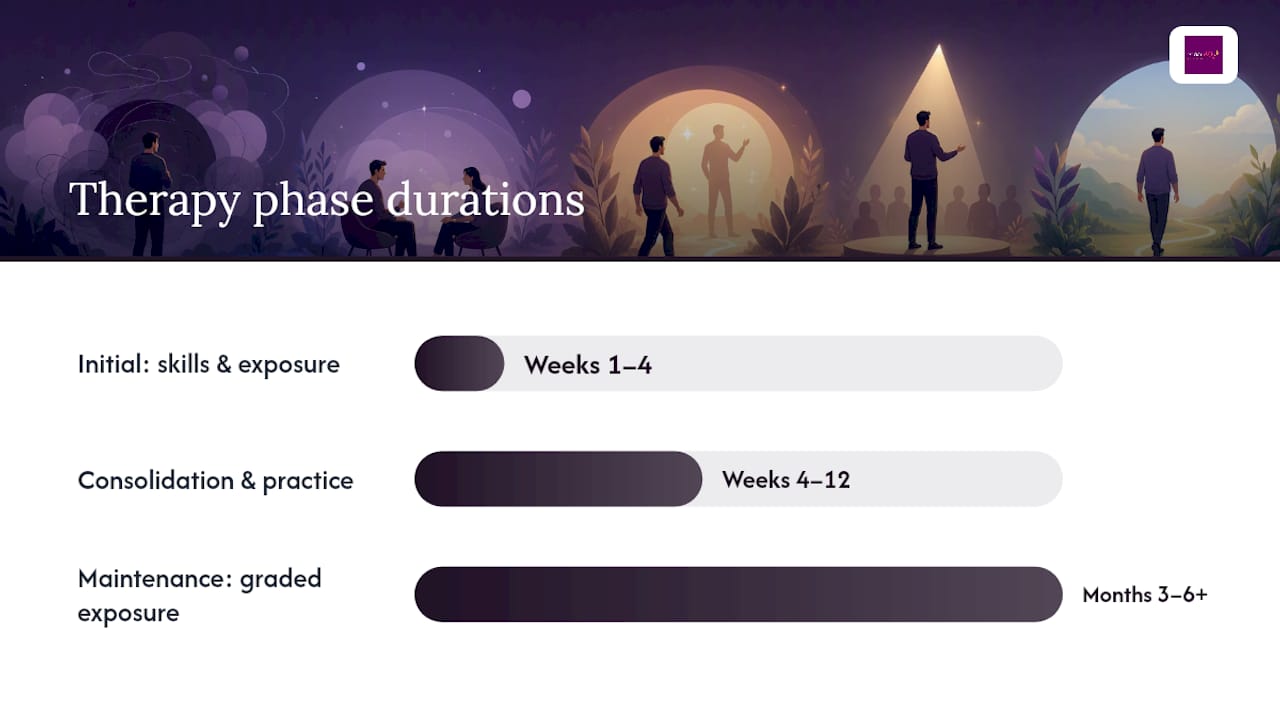
- Weeks 1 to 4: initial skills and early exposure steps, some reduction in anticipatory dread.
- Weeks 4 to 12: measurable improvement typically consolidates within this window with regular structured practice.
- Months 3 to 6+: consolidation, where speaking situations that once felt threatening become routine.
For accredited support, look for therapists registered with the British Association for Behavioural & Cognitive Psychotherapies (BABCP), the professional body that accredits CBT practitioners across the UK. Charities including Mind and Anxiety UK also offer guidance, helplines and, in some cases, low-cost therapy access.
If your symptoms are severe, disabling, or accompanied by panic attacks, speak to a GP or a qualified mental health professional rather than relying solely on self-help.
Practical tools to calm nerves before, during and after you speak
Coping tools work best when matched to timing. What helps you thirty minutes before a talk is not the same as what helps you mid-sentence when your mind blanks.
Before the talk
Diaphragmatic breathing is the fastest way to interrupt the physical anxiety spiral. Try this 4-7-8 script: breathe in through your nose for four seconds, hold for seven, exhale slowly through your mouth for eight. Repeat four times. It activates your parasympathetic nervous system, the body's natural brake pedal, and typically takes under two minutes.

Progressive muscle relaxation works well for people who carry tension in their shoulders or jaw. Tense each muscle group for five seconds, then release, working from your feet upward. Combined with mindfulness practice, this reliably lowers physiological arousal before you need to walk into a room.
Mental rehearsal matters as much as breathing. Rather than picturing failure, visualise the talk going well, from your opening line to the audience's engaged expressions. This isn't wishful thinking; it draws on the same neural pathways that physical rehearsal uses. Reframing the racing heart and sweaty palms as performance energy, rather than as a warning sign, helps some speakers channel that arousal into sharper delivery instead of being paralysed by it.
During the talk
Deliberate pauses do more work than most speakers realise. A two-second pause after a key point looks like confidence, not hesitation, and it gives you a breath.

Shift your visual focus around the room rather than fixing it on one point, and aim your attention at friendly faces first if nerves spike.
Pro Tip: If your mind goes blank, use this recovery script: pause, take one breath, and say, "Let me just gather my thoughts for a moment." Audiences read this as composure, not failure, and it buys you two or three seconds to find your place again.
After the talk
Note what went well before you note what went wrong. Anxious speakers tend to remember only the stumble, not the eighteen minutes that went smoothly. A quick written log, what worked, what you'd adjust, builds an accurate record you can trust more than your in-the-moment panic.
How to build a graded exposure plan that actually rebuilds confidence
Confidence with public speaking is built the same way physical fitness is: through small, repeated, slightly uncomfortable doses, not through one dramatic leap.
Here is a practice hierarchy you can adapt:
- Week 1: speak for two minutes to one trusted friend about a topic you know well.
- Week 2: record yourself giving that same two-minute talk on your phone, then watch it back once.
- Week 3: deliver a short update at a small team meeting, three or four people.
- Week 4: volunteer to lead five minutes of a slightly larger meeting.
- Week 5 to 6: attend a structured practice group, such as a local Toastmasters club, where short prepared and impromptu speaking slots offer feedback in a low-stakes setting.
- Week 7 onward: take on a talk with genuine stakes, a client pitch, a conference slot, a wedding speech, using everything practised at earlier stages.
Structure each practice session with a simple template:
- Objective: what specifically you're practising (pacing, eye contact, opening lines).
- Warm-up: two minutes of breathing or PMR before you begin.
- Focused practice: the speaking task itself, timed.
- Review notes: two things that went well, one thing to adjust.
- Short reflection: one sentence on how your anxiety level compared to last time.
Practise two to three times a week rather than daily marathon sessions; spaced repetition builds more durable confidence than cramming. As you progress, deliberately drop safety behaviours, notes you don't need, a friend in the audience for reassurance, standing behind a lectern, since avoidance and safety behaviours quietly reinforce the fear they're meant to soften. Removing them one at a time, once you're ready, is part of the exposure itself.
If you want structured accountability for this kind of practice, group formats such as those covered in business coaching communities for women can give you scheduled speaking slots and peer feedback that a solo plan lacks.
When to seek professional help, and how to find it
Self-directed practice resolves a great deal of public speaking anxiety, but not all of it. Certain signs suggest it's time to bring in professional support.
Red flags worth acting on:
- Avoidance that's costing you real opportunities, promotions turned down, projects declined, meetings skipped.
- Panic attacks, chest pain, or a sense of losing control that goes well beyond ordinary nerves.
- Anxiety that's spreading beyond speaking into broader social withdrawal.
- Symptoms persisting or worsening despite consistent, honest practice over several months.
If you decide to speak to a GP, a short, direct script helps:
- Describe the specific situations that trigger it (meetings, presentations, particular audiences).
- Explain how long it's been happening and what it's cost you (missed promotions, sleepless nights before talks).
- Ask directly what NHS-funded talking therapy options are available in your area, most areas offer CBT through NHS Talking Therapies without needing a referral.
To find accredited help beyond a GP referral, the BABCP register lets you search for CBT therapists by location and specialism. Mind and Anxiety UK both offer information lines and can point you towards low-cost or charitable therapy options if NHS waiting lists are long.
Before starting with any therapist, ask what percentage of their caseload involves performance or social anxiety, how many sessions they typically expect a case like yours to take, and whether they use exposure-based methods specifically. This is general information, not a substitute for individual clinical advice, if your symptoms are severe or disabling, please speak to a GP or qualified mental health professional directly.
What changes, and what doesn't, when you work on this
Here's what we'd tell you honestly: the goal isn't to stop feeling nervous before you speak. It's to stop letting that nervousness decide what you do.
Most people who work seriously on public speaking anxiety don't end up as people who feel nothing before a talk. They end up as people who still feel the flutter, the dry mouth, the slightly faster heartbeat, and speak anyway, because the fear has stopped running the show. That is not a consolation prize. It's actually a more durable outcome than eliminating nerves entirely, because even experienced, high-functioning speakers tend to keep some version of the butterflies; they've just learned to use that energy rather than fight it.
Progress here rarely looks like a straight line. It looks like a two-minute talk to a friend that felt terrifying in week one and merely uncomfortable by week four. Track that shift, because your memory will try to convince you nothing's changed.
Build your confidence with structured practice and real accountability
Reading about breathing techniques and exposure hierarchies gets you part of the way. What tends to move people faster is doing it alongside others who are working through the same discomfort, with structure and accountability built in rather than left to willpower alone. That's the specific gap a coached, community-based pathway fills that a solo practice plan can't: someone checking in on whether you actually did the exposure task this week, and a room of people who've stood exactly where you're standing.
ProspHER's membership pairs mentorship, group coaching and community events with a personalised pathway, so speaking practice sits inside a wider plan for building confidence at work, not as an isolated exercise. Members get scheduled opportunities to practise, present and get feedback in a supportive setting, alongside a community of over 2,400 women building the same kind of professional confidence. This is not a substitute for accredited therapy where clinical treatment is needed, but it's a strong next step once you've got the fundamentals in place, or if what you need most is regular practice and accountability rather than clinical intervention. Explore the ProspHER membership pathway to see how a structured, personalised route to confidence could fit where you are right now.
Where to find further help and reading
Several UK organisations offer accredited, trustworthy support for public speaking anxiety, and each serves a slightly different purpose.
- NHS mental health pages outline symptoms, self-referral routes for talking therapies, and when to see a GP.
- Mind provides plain-language guidance on anxiety, a helpline, and information on local support groups.
- Anxiety UK offers a dedicated helpline, therapist access at reduced rates for members, and self-help resources specific to anxiety disorders.
- BABCP maintains the UK's main accreditation register for CBT therapists, letting you search by location and specialism.
- Toastmasters clubs run across the UK and offer low-stakes, structured speaking practice with peer feedback, a practical exposure venue that complements clinical treatment rather than replacing it.
For readers who want to go deeper into the evidence base, the neuroscience of performance anxiety and the mechanics of CBT and exposure therapy are covered in the Stanford GSB piece on speaking anxiety and the ADAA's overview of stage fright treatment, both grounded in established clinical research rather than anecdote.
Frequently asked questions
Is public speaking anxiety the same as social anxiety disorder? No. Public speaking anxiety is usually confined to performance situations, while social anxiety disorder involves fear across a much broader range of everyday interactions.
How long does it take to reduce public speaking anxiety? Many people notice initial improvement within a few weeks of consistent practice, with measurable change consolidating over roughly three months of structured effort.
Can breathing techniques really stop stage fright? They won't eliminate the fear entirely, but slow, controlled breathing measurably lowers physical arousal within minutes, which gives you enough composure to think clearly and speak steadily.
Do I need therapy, or can I manage this myself? Many people improve significantly with self-directed graded exposure and practice. Consider professional support if avoidance is affecting your career, or if symptoms include panic attacks or severe distress.
Will the nervousness ever go away completely? Usually not, and that's fine. Most experienced speakers still feel some nerves; the aim is managing that energy so it supports rather than derails your delivery.
Sources
- How to Deal With a Fear of Public Speaking | Psychology Today
- Fear of public speaking: A CBT and Exposure Therapy Approach to Overcoming Anxiety — Dr. Whitley Lassen
- Hacking your speaking anxiety — Stanford Graduate School of Business
- Conquering stage fright — ADAA