
People pleasing at work means putting colleagues' comfort ahead of your own workload, opinions and wellbeing, usually out of fear of conflict rather than genuine generosity. That's different from being helpful. Helpfulness is a choice you make from a place of capacity; people pleasing is a compulsion driven by approval-seeking and conflict avoidance, and it quietly erodes your career while looking, from the outside, like commitment.
You don't need a personality overhaul to shift this. You need three things, starting today:
- Say this line once: "Let me check my workload and come back to you by [time]." It buys you a pause before the automatic yes.
- Practise the three-second pause before answering any request. Silence feels awkward. It's also where your actual choice lives.
- Pick one boundary to test today. Leaving on time. Not replying to Slack after 6pm. Saying "I can't take that on this week."
Pro Tip: Track every "yes" you give for one week before you try to change anything. You can't fix a pattern you haven't measured.
By day seven, success looks like this: you've noticed at least three moments where you paused instead of auto-agreeing, you've said one genuine "no" and survived it, and you've written down how you felt afterwards, not just what happened.

Key Takeaways
Stopping people pleasing at work requires staged practice, not willpower, because the underlying fawn response was learned slowly and unlearns the same way.
| Point | Details |
|---|---|
| Definition matters | People pleasing is compulsive approval-seeking, not the same as genuine collaboration or helpfulness. |
| It's a survival strategy | The fawn response is learned early and reinforced by short-term relief, not a fixed personality trait. |
| Career cost is real | Invisible overwork and workload creep often stall promotion more than skill gaps do. |
| Use a staged plan | An 8-week programme of micro-nos, scripts and delegation builds tolerance gradually. |
| Know when to escalate | Persistent anxiety or trauma history warrants CBT, DBT or somatic therapy, not just scripts. |
Where to read more on people pleasing at work
- MDPI's research on people pleasing: defines the pattern and its links to chronic stress.
- Cleveland Clinic's guide: clinical detail on therapy routes including CBT and DBT.
- Simply Psychology on the fawn response: explains the attachment and nervous-system roots.
- CNBC's communication expert advice: practical prioritisation scripts for managers.
- Psychology Today's workplace assessment: self-check signs and gradual-change rationale.
- AP News on workplace boundaries: specificity and planning around limits.
- Atlassian on team-level boundaries: why boundaries help colleagues, not just you.
- Greater Good Science Center: the case for authenticity over surface acting.
Table of Contents
- What people pleasing at work actually looks like
- Why people pleasing develops in the first place
- The real cost to your career and reputation
- Your 8-week plan to stop people pleasing at work
- Scripts you can use tomorrow
- Small experiments that build lasting change
- When to get professional support
- What the evidence actually supports
- Frequently asked questions
- Sources
What people pleasing at work actually looks like
Reiterating the point above: people pleasing isn't collaboration, it's self-erasure dressed as teamwork. A collaborative colleague negotiates. A people pleaser capitulates, then resents it quietly. The tell is usually in how you feel after you agree to something, not in the agreement itself.
Watch for these patterns showing up on repeat:
- Saying yes before you've checked your calendar, your energy, or whether the task is even yours.
- Over-apologising for things that need no apology, like asking a clarifying question in a meeting.
- Taking on the unglamorous, invisible tasks nobody else wants, because refusing feels riskier than resentment.
- Shrinking your opinions in meetings, then venting about the decision afterwards to someone else.
- Letting other people's moods or reactions steer decisions that are actually yours to make.
Three questions can tell you where you stand, and they take about a minute. Did I agree to that because I wanted to, or because saying no felt unbearable? Would I be upset if a colleague did to me what I just did to myself? Am I doing this task because it's mine, or because someone looked stressed?
Picture the Friday afternoon "quick favour" from a colleague that eats your evening, or the meeting where you nod along to a plan you privately think is wrong. Neither moment feels dramatic. That's exactly why the pattern survives so long unchallenged.
Is people pleasing the same as being a "team player"? No. A team player contributes because they've weighed the request against their capacity and values. A people pleaser contributes because refusing feels dangerous, and that distinction is where careers quietly stall.
Why people pleasing develops in the first place
None of this is a character flaw. It's a learned survival strategy, often built long before your first job. Psychologists call the underlying mechanism the "fawn" response, a fourth option alongside fight, flight and freeze, where appeasing a threat becomes the safest available move.
If you grew up in a home where a parent's mood dictated the emotional weather, that same reflex gets neurologically encoded as a safety strategy, one you carry into adulthood without realising it's still running. Attachment patterns formed in childhood, particularly where love or approval felt conditional, teach a child that being agreeable is the price of belonging. That lesson doesn't expire at 18. It just changes venue, from the family dinner table to the Monday stand-up.
Workplaces then reinforce it. Say yes to the extra project and you get praised for being reliable. Say no once, feel the awkward silence that follows, and your nervous system logs it as a mistake. This is reinforcement in its plainest form: short-term relief and approval, repeated often enough to override the long-term cost. Nobody sits down and decides to become a people pleaser. It happens through hundreds of small transactions where compliance felt safer than honesty.
Breaking the pattern requires what therapists call discomfort tolerance, the ability to sit with someone's disappointment without immediately trying to fix it. That's a skill, not a personality trait, and it can be built.
Pro Tip: Reframe the behaviour from "safety" to "strategy" before you try to change it. Telling yourself "I was weak" invites shame, which stalls progress. Telling yourself "this was the smartest available move for a younger version of me, and it's no longer serving the adult one" makes the same behaviour something you can examine, test, and retire without self-punishment.
The real cost to your career and reputation
The cost isn't just personal exhaustion, it's structural. Vera takes on every last-minute request from her director, never says no, and is rewarded with more work, not more responsibility. Two years later, a colleague who set clearer limits gets the promotion, because the promotion panel remembers her strategic contributions, not her availability at 9pm.
That's the pattern in miniature: people pleasers often become invisible in the exact way that matters for advancement. You're everywhere operationally and nowhere strategically.
The measurable costs stack up quickly:
- Promotion delay, because visible strategic wins get crowded out by invisible admin favours.
- Workload creep, where your job description expands every time you fail to push back.
- Burnout risk, from chronically saying yes past your actual capacity.
- Weaker decisions, because agreeing with the loudest voice in the room isn't the same as backing the best idea.
Clinical observation links this pattern to low self-esteem and difficulty asserting personal needs, which compounds over a career rather than resolving on its own. And it's not just an individual cost. Organisational research ties clearly respected personal boundaries to stronger psychological safety and lower burnout risk across teams, meaning your unclear boundaries don't just cost you, they cost the people managing around you too.
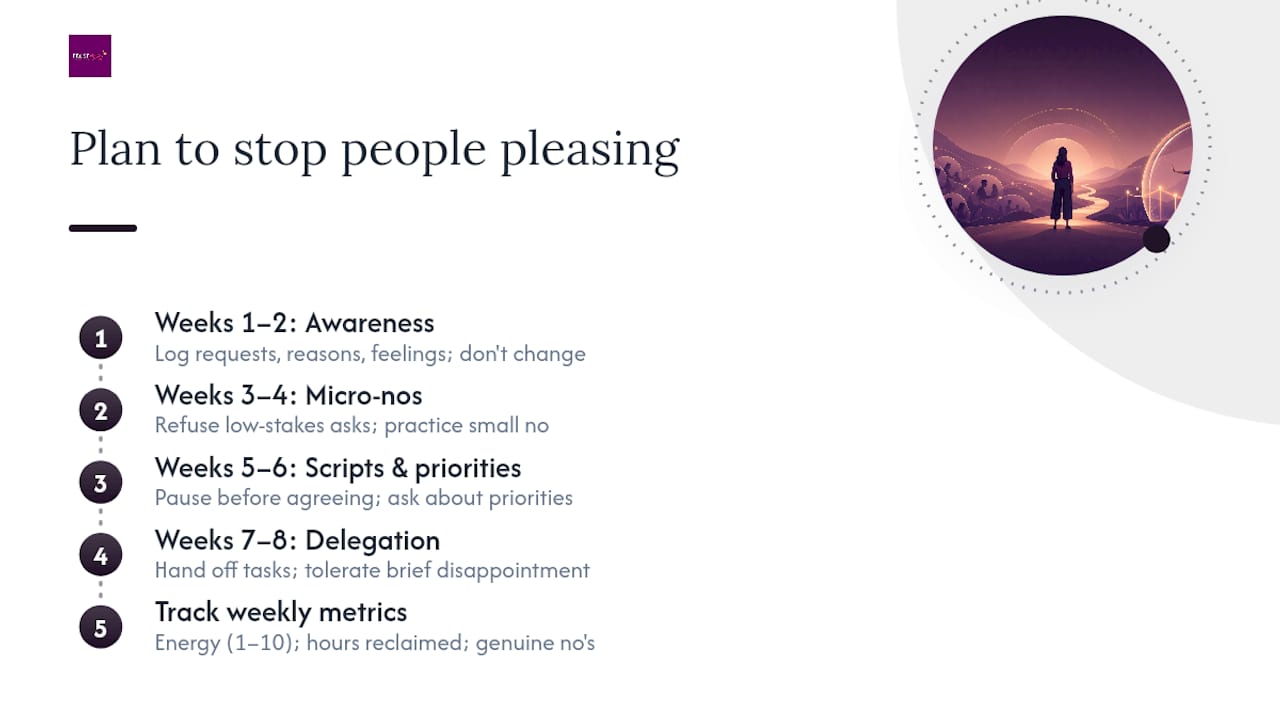
Your 8-week plan to stop people pleasing at work
Behavioural change here works best as staged exposure, not a single dramatic confrontation. Small, repetitive experiments beat grand declarations, because your nervous system needs evidence, collected slowly, that saying no doesn't end in disaster.
Weeks 1 to 2: Awareness. Keep a simple "what I said yes to" log, three columns: the request, why you said yes, how you felt two hours later. Don't change anything yet. You're gathering data on your own pattern, and most people pleasers are startled by what week one reveals.
Weeks 3 to 4: Micro-nos. Practise refusing something genuinely low-stakes. Decline a meeting that doesn't need you. Say "I'll pass on lunch today, I need the hour." The goal isn't the outcome, it's proving to yourself that a small no doesn't detonate the relationship.
Weeks 5 to 6: Boundary scripts and prioritisation conversations. Move from micro-nos to real workload conversations. Communication specialists recommend pausing before agreeing to new work, then asking where it should sit against existing priorities, rather than accepting it on top of everything else. This reframes you as someone managing trade-offs, not someone who simply can't cope.
Weeks 7 to 8: Delegation and exposure to discomfort. Hand something off you'd normally keep out of guilt. Sit with a colleague's mild disappointment without rushing to smooth it over. This is where the real shift happens, because tolerating someone else's brief frustration is the actual skill underneath every boundary you'll ever set.
Track three numbers weekly: energy at the end of each day (1 to 10), hours reclaimed from tasks you didn't take on, and the number of genuine "no"s you delivered. Setting boundaries with specificity and consistency, and planning cover in advance, measurably improves wellbeing and productivity, so vague intentions won't move the needle the way a tracked, repeated behaviour will. ProspHER's goal setting framework offers a template you can adapt directly for this log.
Pro Tip: When a manager piles on more work, resist the instinct to just absorb it. Show your current workload and ask them to help you prioritise rather than adding the new task silently on top. This turns you into someone who manages capacity, not someone who has none.
Pro Tip: Recruit one peer as an accountability partner and tell them what you're practising. A five-minute Friday check-in, "what did you say no to this week?", keeps you honest when the urge to slide back creeps in.
Scripts you can use tomorrow
Language rehearsed in advance is easier to deliver under pressure than language invented on the spot. Try these five, adapted to your own voice and to who you're speaking to.
- Extra project from your manager: "I want to do this well. Can we look at what's already on my plate and decide together what shifts?"
- Colleague asking for help mid-deadline: "I can't take this on today, but I can look at it with you tomorrow morning."
- Meeting running over: "I've got a hard stop in five minutes, let's agree the next step before I go."
- Late-night email demanding a reply: "Got it, I'll pick this up first thing tomorrow." Then actually wait until tomorrow.
- Being asked to quietly fix someone else's mistake: "I can help you flag this, but I don't think I should be the one presenting the fix as if it's mine."
Keep the tone firm, not apologetic; state the position once and stop talking. With a senior stakeholder, soften the framing slightly ("Can we align on priorities?") without softening the actual boundary. With a peer, you can be more direct ("I can't today, try me tomorrow"). Rehearse out loud, not just in your head, a voice note to yourself or a five-minute roleplay with a trusted colleague makes the words far easier to access when your heart rate spikes in the real moment.
Small experiments that build lasting change
Confidence here comes from evidence, not willpower. Run one low-stakes experiment a week and treat each as a data point rather than a verdict on your worth.
- Week one: decline one meeting invite that doesn't need your input.
- Week two: ask for a deadline extension on something genuinely tight.
- Week three: raise a differing opinion in a meeting, even briefly.
- Week four: delegate a task you'd normally keep out of guilt.
Note the request, your response, and how you felt an hour later, then a day later. Most people pleasers discover the anticipated disaster never lands.
Pro Tip: Don't treat one awkward "no" as proof the whole approach failed. A stilted response from a colleague is one data point, not a verdict. Log it, notice what you'd adjust, and run the next experiment anyway.
When to get professional support
Self-help scripts go a long way, but some patterns are too entrenched, or too tied to genuine trauma, to shift through practice alone. Pay attention if you're experiencing persistent anxiety around ordinary requests, a personal trauma history that seems connected to the pattern, or a manager whose behaviour is genuinely unreasonable rather than merely demanding.
Structured therapeutic approaches, including CBT, DBT and trauma-informed or somatic work, are recommended when people pleasing is rooted in deeper anxiety or past experience, because they build assertiveness through guided, graded exposure rather than trial and error alone.
- CBT helps reframe the automatic thoughts that trigger the compulsive yes.
- DBT builds distress tolerance for the discomfort that follows a genuine no.
- Somatic approaches work directly with the nervous-system fawn response, not just the thoughts around it.
- Coaching supports people whose pattern is workplace-specific rather than trauma-rooted; structured coaching can rebuild assertiveness alongside career strategy.
- Employee Assistance Programmes (EAP) offer free, confidential sessions through many employers, a low-friction first step.
If you're approaching HR, frame the request around workload management rather than disclosing personal history you'd rather keep private. A therapist directory or your EAP portal can point you to someone qualified without involving your employer at all.
What the evidence actually supports
The research behind this advice isn't a single study, it's a convergence of clinical and behavioural findings.
- Graded exposure, small nos before big ones, reduces the threat response over time rather than overwhelming it, which is why staged plans outperform sudden confrontations.
- Structured behavioural work strengthens assertiveness more reliably than insight alone; understanding why you people please rarely changes the behaviour by itself.
- Broader research into emotion regulation and workplace behaviour supports skills-based approaches over willpower-based ones.
- Genuine, values-aligned action, rather than surface-level accommodation, correlates with lower stress, which is the deeper argument for deep change over polite masking.
Evidence specific to workplace people pleasing, as opposed to people pleasing generally, is still a developing field, so treat the staged plan above as a well-supported starting point rather than a clinical protocol.
Why this matters to us at ProspHER
We built ProspHER because too many capable women spend their careers managing everyone else's comfort instead of their own trajectory. Many members of our community report clearer direction within 30 days, and boundary work is almost always part of that shift. If you want structured support rather than a solo experiment, our coaching pathways are built for exactly this.
Frequently asked questions
Is people pleasing at work always a bad thing? No. Genuine helpfulness, offered from capacity rather than fear, strengthens teams. The problem is the compulsive version, agreeing because refusal feels dangerous, not because you actually have the time or desire to help.
How long does it take to stop people pleasing at work? Most people notice meaningful shifts within 8 to 12 weeks of consistent, staged practice. The pattern took years to build, so expect gradual, not overnight, change.
What's the fastest first step if I only try one thing? Pause three seconds before answering any request this week. That single habit interrupts the automatic yes long enough for a real choice to appear.
Can people pleasing at work cause burnout? Yes. Chronic overcommitment from an inability to say no is a well-documented driver of exhaustion and reduced decision quality over time.
Should I tell my manager I'm working on this? You don't have to disclose the psychology behind it. Framing conversations around workload and priorities, rather than personal struggle, usually gets better results anyway.
This article is general information, not a substitute for advice from a qualified doctor. Consult a qualified healthcare professional about your own circumstances before acting on anything here.
Sources
- MDPI — (article on people‑pleasing; 2025)
- Cleveland Clinic — how to stop being a people‑pleaser
- Simply Psychology — people‑pleasing psychology
- Psychology Today — are you a workplace people‑pleaser?