
A short, prioritised reading list gets you further than a stack of ten half-finished business books. If you read nothing else this year, start with these eight: Lean In for structural clarity on ambition, The Confidence Code for the science of self-belief, Playing Big for stepping into leadership without waiting to feel ready, Profit First if your numbers are a mess, Permission Granted if you're building something from scratch, Daring Greatly for handling criticism without shrinking, Girl Code for building your own support network, and Nice Girls Don't Get the Corner Office for the workplace habits nobody warns you about.
Bentley University includes several of these in its own must-read list for women in business, and Forbes' recent roundup of essential leadership books for women backs a similar mix of practical strategy and lived experience. Among ProspHER's own community of over 2,400 women, the pattern holds too: members consistently report that pairing a single book with structured accountability, rather than reading in isolation, is what actually moves the needle.
Quick-start shortlist:
- Lean In — the case for negotiating harder — best for anyone stuck justifying their own ambition
- The Confidence Code — the research behind self-doubt — best for high performers who still hesitate
- Playing Big — a framework for leading before you feel ready — best for first-time managers and founders
- Profit First — a simple cash system — best for anyone whose business finances feel chaotic
- Permission Granted — evidence-based startup playbook — best for early-stage founders
- Daring Greatly — vulnerability as strength — best for leaders navigating criticism
- Girl Code — community over competition — best for women building a support network
- Nice Girls Don't Get the Corner Office — habits that hold women back — best for career progression
Key Takeaways
A prioritised shortlist of eight books, matched to your specific stage and paired with one applied action each, delivers more measurable progress than reading widely without structure.
| Point | Details |
|---|---|
| Start with mindset first | Confidence and visibility gaps block most other progress, so read Playing Big or The Confidence Code before tactical titles. |
| Pick one action per book | Apply a single concrete action within two weeks rather than absorbing the whole book passively. |
| Match format to content | Use audiobooks for memoir and mindset titles; use paperback or digital for anything with exercises, like Profit First. |
| Balance classics with new voices | Pair seminal titles like Lean In with recent releases centring underrepresented founders for a fuller picture. |
| Structure beats solo reading | ProspHER members report clearer direction within 30 days when reading is paired with mentorship and community accountability. |
Where to buy or borrow these books in the UK
- Check UK Bookshop's curated list for female entrepreneurs for direct purchase links supporting independent bookshops.
- Most titles are available through UK public libraries; reserve online to avoid waiting-list surprises on newer releases.
- Audiobook versions of Daring Greatly, Big Magic, and The Confidence Code are widely available on major UK audiobook services.
- For guided next steps once you've read, visit ProspHER.
Table of Contents
- How and why we chose these books for women in business
- Top 8 books for women in business at a glance
- What you'll actually learn from each recommended book
- Which category of book matches your current challenge?
- How to choose the right book and get real value from it
- How these books map to real outcomes for ProspHER members
- Why author diversity changes what you take from a business book
- If books alone aren't enough: structured support from ProspHER
- Sources
How and why we chose these books for women in business
Not every business book earns a place on a curated list. The ones here passed a specific filter, and it's worth knowing what that filter was before you buy any of them.
We looked for:
- Direct relevance to women navigating funding, leadership, or career progression specifically
- At least one concrete action the reader can apply within a fortnight
- Author credentials that hold weight, whether that's original research, lived practitioner experience, or a documented track record
- A recent edition or ongoing cultural relevance, not a book stuck in a decade-old market
- A spread of voices, including women of colour and founders from underrepresented backgrounds
Yale School of Management's own reading list of leadership books written by women uses a similar lens, favouring titles that pair research with real application over pure motivation. That distinction matters when you're choosing what to read next.
Some books exist to move you emotionally. Others exist to hand you a system. Neither is wrong, but confusing the two wastes your reading time.
Pro Tip: If a book's back cover promises to change your mindset, expect inspiration and reflection prompts. If it promises frameworks, checklists, or numbered steps, expect homework. Read accordingly, and don't judge a mindset book by a practical-book yardstick.
Top 8 books for women in business at a glance
Here's the shortlist with enough detail to decide in under a minute which one goes on your bedside table first.
-
Lean In — Sheryl Sandberg. Direct, sometimes controversial guidance on negotiating pay, claiming space in meetings, and pushing past self-imposed limits. Best for: women feeling boxed in by internalised expectations. Format: paperback or audio, either works well.
-
The Confidence Code — Katty Kay & Claire Shipman. A journalist-led investigation into where confidence actually comes from and why women underrate their own competence. Best for: high achievers who still feel like impostors. Format: audiobook suits its conversational tone.
-
Playing Big — Tara Mohr. A structured programme for moving from self-doubt to visible leadership, built from workshops Mohr ran with thousands of women. Best for: women avoiding visibility, public speaking, or bigger roles. Format: paperback, since it includes exercises.
-
Profit First — Mike Michalowicz. A behavioural cash-management system that flips traditional accounting to protect profit before expenses eat it. Best for: founders whose business bank balance is a source of anxiety. Format: paperback, ideally with a highlighter.
-
Permission Granted — Maura McAdam. Drawn from over 30,000 hours of research and 300-plus interviews, structured into eight calls-to-action for women entrepreneurs. Best for: early-stage founders wanting evidence, not just encouragement. Format: paperback.
-
Daring Greatly — Brené Brown. Research-backed argument that vulnerability, not armour, is what builds resilient leadership. Best for: leaders who over-manage their image at work. Format: audiobook, narrated by Brown herself.
-
Girl Code — Cara Alwill Leyba. A confidence-and-community-first roadmap that Inc. named among its top picks for inspiring female entrepreneurs. Best for: women who feel isolated running their own business. Format: paperback, easy to dip into.
-
Nice Girls Don't Get the Corner Office — Lois P. Frankel. The revised third edition tackles behavioural habits, from over-apologising to under-negotiating, updated for current workplace realities. Best for: women being overlooked for promotion. Format: paperback, works well as a reference.
What you'll actually learn from each recommended book
Reading a summary online is not the same as sitting with the book and applying it. Here's what each title asks of you, and what you get back.
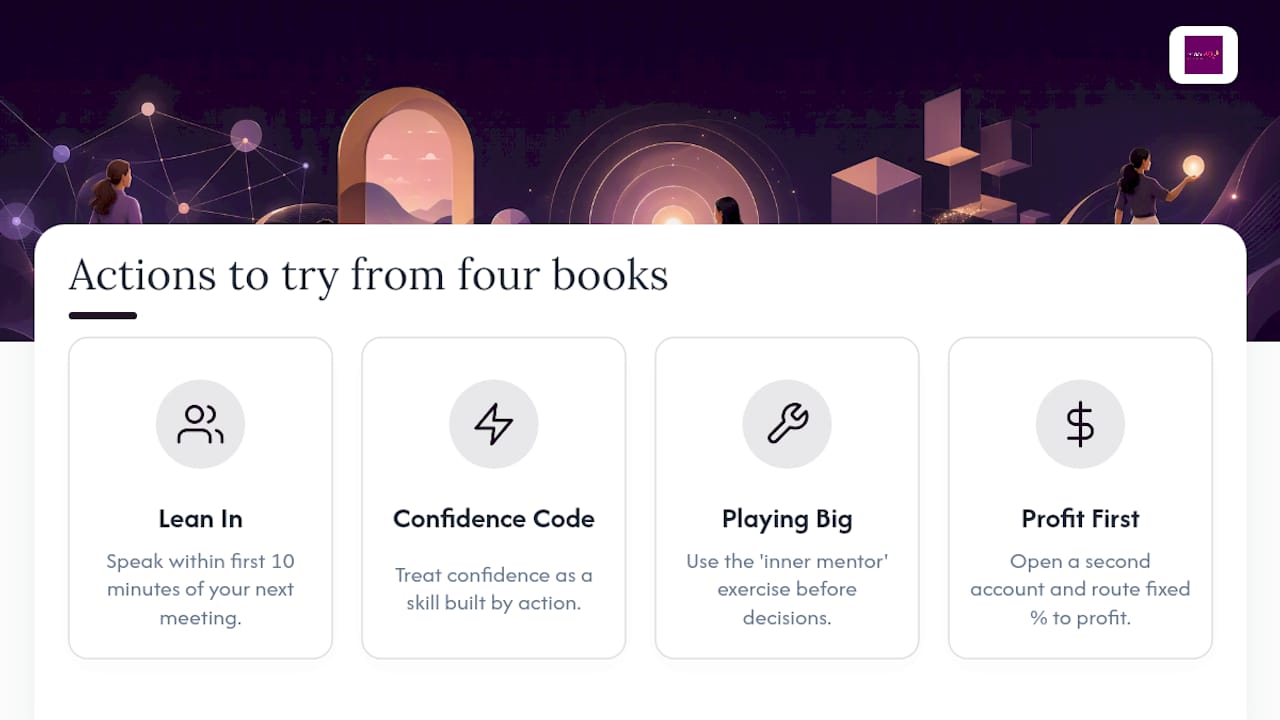
Lean In pushes you to examine where you've pulled back from opportunities before anyone asked you to. The one action to try: in your next meeting, speak in the first ten minutes rather than waiting to be invited in. Best for women early in their careers or returning after a break. Sandberg's credibility comes from her time as Facebook's COO, giving the advice a corporate, large-organisation lens rather than a small-business one.
The Confidence Code explains why confidence functions more like a skill than a personality trait, built through action rather than positive thinking. Best for perfectionists. Kay and Shipman are both journalists, and the book leans on interviews with neuroscientists and executives rather than personal opinion.
Playing Big gives you Mohr's "inner mentor" exercise, a technique for separating your actual judgement from anxiety-driven self-talk. Try it this week before a decision you've been putting off. Best for women stepping into a first leadership role. Mohr built the framework from coaching programmes, not theory alone.
Profit First asks you to open a second bank account and route a fixed percentage of every incoming payment straight into it before spending anything else. Do this for one month and review your profit account balance. Best for founders and freelancers with irregular income. Michalowicz writes as a practitioner who has run and sold several companies; for those interested in maximising their business's value, this practical insight aligns well with advice on how to increase business sale price.
Permission Granted structures its "Permission to Start, Build and Grow" model around specific calls-to-action rather than general encouragement, reflecting Professor Maura McAdam's evidence-based approach. The action: complete the first "permission" exercise in week one, before touching the rest of the book. Best for founders who want structure over inspiration.
Daring Greatly introduces the idea that shame silently shapes leadership decisions, and that naming it out loud reduces its grip. Try naming one work fear to a trusted colleague this week. Best for leaders managing teams through uncertainty. Brown's research background in social work gives the book academic weight beneath its accessible tone.
Girl Code focuses on replacing competition between women with active collaboration, and gives concrete scripts for reaching out to other founders. Send one message this week to a woman in your industry you admire, with no ask attached. Best for solo founders without a peer network.
Nice Girls Don't Get the Corner Office catalogues over a dozen behavioural patterns, from qualifying statements to excessive niceness, that quietly undercut authority. Pick one habit from the book and track how often you catch yourself doing it over a fortnight. Best for women up for promotion or navigating office politics.
Pro Tip: Don't read all eight back to back. Pick one per month, apply the single action before moving on, and you'll retain more than you would cramming the whole shelf in a fortnight.
Which category of book matches your current challenge?
Different problems call for different shelves. Here's the fastest route through each.
Leadership: Start with When Women Lead, where Julia Boorstin's interviews with more than sixty female CEOs identify adaptability and empathy as competitive advantages rather than soft skills. Follow with Daring Greatly for the emotional groundwork.
Mindset and confidence: Read The Confidence Code first for the science, then Playing Big to put it into action. Both work well alongside our guide on building real self-belief.
Money and practical business: Start with Profit First for cash discipline, then move to The Women's Small Business Start-Up Kit, a 7th edition covering current tax and legal basics.
Networking and mentorship: Girl Code and Permission Granted both foreground community, not just individual grit, over solo hustle.
If you've only got time for one category this quarter, choose mindset. Every other category assumes you already believe you're allowed to act on the advice.
How to choose the right book and get real value from it
Match the problem to the book type before you buy, not after.
- Feeling stuck or invisible? Start with mindset titles like Playing Big or The Confidence Code.
- Struggling with cash flow or numbers? Go straight to Profit First or a legal-and-finance manual.
- Building a business from nothing? Permission Granted or The Financial Times Guide to Business Start Up give you structure over sentiment.
- Up for promotion or negotiating? Lean In and Nice Girls Don't Get the Corner Office target workplace behaviour directly.
Once you've picked, use this checklist to actually extract value: summarise the book in three sentences, pick exactly one action from it, run that action for two weeks, then log what changed before choosing your next read.
Pro Tip: Audiobooks work best for mindset and memoir titles you can absorb passively. For anything with exercises or numbers, like Profit First, switch to a physical or digital copy so you can annotate as you go.
How these books map to real outcomes for ProspHER members
Books work best paired with someone checking whether you actually did the thing. Across ProspHER's community members often report gaining clearer direction within a short period, and the pattern among book-readers specifically tracks a familiar shape: reading in isolation stalls, reading alongside a mentor or accountability group sticks.
One member who read Profit First alongside a ProspHER money-mindset session set up her separated profit account within the first week rather than the recommended month, because she had a check-in scheduled that made delay costly. That single structural change is now permanent in her business.
If you want that same structure around your own reading list, our guide on financial literacy for women is a natural next step after Profit First.
Why author diversity changes what you take from a business book
A shelf full of books by the same kind of founder gives you one version of what "business" looks like. That version rarely matches the reality of raising capital while managing bias, or building a company without a network of warm introductions.
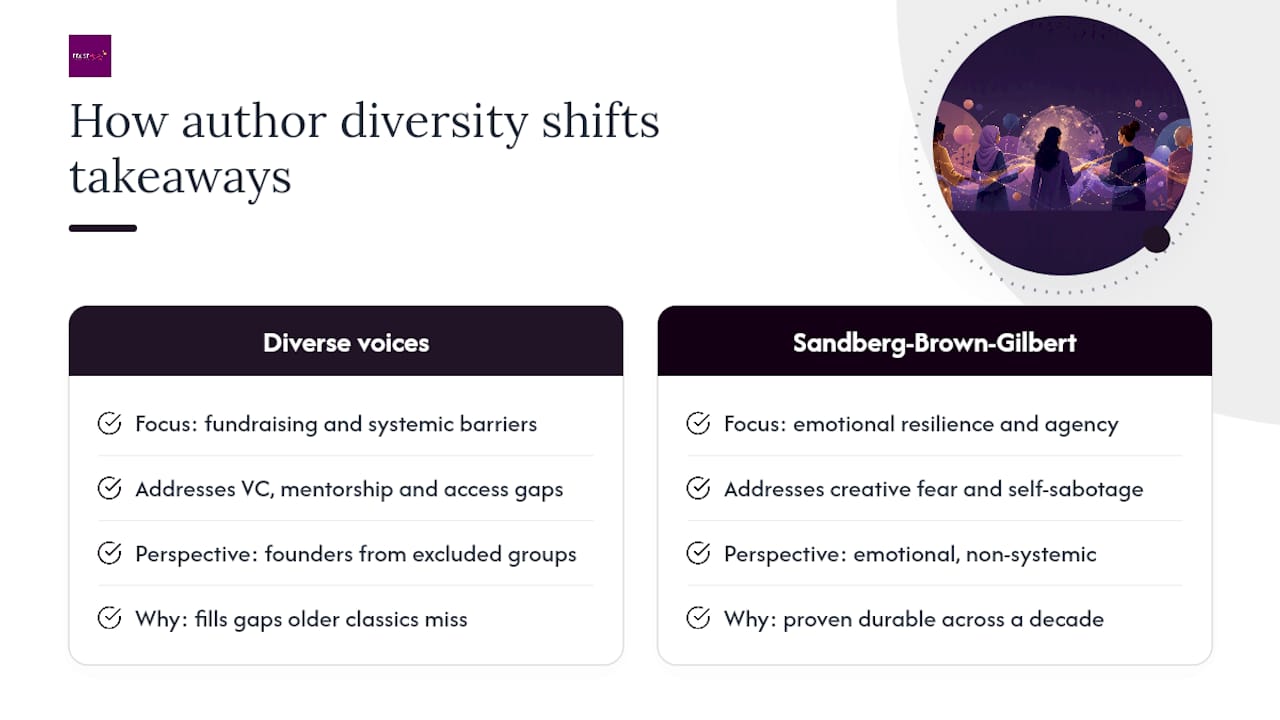
Cynthia Pong's Forbes analysis makes a specific point here: leadership books written by women of colour address workplace challenges that generic leadership advice simply doesn't cover, because the barriers themselves differ. That's part of why this list deliberately includes voices beyond the well-worn Sandberg-Brown-Gilbert trio.
Recent titles addressing founders from historically excluded backgrounds, such as books tackling fundraising for underrepresented entrepreneurs, fill a gap that older business classics never touched. Systemic barriers to venture capital, informal mentorship, and industry access get addressed directly rather than assumed away.
Balance the newer voices against the seminal works too. Big Magic, The Mountain Is You, and Year of Yes remain relevant not because they're recent but because the emotional terrain they cover, creative fear, self-sabotage, and reclaiming agency, hasn't gone out of date. A reading list built entirely from 2026 releases misses the books that have already proven durable across a decade of readers.
A curator's note on how to read this list
We built this sequence to match where you actually are, not where a bestseller list assumes you are. Starting out? Begin with Permission Granted and Playing Big. Scaling? Profit First and When Women Lead. Mid-career pivot? Nice Girls Don't Get the Corner Office, then Daring Greatly.
Read one book at a time, apply the single action, and bring what you learn into a community that will ask what you actually did with it.
If books alone aren't enough: structured support from ProspHER
A good book gives you the framework. It won't chase you up in three weeks to ask whether you actually opened that separate bank account, sent that message, or spoke up in that meeting. That's the gap between reading advice and applying it, and it's the exact gap ProspHER was built to close.
ProspHER pairs the ideas in books like Profit First and Playing Big with real mentorship, practical templates, and a community of over 2,400 women who hold each other accountable to the actions they said they'd take. Three things members consistently point to:
- One-to-one mentorship that translates a book's framework into decisions specific to your business
- Practical templates for money, negotiation, and pitching, so you're not starting from a blank page
- Community accountability that closes the gap between reading an idea and actually doing it
Books are genuinely valuable, and several on this list can shift how you think within a single sitting. But if you've read the theory before and still feel stuck applying it, a structured pathway like the one on the ProspHER career and business growth platform is worth exploring alongside your next book choice. Have a look at what a personalised pathway would look like for your current stage.