
A female founded business is one started and led by a woman, and this category now represents one of the fastest-growing segments of the global economy. Women-led businesses are reshaping industries from technology to manufacturing, often with approaches that prioritise community impact over rapid scaling. 1 in 4 women entrepreneurs plan to launch a new business in 2026, signalling a founder pipeline that shows no signs of slowing. The term “female founded” is widely used, though the recognised industry standard is “women-led business” or “women-owned enterprise.” Both phrases describe the same reality: women building ventures on their own terms, with distinct strategies and priorities.
What does female founded mean in 2026?
Female founded is the shorthand. The fuller picture is more interesting. Women-owned enterprises now span every sector, from steel manufacturing to software, and the data on their growth challenges almost every assumption about who builds businesses and how.
1 in 4 women entrepreneurs plan to launch a new business in 2026. That figure reflects a strong future founder pipeline, not a trend that peaked and faded. Nearly half of women entrepreneurs currently operate as solopreneurs, and 1 in 5 lead mid-sized firms with 10 to 49 employees. These numbers tell you that women are building businesses at every scale, not just at the margins.

Technology is accelerating this momentum. More than 50% of women entrepreneurs plan to use AI to launch or formalise their business, with around 40% expecting AI to drive future growth. That adoption rate is not about following a trend. It is about using available tools to build lean, efficient operations without needing large teams or significant capital from day one.
The preference for lean, independent business structures is deliberate. Women founders are not defaulting to solopreneurship because they lack ambition. They are choosing it because it preserves autonomy and keeps the business aligned with personal values. This is a structural difference from traditional entrepreneurship models, which have historically rewarded rapid scaling and external investment above all else.
Pro Tip: If you are planning to launch in 2026, start by mapping which AI tools can replace your first hire. Automation in areas like invoicing, scheduling, and customer communication can keep your cost base low while you validate your idea.
What barriers do female founders still face?
The ambition is there. The barriers are real, and naming them clearly is the first step to working around them.
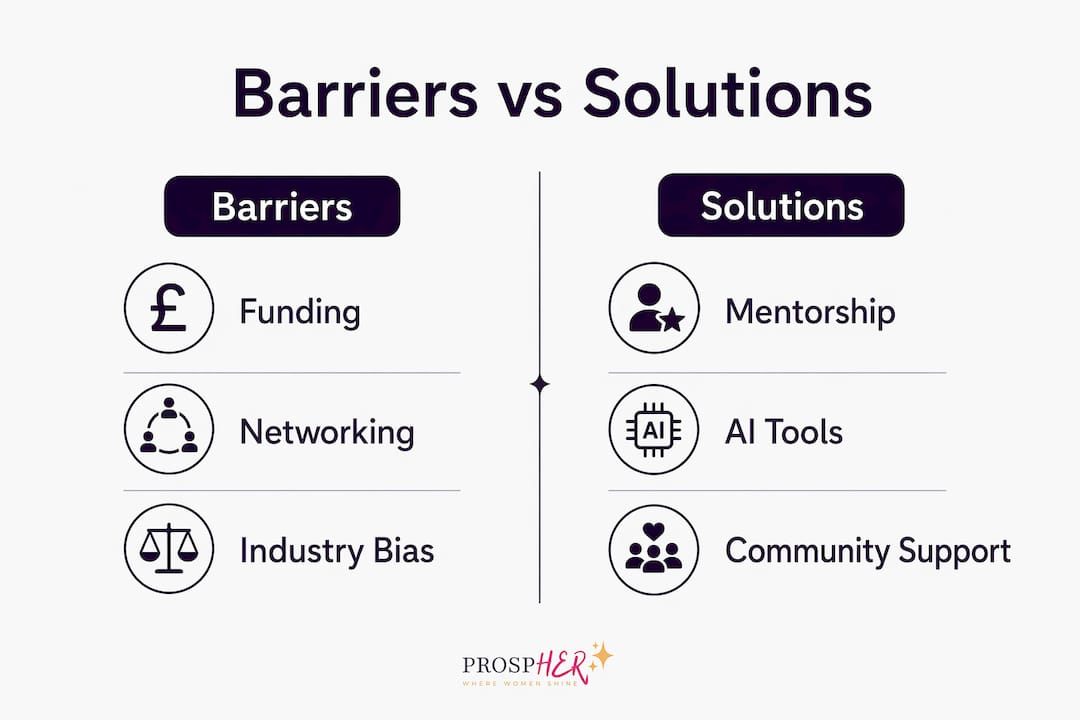
47% of aspiring female founders cite lack of funding as the biggest barrier to starting their business. Women also rely more heavily on personal financing and show greater hesitation around traditional funding channels such as venture capital or bank lending. This is not irrational caution. It reflects a funding environment that has historically been less accessible to women.
Representation at the top remains a persistent problem. Women hold only 13% of C-suite positions in certain industries, and only 44 publicly traded companies worldwide had women involved from founding. That statistic matters because representation in leadership shapes who gets funded, who gets mentored, and whose business model is taken seriously.
“Change in male-dominated industries requires sustained, intentional outreach. Even when attitudes improve, the structural barriers remain. Women who succeed in these sectors do so by building their own networks rather than waiting to be included in existing ones.”
Industries like steel, construction, and finance present specific challenges. Networking in male-dominated sectors requires alternative strategies because intentional support structures rarely exist. Attending niche conferences, building personal advocacy, and creating visibility through media and speaking opportunities are the tools that work when traditional routes are closed.
The barriers are real, but they are not fixed. Women who understand the landscape can plan around it rather than being surprised by it.
How do women founders approach business differently?
The difference is not in capability. It is in priorities, and those priorities produce genuinely different business outcomes.
Women prioritise sustainable, community-oriented growth and risk-aware scaling over the growth-at-all-costs model. This is a strategic choice, not a limitation. Businesses built this way tend to be more resilient, more deeply embedded in their communities, and less vulnerable to the volatility that comes with rapid, debt-fuelled expansion.
Here is how that plays out in practice:
-
Lean business models. Women founders often build with minimal overhead, using freelancers, automation, and community partnerships rather than large permanent teams.
-
Alternative funding paths. Personal financing, revenue-based funding, and grants from bodies like Innovate UK or the British Business Bank are common choices over venture capital.
-
Community as a growth channel. Word of mouth, local partnerships, and peer networks drive customer acquisition rather than paid advertising alone.
-
Impact measurement beyond revenue. Many women-led businesses track metrics like community reach, environmental impact, and employee wellbeing alongside financial performance.
Pro Tip: Before you pitch to any investor, get clear on which metrics matter most to your business model. If your impact is community-based, build a case for that value using data. Traditional financial metrics may underestimate your influence.
The economic impact of female-founded businesses is often distributed through local community support rather than concentrated in large corporate footprints. This means standard financial metrics frequently undercount what these businesses actually contribute. That is not a flaw in the business model. It is a flaw in the measurement tool.
| Approach | What it looks like in practice |
|---|---|
| Lean operations | Solo or micro-team structure with AI and freelance support |
| Alternative funding | Grants, revenue-based finance, personal capital |
| Community growth | Local partnerships, peer referrals, niche events |
| Broader impact metrics | Tracking social and environmental outcomes alongside revenue |
Practical steps for aspiring female founders
You have the idea. Now you need a plan that holds up under pressure.
Start with validation before you spend a penny on branding or product development. Talk to at least 20 potential customers before you build anything. Ask them what they currently use, what frustrates them, and what they would pay to fix it. Their answers will shape your offer far more accurately than any market research report.
-
Map your funding options early. The British Business Bank, Innovate UK grants, and community development finance institutions all offer routes that do not require giving up equity. Know what is available before you assume you need a venture capital round.
-
Use AI from day one. Tools for accounting, scheduling, content creation, and customer communication are widely available and affordable. They extend your capacity without adding headcount.
-
Build your network with intention. Niche conferences and personal advocacy work better than generic networking events, particularly in sectors where women are underrepresented. Find the rooms where your specific industry gathers and show up consistently.
-
Professionalise your personal story. Personal experience is a powerful motivator for founding a business, but investors and partners respond to data. Translate your lived experience into a clear problem statement, a defined market, and evidence of demand.
-
Join a community built for you. Isolation is one of the most underrated risks for early-stage founders. Platforms like ProspHER connect ambitious women with mentors, peers, and practical resources that accelerate progress without adding noise.
Pro Tip: Set a 30-day milestone for your first piece of traction. It does not need to be revenue. It could be 10 discovery calls, one letter of intent, or a waitlist of 50 people. Momentum begins with a concrete target.
Resilience is not about pushing through indefinitely. It is about building systems that sustain you when motivation dips. That means financial buffers, peer accountability, and a clear definition of what success looks like for your specific business, not someone else’s version of it.
Key takeaways
Female founded businesses succeed not by copying traditional models but by building on distinct priorities: community impact, lean operations, and risk-aware growth.
| Point | Details |
|---|---|
| Strong founder pipeline | 1 in 4 women plan to launch a business in 2026, showing sustained momentum. |
| AI adoption is accelerating | Over 50% of women entrepreneurs plan to use AI to launch or grow their business. |
| Funding remains the top barrier | 47% of aspiring female founders cite lack of capital as their biggest obstacle. |
| Different priorities, not less ambition | Women choose sustainable, community-driven growth as a deliberate strategy. |
| Community and networks matter | Intentional networking and peer support are critical tools for female founders. |
What we have learned from watching women build
We have seen a lot of business advice aimed at women that is really just standard entrepreneurship advice with a pink filter applied. That is not what women founders need, and it is not what the data supports.
The most striking thing we observe is how often women founders are told their approach is too cautious or too small, when in reality they are making considered decisions about risk, autonomy, and impact. Women-founded businesses wield significant social and economic influence through community engagement, even when they appear smaller on traditional balance sheets. The measurement problem is real, and it skews how the outside world perceives female entrepreneurial success.
What we also notice is that the women who build with the most confidence are not the ones who have the most resources. They are the ones who have the clearest sense of direction. Clarity produces momentum. Confusion produces stalling. That is why the first investment any aspiring founder should make is in getting clear on what she is actually building and why.
The gap between ambition and action is rarely about capability. It is almost always about confidence and access. Both are solvable problems, and neither requires waiting for the funding environment or the representation statistics to improve first.
— ProspHER
ProspHER: built for women who are ready to move
You know what you want to build. What you need is a clear path to get there, not more content to wade through.
ProspHER is a platform built specifically for ambitious women who want to advance their careers and grow their businesses with confidence. With a community of over 2,400 women, ProspHER delivers personalised pathways based on where you are right now and where you want to go. Whether you need mentorship, peer accountability, or practical resources, the platform cuts through the noise and gives you what actually moves the needle. 94% of members report gaining clearer direction within just 30 days. That is momentum you can build on.
FAQ
What does female founded mean?
A female founded business is one started by a woman, often used interchangeably with “women-owned enterprise” or “women-led business.” The term signals both founding origin and leadership approach.
Why do female founders face more funding challenges?
47% of aspiring female founders cite lack of capital as their biggest barrier, and women are more likely to rely on personal financing than traditional investment channels. Structural gaps in the funding environment, not lack of ambition, drive this pattern.
How are women-led businesses using AI in 2026?
More than 50% of women entrepreneurs plan to use AI to launch or formalise their business, focusing on operational efficiency within lean business models.
Are female founders less ambitious than male founders?
No. Women are not less ambitious but set different entrepreneurial priorities, valuing sustainable, community-driven growth over rapid scaling. This is a strategic difference, not a capability gap.
How can I support female entrepreneurs in the UK?
Buy from women-led businesses, refer them to your network, and advocate for them in funding and leadership conversations. Joining or recommending communities like ProspHER also provides direct, practical support to women building businesses.