
A female entrepreneur is a woman who establishes, owns, and operates a business, shaping industries through innovation, resilience, and a willingness to build on her own terms. The profile of women in business is shifting fast. 1 in 4 women plan to launch a new business in 2026, with 58% considering a start-up within 12 months. That momentum is real, and it is backed by data. Yet the path still carries obstacles that are specific to women founders, from funding gaps to leadership representation. This guide cuts through the noise and gives you the clearest picture of where female entrepreneurship stands right now, and what it takes to move forward with confidence.
How do female entrepreneurs build and operate their businesses?
The structure of a female-owned business often looks different from the mainstream model, and that is a deliberate choice. Nearly 42% of women entrepreneurs operate as solopreneurs, preferring lean structures that keep costs low and decision-making fast. This is not a sign of limited ambition. It reflects a calculated preference for ownership, autonomy, and culture control.
Why do so many women choose to go it alone? The reasons are consistent across the data.
- Ownership retention. Many female founders avoid external investors to keep full control of their vision and direction.
- Flexibility. A lean model allows women to scale at a pace that suits their life, not a board's expectations.
- Lower risk exposure. Staying small reduces reliance on debt or equity financing, which is harder for women to access.
- Culture by design. Without partners or investors, a founder sets the values and working environment from day one.
Female founders often choose lean business models to retain control and avoid bank loans or external investors. That choice shapes everything from cash flow to hiring to growth pace.
Finance management is another area where women founders stand apart. Nearly half of women entrepreneurs manage their finances entirely alone, with only 14% using a dedicated accountant year-round. Running the numbers solo keeps costs down, but it also concentrates risk. A single financial blind spot can stall growth or create compliance problems.
Pro Tip: If you are managing your books alone, set a quarterly review date in your calendar and treat it like a board meeting. Review revenue, expenses, and cash runway with the same rigour you would apply to any client project.
The solopreneur model works well at the start. The challenge arrives when growth demands more capacity than one person can carry. Knowing when to bring in support, whether that is a part-time bookkeeper, a virtual assistant, or a specialist contractor, is one of the most important decisions a female business owner makes.
What challenges do female entrepreneurs face and how can they overcome them?
The gap between women's entrepreneurial ambition and their access to resources is not a capability gap. The gender gap in business ownership stems from differences in how women start, fund, and scale ventures, not from a lack of drive or skill. Understanding that distinction matters. It shifts the conversation from "what's wrong with women founders" to "what's wrong with the system."
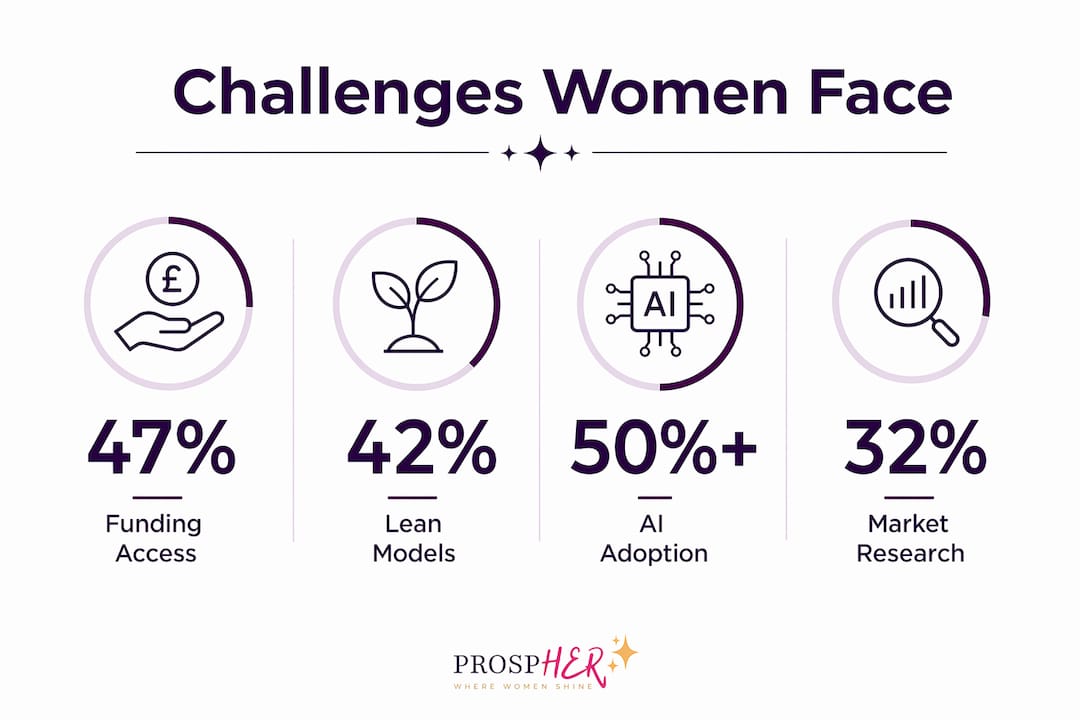
Funding is the sharpest barrier. 47% of aspiring female founders cite lack of funding as the main obstacle to starting a business, and 56% rely on personal financing to get started. Personal savings are a valid starting point, but they cap growth potential and concentrate personal financial risk.
Leadership representation compounds the problem. Female representation in senior leadership declined to 31% in 2026 from 35% in 2024, and women hold just 28% of CEO roles. Fewer women in senior positions means fewer sponsors, fewer role models, and fewer decision-makers who understand the female founder experience.
"Companies with gender-balanced leadership see stronger revenue growth, accelerated innovation, and improved decision-making. Explicitly communicating the business value of gender parity can restore momentum in environments where female representation declines."
Grant Thornton, Women in Business 2026
So what can you do right now? These four tactics address the most common obstacles directly.
- Build a funding map. Research grants, angel networks, and government-backed schemes specifically for women founders in the UK, such as the British Business Bank's programmes. Know your options before you need them.
- Practise your pitch. Women are statistically asked more risk-focused questions by investors. Prepare answers that reframe risk as managed opportunity, not uncertainty.
- Seek out women-led networks. Female founders in male-dominated industries must develop specialised networking skills to gain legitimacy and credibility. Find rooms where your experience is understood, not explained.
- Name the value of diversity. When you are in a room with investors or partners, articulate the commercial case for gender-balanced teams. The data from Grant Thornton backs you up.
Gender bias in networking is real, but it is not insurmountable. The women who break through consistently do one thing: they build relationships before they need them.
How is technology, especially AI, shaping female entrepreneurship?
Artificial intelligence is not a future consideration for women in business. It is a present-day tool that is already reshaping how female entrepreneurs work. More than 50% of women entrepreneurs plan to use AI to launch or formalise their businesses, and 79% expect AI's role in their operations to grow. That level of adoption signals a shift in how women founders think about productivity and scale.
The most common application is idea generation and market research, used by 32% of women entrepreneurs. That makes sense. AI tools can compress weeks of desk research into hours, giving a solopreneur the analytical capacity of a much larger team.
| AI application | Primary benefit for women founders |
|---|---|
| Idea generation | Tests concepts quickly without large research budgets |
| Market research | Identifies gaps and competitor positioning at speed |
| Content creation | Maintains brand presence without a full marketing team |
| Financial modelling | Supports cash flow planning and scenario analysis |
| Customer service | Automates responses, freeing time for high-value work |
The balance between automation and human connection matters. AI handles the repetitive and the analytical. You bring the relationships, the judgement, and the vision. Neither replaces the other.
- Use AI to draft, then edit with your own voice.
- Use AI to research, then validate with real customer conversations.
- Use AI to model scenarios, then make the final call yourself.
Pro Tip: Start with one AI tool and one use case. Trying to automate everything at once creates confusion. Pick market research or content drafting, get comfortable, then expand.
The women who get the most from AI are not the most technically skilled. They are the most intentional. They know what they want the tool to do, and they stay in the driving seat.
What can women founders learn from successful women leaders?
Success stories of women entrepreneurs are not just inspiring. They are instructional. The patterns that emerge from women who have built significant businesses reveal specific mindsets and tactics worth studying.
Kiran Mazumdar-Shaw built Biocon from a garage in Bangalore into one of India's largest biopharmaceutical companies. She entered a sector with no precedent for a female founder and built credibility through scientific rigour and long-term thinking. The lesson is not to wait for the industry to welcome you. Build the track record that makes your presence undeniable.
Laureen Meroueh is pursuing a £1 billion plan to reshape the American steel industry, likely becoming the first solo female CEO in that sector. She faces systemic funding challenges in a male-dominated industrial sector while simultaneously developing a process that could redefine how steel is made. Her story illustrates that being "the only woman in the room" is not a disqualifier. It is a differentiator, if you use it deliberately.
"In male-dominated sectors, female entrepreneurs face the challenge of being the only woman in the room. That requires specialised networking and legitimacy-building skills that go beyond standard business development."
Inc. Magazine, 2026
What connects these stories? Three things stand out consistently.
Resilience is not passive. It is the active decision to keep building when the system is not designed for you. Innovation often comes from being an outsider. Women who enter industries where they are underrepresented frequently spot inefficiencies that insiders have normalised. Legacy thinking matters early. The founders who build lasting businesses think about what they are creating, not just what they are selling.
You do not need to be in steel or biotech to apply these lessons. Every female business owner faces a version of the same challenge: proving the concept in a world that did not build the infrastructure with her in mind.
Key takeaways
Female entrepreneurship in 2026 is defined by deliberate structure, persistent funding barriers, and accelerating technology adoption. The most effective path forward combines lean operational choices with targeted funding strategies, AI adoption, and community-driven networking.
| Point | Details |
|---|---|
| Solopreneurship is strategic | 42% of women founders choose lean models to retain ownership and avoid external investors. |
| Funding gaps are systemic | 47% cite lack of funding as the top barrier; 56% rely on personal financing to start. |
| Leadership representation is declining | Women hold 28% of CEO roles in 2026, down from 35% senior leadership representation in 2024. |
| AI adoption is accelerating | Over 50% of women entrepreneurs plan to use AI, with idea generation and market research leading use cases. |
| Community and networking are non-negotiable | Women in male-dominated sectors must build specialised networks to gain credibility and access. |
The honest truth about momentum for women founders
We have watched the conversation around women in business shift considerably over the past few years. More data, more visibility, more programmes. And yet the funding gap persists. Leadership representation is moving backwards, not forwards. That tells us something important: visibility alone does not create change. Action does.
What we have seen work, consistently, is women who stop waiting for the conditions to be perfect and start building with what they have. The solopreneur model is not a consolation prize. For many women, it is the most direct route to ownership, income, and impact. The key is knowing when to hold that structure and when to scale it.
Technology is the great equaliser right now. A woman running a business from her kitchen in Leeds has access to the same AI research tools as a funded start-up in London. The gap is not access. It is confidence and intentionality in using what is available.
Community is the other factor that changes outcomes. Not networking in the traditional sense, but genuine peer connection with women who understand the specific texture of building a business as a woman. That kind of community accelerates progress in ways that no tool or tactic can replicate on its own.
The women who move fastest are not the ones with the most resources. They are the ones with the clearest sense of direction and the right people around them.
— ProspHER
ProspHER: built for women who mean business
Women founders do not need more content. They need clarity, direction, and a community that understands the specific challenges of building a business as a woman.
ProspHER is a platform built specifically for ambitious women who want to advance their careers and grow their businesses with confidence. With a community of over 2,400 women, ProspHER delivers personalised pathways rather than generic advice. 94% of members report gaining clearer direction within just 30 days. Whether you need mentorship, practical resources, or a network that genuinely gets it, ProspHER gives you the support that fits where you are right now. If you are ready to move forward with momentum, your next step starts here.
FAQ
What is a female entrepreneur?
A female entrepreneur is a woman who starts, owns, and operates a business, taking on the financial and operational risks in pursuit of a commercial or social goal.
What are the biggest challenges for female entrepreneurs in the UK?
Access to funding is the primary barrier, with 47% of aspiring women founders citing it as their main obstacle. Leadership representation and gender bias in networking also significantly affect growth.
How many women plan to start a business in 2026?
1 in 4 women plan to launch a new business in 2026, with 58% considering a start-up within the next 12 months, according to QuickBooks research.
How are female entrepreneurs using AI in their businesses?
Over 50% of women entrepreneurs plan to use AI to launch or formalise their businesses. The most common applications are idea generation and market research, used by 32% of women founders.
Why do so many women choose the solopreneur model?
Women often choose solopreneurship to retain full ownership, avoid external investors, and maintain control over their business culture and direction. Nearly 42% of women entrepreneurs currently operate as solopreneurs.