
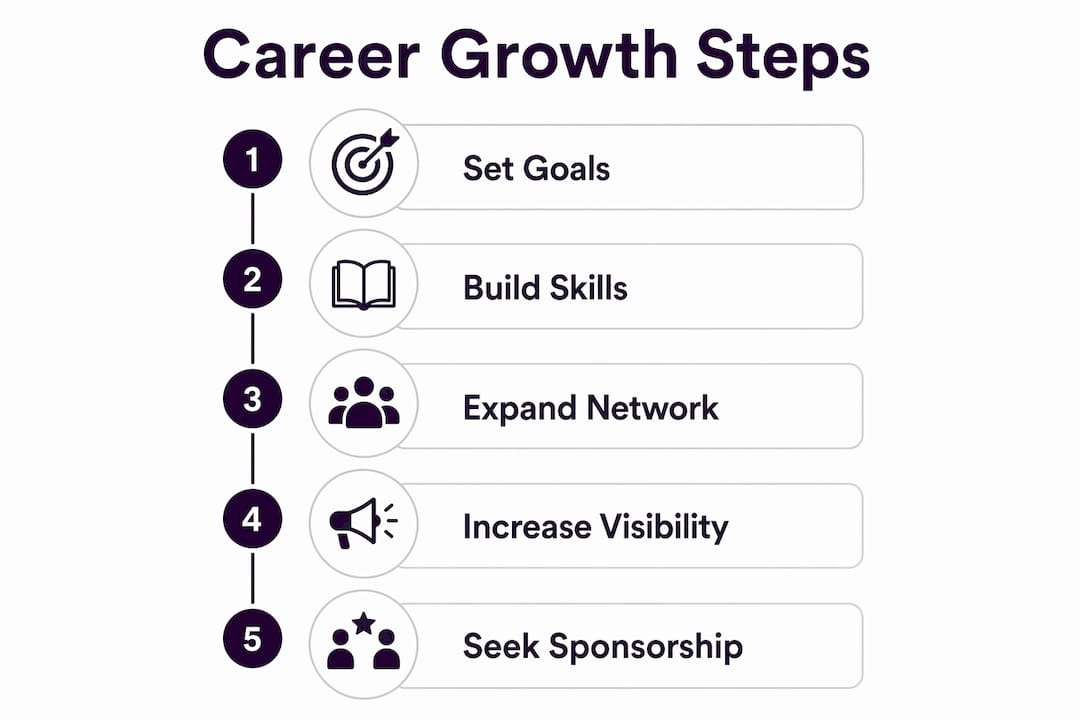
Career development for women is the intentional process of building skills, expanding networks, and increasing visibility to overcome professional barriers and reach meaningful career goals. Most women who stall professionally are not lacking talent. They are lacking structure, sponsorship, and a clear pathway forward. Research confirms that career advancement depends on performance plus visibility, relationships, leadership readiness, and active sponsorship. Hard work alone does not get you promoted. Prosp-her was built on exactly this insight, and with over 2,400 women in its community, 94% of members report gaining clearer direction within just 30 days.
What key strategies help women accelerate their career development?
Professional development for women is most effective when it combines visible competence with deliberate relationship-building. Quiet excellence rarely gets rewarded. You need people in decision-making rooms who know your name and your results.
Here are four strategies that consistently move the needle:
-
Build visibility, not just performance. Volunteer for high-profile projects. Present your results in meetings. Ask to join cross-functional teams where senior leaders can see your work directly.
-
Seek sponsorship, not just mentorship. A mentor gives advice. A sponsor advocates for you when you are not in the room. Identify two or three senior leaders who know your goals and can speak to your readiness.
-
Negotiate for stretch assignments. Ask for roles that sit slightly above your current level. These assignments build credibility faster than any training course.
-
Adopt a strength-based leadership mindset. Strength-based development that focuses on intrinsic abilities helps women build authentic leadership identities. Shifting from fixing weaknesses to amplifying strengths accelerates advancement.
Consistency matters as much as strategy. High performers dedicate at least one hour per week to focused learning, and that habit correlates with a 15% productivity increase. One hour. That is the minimum investment that separates those who grow from those who stay stuck.
Pro Tip: Block one hour every week in your calendar labeled “growth work.” Treat it like a client meeting. Do not move it.

How can women overcome common barriers to career advancement?
The single biggest career barrier for women is the first step into management. Insufficient strategic visibility and a lack of sponsors who advocate in decision-making rooms are the primary causes. This is not about competence. Managers promote women at a lower ratio than men, and the gap widens at every level above entry.
Here are the most common barriers and how to address them directly:
-
Visibility gaps. If decision-makers do not know your goals, they cannot advocate for you. Share your ambitions explicitly with your manager and skip-level leaders.
-
No sponsor in the room. Mentors support you. Sponsors promote you. Build relationships with people who have the authority to open doors.
-
Unprotected development time. Without scheduled time and clear goals, career development stalls. Growth work gets crowded out by urgent tasks unless you protect it deliberately.
-
Gender bias in organizational dynamics. Many leadership programs fail to address gender-based biases and power dynamics. Choosing gender-specific programs gives you space to name these realities and build tactics around them.
-
The meritocracy myth. Believing that results alone drive promotion keeps talented women waiting. Documenting your impact with clear metrics is what actually moves you forward.
“The most overlooked career skill is not a technical one. It is the ability to make your impact visible to the people who decide your future. Sponsorship without visibility is impossible.”
Strategic influence grows when you document your wins, share them with the right people, and frame your contributions in terms of business outcomes. Numbers speak louder than narratives in most organizations.
Which career fields and training programs offer the most growth?
Skill development for women is most powerful when it targets fields with real momentum. Demand for roles in data, AI, and digital commerce is projected to grow between 18% and 40%. Healthcare support roles are growing at approximately 25%. These are not niche opportunities. They represent some of the largest hiring surges across the UK economy right now.
| Sector | Projected growth | Key skills needed |
|---|---|---|
| Data and AI | 18%–40% | Data analysis, machine learning basics, Python |
| Digital commerce | 18%–40% | E-commerce strategy, digital marketing, UX |
| Healthcare support | ~25% | Patient care coordination, health informatics |
| Executive leadership | Ongoing demand | Negotiation, influence, strategic communication |
Formal programs also matter. Executive leadership programs for women with eight or more years of experience range from 4.5 days to 10 weeks in length. They focus on networking and negotiation skills to close the leadership gap. The structure varies, but the best programs combine peer cohorts, real-world application, and direct access to senior faculty or executives.
Aligning your training choice with your next career step is the deciding factor. If you want to move into a director role, prioritize programs that teach influence and organizational dynamics. If you want to shift sectors, prioritize technical credentials that signal credibility in the new field.
Pro Tip: Before enrolling in any program, write down the specific role or outcome you want within 18 months. Then ask whether the program directly prepares you for that outcome. If the answer is unclear, keep looking.
What practical steps build a sustainable career development plan?
Career planning for women works best when it is treated as an ongoing practice, not a one-time event. Most women review their careers only when something goes wrong. The women who advance consistently treat career planning like a recurring business meeting.
Here is a practical framework to build momentum:
-
Schedule a monthly “growth meeting” with yourself. Block 60 minutes. Review your goals, your progress, and your network. Treating career planning like a business meeting creates consistent space for growth.
-
Document your impact in real time. Keep a running record of wins, metrics, and feedback. When you need to make a case for promotion or a new role, the evidence is already there.
-
Frame development requests as business investments. Framing professional development as revenue-generating or efficiency-enhancing significantly improves approval chances. Do not ask for a course. Show how it will benefit your team.
-
Combine internal and external opportunities. Internal transfers, secondments, and new project assignments build visibility inside your organization. External programs, certifications, and peer networks build credibility and perspective outside it.
-
Seek structured support. Peer groups, leadership programs, and platforms built specifically for women’s advancement give you both accountability and community. Skill building for women accelerates when it happens in a supported environment, not in isolation.
The women who advance fastest are not the ones who work the hardest. They are the ones who plan deliberately, advocate for themselves clearly, and build relationships with people who can open the next door.
Key Takeaways
Structured, intentional career development for women requires visibility, sponsorship, documented impact, and protected time for growth work to produce real advancement.
| Point | Details |
|---|---|
| Visibility drives promotion | Share your goals and results with decision-makers, not just your direct manager. |
| Sponsorship beats mentorship | Find advocates who speak for you in rooms where promotion decisions are made. |
| Protect your growth time | Block one hour per week for focused learning to sustain a 15% productivity gain. |
| Target high-growth sectors | Data, AI, digital commerce, and healthcare support roles offer 18%–40% projected growth. |
| Frame development as investment | Link training requests to team goals and measurable outcomes to win organizational support. |
What we have learned about advancing careers with intention
Here is something we see repeatedly inside the Prosp-her community. Women arrive with talent, drive, and a track record of results. What they are missing is not capability. It is clarity about where to direct their energy and who needs to see their work.
The conventional advice tells you to work harder, be more confident, and wait for the right opportunity. We think that advice is incomplete. Confidence without visibility gets you nowhere. Hard work without sponsorship gets you overlooked. The women who move forward are the ones who treat their career like a business. They set goals, track outcomes, build relationships with intention, and ask for what they want directly.
Strength-based development is not a soft concept. It is a practical one. When you build from what you are already good at, you grow faster and lead more authentically. Trying to fix every perceived weakness is exhausting and rarely produces the results that playing to your strengths does.
The systemic barriers are real. Gender bias in promotion decisions is documented and persistent. But waiting for organizations to fix themselves is not a strategy. The women who advance do so by building influence within the system while also advocating for change. Both things are true at once.
You do not need a perfect plan. You need a consistent practice. Monthly reflection, weekly learning, and one sponsor who knows your name. Start there.
— ProspHER:
Prosp-her: built for women who are ready to move forward
Ambitious women deserve more than generic career advice. They need a clear pathway, real support, and a community that understands the specific challenges they face.
Prosp-her is a career and business growth platform built specifically for women who want to advance with clarity and confidence. The platform gives you a personalized pathway based on your current situation and goals, whether that means mentorship, skill building for women, or peer community. With over 2,400 members and 94% reporting clearer direction within 30 days, Prosp-her delivers results that generic platforms do not. If you are ready to build career momentum with structure and support, visit Prosp-her and find your pathway forward.
FAQ
What is career development for women?
Career development for women is the deliberate process of building skills, increasing visibility, and cultivating relationships to advance professionally. It goes beyond job performance to include sponsorship, strategic networking, and intentional planning.
Why do women get stuck in their careers?
Women most often stall due to insufficient visibility, lack of sponsors, and unprotected time for growth work. Without scheduled development time and clear goals, career progress stalls regardless of performance level.
What is the difference between a mentor and a sponsor?
A mentor gives advice and guidance. A sponsor actively advocates for you in decision-making conversations where promotions and opportunities are discussed. Both matter, but sponsorship has a more direct impact on advancement.
Which career fields offer the best opportunities for women in 2026?
Data, AI, digital commerce, and healthcare support roles offer some of the strongest growth projections, with demand rising between 18% and 40% depending on the sector. These fields reward both technical credentials and leadership skills.
How can women fund professional development through their employer?
Frame the request as a business investment tied to team goals and measurable outcomes. Linking a training program to revenue generation or efficiency gains significantly improves the likelihood of organizational approval and funding.